
Synthetic data is fake data made by a computer to copy the patterns of real data, without being a record of real events or people. It looks and acts like the real thing, so you can use it to test tools, run checks or train AI. It matters because teams can work with life-like data when real data is scarce, private or hard to share.
Key Takeaways
- A computer makes it, using anything from simple maths to AI models.
- Good fake data keeps the key patterns of the real set, so tests on it give similar results.
- There are three main types: fully synthetic, partially synthetic and hybrid.
- It can cut how much personal data you handle, but it is not anonymous by default.
- Bias in the source carries straight through. Also, training AI on too much AI-made content can harm models.
What Is Synthetic Data?
Say you need 50,000 customer records to test a new dashboard. You only have 2,000 real ones, and you can’t share those outside the firm. So you train a model on the real rows and ask it for new rows that follow the same patterns. Those new rows are synthetic.
The UK’s Information Commissioner’s Office (ICO) describes it as “artificial” data that copies the patterns of real data. It also notes that if you study good fake data, you should get much the same results as from the real set.
IBM adds that it can come as text, tables, or media such as images and video. In other words, most kinds of data a firm uses can have a fake twin.
How Synthetic Data Works
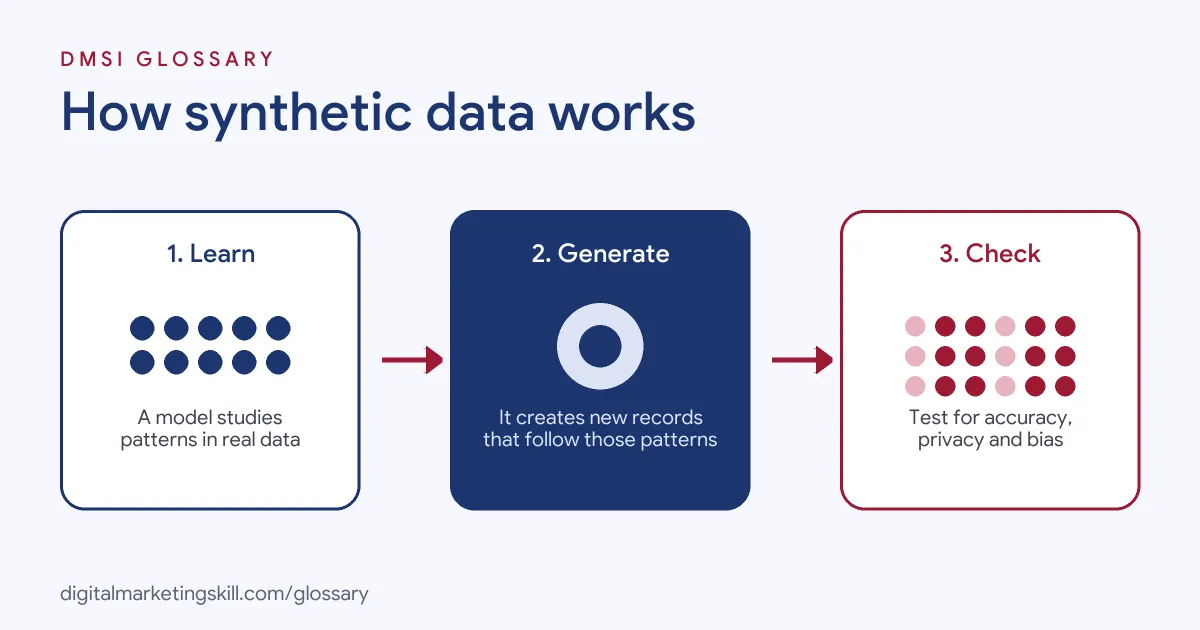
Most of it starts with real data. First, a model studies the real set and learns its shape. Next, it makes new records that share those patterns. Then the team checks the output for errors, privacy leaks and bias before use.
Generation Methods
IBM lists several common techniques:
- Statistical methods: Good when you know how the data is spread. The system draws new points from that spread.
- Generative adversarial networks (GANs): Two neural networks compete. One makes data, and the other tries to spot fakes. In the end, the fakes are hard to tell apart. GANs are often used for images.
- Transformer models: The same kind of model that powers chatbots. They are good at text and can also make tables.
- Variational autoencoders (VAEs): Models that squeeze data down and then make new versions of it.
- Agent-based modelling: Simulations of many single “agents” and how they act.
You don’t have to build these yourself. For instance, IBM points to free, open-source tools such as the Synthetic Data Vault, a Python library.
Types of Synthetic Data
The ICO and IBM both split it by how much of the data is fake:
| Type | What it contains | Typical use |
|---|---|---|
| Fully synthetic | Each field is made up, with no real records | Training models where real cases are rare, such as fraud |
| Partially synthetic | Real data with only some fields, often the private ones, swapped | Hiding personal details while the rest stays real |
| Hybrid | Real records paired at random with fake ones | Studying customer data without tracing results to one person |
Synthetic Data Examples
Here are three made-up examples of how a team might use it:
- Testing a CRM import (example): Before it moves 100,000 contacts to a new CRM, an agency makes fake contacts with real-looking names, dates and order values. It tests field mapping and flows on those. So if something breaks, no real customer is exposed.
- Building a dashboard (example): An analyst builds a sales dashboard before the client grants data access. Fake sales records let the analyst set up each chart in advance.
- Training a lead-scoring model (example): A firm has very few big deals in its records. It adds fake examples of that rare group, so the model has more to learn from. Then it tests the model on real data only.
In each case, the fake records stand in for real ones while you build and test. Choices about real customers still rest on real data.
Synthetic Data vs Real Data vs Anonymised Data
These three options are easy to mix up, so here is a quick comparison:
| Option | What it is | Main risk |
|---|---|---|
| Real data | Records of real people and events | Privacy, security and short supply |
| Anonymised data | Real records with names and other clues stripped out | People may be traced again if it is done badly |
| Synthetic data | New records made to mimic real patterns | May leak details if too close to the source, and copies its bias |
In short, real data is the most exact, anonymised data hides names, and fake data swaps the records out in full.
How to Use Synthetic Data Safely
Follow these steps each time you make or use it:
- Define the job. Decide if you need it to test, to study trends or to train a model. Each needs a different level of detail.
- Check your right to use the source. The ICO notes that you need real data to make it, which may mean handling personal data.
- Pick a method or tool. Simple tests may only need basic sampling. Text or images may need an AI model.
- Compare it with the original. Check that key averages, ranges and links match, so it is a fair stand-in.
- Test for privacy leaks. The ICO warns that the closer it is to the real data, the more likely it is to reveal someone’s details.
- Check for bias. If the source doesn’t reflect your customers, the ICO points out that the fake version won’t either.
- Label it clearly. Mark files and dashboards as fake, so nobody takes them for real results.
Best Practices
A few habits keep it useful and safe:
- Use it to build and test, then confirm with real data. Check any model or campaign choice against real results.
- Keep humans in the loop. Look at samples by hand to catch odd or impossible rows.
- Take extra care with decisions about people. The ICO says that if it feeds choices with legal or health effects, you must assess and reduce bias.
- Document how you made it. Note the source, the method and the checks, so others can trust it.
Common Mistakes to Avoid
First, many teams assume it is anonymous by default. However, the ICO is clear that this depends on how close it is to the source. Second, they forget that bias in the real data carries through. Third, they report results from fake data as if they were real. Finally, some feed AI-made content back into AI training with no limits. A study in Nature found that indiscriminate use of model-generated content in training causes “irreversible defects” in later models, which the authors call model collapse.
Where You’ll Use Synthetic Data at Work
The term shows up most in AI and data roles. Still, marketers meet it in testing, reports and AI projects. For example, current remote listings ask for:
- “Familiarity with synthetic data generation and dataset distillation” (AI Applications Engineer).
- “Experience with model customization, fine-tuning, synthetic data, advanced retrieval, knowledge graphs, or multimodal document processing” (Senior AI Agent Developer).
- “Familiarity with data licensing, synthetic data generation, or contamination detection involving client data” (Director of Engineering, Data Labs).
As a marketer, you are more likely to use fake records to test tools than to build them. Even so, if you know the risks, you can work well with data teams and protect customer privacy. It also connects closely to machine learning, where most synthetic datasets end up.
Learn It in the Full Stack Programme
AI fundamentals, covering strategy and planning, are part of every DMSI track. To apply AI and data skills across every channel, the Full Stack programme covers all four tracks and all ten courses, with one portfolio project from each. You also work on a U.S. Project Internship from day one, with unlimited 1-on-1 mentoring.
For more on where AI fits in daily marketing work, read our guide to AI in digital marketing.
Frequently Asked Questions
What is synthetic data in simple terms?
It is fake data made by a computer that follows the same patterns as real data. You can use it to test or train without exposing real records.
Is synthetic data anonymous?
Not by default. According to the ICO, the closer it is to real data, the more likely it is to reveal someone’s personal details.
How is synthetic data created?
Common methods include statistical sampling, generative adversarial networks, transformer models, variational autoencoders and agent-based simulations.
Can synthetic data replace real data?
Sometimes, for tests and early model training. However, you should still check results against real data, because fake records can miss rare cases or carry bias.
What is model collapse?
It is the harm done when AI models learn from too much AI-made content. Researchers found that rare patterns from the real data fade away over time.
Sources: ICO: Synthetic data; IBM: What is synthetic data?; Nature: AI models collapse when trained on recursively generated data; remote job listings on Himalayas.