TikTok for business means running an organic profile, paid ads, or a TikTok Shop storefront on the same app your customers already use. Unlike older platforms, TikTok ranks content by interest rather than follower count. As a result, a small account can still reach a large audience. This guide shows how to use TikTok for business and how to measure the results.
Key Takeaways
- TikTok’s own ad-planning tool puts its ad audience at 1.59 billion people, per DataReportal’s review of TikTok’s advertising data.
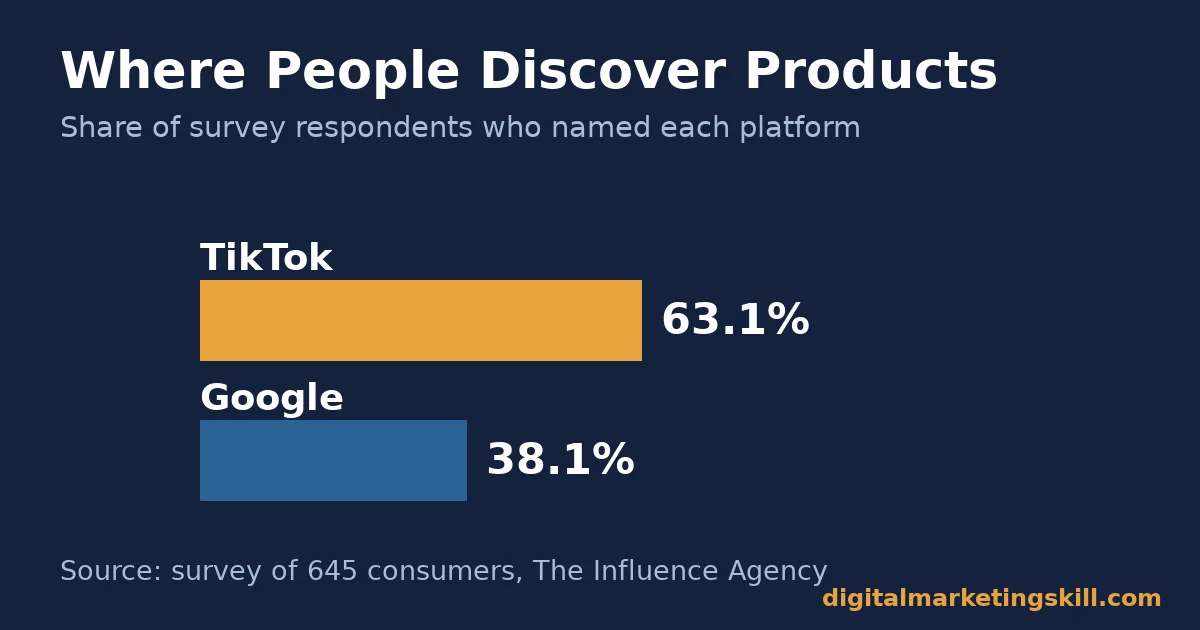
- In a survey of 645 people, 63.1% said they discover new products on TikTok, versus 38.1% on Google Search, per The Influence Agency.
- TikTok Shop’s global sales grew 92% year-over-year to $50.3 billion in a single half-year, per Tubefilter’s review of TikTok Shop data.
- TikTok’s ad audience splits close to even by gender: 55.7% male, 44.3% female. The largest age group is 25 to 34, per DataReportal.
- Among US adults, 31% say they use TikTok, rising to 65% of adults aged 18 to 29, per Pew Research Center (a US-only figure).
In this guide
- Why Most Business Accounts Stall
- How TikTok for Business Actually Gets Discovered
- Who You’re Actually Reaching on TikTok
- What Differs By Approach
- How To Lead With Each Approach
- Common Mistakes That Waste a TikTok for Business Budget
- Working With Creators: What the Disclosure Rules Require
- How To Measure What’s Working
- The One Decision Rule That Saves the Most Wasted Effort
- What This Looks Like in Practice
- Frequently Asked Questions About TikTok for Business
- Where to Learn TikTok for Business Properly
Why Most Business Accounts Stall
Most businesses treat TikTok like a smaller Instagram. They post one polished ad, wait for followers to arrive, then stop when nothing happens. However, that approach misses how the platform actually works.
This is an informed reading of public platform data, not a fixed formula. Ranking signals change often, and figures here are averages across a huge, mixed audience. Your result in any single week can land far from average. Nothing here guarantees followers, sales, or income.
The real gap is simple. Most businesses plan content around their own calendar. TikTok’s system instead judges each video in its first few hours. Match that, and reach follows. Skip it, and even a good video sits unseen.
How TikTok for Business Actually Gets Discovered
TikTok built its main feed, the For You page, on a content graph, not a social graph. A social graph (what Facebook and LinkedIn mostly use) shows you posts from accounts you follow. A content graph shows you content based on what you watch, no matter who posted it.
In practice, a brand-new account with zero followers can outperform an account with ten thousand followers. All it needs is one video that holds attention. TikTok tests a new video on a small pool of viewers first. It checks how long they watch, whether they replay it, and whether they comment. Only then does it widen distribution.
Three signals drive most of that early test: watch time, replays, and early comments. Hashtags matter less than they used to for reach. In fact, they mainly help TikTok’s search index understand your topic, which matters for TikTok Shop and search traffic.
TikTok’s own newsroom explainer on how the For You feed works confirms this directly. It states that “neither follower count nor whether the account has had previous high-performing videos are direct factors.” Finishing a longer video, by contrast, carries real weight for TikTok for business accounts.
For a business using TikTok, that has one practical result. Post frequency and watch time matter more than production budget. A phone video that holds attention for 30 seconds will usually beat a studio ad that loses viewers after five.
Who You’re Actually Reaching on TikTok
Before you build a content plan, know who is watching. Globally, TikTok’s own ad data shows a near-even gender split: 55.7% male, 44.3% female. The single largest age group sits between 25 and 34, not in the teens, per DataReportal’s review of TikTok’s ad tools.
In the United States, Pew Research Center found that 31% of adults use TikTok. That figure nearly doubles among 18 to 29 year olds, at 65%, and drops with each older bracket, down to 11% among adults 65 and up.
Pew also found usage runs higher among Hispanic (53%) and Black (51%) adults than White adults (30%), and higher among lower-income households. These are US-only figures and will not match every market. Still, they challenge the common assumption that TikTok for business only reaches teenagers.
The practical point: if your product serves adults in their late twenties and thirties, TikTok is not a niche bet. In other words, you are following a large, varied slice of consumers who already spend time there.
The audience is also spread far wider than any one country. DataReportal’s ranking of ad-reach by country lists the United States, Indonesia, Brazil, Mexico, and Pakistan among the largest, each with tens of millions of users. So if you sell internationally, treat TikTok as a genuinely global channel rather than a platform tied to one market, and adjust your language and references for each audience you target.
What Differs By Approach
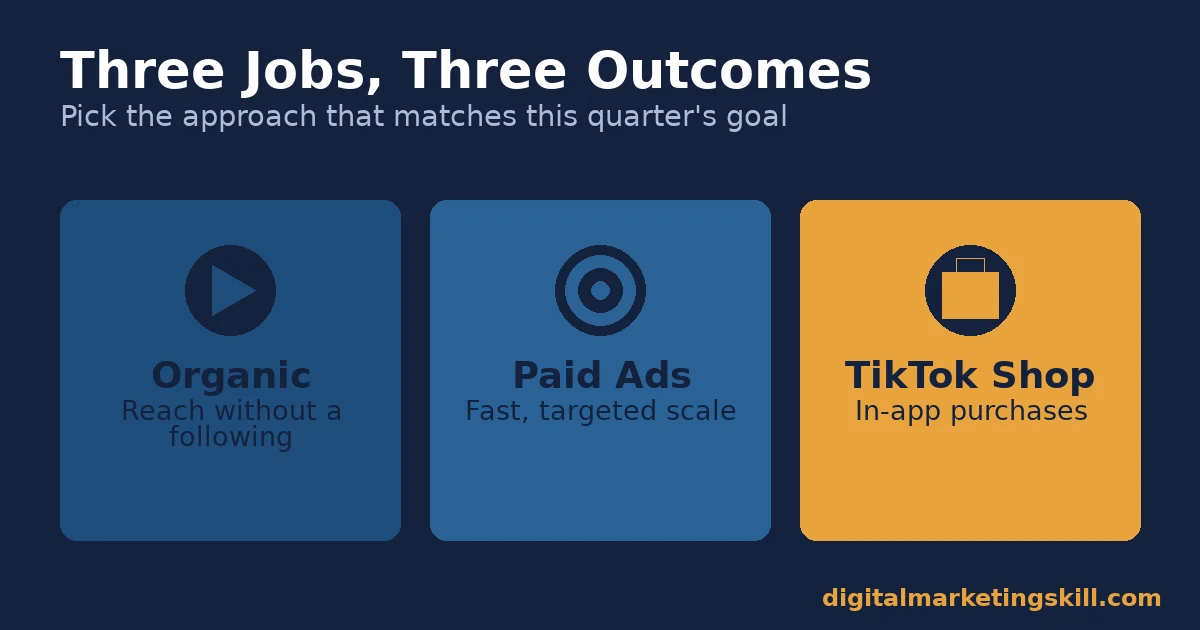
TikTok for business covers three different jobs: organic content, paid ads, and TikTok Shop. Each is built for a different outcome. Treating them as one strategy is the most common reason results disappoint.
Organic TikTok for Business: Built For Reach Without a Following
Organic posting is the cheapest way in. It is also the best way to test what your audience wants before you spend on ads. Because the content graph rewards watch time over follower count, a new account can get real views from its first few posts. The tradeoff is unpredictability. Reach depends on the algorithm’s daily behavior, not your budget. Results vary from post to post.
Paid Ads: Built For Fast, Targeted Scale
TikTok’s ad platform lets you pick an audience by interest, behaviour, or lookalike match. It then also delivers to that audience for a fixed budget. This removes the guesswork of organic reach. But it also removes the “free” part. Every view is paid. A weak video still gets shown; it just gets shown to people who scroll past faster, which drives up cost.
TikTok Shop: Built For In-App Purchases
TikTok Shop lets a customer buy a product without leaving the video. It also shortens the path from “I saw this” to “I bought this.” That is why Shop-tagged videos convert differently from a video that just links out to a separate store. The tradeoff is setup cost, and it is easy to underestimate. Product catalogs, shipping rules, and return policies need to be ready before the first sale, not after.
A rough way to choose where to start: with no budget, lead with organic content. With a tested offer and money you can afford to spend while learning, add paid ads. With a physical product and reliable shipping already in place, set up TikTok Shop alongside either of the other two.
How To Lead With Each Approach
Knowing what each approach is built for only helps once you know where to spend your first hour inside it.
Organic Content: Lead With a Content System
Pick one weekly format you can repeat: a product demo, a behind-the-scenes clip, or a customer question answered on camera. Post four to five times a week. In the long run, consistency, not one viral hit, is what compounds reach. Write your bio like a shop sign: what you sell, who it is for, and one link to learn more.
Paid Ads: Lead With a Narrow Audience and a Clear Offer
Start with one audience and one offer, not five variations at once. A narrow test tells you what works faster than a broad one does. Use your best-performing organic video as the ad creative, before you commission a new one. A video that already holds attention organically is a safer starting bet than an untested concept.
TikTok Shop: Lead With Trust Signals Before Checkout
Before you tag a single product, fill in real shipping times, a working returns policy, and a handful of genuine reviews. Shoppers who buy inside a video decide fast. They have no time to research your brand elsewhere. The trust signals need to already be on the page they land on.
Common Mistakes That Waste a TikTok for Business Budget
Four mistakes show up again and again on TikTok for business accounts. Each one is fixable without extra spend.
- Posting ads as the first and only content. An account with no organic history gives TikTok’s system no watch-time data to learn from. Even a paid ad then struggles to find its audience efficiently, since there is no baseline performance to compare it against. Post organically first, for at least a few weeks, before you move any budget into ads.
- Linking out instead of keeping the sale in-app. A video that sends viewers to an outside site loses many of them at the link tap. Where it fits your product, TikTok Shop keeps the purchase on the same screen.
- Treating every video as a one-off. Without a repeatable format, there is nothing to learn from between posts. A consistent format turns each video into a test you can improve.
- Using creators without a clear, visible disclosure. If a creator is paid or given free product to feature your business, that relationship must be disclosed on the video itself, not buried in a caption.
Working With Creators: What the Disclosure Rules Require
Many businesses use creators to extend their reach, instead of or alongside their own account. If money or free product changes hands, that is a paid partnership. It comes with a disclosure requirement.
In the United States, the Federal Trade Commission’s endorsement guidance sets the standard. If a connection between a creator and a business would change how a viewer judges the content, it must be disclosed clearly.
The FTC has flagged small, easy-to-miss text captions as not enough. Instead, it recommends text placed on the video itself, visible for long enough to read, using plain words such as “This is an ad” or “#ad” at the start.
This is a US rule, though many other countries have similar disclosure requirements. So check your own market if you run creator partnerships outside the US. Overall, treat disclosure as a design choice, not a legal afterthought. In practice it does not hurt performance; viewers are used to seeing “#ad” on content they still choose to watch.
How To Measure What’s Working
Four numbers tell you most of what you need to know about whether your TikTok for business effort is paying off. Each is defined here in one line, so you can find it in TikTok’s own analytics dashboard.
- Average watch time: how long a viewer stays on your video, as a percentage of its length. Above 50% signals a video that holds attention.
- Engagement rate: likes, comments, and shares divided by total views. It shows whether people who watched also reacted.
- Cost per click (CPC), for ads: what you pay each time someone taps through to your site or shop. Compare it against your average order value.
- Shop conversion rate: the share of viewers who complete a purchase. This number shows whether your trust signals and pricing are working.
Check these weekly for the first month of any new format, ad set, or shop listing. Switch to monthly once a pattern is stable. A number that moves against trend for two weeks straight is worth investigating before you scale spend further.
Write these four numbers down somewhere you will look at again, such as a shared spreadsheet. Do not leave them inside the app’s own dashboard. One screenshot a week builds a simple trend line within a month. That trend line usually beats any single video’s result as a guide to action.
It also helps to log what changed alongside each number: a new hook style, a different posting time, a new product tag. Without that note, a jump in watch time or conversion rate is just a mystery. With it, you have a repeatable playbook you can hand to anyone else running the account.
The One Decision Rule That Saves the Most Wasted Effort
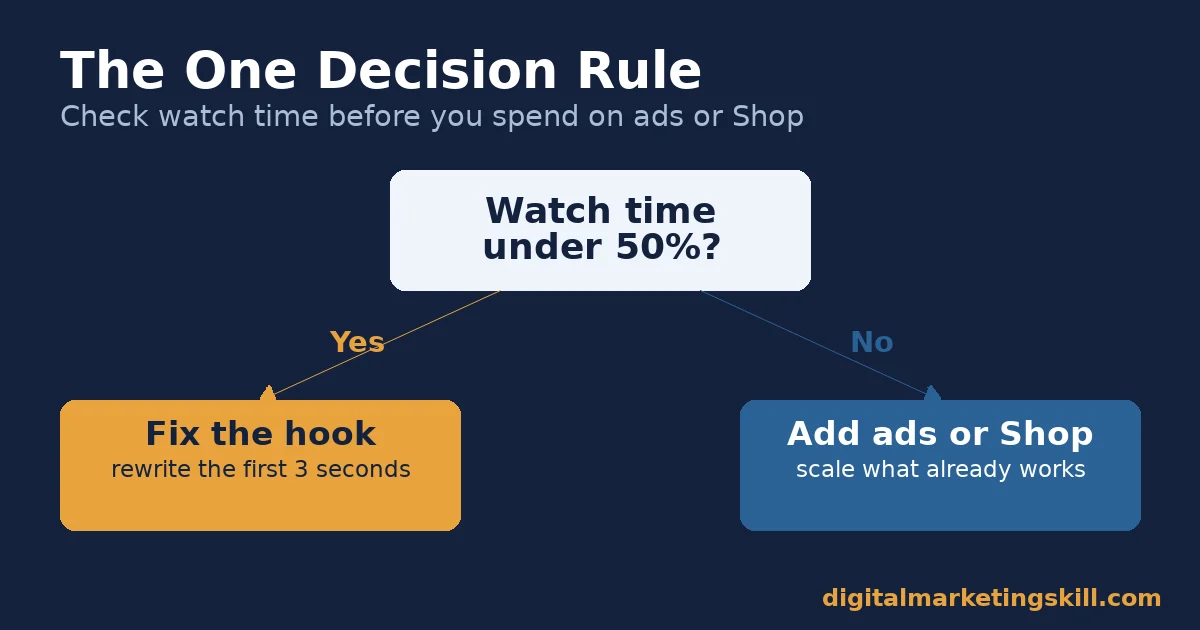
Decision rule: if your organic videos hold under 50% average watch time, fix the first three seconds before you spend on ads or Shop setup. Paid reach and in-app checkout both amplify whatever your content already does. Neither one fixes a video people stop watching.
Illustrative, invented numbers: picture a small skincare brand whose organic videos average 35% watch time and about 800 views each. Instead of raising an ad budget, the brand rewrites its first three seconds to open on the result, not the product.
As a result, watch time rises to 55%, and the next ten videos average 4,200 views, with no ad spend at all. Only once that lift holds across several videos does the brand turn on paid spend, now backed by creative it already knows works.
What This Looks Like in Practice
Independent reporting backs this pattern at platform scale. Tubefilter’s coverage of TikTok Shop data shows the Shop tab, shoppable video, and livestream selling now split roughly half, 40%, and 8% of TikTok Shop’s total sales. Video-driven sales are growing fastest of the three. That split makes sense: shoppable video reaches people the Shop tab alone cannot. The video does the attention-holding work. The Shop tag does the conversion work.
One limit applies here: this figure describes TikTok Shop’s aggregate sales mix, not any single brand’s result. It also says nothing about profit margin after ad spend, returns, or fees. So treat it as a directional signal, not a benchmark to hit.
Frequently Asked Questions About TikTok for Business
Is TikTok for business worth it with no video experience?
Yes, with a caveat. TikTok’s content graph rewards watch time more than production quality. A phone-filmed video that holds attention can beat a polished one that does not. Give yourself time to learn the platform’s pacing before judging the result.
How much does TikTok for business cost to start?
Organic posting costs only time. A free business account and a phone are enough to start. Paid ads and TikTok Shop add real cost: you set the ad spend, and Shop setup needs listings, shipping, and return policies ready before the first sale.
How often should a business post on TikTok?
Four to five times a week is a reasonable starting pace. It builds the watch-time history the algorithm uses to decide how far to spread your content. Consistency over time matters more than any single post.
Do hashtags still help TikTok content get discovered?
They help TikTok’s search index understand your topic, which matters for TikTok Shop and search traffic. They no longer drive the main feed’s reach the way watch time and engagement do.
What’s the difference between a TikTok ad, ad group, and campaign?
A TikTok ad is one video or creative. An ad group, then, is a set of ads sharing one audience and budget. A campaign is the top-level container holding one or more ad groups aimed at one goal, such as traffic or sales.
Can a business sell directly through TikTok, with no separate website?
Yes. TikTok Shop lets a business list products, take payment, and manage orders without sending the viewer to an outside site. That is why it converts differently from a video that links elsewhere.
How do I know if my TikTok content is actually working?
Track average watch time and engagement rate weekly for the first month of any new format. If watch time sits under about half the video’s length, fix the content itself. More posting or ad spend will not fix it.
Do I need to disclose a partnership if I only gave a creator free product?
Yes. Under FTC guidance, free product counts as something of value exchanged for a feature. It needs the same clear, on-screen disclosure as a paid post. The rule is based on the exchange, not the dollar amount.
Should a business use TikTok Shop if it only sells services, not physical products?
Not directly, since TikTok Shop is built around shippable, physical items. However, organic content and paid ads still work for service businesses; the goal there is usually sending interested viewers to a booking page or a lead form, not an in-app checkout.
Where to Learn TikTok for Business Properly
Reading about TikTok’s content graph is a start. Still, building a working TikTok for business system takes structured practice, feedback on real work, and current tools.
For that reason, Digital Marketing Skill Institute’s Master Diploma in Digital & AI Marketing is built around four AI-powered tracks, totalling ten execution-first courses, with a Full Stack option for learners who want all four: AI-Powered Social Media Management and Advertising, AI-Powered Lead Generation and Email Automation, AI-Powered Google Specialist, and AI-Powered WordPress and SEO Specialist.
The program runs 100% online. It includes unlimited 1-on-1 coaching and mentoring, a U.S. Project Internship with a verified U.S. Work Reference Letter, and dual US and UK accreditation recognised in more than 100 countries. Whether you live in a major city or anywhere in your country with an internet connection, the coaching and coursework work the same way.
If you are weighing platforms for your own plan, see our breakdown of how creators make money on TikTok and how to grow as a content creator on TikTok. For reach beyond one platform, see our notes on social media management and small business influencer marketing as your next steps once TikTok for business is working for you.
You can start building this skill set today, anywhere in your country. Explore the program on the Digital Marketing Skill Institute homepage, browse more guides on our blog, read student outcomes on our reviews page, and when ready, apply here. Results vary by effort and market; see our earnings disclaimer, and visit digitalmarketingskill.com to learn more.
Every figure in this guide was checked against its original source before publication. Figures marked as illustrative are invented examples, not real results.