
Pinterest marketing means using Pinterest’s visual search engine, not its social feed, to reach people who are already planning a purchase. That single distinction, search intent over social scrolling, is why Pinterest marketing converts differently than most other platforms. This guide covers how it works, the pin formats to use, and the one decision rule that matters most.
Key Takeaways
- Pinterest now reaches 640 million monthly active users worldwide, per the platform’s own audience data.
- 96% of top searches on Pinterest are unbranded. People are open to discovering a new product, not just searching for one they already know (Pinterest).
- 80% of weekly Pinners say they feel inspired by the shopping experience on the platform (Pinterest).
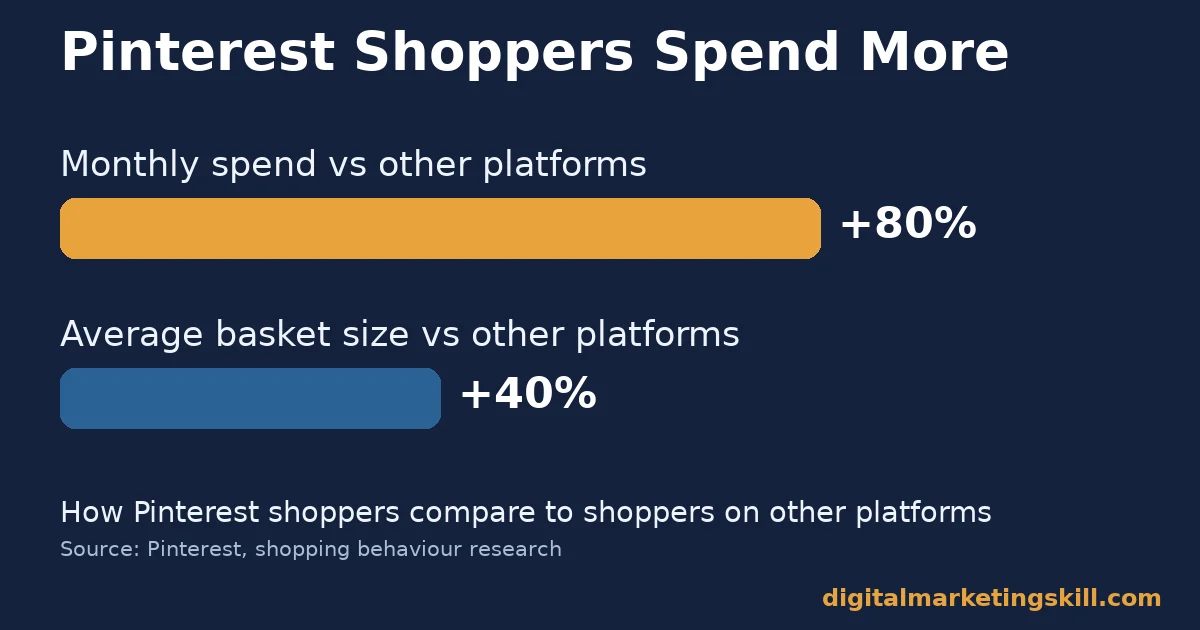
- Pinterest shoppers spend 80% more per month than people on other platforms, and carry a 40% bigger basket size, per Pinterest’s own shopping research.
- Brands running shopping ads on Pinterest see 3x the conversion and sales lift compared to the platform’s baseline (Pinterest).
In this guide
- The Gap Most Pinterest Marketing Advice Skips
- How Pinterest Marketing Actually Works
- What Differs By Pin Format
- How To Launch And Grow With Each Pin Format
- Measure What Matters: The KPIs That Tell You Pinterest Marketing Is Working
- The One Decision Rule: Match Format To Purchase Readiness
- A Worked Example: Pairing Discovery And Purchase Pins
- Frequently Asked Questions About Pinterest Marketing
- Your Next Step
The Gap Most Pinterest Marketing Advice Skips
Most Pinterest marketing guides stop at “post pretty pictures.” That advice misses the actual mechanism. Pinterest marketing is not about competing for social attention. It is about competing for search intent.
Two ground rules keep this guide honest. First, every figure here is named at its source. A shopping-behavior statistic from one market is not a universal law. Second, Pinterest is not fully available in every country. Pinterest restricts ad products and certain pin formats by region. Check availability before building a strategy around one specific feature.
With that said, here is the plan. We cover how Pinterest marketing actually works. We cover the pin formats and when each one earns its place. Then we cover how to launch and grow with each format, which numbers to track, and one decision rule that applies no matter what you sell.
It also helps to name the common mistake early. A business posts a handful of pretty pins. It waits for engagement, the way other platforms reward it. Then it gives up when nothing happens fast. Pinterest marketing rewards patience and volume over time. It works more like search engine optimisation than instant social virality.
That patience is the hardest part to accept, because almost every other channel trains marketers to expect a fast signal. A Pin published this week might not peak in impressions for several months, after Pinterest’s own search system has had time to test it against enough searches to understand what it answers.
How Pinterest Marketing Actually Works
Pinterest is a visual discovery tool. People search it, much like a search engine, to find ideas for a project, an outfit, or a gift. The content, called a Pin, can be an image, a video, or a product listing.
The mechanism depends on three things working together. A pinner searches or browses for an idea. Pinterest’s own search has to index and rank your Pin for that search, much like Google ranks a web page. Then your Pin needs a clear path, usually a link, back to your website or store.
This is why Pinterest marketing rewards keyword research the same way search engine optimisation does. Pinterest’s own Trends tool shows which searches are rising. A Pin’s title and description are not just captions. They are how the platform decides which searches your content should answer.
People come to Pinterest already planning to try or buy something. So the platform sits closer to the bottom of the funnel than most social channels. Pinners are not there to be entertained. They are there to decide.
Boards matter too. A board is a saved collection of Pins around one theme, and it works as a lightweight extension of content creation.
A board with a vague, generic name like “stuff we like” ranks for almost nothing at all. By contrast, a board named for the exact thing a pinner searches, like “small bathroom storage ideas,” can rank for that search for years.
What Differs By Pin Format
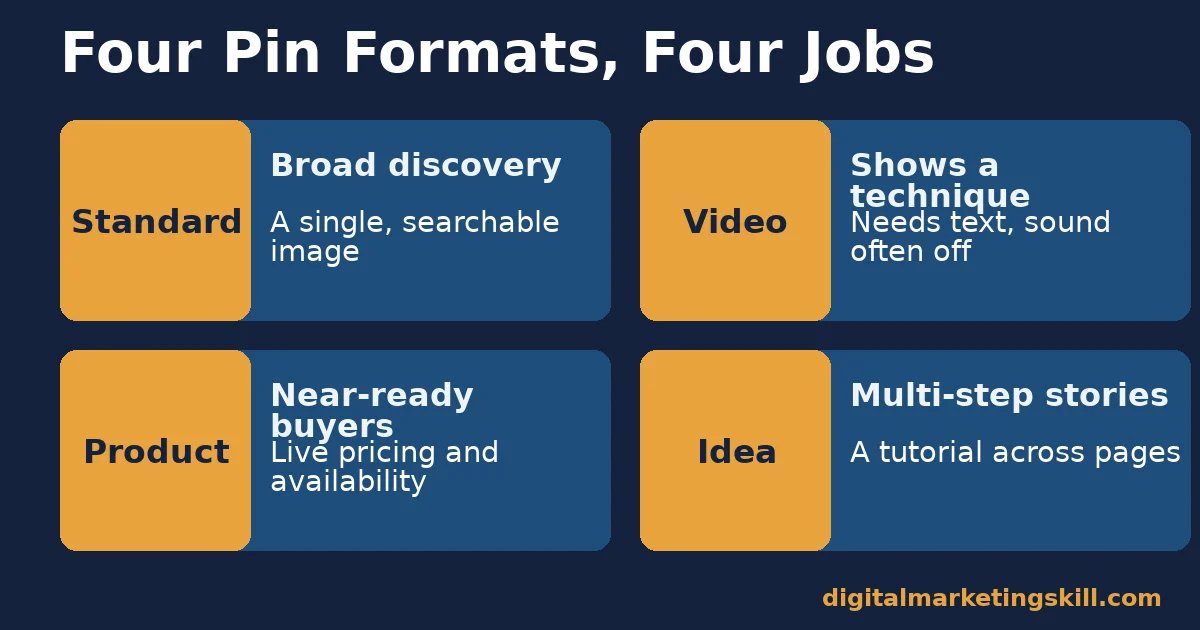
Pinterest marketing offers several pin formats. Each one targets a different stage of a pinner’s decision, from early inspiration to a near-ready purchase.
Standard Pin: Built For Broad Discovery
A standard Pin is a single vertical image with a title, a description, and a link. It is the default format in Pinterest marketing and the easiest to produce at volume.
Its strength is reach. A clear, high-quality image with a specific, searchable description can surface in results for months or years. By contrast, a social post usually disappears from a feed within days.
Because the format is simple, it is also the easiest to test. A business can publish several Standard Pins for the same product, each with a different title and description, and let the search data decide which angle actually gets found.
Video Pin: Built For Demonstrating An Idea
This format uses motion, and optionally sound, to show something a still image cannot. That could be a technique, a transformation, or a product in use.
Its limit is attention span without sound. Most pinners browse with audio off. So a video Pin needs clear text overlay or captions to land its point at all.
Product Pin: Built For A Pinner Close To Buying
A Product Pin pulls in real-time pricing and availability from a linked catalog, alongside the image. It tells a near-ready buyer exactly what something costs before they click through. Setting one up requires connecting a product catalog feed, which is a one-time technical step most ecommerce platforms support directly.
Its limit is availability. Product Pins, and Pinterest’s shopping ad products generally, are not supported in every region. Confirm access before planning a campaign around them.
Idea Pin: Built For Multi-Step Stories
An Idea Pin is a multi-page format, closer to a short story than a single image. It is built for sharing a process, a tutorial, or several related ideas at once.
Its strength is depth within one piece of content. Its limit is availability, like Product Pins. It also rewards a narrative structure more than a single strong image does, since a sequence of weak pages rarely outperforms one excellent Standard Pin.
Treat it as a bonus format, not a replacement for Standard Pins. A business that moves all its effort into Idea Pins loses the long-term search visibility that Standard Pins build over months.
How To Launch And Grow With Each Pin Format
The same core steps apply across formats in Pinterest marketing. Set up a business account; a personal account cannot access analytics or shopping features. Start by identifying your target audience, then research the specific searches that audience already uses. Build boards around those searches, not around internal company categories. Then match your format to the pinner’s stage.
Standard Pin: Lead With A Specific, Searchable Description
Use a vertical image, close to a 2:3 ratio. That is what performs best in most pinners’ feeds. Write a description the way you would write a search query. Name the exact idea or product, not a vague brand slogan.
Check that any linked page loads quickly and matches what the Pin promised. A mismatch between the Pin and the landing page is one of the fastest ways to lose the trust a Pin just earned.
Video Pin: Lead With A Silent-First Script
Script the video to work with the sound off first. Treat audio as a bonus layer, not the main carrier of meaning. Select a strong cover image, since that single frame decides whether anyone presses play at all. Check Pinterest’s own pin specifications before exporting, since the wrong aspect ratio gets cropped awkwardly in the feed.
Keep organic videos short, generally under a minute, and keep any paid video even shorter than that. Pinterest marketing rewards a fast, clear payoff over a slow build.
Product Pin: Lead With An Accurate, Linked Catalog
Connect a real product catalog so pricing and availability stay accurate automatically. A Product Pin showing a sold-out or wrongly priced item damages trust fast. Link directly to the exact product page, not a general category page.
Only use this format where it is actually supported, and where the linked page lets a pinner complete the purchase. A Product Pin that leads to a page with no way to buy defeats its own purpose, and it wastes the exact moment a near-ready buyer was prepared to act.
Keep the product title shown in the Pin close to the title on the actual product page. A pinner who clicks through expecting one item, and lands on a page describing something slightly different, usually leaves without buying anything at all.
Idea Pin: Lead With A Clear Step-By-Step Structure
Plan the Idea Pin as a sequence, not a single thought spread across pages. Each page should move the story forward. That could be a step in a tutorial or a stage in a transformation.
Use text overlay generously. Like video Pins, most of this content gets viewed without sound. Close with a clear next step. A strong Idea Pin earns a follow, not just a view.
Measure What Matters: The KPIs That Tell You Pinterest Marketing Is Working
Impressions show how often a Pin appears in search or browse results. A low number usually means weak keywords or a new, unestablished Pin. Saves show how often a pinner adds your Pin to their own board. A save signals genuine interest, even before any click happens.
Outbound clicks measure how many people actually leave Pinterest for your linked page. This is the number that most directly reflects traffic, not just visibility. Conversion rate measures how many of those visitors complete a purchase or goal once they land. Pair Pinterest’s own analytics with a web analytics tool, since Pinterest’s numbers stop at the click.
Read saves and outbound clicks together. A Pin with high saves but low outbound clicks is being enjoyed, not acted on. That usually means the image works, but the description or offer gives pinners no clear reason to click through right now.
Track these numbers by pin format too, not only in aggregate. A Standard Pin with low outbound clicks may still be doing its job if saves are high, since it is building awareness. A Product Pin with the same low click rate almost always signals a real problem, since clicking through is its entire purpose.
Review these numbers monthly rather than daily. Pinterest’s search-driven model means a single Pin’s performance can shift slowly over weeks, so daily swings usually reflect normal noise rather than a real change worth reacting to.
The One Decision Rule: Match Format To Purchase Readiness
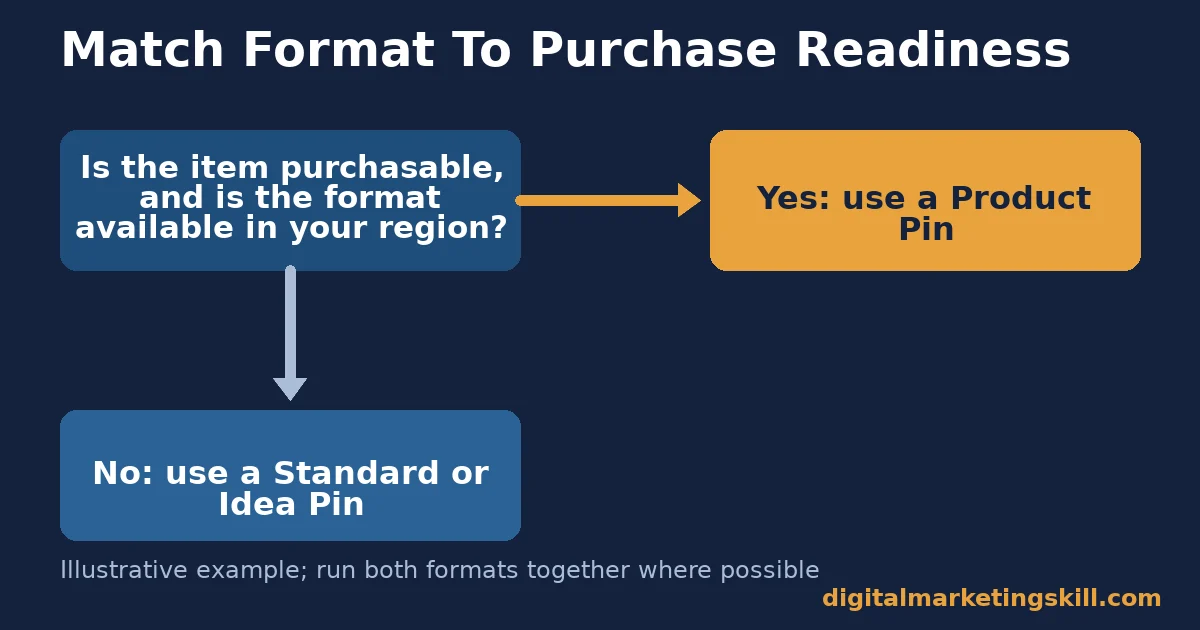
Here is the rule for Pinterest marketing. Use a Product Pin whenever the item is purchasable and the format is supported in your region. Use a Standard or Idea Pin whenever the goal is discovery rather than an immediate sale.
Illustrative, invented numbers: imagine two Pins for the same product, one Standard and one Product, shown to similar audiences. The Standard Pin might earn more saves. It reads as inspiration people file away for later. The Product Pin might earn fewer saves but a notably higher outbound click rate, because it already answers the price question a near-ready buyer has.
Running both is usually better than picking one. The Standard Pin builds the discovery audience. The Product Pin converts the share of that audience that is already close to buying. Treating the choice as either-or, rather than both-and, is one of the more common mistakes businesses make when they first apply this rule.
A Worked Example: Pairing Discovery And Purchase Pins
This example uses illustrative, invented numbers to show the mechanism, not a specific brand’s real results. Picture a small home goods brand launching one new product. The brand has no existing following on Pinterest and a modest budget, which matters, since the example works precisely because it does not rely on either.
They create one Standard Pin showing the product styled in a room. The description is broad and searchable, something like “cozy living room decor ideas.” That Pin earns strong saves from people planning a redecoration. Most of them are not ready to buy yet.
They also create a Product Pin for the same item. It links straight to the purchase page with live pricing. That Pin earns fewer total views. But a much higher share of its viewers click through, because it reaches people later in the same search journey, closer to a decision.
Weeks later, some of the people who saved the Standard Pin search again. This time they are ready to buy, and the Product Pin is what they find. Neither Pin alone would have captured both the early-stage and late-stage pinner, since each one only speaks clearly to one side of that gap.
Together, they cover the same journey two different visitors take at two different speeds. That pairing is the core lesson this guide argues for. Pinterest marketing works best when formats are paired to stages, not chosen once and left alone.
Frequently Asked Questions About Pinterest Marketing
How do I start Pinterest marketing for my business?
Set up a Pinterest business account rather than a personal one. Only a business account unlocks analytics and shopping features, both of which matter from day one. Research the specific searches your audience already uses. Build boards around those searches, and start publishing a steady mix of Standard Pins before adding other formats. Expect the first real signal to take a few weeks, not a few days.
What is the best pin format to use?
There is no single best format. It depends on the pinner’s stage. Use Standard or Idea Pins for discovery and early inspiration. Use Product Pins once someone is close to a purchase decision and the format is available in your region. Most accounts do best running several formats side by side, not just one, since each format reaches a slightly different part of the same audience.
How is Pinterest marketing different from other social media marketing?
Pinterest functions as a visual search engine, not a social feed. People use it to plan and research a future action, often a purchase, rather than to catch up with friends. That is why Pinterest marketing rewards keyword-driven content over short-term virality. A business moving budget from a social feed to Pinterest should expect a slower start and a longer payoff, not a like-for-like swap.
Do I need a large following to succeed with Pinterest marketing?
No. Pinterest surfaces content through search and recommendations, not just follower feeds. A well-optimised Pin from a small account can still reach a large, relevant audience months after publication, which is a meaningfully different dynamic from a follower-driven feed, where audience size caps reach on day one.
How long does it take to see results from Pinterest marketing?
Longer than most social platforms, and that is normal. Pinterest marketing behaves more like search engine optimisation. A strong Pin can keep earning impressions and clicks for months, rather than producing one short burst of attention right after posting. Most businesses need at least a few months of consistent, steady publishing before they can fairly judge whether a strategy is actually working.
Is Pinterest marketing available everywhere in the world?
Pinterest itself is widely available, but specific features are not. Product Pins, Idea Pins, and shopping ads are only supported in certain regions. Always confirm feature availability for your market before building a strategy around one specific pin format.
What is the biggest mistake businesses make with Pinterest marketing?
Treating it like another social feed and expecting fast engagement. The platform rewards consistent, keyword-researched publishing over time. Businesses that give up after a few weeks usually quit right before the compounding effect would have started to show. That timing problem, not a flaw in the platform itself, explains most failed Pinterest efforts.
Can a small business compete with big brands on Pinterest?
Yes, more easily than on most platforms. Since ranking depends heavily on how well a Pin matches a specific search, a small business targeting a narrow, well-researched keyword can outrank a larger brand that only targets broad, generic terms.
Should I delete old Pins that aren’t performing?
Generally no, unless a Pin links to a page that no longer exists or no longer matches the Pin’s description. Because Pinterest marketing rewards content that keeps earning impressions over months, an older Pin can still be quietly working even if it looks inactive on a quick glance.
How often should I publish new Pins?
Consistency matters more than any specific number. A steady weekly rhythm of new, well-researched Pins tends to outperform a single large batch published once and never repeated, since Pinterest marketing rewards accounts that keep adding fresh, relevant content over time.
Your Next Step
Treating Pinterest as a search engine, not a social feed, changes almost every decision in this guide. Want structured, practical training in the research and content skills that make a channel like Pinterest marketing actually convert?
The Master Diploma in Digital & AI Marketing at Digital Marketing Skill Institute is built around four AI-powered tracks, totalling ten courses, with a Full Stack option for completing all four: AI-Powered Social Media Management and Advertising, AI-Powered Lead Generation and Email Automation, AI-Powered Google Specialist, and AI-Powered WordPress and SEO Specialist.
The program includes unlimited one-on-one coaching and mentoring, plus a U.S. Project Internship with a verified U.S. Work Reference Letter. It carries dual US and UK accreditation, recognised in more than 100 countries, and runs 100% online, so you can build these skills from anywhere in your country.
Explore the blog for more practical guides, or go straight to the application page to get started. Wherever you live, the training and mentoring are built to travel with you. Learn more at digitalmarketingskill.com, or visit digitalmarketingskill.com again once you have picked your first pin format.
Every figure in this guide was checked against its original source before publication. Figures marked as illustrative are invented examples, not real results.
