
Most small business posts don’t fail because the platform is wrong. They fail because there is no campaign behind them. Strong social media campaign strategies turn scattered posts into a structured push. They give the push a goal, a measured result, and a next step, instead of one more update nobody acts on.
Key Takeaways
- Social platforms now reach 5.66 billion user identities, 68.7% of the global population, so the audience problem is rarely “are they there” (DataReportal).
- Online adults use an average of 6.75 different social platforms a month. A campaign built for only one platform usually under-reaches its own audience (DataReportal/GWI).
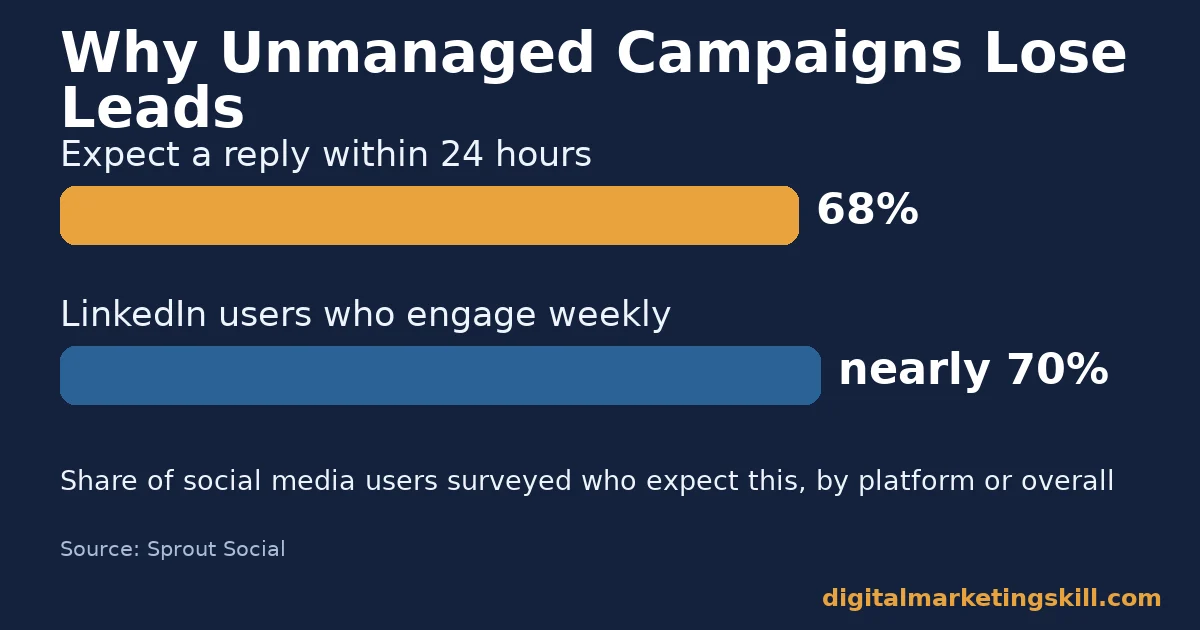
- 68% of social users expect a brand to reply within 24 hours, so unmanaged comments quietly cost campaigns their best leads (Sprout Social).
- 44% of consumers rank product or service quality as their top priority. 33% rank content originality next. A clever hook still needs a real offer behind it (Sprout Social).
- Nearly 70% of LinkedIn users engage with brand content at least weekly, which is why B2B campaigns built for LinkedIn routinely outperform the same message on a broad-reach feed (Sprout Social).
In this guide
- The Gap: Why Most “Campaigns” Are Just Posts With Extra Steps
- How Social Media Campaign Strategies Actually Work
- Social Media Campaign Strategies By Platform: What Each One Rewards
- Social Media Campaign Strategies That Lead With the Right Move
- Measuring Social Media Campaign Strategies: Five KPIs, Defined
- The One Decision Rule Behind Strong Social Media Campaign Strategies
- A Real Case: Fourteen Dollars, One Clear Offer
- Frequently Asked Questions About Social Media Campaign Strategies
- Your Next Step
The Gap: Why Most “Campaigns” Are Just Posts With Extra Steps
Search any guide to social media campaign strategies and you get the same checklist. Pick a platform. Write some content. Post it. Hope. That checklist describes posting, not a campaign.
A real campaign has four things a random post never has. It needs a single measurable goal. It needs a defined audience segment. A planned sequence of content matters too, not one piece posted and forgotten. And somewhere there has to be a point where you look at the numbers and decide whether to keep going, change course, or stop entirely.
Two ground rules before the detail. First, every platform figure in this guide is a snapshot of self-reported, aggregated behaviour. It is not a guarantee for your account. Treat it as an informed starting point, not a settled fact.
Second, “best platform” is a moving target shaped by your own audience and offer. It is a snapshot, not a permanent ranking. The method in this guide matters more than any single number inside it. If a campaign needs cold traffic rather than warm engagement, read this alongside broader inbound marketing strategies, since the two approaches solve different stages of the same funnel.
How Social Media Campaign Strategies Actually Work
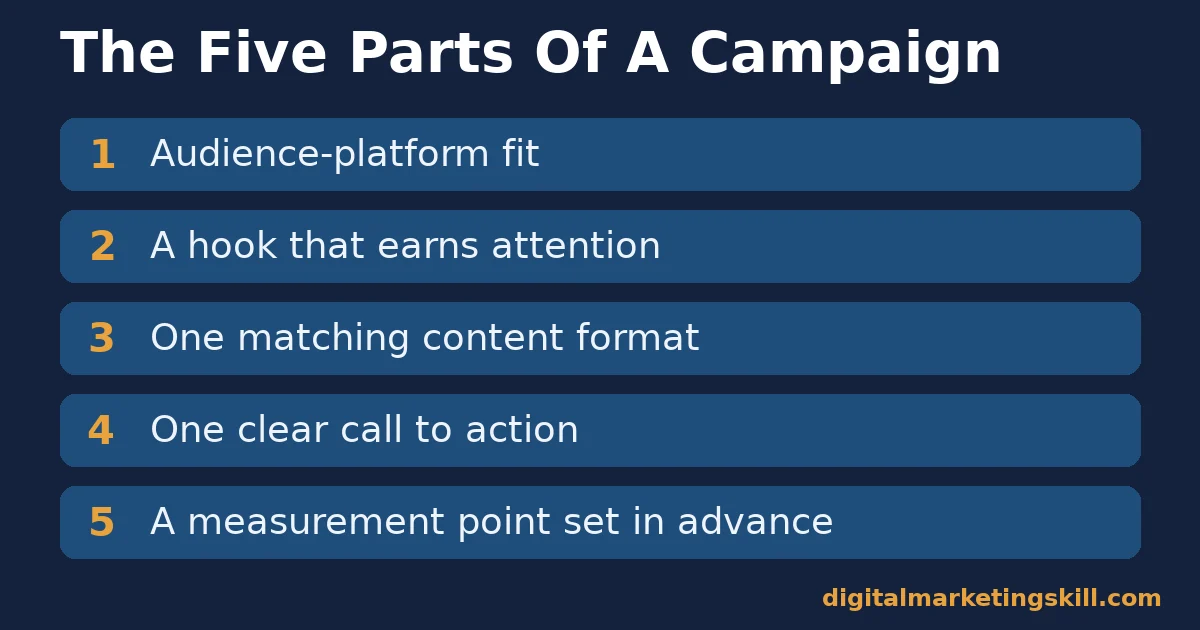
A working campaign runs on five linked parts, in order. Break any one of them and the rest cannot compensate for it.
The Five Parts, In Order
- Audience-platform fit. Choose the platform because your buyer spends time there, not because a competitor does.
- The hook. The first line, or the first three seconds of video, must earn attention before your offer gets a chance.
- Format. Video, carousel, image and text each carry a different cost of attention. One format can win on one feed and lose on another, with identical copy.
- One call to action. Stated once, clearly. Asking for a like, a follow and a sign-up in one post usually earns none of them.
- The measurement point. A date or number at which you read the results and decide. Set it before the campaign starts, not after you have judged it by gut feel.
Everything in the rest of this guide fits one of those five parts.
User-Generated Proof, and Why Platform Comes Last
If your business leans on content people share rather than content people buy from directly, pair this mechanism with user-generated content. A campaign that asks your audience to help create the proof often out-converts one that only asks them to watch it.
Notice what is missing from the five parts above: the platform itself. Platform choice matters, but it is downstream of the goal. Decide what the campaign needs to do first. Only then pick where it runs.
Notice too what is missing from “who runs this”: a big team. A single owner, a part-time hire, or an outside freelancer can all run a good campaign. What they cannot skip is the measurement step, and being accountable for the decision that follows it.
Organic Reach vs. Paid Spend: Different Jobs, Not Rivals
Many small businesses treat organic posting and paid spend as competing choices, when they are actually solving different problems. Organic social media campaign strategies are slower, but they are nearly free and they build the audience data you will later use to target paid campaigns.
Paid spend is faster and more controllable. But it buys attention rather than earning it, and it stops working the moment the budget stops. A sensible sequence is organic first, to find out which hook and offer actually convert. Then paid, to scale the version that already works, rather than guessing at scale from day one.
Skipping straight to paid spend behind an unproven hook is one of the most expensive mistakes a small business can make. It pays to learn what free testing would have shown for nothing.
Social Media Campaign Strategies By Platform: What Each One Rewards
The same offer, written the same way, performs differently depending on where it lands. Here is what each major platform is actually built to reward, and why copying a strategy wholesale from one platform to another usually underperforms.
Facebook: Built For Broad Reach And Retargeting
Facebook’s strength is its size and its ad targeting depth, not organic discovery. Its audience spans nearly every age group and income level.
That breadth makes it strong for retargeting people who already know your brand, rather than for cold discovery of people who have never heard of you. A social media campaign built mainly for Facebook usually works best as the second step in a sequence, not the first introduction to a stranger.
Instagram: Built For Visual Discovery
Instagram rewards visual storytelling. It is particularly strong for brands with a strong image, product shot or short demonstration to show. It reaches users who are actively browsing, rather than people who scroll past everything that is not a video. A business selling a visible, physical result tends to get more out of this platform than one selling an abstract service.
LinkedIn: Built For B2B Trust
LinkedIn’s audience engages with brand content at a notably higher rate than most networks: nearly 70% at least weekly, per Sprout Social. That makes it the strongest platform for B2B campaigns. They need to build credibility before a sale, not just reach a wide audience.
TikTok: Built For Fast, Native Attention
TikTok rewards content that looks and feels native to the feed, not a repurposed ad. TikTok’s own creative guidance recommends introducing the content proposition within the first three seconds. It also notes that opening with suspense alone can lift watch time by around 16%. Campaigns that open with a polished brand intro instead of a hook tend to get scrolled past before that window closes.
Social Media Campaign Strategies That Lead With the Right Move
Knowing what a platform rewards only helps if your campaign is actually built around it. Here is the matching move for each platform.
Facebook: Lead With a Retargeting Sequence
Build a short sequence. Start with one post that earns a click or a save. Follow up with a second post aimed specifically at the people who engaged with the first. Sequencing beats a single broad post. It speaks to people at a different stage of attention each time, rather than treating a cold stranger and a warm lead the same way.
Instagram: Lead With a Story-Driven Series
Instead of one polished post, plan a short series. Show a before, a process shot, and a result, told as a story your audience can follow across two or three posts. Meta’s own guidance on Stories suggests posting often enough to stay visible in the stories feed, and using interactive stickers to turn passive viewers into active participants.
Series content gives people a reason to come back, which a single post cannot do. It also pairs well with a focused hashtag set, so the series is discoverable beyond your existing followers, not only visible to people who already follow you.
LinkedIn: Lead With Proof, Not a Pitch
Open with a specific result, a number, or a lesson learned. Mention your offer at the end, if at all. LinkedIn audiences disengage quickly from posts that read as an advertisement in the first line, because the platform’s whole culture rewards insight over sales copy.
TikTok: Lead With Native-Feeling Video
Film it the way a user would film it: handheld, unscripted-looking, with the hook in the first words on screen, not a logo. Treat the first second as the entire pitch. Everything after it only matters if the first second works. If you are deciding how much production effort a platform deserves, a broader video strategy by platform is worth reading before you shoot anything.
Measuring Social Media Campaign Strategies: Five KPIs, Defined
You cannot apply the decision rule in the next section without reading these numbers correctly first. Each one answers a different question, and mixing them up is the most common measurement mistake small businesses make.
The Five KPIs
- Reach is the number of unique accounts that saw your content at least once. It tells you whether the campaign found an audience. It tells you nothing about whether that audience cared.
- Engagement rate is total engagements (likes, comments, shares, saves) divided by reach. It tells you whether the content itself, not just the targeting, actually worked.
- Click-through rate is clicks divided by the number of people who saw the post with a link. It tells you whether your hook and your call to action matched what people expected to find next.
- Conversion rate is the share of clicks that completed your defined goal action, such as a sign-up or a sale. This is the number that matters most, and the one most campaigns skip measuring entirely.
- Cost per lead is total spend divided by qualified leads generated, for paid campaigns. It tells you whether the campaign can scale profitably, not just whether it can generate attention.
The One Measurement Gap Most Businesses Skip
Most social media campaign strategies fail at this exact step. A business tracks reach and engagement because the platform shows those numbers on the home screen. It never checks conversion rate, because that number requires linking the platform back to a sale.
Fixing that one measurement gap is usually simple: use a link tracker, a unique landing page, or a dedicated promo code for each separate campaign. That way a sale can be traced back to the post that caused it, and the rest of this guide becomes far easier to apply.
The One Decision Rule Behind Strong Social Media Campaign Strategies
Most social media campaign strategies live or die on one judgment call: what to fix first when the results come in mixed, rather than clearly good or clearly bad. This single rule removes most of that guesswork.
If a campaign is low on reach but its conversion rate on the people it did reach is strong, scale the budget before you touch the creative. If reach is strong but conversion is weak, fix the offer and the call to action before you spend more on distribution.
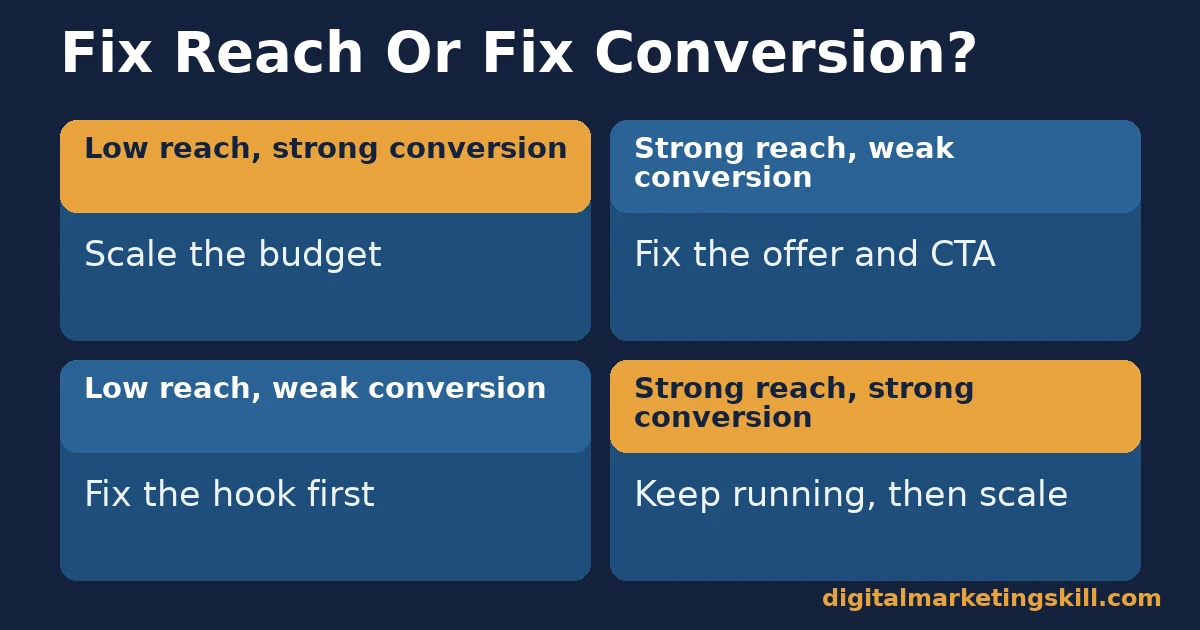
Reach problems are solved with budget or targeting. Conversion problems are solved by changing what you are asking people to do. More reach behind a weak offer only wastes money faster, and it can make a struggling campaign look busy while it quietly loses money.
Illustrative, invented numbers: a campaign reaches 2,000 people. It gets 80 clicks, a 4% click-through rate. It gets 2 sign-ups, a 2.5% conversion rate on those clicks. The conversion rate is thin relative to the click-through rate. The fix here is a clearer call to action or a simpler sign-up step, not a bigger ad budget behind the same landing page.
When to Stop a Campaign
Apply the same discipline to stopping a campaign. Stop at your pre-set measurement point, not before it and not long after it.
If reach and engagement are both near zero after a fair sample of posts, the hook or the audience fit is wrong, and no amount of extra time will fix that on its own.
If the numbers are promising but still building, extend the measurement point once, with a new deadline, rather than letting the campaign run indefinitely with no end in sight. A campaign without a stop rule tends to drift, quietly spending time or budget long after the real answer was already visible in the numbers.
A Real Case: Fourteen Dollars, One Clear Offer
Case studies on social media campaign strategies are often vague about the actual numbers, which makes them hard to learn from or verify. This one is specific enough to check against its own published source.
Ayooluwa Osemi, a graduate of the Digital Marketing Skill Institute, ran a small Facebook and Instagram ad campaign. The result is documented on the Institute’s published reviews page: an ad spend of $14 generated $878 in sales.
This is a single, self-reported result from one small campaign on one offer. It says nothing about repeatability at a larger budget, or on a different product. It is not typical and it is not guaranteed, consistent with the Institute’s earnings disclaimer.
What it does show plainly is the mechanism in this guide working at a small scale. One platform fit for the offer, one clear call to action, and a result that was actually measured rather than guessed at afterward. None of those three things required a large budget. They required the structure this guide has been describing.
Frequently Asked Questions About Social Media Campaign Strategies
How long should a social media campaign run?
Long enough to reach your pre-set measurement point with a meaningful sample. That is usually several weeks for an organic campaign, and as little as a few days for a paid one with daily spend. Running time matters less than deciding the measurement point before you start, because a campaign with no deadline rarely gets reviewed at all.
Do I need a different campaign for every platform?
You need a different lead move for every platform, even if the underlying offer stays the same. Posting the identical asset everywhere ignores the platform differences described above. It usually under-performs a version adapted to each platform’s native format, even when the core message is identical.
What is a realistic first goal for a small business campaign?
Pick a specific, measurable action tied to revenue, such as sign-ups, bookings or qualified leads, rather than followers or likes. Vanity metrics can rise while the business sees no real change in income. That is exactly why the decision rule above is built around conversion, not reach.
Should I boost every post or only run planned campaigns?
Boosting individual posts without a sequence, a single call to action and a measurement point is spending, not a campaign. It can still work occasionally, by accident. But it will not reliably tell you what to repeat, or what to fix next time.
How many platforms should a small business run at once?
Fewer than you think. Online adults already split their attention across close to seven platforms a month on average. A focused social media campaign on the one or two platforms where your specific audience is most concentrated usually outperforms a thin effort spread across five platforms at once.
What is the biggest reason a social media campaign fails?
No defined call to action, or more than one call to action competing for attention in the same post. The mechanism section above exists because this single failure point accounts for more underperforming social media campaign strategies than weak creative or the wrong platform choice ever does.
Can a social media campaign work without any paid budget?
Yes, but it needs a stronger hook and a more patient measurement point, since organic reach is smaller and slower than paid reach. The story-driven and proof-led moves described above were all designed to work at zero budget first, with paid spend as an optional accelerant once you know the message converts.
Do social media campaign strategies differ for a service business versus a product business?
The five-part mechanism stays the same, but the proof changes. A product business can show the product directly, so Instagram-style visual proof tends to work well. A service business usually has nothing physical to show. Its proof has to come from a specific result, a client quote, or a documented case. That kind of proof fits LinkedIn’s proof-led approach, or a short explainer video, more naturally than a product shot.
Your Next Step
Social media campaign strategies work when they are built, not improvised. That means one audience, one platform-matched hook, one call to action, and one measurement point set in advance.
If you want to build and run campaigns like this with structured feedback rather than trial and error, the Master Diploma in Digital & AI Marketing at Digital Marketing Skill Institute includes an AI-Powered Social Media Management and Advertising track. It sits inside a program of four AI-powered tracks and ten courses, with a Full Stack option for completing all four.
The program adds unlimited 1-on-1 coaching and mentoring, plus a U.S. Project Internship with a verified U.S. Work Reference Letter. It is dual US and UK accredited, recognised in more than 100 countries, and 100% online, so you can build real campaigns for real clients anywhere in your country.
Explore more strategies on the Digital Marketing Skill Institute blog, read verified student outcomes on the reviews page, or apply when you are ready to start. None of it requires a large budget on day one. It requires the structure this guide has walked through, applied consistently, one campaign at a time.
Every figure in this guide was checked against its original source before publication. Figures marked as illustrative are invented examples, not real results.
