
Video marketing means using video content, on purpose and with a clear goal, to reach a target audience and move them toward a purchase. Most businesses already believe this works. Fewer match the right video type to the right stage of the buying journey. That mismatch is where most of the wasted budget sits.
Key Takeaways
- 93% of marketers who use video call it an important part of their strategy, and 83% say it has directly increased sales (Wyzowl survey of marketers and consumers).
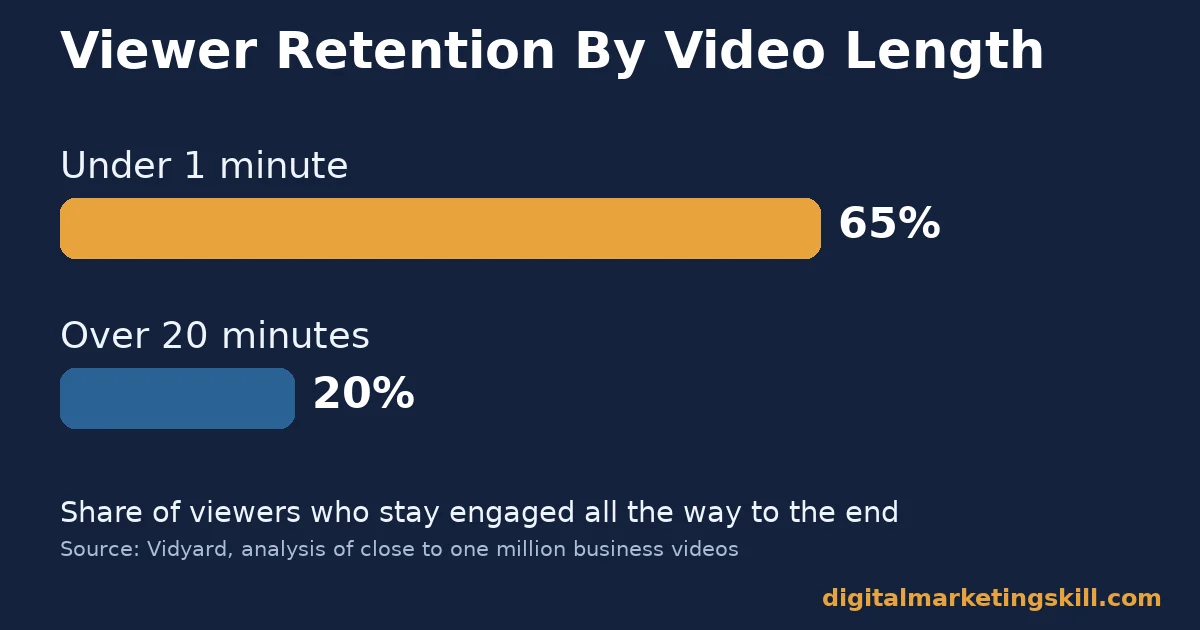
- Videos under one minute keep 65% of viewers engaged to the end; videos over 20 minutes keep only 20%, based on an analysis of close to a million videos (Vidyard).
- YouTube Shorts now average more than 200 billion daily views, according to YouTube’s own press page.
- 78% of US viewers agree YouTube has the most trusted creators for product recommendations while shopping, outperforming the social media average, per a Kantar survey reported by Think with Google.
- 85% of video marketers say video has generated leads for their business (Wyzowl).
In this guide
- The Gap Most Video Marketing Advice Skips
- How Video Marketing Actually Works
- What Differs By Video Type
- How To Plan And Launch Each Video Type
- Measure What Matters: The KPIs That Tell You It’s Working
- The One Decision Rule: Match Length To Funnel Stage, Not To Habit
- A Worked Example: Sequencing Three Video Types
- Frequently Asked Questions About Video Marketing
- Your Next Step
The Gap Most Video Marketing Advice Skips
Most video marketing guides stop at “make more videos.” That advice is not wrong, but it is incomplete. The real gap is matching video type to funnel stage. A brand that only publishes product demos never catches a cold audience. A brand that only publishes brand films never closes a warm one.
Two ground rules apply here. First, every figure in this guide is named at its source and limited to what it measures. A US survey is not a global one. A marketer’s self-reported opinion is not an independent audit. Second, video marketing is not free. It costs time or money to produce, even on a tight budget. So each video needs a stated goal before it gets made.
With that said, here is the plan. We cover what video marketing actually does, the main video types, and when each one earns its place. Then we cover how to plan and launch each type, which numbers to track, and one decision rule for choosing video length.
It also helps to name why so many businesses stall at “we should make more videos.” A team films a product demo, posts it once, and waits. Nothing happens. The one video they made was built for a buyer who had already decided. But it was shown to an audience that had not even heard of the brand yet. The video was fine. The sequencing was wrong.
How Video Marketing Actually Works
Video marketing is the use of video content to build awareness, explain a product, and move a viewer toward a purchase. It is not a single tactic. Instead, it is a format that can serve almost every stage of a funnel, from a stranger’s first impression to a customer’s onboarding.
That range is also why “video marketing” as one phrase can mislead. A brand doing it well runs several distinct video efforts at once, each with its own goal.
The mechanism is simple to state and harder to execute. A video has to earn attention fast, deliver its point, and end with a clear next step. Lose any one of those three steps and the video becomes a cost with no return.
Video also works because it appeals to more than one sense at once. Sound, motion, and a face or voice build trust faster than text alone. That is part of why knowing your target audience matters even more for video. The wrong tone loses a viewer in seconds, long before a blog post would lose a reader.
Distribution decides whether any of this matters. A strong video posted nowhere your audience looks gets zero return. The platform is part of the strategy, not an afterthought.
Video rarely works alone either. The same footage can anchor a blog post, get cut into social clips, and sit inside an email. That is one reason content creation and video planning should happen together, not as two separate workflows.
What Differs By Video Type
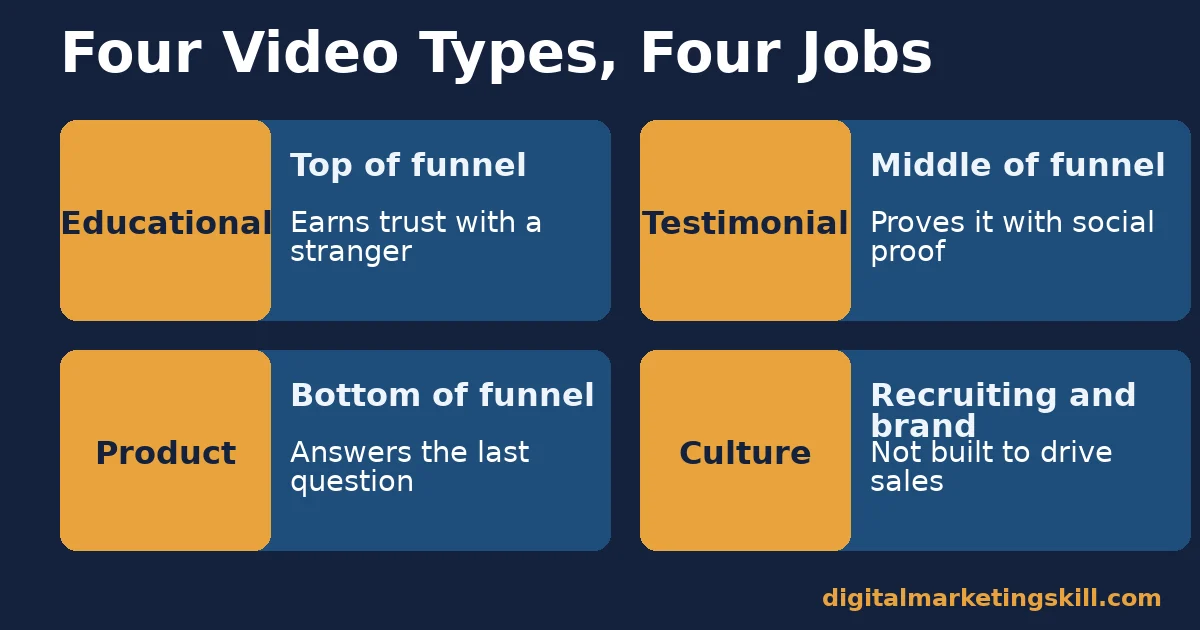
Four video types cover most business use cases. Each one does a different job in the funnel. Using the wrong type for the wrong stage is the single most common video marketing mistake, more common than bad production quality or a small budget.
Educational Video: Built For Trust At The Top Of The Funnel
An educational video teaches the viewer something, whether that is a new idea or a clearer way to do something familiar. It works on a stranger because it asks for nothing in return except attention.
The trade-off is that it rarely closes a sale on its own. Its job is to make a brand look credible, not to make a cart fill up.
A how-to video, an explainer, or a short answer to a common question all count here. The test is simple: would this video still be useful if the brand’s name were removed from it? If yes, it is doing its job.
Keep educational content free of any direct pitch. The moment it starts selling, it stops being educational, and the trust it was building drops fast.
Testimonial Video: Built For Trust In The Middle Of The Funnel
A testimonial video shows a real customer or employee talking about a real result. It works on a viewer who already knows the brand but has not decided to buy yet.
Its strength is social proof. Its limit is credibility. A testimonial that feels scripted or vague does less than no video at all, because it signals the brand has nothing stronger to show.
Employee testimonials work too, not only customer ones. A business that shows how it treats its own people earns extra trust. Buyers often assume that good internal culture predicts good external service.
Product Video: Built For Decisions Near The Bottom Of The Funnel
A product video shows exactly what something does and how it works. It answers the specific questions a near-ready buyer still has before paying.
Because the viewer is closer to a decision, this is the video type most directly tied to conversion. It is also the type that dates fastest, so it needs the least promotional, most evergreen framing possible.
A launch announcement fits here too, when it shows the product working rather than only hyping its arrival. Viewers this close to a decision reward proof over excitement.
Company Culture Video: Built For Recruiting And Brand, Not Sales
A company culture video shows what it is like to work with or inside a business. It rarely drives a purchase directly.
Its real job is recruiting and brand perception. Treating it as a sales tool, and judging it on conversion, misreads what it is for.
Judge it instead on application quality, candidate mentions, and whether it gets shared inside the industry. Those are the signals that match its actual purpose.
How To Plan And Launch Each Video Type
The same five steps apply to any video type. Set one specific goal. Know your target audience. Script the video around their questions, not your product list. Pick the platform where that audience already watches. Promote the video; it will not find its audience on its own.
Skipping any one of these five steps tends to show up later as a confusing result. A video with no stated goal cannot be judged a success or failure, because nobody agreed on what success would look like before it was made.
Educational Video: Lead With A Single Clear Lesson
Pick one idea, not five. A ten-minute video that tries to teach everything teaches nothing well, because the viewer’s attention drops long before minute ten.
Title and thumbnail should state the lesson plainly. That single line decides whether a stranger clicks at all.
Research the question first. If people are already searching for the answer, basic YouTube SEO can help, and checking YouTube’s own analytics guidance shows exactly where viewers drop off. It puts an educational video in front of exactly the cold audience it is built for, without any ad spend.
Testimonial Video: Lead With The Specific Result, Not The Compliment
Ask the person for a specific outcome, a number, a before-and-after, or a problem solved, rather than general praise. “It changed my business” convinces nobody; “it cut my response time from two days to two hours” does.
Keep it under two minutes. A testimonial this far down the funnel should confirm a decision the viewer has nearly made, not relitigate the whole pitch.
Shoot more than you need and cut hard. The strongest ten seconds of a twenty-minute interview usually beats the whole raw clip.
Product Video: Lead With The Exact Question A Buyer Still Has
Write the script from your support inbox, not your feature list. The questions people ask before buying are the questions the video should answer first.
Show the product in use, not just described. A viewer this close to a decision wants proof it works as claimed, not another list of adjectives.
Put the video where the decision happens, usually a product or pricing page. Do not rely only on a social feed the buyer has already scrolled past. This mirrors how engaging content works everywhere. Context decides whether the same asset lands or gets ignored.
Company Culture Video: Lead With Real People, Not A Script
Let employees speak in their own words. A heavily scripted culture video reads as marketing, which defeats its purpose.
Share it where recruiting and brand audiences actually are, such as a careers page and professional social platforms, rather than treating it as general promotional content.
Keep it running longer than a campaign-style video. A culture video earns its budget back slowly, over many months of recruiting and brand searches, not in one quick burst.
Measure What Matters: The KPIs That Tell You It’s Working
View-through rate is the share of people who finish the video, or a set portion of it. It is the clearest signal of whether the content, not just the thumbnail, is working. A video with a strong click rate but a weak view-through rate has a thumbnail or title problem, not a content problem; a video with a weak click rate but a strong view-through rate has the opposite.
Click-through rate (CTR) measures how many viewers act on the video’s call to action. A high view-through rate with a low CTR usually means the content held attention but the ask at the end was unclear or missing.
Cost per view and cost per lead tell you whether the channel is efficient, not just popular. A video with huge views but a high cost per lead may be reaching the wrong audience. It may be entertaining a crowd that was never going to buy, which is a common trap with broad, highly shareable content.
Track these by video type, not just in aggregate. An educational video with low CTR is not necessarily failing; a product video with low CTR almost always is, because its entire job is to prompt an action.
Check these numbers alongside wider channel data too. Look at how the video performs as part of social media for business growth. A video’s view count rarely tells the whole story on its own.
The One Decision Rule: Match Length To Funnel Stage, Not To Habit
Here is the rule. Keep top-of-funnel video under two minutes. Let bottom-of-funnel video run as long as it needs to answer a real buyer question, no longer.
Illustrative, invented numbers: imagine a brand testing a 90-second educational video against a 90-second product demo, both shown to a cold audience. The educational video might hold a 50% view-through rate. Shown too early, the product demo might hold only 15%, because the cold viewer has no context yet for why the product matters to them.
The fix is not a better product video. It is sequencing: earn attention with the educational video first, then retarget the viewers who finished it with the product video. Same assets, different order, very different result.
A Worked Example: Sequencing Three Video Types
This example uses illustrative, invented numbers to show the mechanism, not a specific brand’s real results. Picture a business launching a new service with a three-video sequence instead of one video trying to do everything.
Most businesses skip this sequencing. They make one product demo and run it as an ad to a cold audience. The demo performs poorly, and the team concludes video does not work for them. What actually happened is that the wrong video type met the wrong audience at the wrong stage.
The first video, educational, reaches a broad cold audience and earns a 40% view-through rate. A testimonial comes next. It retargets only the people who finished the first video, and converts 10% of that smaller, warmer group into a landing page visit. Finally, a product demo appears only to those landing page visitors, converting 20% of them into a lead.
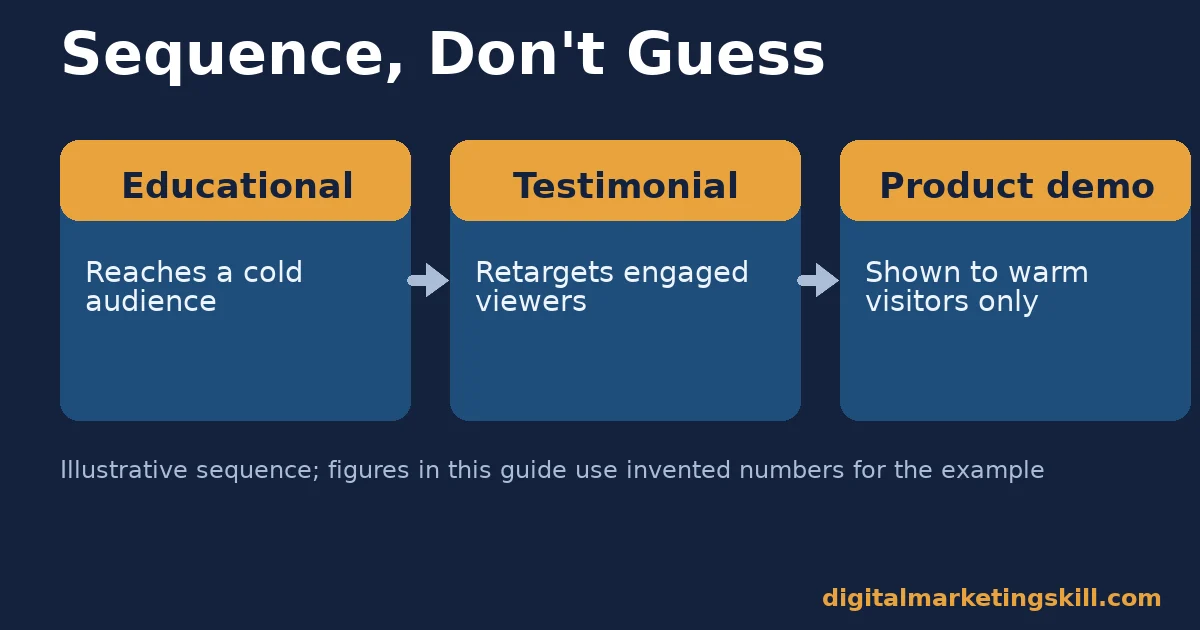
The lesson is not the specific percentages. Each video had one job. Each one reached the right audience for that job. And each one was measured against a goal that matched its stage, rather than a single blended conversion number applied to all three.
This sequence also costs less to run than it looks. The same footage from the educational video can often supply b-roll for the testimonial, and the same product shots can serve both the demo and future social clips. Sequencing is a planning decision, not a bigger production budget.
Frequently Asked Questions About Video Marketing
What is video marketing?
Video marketing is the use of video content, on purpose, to build awareness, explain a product or service, and move a viewer toward a purchase. It covers everything from short educational clips to full product demonstrations.
What are the main types of video marketing?
Four cover most business needs: educational videos, testimonial videos, product videos, and company culture videos. Each one targets a different stage of the buying journey, from a stranger’s first impression to a near-ready buyer’s last question.
How long should a marketing video be?
It depends on the funnel stage, not a fixed rule. Keep top-of-funnel video under two minutes to protect view-through rate, and let bottom-of-funnel video run as long as it takes to answer a real buyer question.
What is a good view-through rate for a marketing video?
There is no single universal benchmark, since it varies by video type, length, and platform. The more useful practice is comparing a video’s view-through rate against similar videos of the same type and length, rather than against an unrelated industry average. A short educational clip and a ten-minute product walkthrough should never be judged on the same scale.
Do I need a big budget to start video marketing?
No. An educational or testimonial video can be made with a phone camera and natural light. The budget matters less than having one clear goal and a script built around the viewer’s questions, not the product’s feature list. A product video usually benefits from steadier footage and cleaner audio, since it is closer to the purchase decision, but even that does not require a professional studio to start.
Where should I publish my marketing videos?
Wherever your target audience already watches. That is often YouTube for searchable, evergreen content, plus the social platforms your specific audience uses daily. Publishing everywhere with no plan usually performs worse than one platform done well, since a thin effort spread across five channels rarely beats a focused effort on one.
How do I measure if a marketing video is working?
Track view-through rate, click-through rate, and cost per lead, by video type rather than in aggregate. A low click-through rate on an educational video is normal; the same number on a product video usually signals a problem.
Should every business use video marketing?
Nearly every business can benefit from at least one video type, even a simple educational clip. The question is not whether to use video, but which type fits the current funnel stage the business needs to fix. Starting with the stage that is weakest right now usually earns a faster return than starting with whichever video type feels most exciting to make.
What is the biggest mistake businesses make with video marketing?
Making one video and expecting it to work for every stage of the funnel. A single video built for a cold stranger rarely also closes a warm, ready buyer. Testing that one video against both audiences usually just wastes the budget.
Can short-form video replace longer marketing videos?
Not entirely. Short-form video is strong for awareness and discovery, which fits the top of the funnel well. But a buyer close to a decision often still wants a longer, detailed product video before they commit, so the two formats usually work best together rather than as a replacement for each other.
Your Next Step
Matching video type to funnel stage will do more for a business than publishing more video with no plan. Want structured, practical training in the skills that make video marketing actually convert?
The Master Diploma in Digital & AI Marketing at Digital Marketing Skill Institute is built around four AI-powered tracks, totalling ten courses, with a Full Stack option for completing all four: AI-Powered Social Media Management and Advertising, AI-Powered Lead Generation and Email Automation, AI-Powered Google Specialist, and AI-Powered WordPress and SEO Specialist.
The program includes unlimited one-on-one coaching and mentoring, plus a U.S. Project Internship with a verified U.S. Work Reference Letter. It carries dual US and UK accreditation, recognised in more than 100 countries, and runs 100% online, so you can build these skills from anywhere in your country.
Explore the blog for more practical guides, or go straight to the application page to get started. Wherever you live, the training and mentoring are built to travel with you. Learn more at digitalmarketingskill.com, or visit digitalmarketingskill.com again once you have picked your first video type.
Every figure in this guide was checked against its original source before publication. Figures marked as illustrative are invented examples, not real results.
