
You can make money on Instagram through five real paths: brand sponsorships, affiliate commissions, a Reels bonus, your own digital product, or Instagram Shop. Most creators who make money on Instagram consistently combine two paths, not one. They also build an engaged niche audience first, before chasing any payout feature.
Key Takeaways
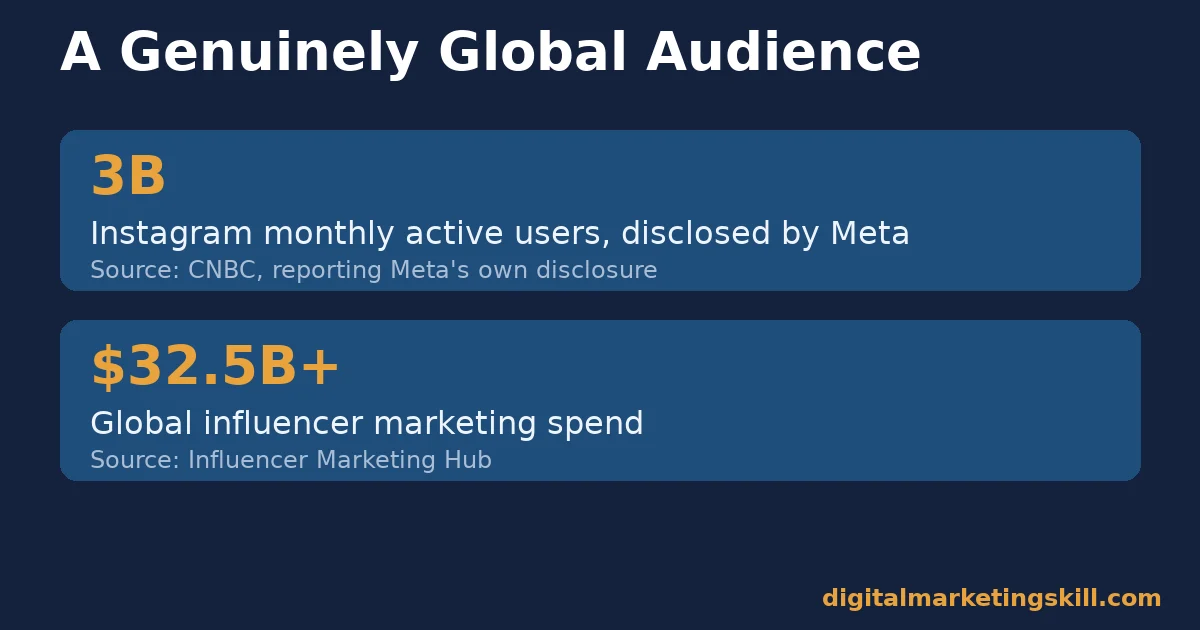
- Instagram has reached 3 billion monthly active users, a scale Meta itself disclosed, according to CNBC’s reporting of the announcement. That gives creators in any niche a genuinely global audience to build from.
- Global influencer marketing spend has passed $32.5 billion, according to Influencer Marketing Hub’s own tracking. Most of that spend goes to small, engaged creators, not only celebrities.
- Instagram’s native affiliate tagging lets a creator attach product links inside Reels. Instagram tracks and pays the commission itself, instead of routing it through a third-party link.
- Meta’s Reels bonus programs pay by views, but access stays invitation-only and limited to a few countries. It is not a reliable way to make money on Instagram from most locations.
- The US Federal Trade Commission requires a clear disclosure on every sponsored or affiliate post. That rule applies in any country, any time a creator is paid or given free product.
In this guide
- The Gap Most “Make Money On Instagram” Guides Miss
- How Creators Actually Make Money On Instagram
- Four Income Paths, Four Starting Points
- Running Each Path Without The Common Losses
- Sponsorships: Lead With A Simple Media Kit
- Affiliate Links: Lead With Disclosure, Not Just Placement
- Digital Products: Lead With One Offer, Not A Catalogue
- Instagram Shop: Lead With A Clean, Current Catalogue
- Reels Bonus Programs: Treat As A Bonus, Not A Plan
- Tools That Fit A First-Time Budget
- Avoid The Mistakes That Quietly Cap Income
- Measure The Numbers That Actually Predict Income
- The One Decision Rule That Matters Most
- What A Documented Audience-And-Content Business Looks Like
- Frequently Asked Questions About How To Make Money On Instagram
- Where To Start, Wherever You Live
The Gap Most “Make Money On Instagram” Guides Miss
Most guides to how to make money on Instagram just list every possible method: ads, affiliate links, sponsorships, products, coaching. They rarely say which method pays at a small audience size, and which only pays once you already have scale. That gap is what this guide fixes.
A few ground rules first. Platform features and payout programs change often, so treat program details as current rules, not permanent ones. Also check Instagram’s own tools before you commit real time to one method. Every figure in this guide is traced to the company or organisation that published it, with what it does and does not prove stated plainly.
How Creators Actually Make Money On Instagram
Money reaches a creator on Instagram in one of three ways. First, a brand pays directly for a sponsored post or Story. Second, a retailer pays a commission on a sale the creator’s content drove. Or, third, Instagram itself pays the creator, based on views inside one of its bonus programs.
Each path rewards a different kind of account. Sponsorships reward a defined, trusted niche audience. Affiliate commissions reward content that sits close to a buying decision. Platform bonuses reward raw view count, and Meta alone sets and changes the rules for those bonuses, so they stay the least predictable of the three.
Build The Audience Before You Pick The Method
Every path above needs one thing first: an audience that trusts the account enough to click, buy, or follow a recommendation. Because of that, a small, engaged audience in a defined niche consistently out-earns a larger, generic one. Brands and affiliate programs pay for relevance, not raw follower count.
Four Income Paths, Four Starting Points
Each path below suits a different stage of audience growth. Pick the one that matches your actual audience size, not your ambition. That single fix turns more stalled accounts profitable than any new content trick.
A brand-new account with a few hundred followers rarely lands a paid sponsorship. But it can still start to make money on Instagram through affiliate links, since those pay on the sale, not on reputation.
An account with a few thousand engaged followers in a defined niche is usually ready for its first sponsorship pitch. A larger, established account is often the only one with enough reach to make a digital product or an Instagram Shop catalogue worth the setup time.
Brand Sponsorships: Built For A Defined Niche
A sponsorship means a brand pays a creator directly to feature a product. So brands look for a clear niche, a consistent posting rhythm, and an audience that resembles their own customers. Total follower count matters far less than that match.
Affiliate Commissions: Built For Buying Intent
Affiliate income pays a commission on sales a creator’s content drives. Instagram’s own affiliate tools let a creator tag products directly inside a Reel. Then the app tracks clicks and sales and pays the creator, with no brand deal negotiated first.
A Digital Product: Built For Margin At Any Audience Size
A digital product, a template, a guide, or a short course keeps nearly all of its revenue. That is because there is no manufacturing cost, no shipping cost, and no third party taking a cut. This path pays least predictably at first, because it needs real trust already built with the audience.
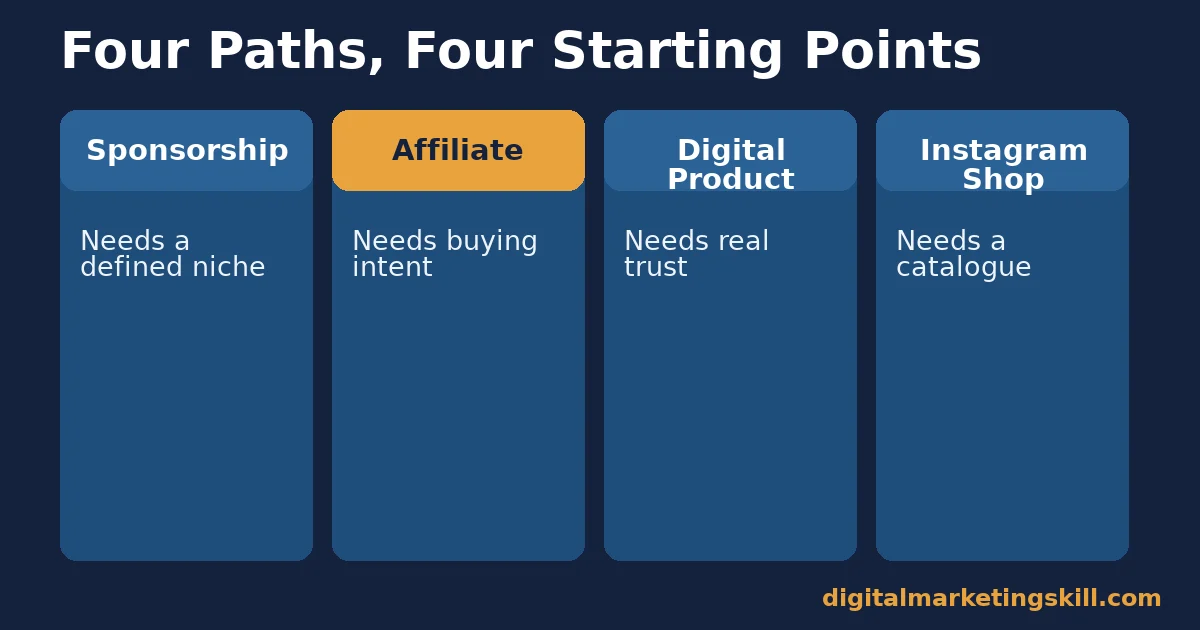
Instagram Shop: Built For Browsers Already On The App
Meta’s own Instagram Shopping documentation lets a creator tag a product catalogue directly on posts and Reels. A follower can buy without leaving the app. This path suits a creator who already sells a physical or print-on-demand product more than one relying only on affiliate income.
Running Each Path Without The Common Losses
Sponsorships: Lead With A Simple Media Kit
A media kit does not need to be elaborate. State your niche, average reach, audience location split, and one or two results from past posts, if any exist. So brands move faster on a creator who has already done this work, instead of figuring out audience fit themselves.
Affiliate Links: Lead With Disclosure, Not Just Placement
Every affiliate or sponsored post needs a clear disclosure. That rule applies in every country, any time payment or free product is involved. The FTC’s own endorsement guidance says disclosures must be clear and conspicuous, not buried in a long caption or a hashtag at the end. Skipping this costs more than a legal risk. Followers who spot an undisclosed paid post stop trusting the account.
Digital Products: Lead With One Offer, Not A Catalogue
Launch one offer first, priced clearly, before you build a second. That is because a catalogue of five low-priced products usually earns less than one well-tested offer. Audience attention and trust are the limiting resource here, not product count.
Instagram Shop: Lead With A Clean, Current Catalogue
An out-of-stock or outdated shop loses buyer trust fast, so keep the catalogue current. Tag only the products that are actually relevant to a given post, and treat the shop as a support for content, never a replacement for it.
Reels Bonus Programs: Treat As A Bonus, Not A Plan
Meta’s Reels bonus programs pay by views, but access stays invitation-only. Eligibility has also been limited to a handful of countries at different times. Building a strategy around a bonus program you cannot control is weaker than building an audience that already supports sponsorships, affiliate sales, or a product launch.
Tools That Fit A First-Time Budget
You do not need paid software to start tracking how you make money on Instagram. Instagram’s own professional account insights already show reach, engagement, and link clicks for free, which covers most of what a new creator needs. Add a paid analytics tool only once manual tracking in a spreadsheet is clearly costing you more time than it saves.
Keep one spreadsheet row per income path, not per post. Update it monthly with clicks, conversions, and payout per path. That single habit shows, at a glance, which path is actually worth more of your posting time, instead of guessing from memory.
Avoid The Mistakes That Quietly Cap Income
A few mistakes repeat across almost every account that stalls. Posting on every platform feature at once, instead of mastering one income path first, spreads effort thin without building real proof in any single area. Chasing follower count with giveaways brings in low-intent accounts that never click a link or buy a product, which then drags down the engagement rate that brands and affiliate programs actually check.
Ignoring audience location is another common one. A creator whose audience sits mostly outside the countries where a brand ships, or where an affiliate program pays, earns far less from a sponsorship than the follower count alone would suggest. Checking audience location inside Instagram’s own insights before pitching a brand avoids this mismatch entirely.
Measure The Numbers That Actually Predict Income
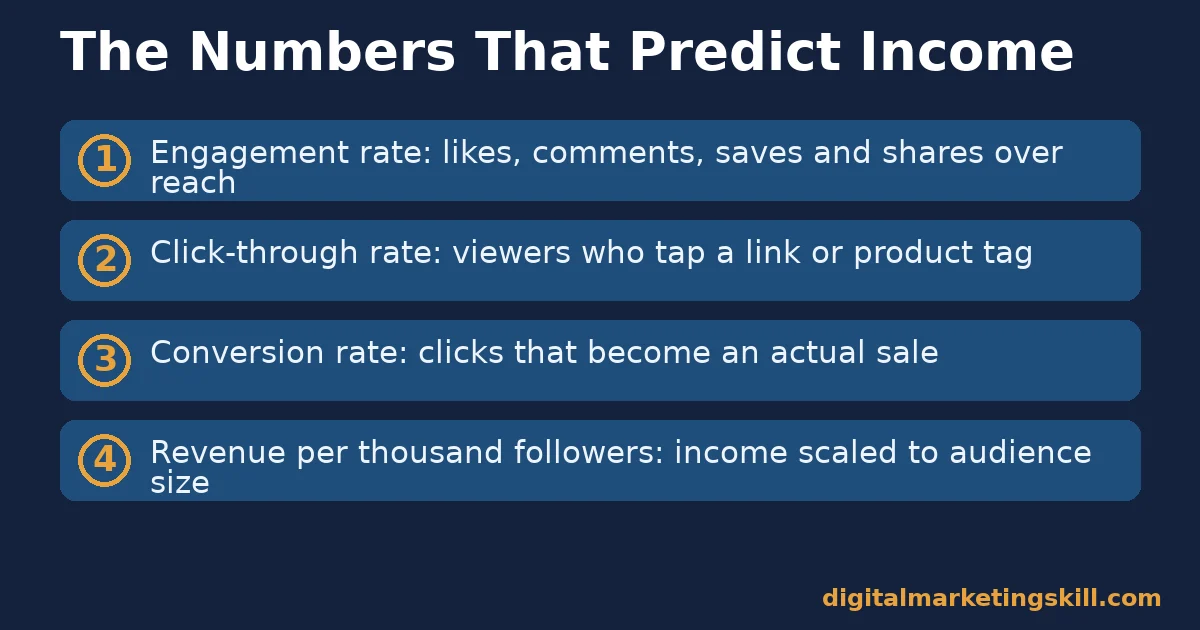
Track these four numbers together. Follower count alone predicts very little about real income from Instagram.
- Engagement rate: likes, comments, saves, and shares, divided by reach, shown as a percentage. Brands and affiliate programs lean on this far more than follower count to judge whether an audience is real.
- Click-through rate on links: the share of viewers who tap a bio link, product tag, or Story link. This number converts an audience into affiliate or product income.
- Conversion rate on an offer: the share of clicks that become a sale. A high click-through rate paired with a low conversion rate usually points to the offer or landing page, not the audience.
- Revenue per thousand followers: total monthly income, divided by followers, multiplied by one thousand. Use this to compare your own account’s earning efficiency over time, independent of audience size.
Our guide to social media marketing ROI covers how to tie a single post to a stated goal. That is the fastest way to see which of your own posts actually drive the third and fourth numbers above.
The One Decision Rule That Matters Most
Do not chase a new way to make money on Instagram until your current one converts well. Pick the single highest-intent path for your audience size. Fix its conversion rate first. Only then add a second method.
Illustrative, invented numbers: an account with 8,000 followers and a 4% engagement rate posts an affiliate link ten times in a month. Two hundred people click. Four buy. That is a 2% conversion rate on clicks, and roughly $3 in commission per buyer. Total affiliate income for the month: $12.
Before adding a second income method, that creator’s real decision is whether the 2% conversion rate can improve. In practice, that means testing the product recommended, then the caption, then the time posted. Doubling conversion doubles income with the same audience and the same posting effort.
What A Documented Audience-And-Content Business Looks Like
Buffer, the social media scheduling company, publishes its own revenue dashboard publicly. It is not a single creator account. But it is a documented, verifiable case of an audience-and-content business, built partly on social platforms including Instagram, that reached real recurring revenue over years.
Buffer’s own public dashboard reports tens of millions of dollars in annual recurring revenue, from tens of thousands of paying customers. In other words, content, trust, and a product built that number, the same three ingredients a single creator account needs, at a much smaller scale.
The limit on this case: Buffer runs a product team, a content team, and years of paid marketing behind its audience. Its relevance here is not the scale. It is the mechanism. Consistent content that earns trust, followed by one clear product offer, compounds far more reliably than chasing every new monetisation feature a platform adds.
Frequently Asked Questions About How To Make Money On Instagram
How many followers do I need to make money on Instagram?
There is no fixed minimum. Micro-creators with a few thousand highly engaged, niche-relevant followers regularly earn sponsorship and affiliate income, because brands pay for relevance and engagement rate, not raw follower count alone.
Is the Instagram Reels bonus program available everywhere?
No. Access has stayed limited to specific countries and invitation-only at different times. It should not be the main plan for a creator trying to make money on Instagram from any location.
Do I have to disclose affiliate links and sponsored posts?
Yes, in every country, any time you are paid or given free product for a post. Make the disclosure clear and visible. Do not hide it in a long caption.
What is the difference between an affiliate link and a sponsorship?
A sponsorship pays a flat or negotiated fee, regardless of sales. An affiliate link pays a commission only when a sale happens, so it rewards content that sits close to a buying decision.
Can I sell a digital product with a small audience?
Yes. A single well-tested digital product often earns more from a small, trusting audience than a large, generic one. Margin stays high, and no brand deal needs negotiating first.
How long does it take to start earning on Instagram?
This varies widely by niche, posting consistency, and starting audience size. Sponsorship and affiliate income usually follow engagement rate and trust built over months, not a fixed timeline.
What niche earns the most on Instagram?
No single niche guarantees the highest income. However, higher-intent niches, where followers actively research a purchase, such as finance tools, software, or specific hobbies, tend to convert affiliate links better than broad lifestyle content.
Do I need a business account to monetise Instagram?
Most of Instagram’s creator and shopping tools, including affiliate tagging, need a professional account. It is free to set up, and separate from a personal account.
Can I combine several income paths on the same Instagram account?
Yes, and most creators who earn consistently do exactly that. A common pattern is affiliate links for most posts, with occasional sponsorships once the niche is established, and a digital product added later once the audience has grown enough to support it.
Do brands pay more for Reels than for feed posts?
It depends on the brand and the campaign goal. Reels often reach a wider, non-follower audience, which can justify a higher rate for brand awareness. Feed posts and Stories can convert better for a brand chasing direct sales from an already-engaged audience.
Where To Start, Wherever You Live
Every income path in this guide, sponsorships, affiliate commissions, a digital product, or Instagram Shop, depends on the same underlying skill. Build an audience that trusts the account enough to act on a recommendation. Then market to that audience on purpose, instead of hoping the algorithm does it for you.
Where Digital Marketing Skill Institute Fits
That is exactly what Digital Marketing Skill Institute’s Master Diploma in Digital & AI Marketing teaches. Its AI-Powered Social Media Management and Advertising track covers building and monetising an audience on platforms like Instagram. Its AI-Powered Lead Generation and Email Automation track covers turning that audience into a list you can sell a digital product to directly, anywhere in your country.
It also includes unlimited 1-on-1 coaching and mentoring, a U.S. Project Internship with a verified U.S. Work Reference Letter, and dual US and UK accreditation recognised in more than 100 countries, delivered 100% online. See the full track breakdown on the Master Diploma program page, read outcomes on the reviews page, and browse more guides on the digital marketing blog.
When you are ready, apply here. Learn more at digitalmarketingskill.com, and start building the audience and skills that make any way to make money on Instagram worth pursuing, from digitalmarketingskill.com.
Every figure in this guide was checked against its original source before publication. Figures marked as illustrative are invented examples, not real results.
![9 Amazing Digital Marketing Skills to Make Money Online [With Proof]](https://digitalmarketingskill.com/wp-content/uploads/2019/07/9-Amazing-Digital-Marketing-Skills-to-Make-Money-Online-With-Proof-17.png)






