
The costliest online marketing mistakes come from judging every channel on the same clock. Search, paid ads, social media, email and your website each fail in a different way and pay back at a different speed. So match your patience, budget and tracking to each channel, and most of these mistakes disappear.
Key Takeaways
- Search is slow by design. Google’s own SEO Starter Guide says some changes take effect in a few hours, while others can take several months.
- Paid ads need data before you judge them. Google Ads says a bid strategy can need up to around 50 conversion events or three conversion cycles to calibrate.
- Speed is a sales lever. In a Google-commissioned study of 37 brand sites, a 0.1-second faster mobile site lifted retail conversions by 8.4%.
- Most pages never get found. Ahrefs analysed about 14 billion pages and found that 96.55% get no traffic from Google.
- Proof is the weak spot. HubSpot’s survey of more than 1,500 marketers found measuring ROI is the leading obstacle, named by 33%.
In this guide
- What Most Lists of Online Marketing Mistakes Leave Out
- Why Online Marketing Mistakes Happen: Every Channel Runs on a Different Clock
- How Online Marketing Mistakes Differ by Channel
- How to Fix Online Marketing Mistakes, Channel by Channel
- How to Measure Whether You Are Still Making Online Marketing Mistakes
- The Most Useful Rule: Set the Review Date Before You Launch
- A Real Case: A Small Ad Test Judged on Results
- Frequently Asked Questions About Online Marketing Mistakes
- Start With One Channel, Then Expand
What Most Lists of Online Marketing Mistakes Leave Out
Most articles on online marketing mistakes list the usual suspects: no strategy, no blog, no patience, too many channels. All of those are real. But a list treats every channel the same, and that is the root problem. A mistake in paid ads costs money in days, while a mistake in search costs you months.
This guide takes a different angle. It explains why each channel runs on its own clock, what goes wrong in each one, and how to fix it. It also gives you a simple review schedule, so you stop judging slow channels too early and fast channels too late.
Here are the ground rules. Timelines come from Google’s own documentation where we cite it. Where no official source exists, we say it is our rule of thumb. The survey figures are self-reported, and the site-speed study was commissioned by Google, so read each with those limits in mind. Treat every range as a snapshot, not a promise.
If you want a broader overview first, our guide to common digital marketing mistakes covers strategy-level problems. This article focuses on timing and measurement, channel by channel.
Why Online Marketing Mistakes Happen: Every Channel Runs on a Different Clock
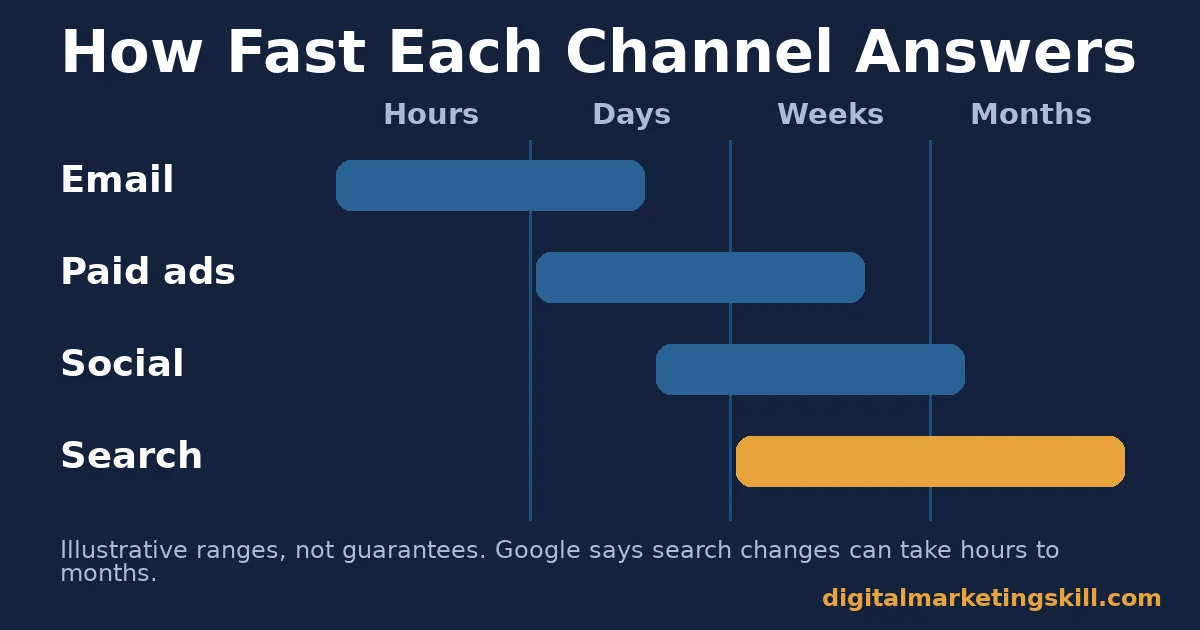
Online marketing works by feedback. You launch something, the market responds, and you adjust. The trouble is that each channel answers at a different speed. Email can show results within hours. Paid ads settle over days or weeks. Search can take months.
Most online marketing mistakes happen when you ignore that difference. You judge search after two weeks and quit. Or you let a paid campaign run for months without checking what each sale costs. In both cases, the channel was fine. The review timing was wrong.
Three Signs You Are Judging on the Wrong Clock
You can spot these online marketing mistakes before they cost much. Look for three warning signs in how your team talks about results.
- You change plans every week. Frequent switching means no channel runs long enough to show what it can do.
- Nobody knows the cost of a customer. If you cannot say what one sale costs by channel, you are judging on feelings rather than numbers.
- Every channel has the same deadline. A single monthly verdict for search, ads and email ignores how differently they respond.
If two or more of these sound familiar, start with the review rule later in this guide. It takes an hour to set up and saves months of guesswork.
The Cost of Judging Too Early or Too Late
Judging too early wastes the effort you already made. Google’s SEO Starter Guide advises waiting a few weeks before you assess whether a change helped. If you rewrite a page every few days, you never learn what worked.
Judging too late wastes money instead. A paid campaign that loses money every day does not improve because you wait. So the fix is not “be patient” or “move fast”. It is to set the right review date for each channel before you launch.
The scale of the opportunity makes this worth doing. DataReportal’s global digital overview counts about 6.12 billion internet users, around 73.8% of the world’s population. Whether your customers are local or spread across many countries, they meet you through these same channels.
How Online Marketing Mistakes Differ by Channel
Each channel has its own typical failure. The five sections below describe what each channel is built for and where people usually go wrong. Later, a matching set of sections gives the fix for each one.
Search: Built for Compounding
Search engine optimisation, or SEO, means shaping your pages so they appear when people search. Its strength is compounding: one good page can bring visitors for years. Its weakness is speed, because Google may take weeks or months to reflect a change.
The common mistake is publishing pages nobody searches for. Ahrefs looked at about 14 billion pages in its search traffic study and found 96.55% get no Google traffic. Its main reasons were no search demand, no backlinks and a mismatch with what searchers want.
Paid Ads: Built on Learning
Paid ads on search engines and social platforms buy attention straight away. Modern ad systems use automated bidding, which means software sets your bids to reach a goal such as sales. That software needs data before it works well.
Google Ads says a bid strategy can need up to around 50 conversion events or three conversion cycles to calibrate, and that changes to settings restart this learning period. So the common mistake is editing a campaign every day, which keeps it learning forever.
Tracking errors cause many online marketing mistakes in paid ads. If the platform counts page views as sales, or misses real sales, the software learns the wrong lesson. It then spends your budget chasing the wrong people, and the reports still look busy.
Social Media: Built on Consistency
Social media rewards steady, recognisable posting. Audiences follow accounts they trust to show up. As a result, one viral post rarely changes a business, while months of useful posts often do.
The common mistake is trying to be everywhere at once. A small team spread across five platforms posts rarely on each one, so none of them builds momentum. Our guide to social media marketing mistakes covers the platform-level errors in more detail.
Email: Built on Permission
Email reaches people who asked to hear from you. That permission makes it one of the fastest channels to test, because you can see opens and clicks within hours.
The common mistake is waiting too long to start a list, then sending only sales messages. People who joined for useful tips soon stop opening. So the list shrinks in value even while it grows in size.
Your Website: Built to Convert
Every channel sends people to your website, so its job is to turn visits into action. A slow or confusing page wastes every other channel’s work. Many visitors will not wait for a slow page, and they rarely come back to try again.
The common mistake is treating the website as finished once it launches. In practice, speed and clarity decide how many visitors act. Small delays add up, especially on mobile phones.
How to Fix Online Marketing Mistakes, Channel by Channel
Each fix below mirrors a channel above. Start with the channel that brings most of your customers today, because a fix there pays back fastest. For a wider plan that ties channels together, see our guide to building an online marketing strategy.
Search: Lead With Demand and Patience
Before you write, check that people search for the topic and look at what already ranks. Match that format, then make your page more useful. After publishing, wait a few weeks before you judge it, as Google suggests.
Meanwhile, earn a few links from relevant sites, and fix basic problems such as missing titles. Our list of common SEO mistakes and how to fix them is a good checklist for this step.
Paid Ads: Lead With Clean Tracking and Stable Settings
First, make sure the ad platform records the right conversion, such as a purchase or a form. If tracking is wrong, the bidding software learns the wrong lesson. Then set a budget you can hold steady until the learning period ends.
During that time, change as little as possible. Instead, write down ideas and test them one at a time once the campaign has enough data. Judge the campaign on cost per result, not on clicks.
Social Media: Lead With One or Two Platforms
Pick the one or two platforms where your customers already spend time. Post on a schedule you can keep for months, not days. Then judge each post by saves, shares and replies, because those signal real interest.
Also repurpose your best work. One strong idea can become a short video, a carousel and an email. That way, you publish more without starting from zero each time.
Email: Lead With a Welcome Sequence
Start collecting emails early, even with a simple sign-up form. Then write a short welcome sequence of three to five emails that delivers what people signed up for. Only after that should you mix in offers.
A simple three-email welcome sequence might look like this:
- Right away: deliver the guide, checklist or discount people signed up for, and say what to expect next.
- A few days later: share your most useful tip or story, with one link to read more.
- After about a week: answer the question new customers ask most, then make one clear offer.
This order builds trust before it asks for money. As a result, fewer people unsubscribe, and the offer reaches readers who already value what you send.
Judge email after one full sequence, not one send. Watch the click rate, because it shows whether people found the content useful enough to act. If you are unsure why email deserves this effort, read our guide to the benefits of email marketing.
Your Website: Lead With Speed
Speed is one of the easiest online marketing mistakes to measure and fix. In “Milliseconds Make Millions”, a study commissioned by Google and run by 55 and Deloitte, a 0.1-second improvement in mobile site speed lifted retail conversions by 8.4%. It also raised retail consumer spending by 9.2% and travel booking rates by about 10%.
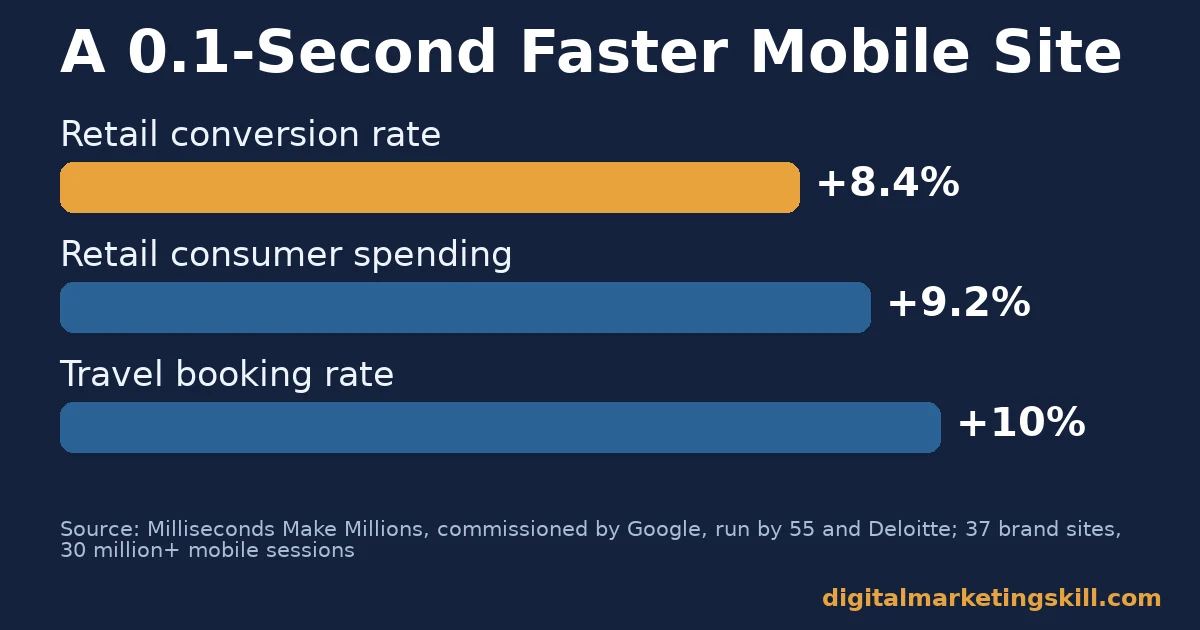
That study covered 37 European and American brand sites and more than 30 million sessions, so smaller sites may see different results. Still, the direction is clear. Compress images, remove unused plugins and test your key pages on a phone.
A Five-Minute Speed Check
- Pick your three most visited pages. These usually include your homepage and your best-selling product or service page.
- Open each one on a phone using mobile data. Count how long it takes before you can read the main content.
- Run a free speed test. Check whether Largest Contentful Paint is under 2.5 seconds.
- Fix the biggest file first. An oversized image is often the single largest delay.
Repeat the check after each change. Speed problems creep back as you add images, plugins and scripts, so a monthly check keeps this mistake from returning.
How to Measure Whether You Are Still Making Online Marketing Mistakes
You cannot fix what you do not track. Each metric below is defined in one sentence and linked to a channel. Read them next to the sales and traffic numbers you already follow.
- Conversions (all channels). A conversion is the action you want, such as a sale, sign-up or enquiry. Count it the same way in every tool, or your comparisons will mislead you.
- Cost per result (paid ads). This is ad spend divided by conversions. Compare it with what a customer is worth to you, not with other advertisers.
- Search impressions (search). Impressions count how often your pages appear in Google results. Rising impressions usually come before rising clicks.
- Saves and shares (social media). These show that people valued a post enough to keep or pass it on. They are a better guide than likes alone.
- Click rate (email). This is the share of recipients who click a link in your email. A falling click rate is an early warning that content has drifted from what subscribers want.
- Largest Contentful Paint (website). This measures how long the main content takes to appear. Google’s Core Web Vitals guidance calls 2.5 seconds or less good, measured at the 75th percentile of page loads.
Why a Simple Scorecard Beats a Complex Dashboard
Measurement itself is a common gap. HubSpot’s State of Marketing report found that measuring marketing ROI is the leading obstacle for marketers, named by 33%, while 73% say their budget faces more scrutiny than before. So a simple, consistent set of numbers is worth more than a complex dashboard nobody reads.
Keep one row per channel, with the review date, the first number and the result. Over a few months, that sheet shows which online marketing mistakes you have fixed and which keep coming back.
The Most Useful Rule: Set the Review Date Before You Launch
If you remember one decision rule from this guide, make it this one. Before you launch anything, write down when you will judge it and which number you will check first. Then do not judge it before that date.
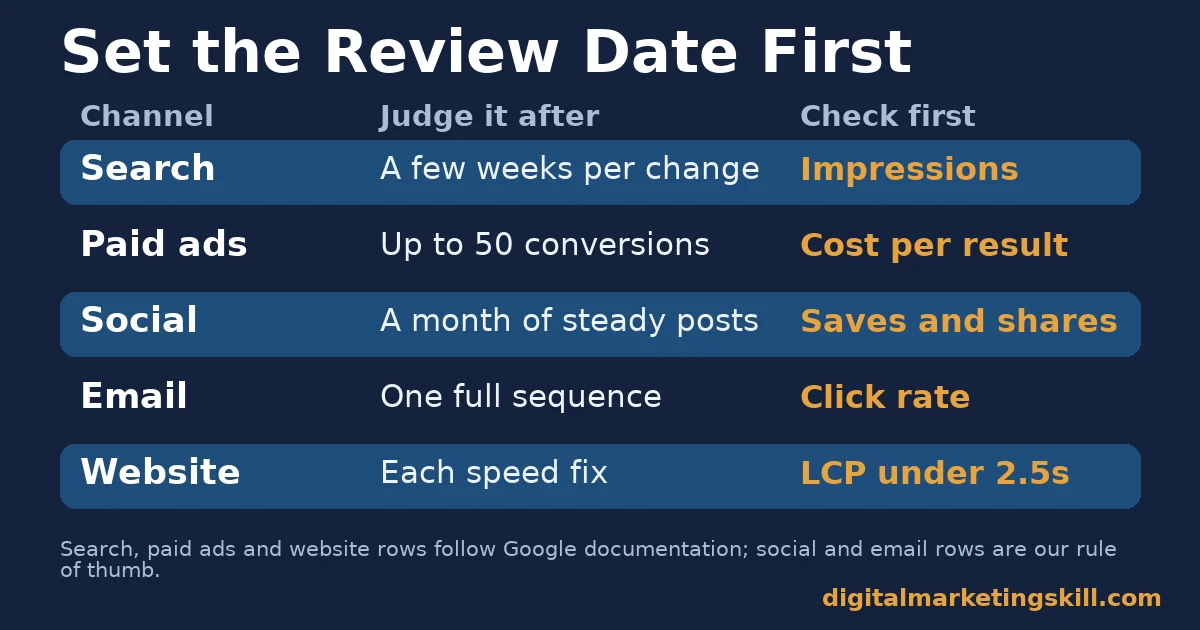
This rule prevents the two biggest online marketing mistakes at once. It stops you quitting slow channels too early, and it forces you to check fast channels on time. It also turns vague arguments about “whether marketing works” into a calendar entry and a number.
Here is an illustrative example, with invented numbers. A small bakery runs ads and rewrites its menu page in the same week. The owner decides to review the ads after 30 orders and the page after four weeks.
At the ads review, each order costs more than it earns, so the owner pauses the ads. At the page review, search impressions have doubled, so the owner keeps going. Without the plan, both would have been judged on day three.
A Real Case: A Small Ad Test Judged on Results
Ayooluwa Osemi, a Digital Marketing Skill Institute student featured on our reviews page, reports spending $14 on Facebook and Instagram ads and making $878. That is the result as the student published it. It does not show the costs of the goods sold, so it is not a profit figure.
The useful lesson is the method, not the number. A small budget, one clear offer and a result judged on money in versus money out is the opposite of the common mistake of spending first and measuring later. Results like this depend on the product, the audience and many other factors. They are not typical, and our earnings disclaimer explains why no outcome is guaranteed.
If you want to copy the method safely, keep three habits. Start with a budget you can afford to lose. Decide the result you need before you spend. And stop or change the ad once you reach your review point. Those habits avoid the most expensive online marketing mistakes, whatever your budget.
Frequently Asked Questions About Online Marketing Mistakes
What is the most common online marketing mistake?
The most common mistake is judging every channel on the same timeline. Search can take months to respond, while paid ads can lose money in days, so each needs its own review date.
How long should I wait before judging SEO?
Google’s SEO Starter Guide suggests waiting a few weeks to assess a change. New content can take longer, so track search impressions monthly rather than rankings daily.
Why do my ads perform badly in the first week?
Automated bidding needs data to learn. Google Ads says a bid strategy can need up to around 50 conversion events or three conversion cycles, and frequent edits restart that learning.
Should a small business be on every social media platform?
No. Choose one or two platforms where your customers already spend time and post consistently there. Spreading a small team across many platforms usually means weak results everywhere.
Does website speed really affect sales?
In a Google-commissioned study by 55 and Deloitte, a 0.1-second faster mobile site lifted retail conversions by 8.4%. Results vary by site, but faster pages generally lose fewer visitors.
Are online marketing mistakes different for small businesses?
The mistakes are the same, but they cost a small business more, because there is less budget to absorb them. Small teams should focus on one or two channels and review them on a fixed schedule.
How do I measure if my online marketing is working?
Pick one conversion that matters, such as a sale or enquiry, and track it in every channel. Then compare cost per result with what a customer is worth to you.
Start With One Channel, Then Expand
Online marketing mistakes are rarely about effort. They are about timing and measurement. Pick the channel that brings most of your customers, set its review date and first number today, and apply one fix from this guide. Then measure it on the date you chose, and only then move to the next channel.
If you want guided practice, Digital Marketing Skill Institute teaches these skills hands-on. The Master Diploma in Digital & AI Marketing includes nine practical courses, covering SEO, Google Ads, social media advertising, email automation and analytics. It comes with unlimited 1-on-1 coaching and mentoring and real project work inside a U.S. company. The diploma is dual US and UK accredited and recognised in more than 100 countries.
The programme is fully online, so you can study from anywhere in your country. You can find more guides on the Digital Marketing Skill Institute blog. When you are ready, apply for the Master Diploma, or start from the Digital Marketing Skill Institute homepage.
Every figure in this guide was checked against its original source before publication. Figures marked as illustrative are invented examples, not real results.
![9 Amazing Digital Marketing Skills to Make Money Online [With Proof]](https://digitalmarketingskill.com/wp-content/uploads/2019/07/9-Amazing-Digital-Marketing-Skills-to-Make-Money-Online-With-Proof-17.png)