
Starting a profitable online business takes more than a website and a product idea. Most new owners get the setup steps right. Then they skip the one question that decides everything: will this specific business actually turn a profit, and how soon? This guide covers both, with real KPIs and one decision rule you can apply before you spend a dollar.
Key Takeaways
- A profitable online business needs three things working together. It needs an offer, an acquisition channel, and a cost structure that leaves real margin. Most guides only cover the first one.
- WordPress now powers 40% of all websites, per W3Techs’ own tracking, which is why most independent online businesses still start there.
- Roughly half of new US business establishments survive five years (49.8% to 56.3%, depending on birth year), per the US Bureau of Labor Statistics’ own data.
- Service businesses earn cash fastest; product and content businesses compound slower but scale further without more of your own hours.
- Buffer’s own public metrics dashboard shows $26.80M in annual recurring revenue from 81,991 paying customers, proof that real, tracked numbers (not vanity metrics) define a profitable online business.
In this guide
- The Real Gap In Most “Start An Online Business” Guides
- How A Profitable Online Business Actually Forms
- What Actually Differs Between Business Models
- How To Start Each Model Without Wasting Months
- The Three KPIs That Actually Predict Profit
- One Decision Rule For Choosing Your Model
- A Published Case: What Open Numbers Show
- Frequently Asked Questions About Starting A Profitable Online Business
- Turning Your Idea Into A Profitable Online Business
The Real Gap In Most “Start An Online Business” Guides
Most guides give you nine steps: pick a niche, buy a domain, install WordPress, write content, build a list. These are useful steps, and most of them belong on any checklist. But none of them tell you whether your specific business idea can actually turn a profit, for your specific costs and your specific audience.
Following every step perfectly can still produce a business that loses money every single month. The steps describe how to build the machine. They say nothing about whether the machine, once built, actually makes more than it spends.
The Survival Baseline Worth Remembering
Roughly half of new US business establishments do not survive five years, per the US Bureau of Labor Statistics’ own tracking, a figure that covers every industry, not only online businesses. It is a sobering baseline worth remembering before assuming a working website equals a working business. The businesses that do survive tend to share one habit: they track real numbers early, instead of waiting until a problem is too large to fix cheaply.
A profitable online business is not the same as a working website. A website can get traffic and still lose money every month, because traffic alone pays no bills. Revenue minus real cost is the only number that matters, and most beginner guides never ask you to calculate it.
This guide is an informed framework, not a guarantee of income, and nothing here is financial or legal advice. Every figure is named to its source. None is tied to a specific year, since market conditions and platforms change. Treat every number as a reference point for your own planning, not a promise of what you personally will earn.
How A Profitable Online Business Actually Forms
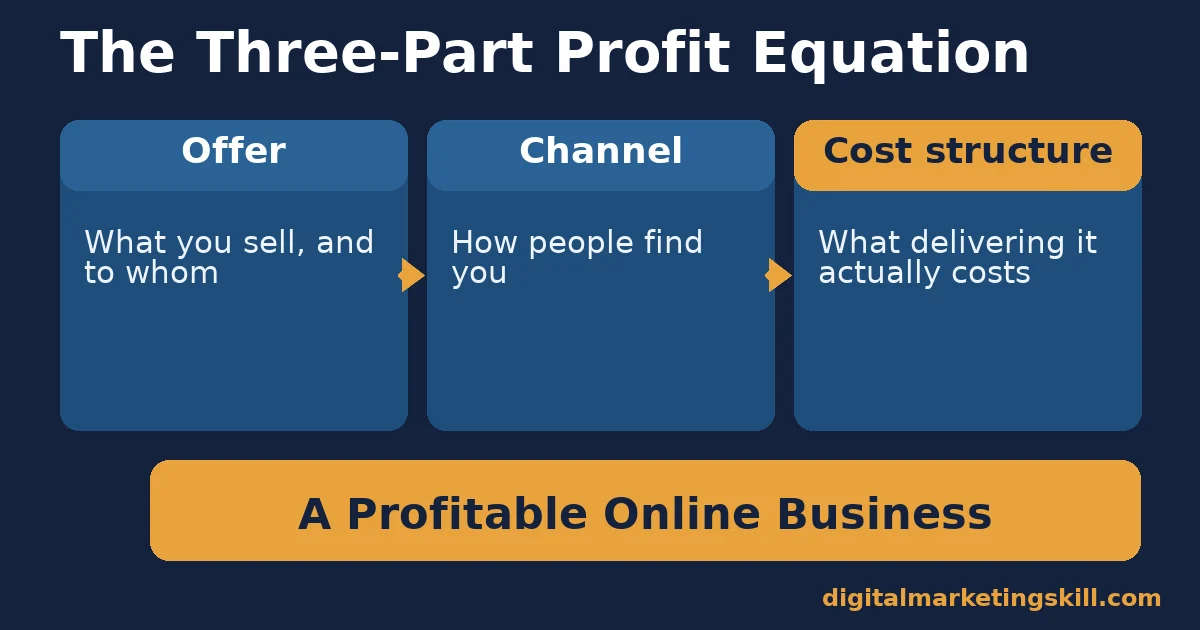
Profit comes from three decisions, not nine steps. Get any one wrong and the other two cannot save you.
The Three-Part Profit Equation
First, your offer. What you sell, and to whom, decides your ceiling. A $9 digital product and a $900 consulting package need completely different numbers of customers to reach the same revenue.
Second, your acquisition channel. How people find you decides your cost per customer. Organic search and email are nearly free once built, but slow to build. Paid ads are fast, but every customer costs real money from day one. Social media sits somewhere between the two: free to post, but increasingly reliant on paid boosts to reach a meaningful audience on most major platforms.
Third, your cost structure. Hosting, tools, payment fees and your own time all subtract from revenue before anything counts as profit. Many new owners price their offer without ever adding these up. The US Small Business Administration’s own startup cost guide splits this into two groups. One-time expenses cover things like equipment, permits and a website. Ongoing monthly expenses cover hosting, software and marketing. The guide recommends tracking both for at least a year before calling a number a true cost.
A profitable online business needs all three aligned. An excellent offer with no channel never reaches buyers. A great channel paired with thin margins just buys you a busier, poorer business, since every extra sale barely covers its own cost.
What Actually Differs Between Business Models
Two broad models sit at opposite ends of one spectrum. One pays you faster. The other pays you longer. Knowing which one fits your situation now matters more than picking the “best” one in theory.
Service Businesses: Built For Fast Cash Flow
A service business sells your time or skill directly: consulting, freelance writing, design, marketing services, coaching. You can land your first paying client before you ever touch a logo or a domain. Cash flow starts immediately, because you are the product.
The limit is obvious once you hit it. Your income is capped by your hours, unless you later hire or build packaged offers. A profitable online business built purely on services rarely scales past what one skilled person, or a small team, can personally deliver. Raising your rate helps for a while. Eventually, though, every service business runs into the same ceiling: there are only so many billable hours in a week.
Product And Content Businesses: Built For Compounding Growth
A product or content business sells something that keeps selling without more of your direct time. Think of a digital course, a physical product line, an ad-supported or affiliate-funded blog, or a small software tool. Early months are slower and often unprofitable, since you are building the asset before it earns.
The payoff is compounding. An old article can still bring in buyers years after you wrote it. A product listing keeps selling while you sleep. This is the model most “passive income” claims describe, though the real work happens entirely up front, not after launch.
Patience is the real price of entry here, not money. A profitable online business of this type often publishes dozens of pages, or dozens of products, before the first few start earning consistently. Owners who quit at month two rarely see the compounding effect that shows up closer to month eight or twelve.
Hybrid Businesses: Built To Bridge The Gap
A third option blends both. Many owners start as a freelancer or consultant. Over time, they notice the same client request coming up again and again, and package that repeated work into a course, template or tool. The service income funds the slower product build, so the owner never has to survive a fully unprofitable stretch.
The cost is focus. Running both at once, especially early, means client work constantly interrupts product-building time. A profitable online business built this way usually takes longer to reach its product phase than one built around a product from day one. It is a slower path, but a far less risky one, since income never fully stops while the product is being built.
How To Start Each Model Without Wasting Months
Choosing where to start mirrors the trade-off above. Match the model to how much runway you actually have, in time and in savings.
Service Businesses: Lead With Your First Client
Do not build a full website before you have one paying client. Reach out directly, through your existing network or a freelance platform, and deliver one project well. Use that result, and the client’s own words, as your first piece of proof.
Build the website and the domain once you have income to justify the time. A guide like how to choose the right domain name is useful once you reach that stage. Factor in payment processing fees from the start too. Stripe’s own published pricing is a useful, transparent reference point for what a typical card transaction actually costs a small online business, and it is worth checking before you set any prices.
Product And Content Businesses: Lead With One Channel
Before publishing your first page or listing, write down who the buyer is and what single problem the product solves for them. A clear answer here saves months of unfocused content later, and keeps every channel decision tied back to one buyer, not a vague general audience.
Pick exactly one acquisition channel before you build anything else: search content, a single social platform, or an email list from day one. Spreading effort across five channels at once is the most common reason these businesses stall before they earn anything.
WordPress remains a practical starting platform for this model, since it now runs 40% of all websites tracked by W3Techs, which means plugins, themes and support exist for almost any need. For the content and search side of this model, Google’s own SEO starter guide is worth reading before you publish anything. It states plainly that compelling, well-organised content matters more to ranking than any technical trick. Descriptive URLs and clear titles also help, since they let both readers and search engines understand a page faster.
The Three KPIs That Actually Predict Profit
Website traffic is the number most new owners watch. It is not the number that predicts profit. Three metrics do that job.
Three Numbers, Defined In Plain Terms
Three numbers, checked together, tell you more than any traffic report ever will.
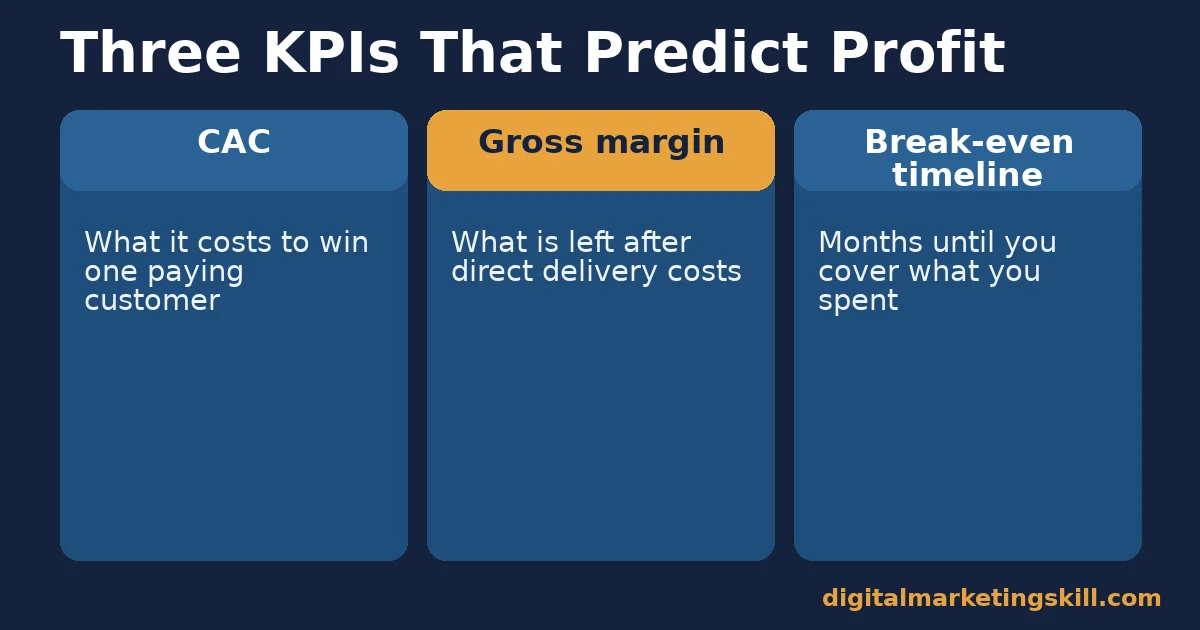
Customer acquisition cost (CAC) is what you spend, on ads, tools or your own paid time, to win one paying customer. It only means something next to what that customer is worth over the life of their relationship with your business.
Gross margin is what is left of a sale after the direct cost of delivering it: hosting, payment fees, materials, contractor time. A high-revenue business with thin margin can still lose money at scale. This is why revenue alone is such a misleading headline number to chase.
Break-even timeline is how many months of revenue it takes to cover what you spent building the business before you earned anything. A shorter timeline means less risk if the market shifts, your plans change, or a channel you relied on suddenly stops working as well as it used to.
A simple spreadsheet is enough to track all three. List monthly revenue, total spend, and new paying customers in three columns, then calculate CAC, gross margin and break-even manually each month. You do not need expensive software for this in the first year; you need consistency.
Check these three monthly, not just revenue. A profitable online business shows healthy numbers in all three, not just a rising top line. The SBA’s break-even guidance frames this well: break-even is the point where total revenue finally equals total cost, and everything earned after that point is genuine profit, not just turnover.
One Decision Rule For Choosing Your Model
Here is the rule. If you need income inside 60 days, start a service business. If you can fund three to six unprofitable months, start a product or content business instead.
Do not try to run both at full effort at once. The service work will always win your attention when a client is waiting, and the compounding asset will stay unbuilt as a result. Pick one model to lead with, even if you plan to blend them later once the first one is stable.
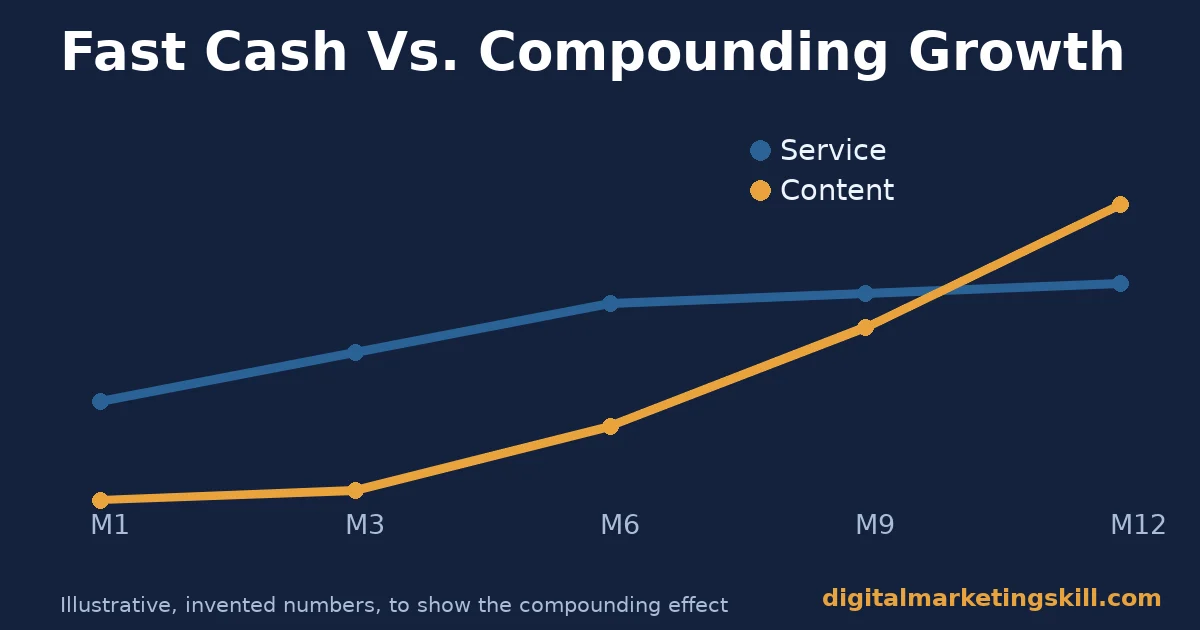
Illustrative, invented numbers, to show the trade-off. Imagine a freelance service business earning $2,000 in month one, rising slowly to $4,000 by month six, capped by available hours. Now imagine a content business earning $0 for four months. Then it earns $1,500 in month five, and $6,000 by month twelve, as search traffic compounds. The service business wins in the short term. The content business, left running, can pass it within a year and keep growing after that, without more of the owner’s hours.
A Published Case: What Open Numbers Show
Buffer, a social media scheduling tool, publishes a live public metrics dashboard rather than vague growth claims. At the time this was checked, it showed $26.80M in annual recurring revenue and 81,991 paying customers. It also reported a customer lifetime value of $408.85. All of these figures are self-reported by Buffer on its own site.
The limits matter. This is one company, in one category (subscription software), and the numbers move over time since Buffer updates the page itself. It is not a template for every profitable online business, and a SaaS subscription model earns very differently from a service business or a single product launch.
What it does show is the discipline worth copying. Track real revenue and real customer numbers, not just visits or sign-ups. Be honest with yourself about which of the three KPIs above is actually weak, instead of celebrating a traffic graph that never turns into deposits in a bank account. A smaller, newer online business can copy this habit at almost no cost: a simple spreadsheet, checked monthly, does the same job a public dashboard does for Buffer.
Frequently Asked Questions About Starting A Profitable Online Business
How much money do I need to start a profitable online business?
A service business can start with almost no cash, since you are selling your own time. Just a domain, basic hosting and a simple website are usually enough to begin. By contrast, a product or content business needs more patience than cash. The real cost there is unpaid months of building before revenue starts.
How long does it take an online business to become profitable?
A service business can turn cash-flow positive from the first paying client. By contrast, a product or content business more commonly takes several months to a year before revenue covers its own costs, which is why the decision rule above weighs your available runway so heavily.
Do I need to know how to code to start a profitable online business?
No. Platforms such as WordPress, which now runs 40% of all websites, are built for people without coding skills. Most hosting providers include a simple installer for it. Coding knowledge helps with customisation later, but it is not a starting requirement.
What is the biggest reason new online businesses fail to turn a profit?
Spreading effort across too many channels or offers at once is the most common cause. Never calculating real gross margin before pricing comes a close second. Both mean the business can have real customers and still lose money every month.
Is a content or blog-based business still a profitable online business model?
Yes, though it takes longer to pay off than most new owners expect. It compounds well once an audience and search visibility exist. Our dedicated guide covers the blog-building approach in more depth, and steady list-building pairs well with it, using the methods in our guide to starting email marketing.
Should I use paid ads or search content to find my first customers?
Paid ads bring customers fastest but stop the moment you stop paying, so they suit a service business needing income now. Search content, supported by proper keyword research such as the process in our Google Keyword Planner guide, builds slower but keeps earning long after you stop actively promoting it.
Can I run a profitable online business part-time, alongside a job?
Yes, and many owners start exactly this way. A service business is harder to run part-time, since clients expect fast replies during business hours. A product or content business fits part-time schedules better. The work, writing, building or recording, can happen in evenings or weekends without a client waiting on you.
What counts as a realistic profit margin for a new online business?
This varies widely by model. Service businesses with low overhead can often keep 50% to 80% of revenue as profit, since the main cost is the owner’s own time. Product and content businesses carry more fixed cost, such as tools, hosting and sometimes inventory. A realistic early target for those is closer to 20% to 40%, rising as the audience and systems mature.
Do I need a registered company to start a profitable online business?
Not always, and requirements vary by country, so check your own local rules before assuming either way. Many owners start as a sole proprietor or freelancer with no formal registration. Registering a company tends to make sense once revenue and risk both grow enough to justify the extra paperwork and the legal protection it brings.
Turning Your Idea Into A Profitable Online Business
Building a profitable online business is a matching problem, not a checklist. Match a service model to a short runway and an urgent need for income. Match a product or content model to a longer runway and a willingness to build before you earn. Then track customer acquisition cost, gross margin and break-even timeline every month, not just traffic.
Keep Building The Skills Behind A Profitable Online Business
If you want a structured, guided way to build these skills instead of piecing them together from guides, the Digital Marketing Skill Institute offers one. Its Master Diploma in Digital & AI Marketing covers ten practical courses, from AI-powered lead generation and SEO to AI-powered social media advertising. Each course maps directly onto one of the three decisions covered above: finding an offer that sells, choosing and running an acquisition channel, and tracking the numbers that actually define a profitable online business. The program includes unlimited 1-on-1 coaching and mentoring, plus a real U.S. project internship from day one.
The program is dual accredited in the US and UK, recognised in more than 100 countries, and runs 100% online, so you can build a profitable online business from anywhere in your country. Apply to the Master Diploma program, read more on the Master Diploma page, browse more guides on the blog, or see what graduates say on the reviews page. Wherever you live, Digital Marketing Skill Institute teaches these skills 100% online. Learn more at digitalmarketingskill.com.
Every figure in this guide was checked against its original source before publication. Figures marked as illustrative are invented examples, not real results.
![9 Amazing Digital Marketing Skills to Make Money Online [With Proof]](https://digitalmarketingskill.com/wp-content/uploads/2019/07/9-Amazing-Digital-Marketing-Skills-to-Make-Money-Online-With-Proof-17.png)






