
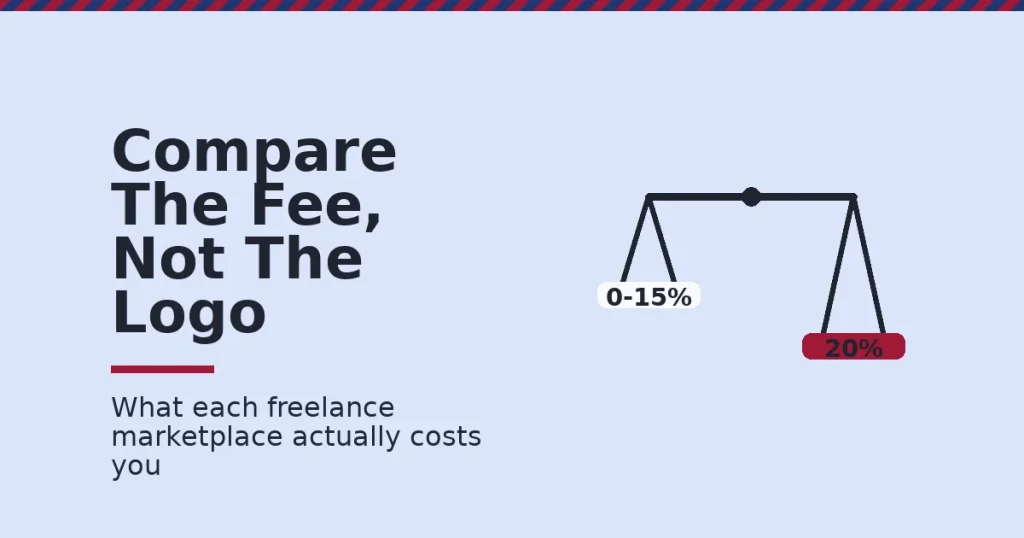
Freelance marketplaces are online platforms that connect freelancers with paying clients. They differ far more than most lists admit. The fee each one takes, and how it vets who gets listed, changes your real take-home pay more than the platform’s size does. Pick the wrong type and you lose income to fees, or to months spent unseen.
Key Takeaways
- Open bidding marketplaces let anyone apply, but reward volume pitching over a polished profile.
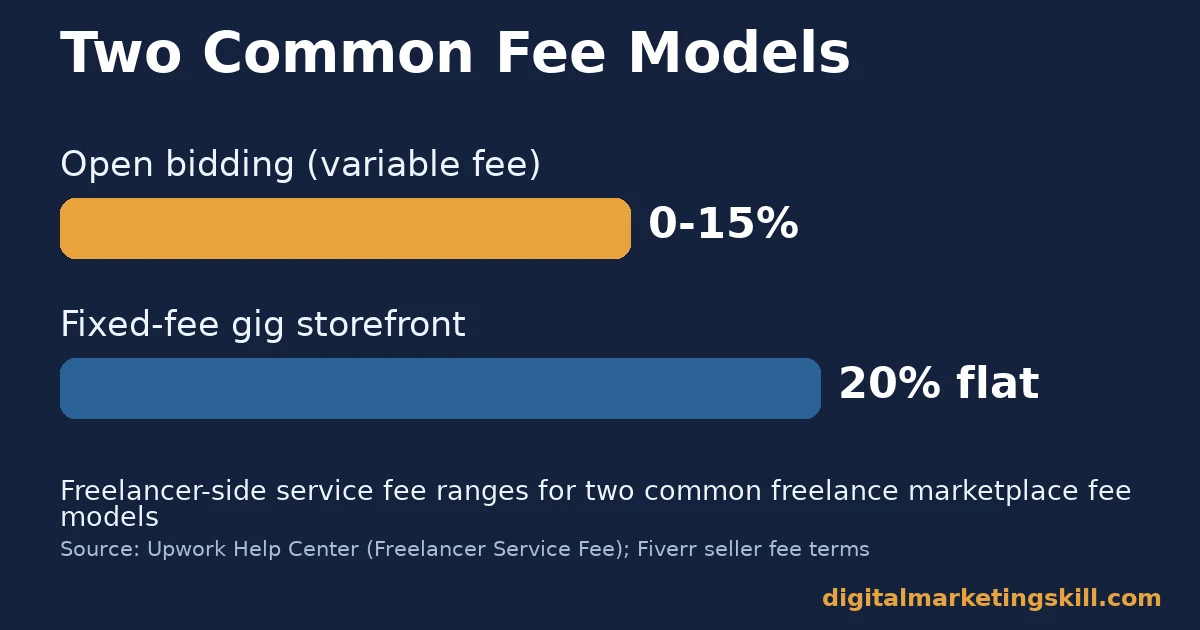
- Upwork now charges a variable freelancer service fee of 0% to 15% per contract, replacing its older flat 10% rate.
- Fiverr charges a flat 20% seller fee on every order, with no tiers and no loyalty discount.
- Toptal accepts fewer than 3% of applicants after a five-step screening process, trading open access for pre-vetted clients.
- Worldwide, freelancers charge an average of $21 an hour across a survey of more than 7,000 freelancers in over 150 countries.
In this guide
- The Real Gap In Most Freelance Marketplace Lists
- How Freelance Marketplaces Actually Make Money
- What Differs By Marketplace Type
- How To Actually Start On Each Marketplace Type
- Common Mistakes Across Freelance Marketplaces
- How To Measure Which Marketplace Is Actually Working
- The One Decision Rule For Freelance Marketplaces
- A Real Case, With Its Limits
- Frequently Asked Questions About Freelance Marketplaces
- Your Next Step With Freelance Marketplaces
The Real Gap In Most Freelance Marketplace Lists
Most “best freelance marketplaces” lists are just logos and star ratings. They rarely explain what each platform actually costs you in fees. They rarely explain how hard it is to get noticed on each one, either.
This guide ranks freelance marketplaces by their business model, not their popularity. A platform with the most freelancers is not automatically the one that pays you the most for your specific skill. Figures below are a snapshot from named sources, not a permanent ranking, since fee structures change over time.
A second reason generic lists fail is that they treat every marketplace as interchangeable. A bidding platform, a fixed-price storefront, and a vetted expert network ask for completely different things from you. Comparing them on star rating alone hides that difference, and leaves you guessing which one is worth the time it takes to build a working profile.
How Freelance Marketplaces Actually Make Money
Every freelance marketplace earns money the same basic way. It takes a cut of what a client pays a freelancer. The cut, and what you get for it, is where the models split apart.
Open marketplaces take a smaller or variable cut, but leave the work of finding clients mostly to you. Vetted marketplaces take a similar or smaller cut but screen out most applicants before you ever see a client. Fixed-fee gig marketplaces trade a flat, often higher fee for a simpler, storefront-style listing.
A Short, Worked Fee Example
Illustrative, invented numbers make the fee gap concrete. A freelancer bills a client $1,000 for a project. On a flat 20% fee, the platform keeps $200, leaving $800. On a variable fee closer to 10% for an established client relationship, the platform keeps $100, leaving $900.
That $100 difference on one project is easy to dismiss. Across fifty similar projects a year, it adds up to $5,000, which is the kind of gap a fee-blind comparison of freelance marketplaces never surfaces. Run this same calculation with your own typical project value before picking a platform, rather than trusting a general fee percentage in isolation.
Why The Fee Structure Matters More Than The Name
A platform that takes 20% flat costs you the same on a $50 gig as on a $5,000 contract. A variable-fee platform can cost far less on a large, long-term client relationship. Match the fee model to the size of work you actually do.
Do this math before you commit real time to a platform. Multiply your target hourly rate by the platform’s fee percentage, then compare what is left across two or three platforms for the same project size.
This also explains why a marketplace with a higher advertised fee can still be the better choice. A vetted marketplace that charges more per project but delivers far fewer unpaid hours spent pitching often beats a cheaper, open marketplace on effective hourly pay.
What Differs By Marketplace Type
Four marketplace types cover most freelance work. Each trades access against vetting and fee structure differently.
Open Bidding Marketplaces: Built For Volume And Access
Open marketplaces like Upwork let any freelancer create a profile and bid on posted jobs. Upwork now charges a variable freelancer service fee of 0% to 15% per contract. The rate is set when you submit a proposal, and it replaces Upwork’s older flat 10% rate.
Access is easy, but visibility is not. Hundreds of freelancers can bid on the same job. A strong proposal and portfolio matter more here than almost anywhere else, because that volume of competition rewards whoever stands out fastest. Expect your early proposals to go unanswered more often than not; that is normal, not a sign the platform does not work for you.
Fixed-Fee Gig Marketplaces: Built For Packaged Services
Platforms like Fiverr work as a storefront. You list fixed-price packages and clients buy directly. Fiverr charges a flat 20% seller fee on every order, with no tiers and no loyalty discount at any seller level.
This model suits clearly defined, repeatable services, such as a logo design package or a short video edit. It suits open-ended consulting far less well, since every scope change needs a new listing. A seller who keeps the scope tight avoids most of that friction.
Vetted Marketplaces: Built For Pre-Screened, Premium Clients
Selective networks like Toptal accept fewer than 3% of applicants after a five-step screening process covering language, skill review, and test projects. In exchange, clients on the platform are pre-qualified and used to paying premium rates.
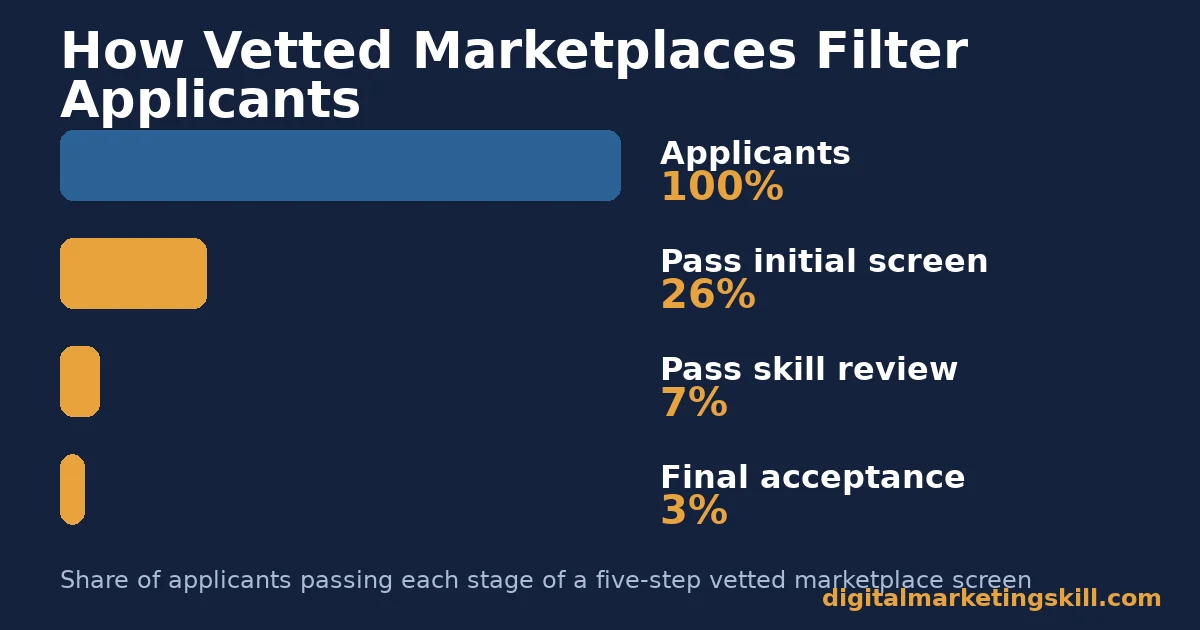
The trade-off is access, not fees. Getting in is the hard part. Once you are in, you compete with far fewer freelancers for each job.
Specialist rates here often run well above the US median wage for web and digital interface designers, which the Bureau of Labor Statistics puts at roughly $50 an hour. That gap is the whole reason the harder application is usually worth it.
Niche Marketplaces: Built For Specialist Skills
Niche marketplaces focus on one skill category: writing, voice-over, bookkeeping, or a specific programming language. They attract clients already searching for that exact skill, rather than browsing a general category.
These platforms tend to have smaller client pools than Upwork or Fiverr. They also carry far less competition per job, because a general marketplace buries a specialist under hundreds of generalist profiles.
A niche marketplace rarely shows up at the top of a generic search for “best freelance sites.” Finding one usually takes a direct search for your specific skill plus the word “marketplace” or “platform.” A quick scan of forums or communities for your specialty often surfaces the same one or two names repeatedly, which is a reasonable signal of where real work actually flows.
How To Actually Start On Each Marketplace Type
Picking the type is step one. Here is the practical starting move for each, in the same order as above.
Open Bidding: Lead With A Narrow, Specific Profile
Write your profile around one specific skill, not five general ones. A narrow profile wins more bids than a broad one, because clients searching an open marketplace are usually looking for a specific solution, not a generalist. If you are completely new to this, start with the basics in freelancing for beginners before building out a profile.
Price your first handful of bids slightly below the going rate to win your first reviews. Raise your rate once you have five or more completed jobs with strong feedback attached to your profile.
Fixed-Fee Gig: Lead With One Tightly Scoped Package
Define exactly what is and is not included in your first package, down to the number of revisions. A gig with a vague scope invites scope creep that a flat fee does not cover. List a clear price for anything beyond the base package, so extra work becomes an upsell instead of free labor.
Vetted Marketplace: Lead With Your Strongest Work Sample
Apply with your single best piece of work, not your most recent one. Screening reviewers see hundreds of applications, so the sample needs to stand out in the first few seconds of review. A dedicated marketing portfolio built before you apply makes this far easier than scrambling to assemble one afterward.
Expect the process to take real preparation time, often several weeks from first application to acceptance. Treat a rejection as information about which part of the screening needs more work, not as a final verdict on your skill.
Niche Marketplace: Lead With Proof Inside That Specialty
Before you apply, make sure your portfolio speaks the specialty’s own language: industry terms, tools, or formats specific to that niche. A generalist portfolio undersells you on a specialist platform. Writers specifically can look at how one freelance writer built a paid career inside one niche rather than spreading across many.
Search for the smaller, specialist communities where people in that niche already gather, not just the big general marketplaces. A niche marketplace is often mentioned there before it shows up in a general search.
Common Mistakes Across Freelance Marketplaces
These four mistakes cost freelancers real income on every marketplace type above.
- Joining five platforms before mastering one. Spreading your limited time across too many freelance marketplaces means no single profile builds enough reviews to rank well anywhere.
- Pricing the same on every platform. A rate that makes sense on a vetted network often prices you out of an open bidding marketplace, and the reverse undervalues you on a vetted one.
- Ignoring the fee when quoting a client. Quoting a rate without accounting for the platform’s cut means you quietly work for less than you intended.
- Treating every client message the same way. A quick, specific reply to a new lead on any freelance marketplace outperforms a slower, generic one almost every time.
- Abandoning a profile after a slow first month. Most freelance marketplaces reward accounts with consistent activity over time; a profile left idle for weeks loses momentum it then has to rebuild from scratch.
None of these mistakes are fatal on their own, but they compound. A freelancer who fixes even two of the four usually sees a noticeable change in results within a few months.
How To Measure Which Marketplace Is Actually Working
Track these numbers across every marketplace you use, not just the one that feels busiest.
- Effective take-home rate: your invoiced amount minus the platform’s fee, divided by hours worked. This is the number that actually determines which marketplace pays best.
- Proposals per hire: how many bids or applications it takes to land one job on that platform. A rising number signals saturation or a weak profile.
- Repeat client rate: the share of clients who hire you again on the same platform. This is usually the fastest route to reducing how much time you spend bidding.
- Time to first reply: how long it takes a posted proposal to get a response. A platform where replies take weeks is quietly wasting your pipeline.
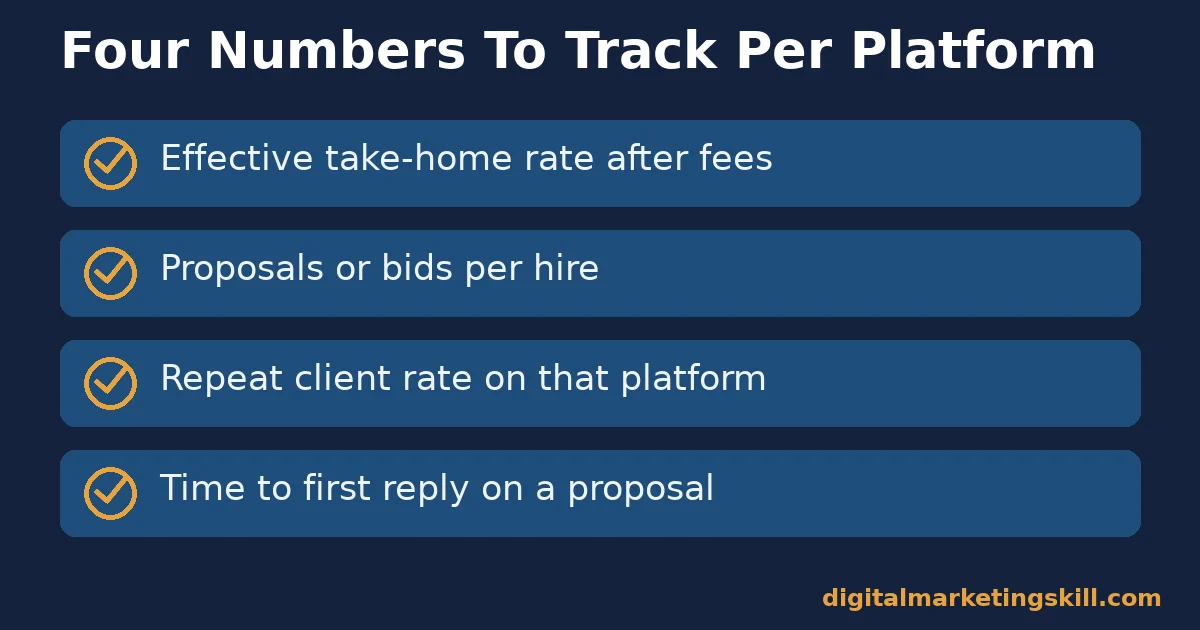
Review these numbers every few months per platform, not just once. A marketplace that paid well last year can quietly saturate as more freelancers join it.
Write the four numbers down somewhere you will actually revisit, even a simple spreadsheet. Comparing them side by side across platforms is the only reliable way to see which marketplace is quietly costing you time rather than earning it. A platform that looks busy but shows a falling effective take-home rate is worth leaving, even if it was your first and most familiar one.
The One Decision Rule For Freelance Marketplaces
If you have no portfolio or client history yet, start on an open bidding marketplace to build proof fast. Once you have five or more strong results, apply to a vetted marketplace for better rates per hour. Add a niche marketplace alongside either, if one exists for your specific skill.
Do this in order, not all at once. Spreading thin across three new platforms in the same month usually means none of them get the attention needed to actually work.
Illustrative, invented numbers: a freelance writer earning $15 an hour on an open marketplace builds a portfolio of twelve solid client projects over six months. They then apply to a vetted network and get accepted. Their rate moves to $45 an hour with the same skill level, because the vetted network’s clients already expect to pay more for pre-screened talent.
Notice what changed and what did not. The writer’s skill was the same on both platforms. What changed was the proof behind it, and the kind of client willing to pay for that proof without negotiating it down. The twelve months spent building that proof were not wasted time; they were the real cost of the jump to a higher-paying marketplace type.
A Real Case, With Its Limits
Among students who have shared results on the Digital Marketing Skill Institute’s reviews page, Olajire Jacob described charging an average of $500 to set up email marketing automation flows for clients in the US, UK, and Canada, scaling that service to $5,000 a month working with clients found partly through freelance platforms and partly through referrals.
This is one individual’s self-reported, published result, not a guaranteed outcome. It blends platform work with direct referrals rather than one marketplace alone. See the Institute’s earnings disclaimer for the full context before treating any one result as typical.
The pattern still holds a useful lesson. Marketplace work rarely stays the only source of income for long; it tends to become the proof that makes direct, referred clients possible later. Treat your first marketplace projects as the evidence you will eventually use to win work outside any single platform.
Frequently Asked Questions About Freelance Marketplaces
Which freelance marketplace has the lowest fees?
It depends on the size of your average project. Upwork’s variable 0% to 15% fee can beat Fiverr’s flat 20% on larger contracts, but a small, one-off gig may cost about the same on either, once you account for time spent on each platform’s application process.
Run the actual math for your typical project size rather than trusting a general ranking. The “cheapest” marketplace on paper is not always the one that leaves you with the most money at the end of a project.
What is the biggest mistake freelancers make choosing a marketplace?
Judging a marketplace by total freelancer count instead of by the fee and vetting model. A platform with millions of freelancers can still be a poor fit if its fee structure does not match how you price your work. The number of other freelancers on a platform says little about whether it fits your specific skill and rate.
Do I need to join multiple freelance marketplaces at once?
Not at the start. Build proof on one platform first, then expand once you have a repeatable process for winning work there; the same approaches that win clients off-platform also strengthen your profile on a second one. Spreading across four platforms with no results on any of them usually performs worse than focusing on one.
Are vetted freelance marketplaces worth the harder application?
Usually yes, once you have enough portfolio proof to pass screening. The trade-off is time spent applying against a meaningfully higher rate once accepted, so it tends to pay off for freelancers who already have real client results to show. Applying too early, before that proof exists, usually just wastes the application attempt.
Can beginners use niche freelance marketplaces?
Yes, if the beginner has real skill in that niche, even without broad freelance experience. A beginner with strong, specific proof in one niche often does better there than on a crowded general marketplace. The absence of a long freelance history matters less on a niche platform than the quality of the one or two samples you can show.
How do freelance marketplaces handle payment protection?
Most major marketplaces hold client funds before work begins and release them on approval or after a dispute process. The specific protections vary by platform, so always confirm a given platform’s current payment terms before relying on them for a large project.
Keep in mind that marketplace income is still usually taxable; in the United States, for example, self-employment tax applies once net self-employment earnings reach $400. Keep a simple record of every payment as it arrives, regardless of which marketplace it came through.
Is it realistic to replace a full-time income through freelance marketplaces?
Yes, but rarely quickly. It typically takes months of consistent delivery and reviews before a marketplace income reaches a full-time level. The timeline depends heavily on the skill, the marketplace type, and the hours available each week, so treat any claim of a fast, guaranteed timeline with suspicion.
Your Next Step With Freelance Marketplaces
Picking the right freelance marketplace type is only half the equation. The skill behind your profile is what actually wins the work, keeps clients coming back, and eventually lets you raise your rate past what any single platform would offer on its own.
The Master Diploma in Digital & AI Marketing at Digital Marketing Skill Institute is built around four AI-powered tracks, including AI-Powered Lead Generation and Email Automation and AI-Powered Google Specialist, across ten total courses, with a Full Stack option if you want all four.
Every track includes unlimited one-on-one coaching and mentoring, plus a U.S. Project Internship that leaves you with a verified U.S. work reference letter, not just a certificate.
The program carries dual US and UK accreditation, and is recognised in more than 100 countries. It runs 100% online, so you can build a marketable skill wherever you live, anywhere in your country. See student reviews on the Institute’s homepage, or apply to start, from Digital Marketing Skill Institute.
Every figure in this guide was checked against its original source before publication. Figures marked as illustrative are invented examples, not real results.
![9 Amazing Digital Marketing Skills to Make Money Online [With Proof]](https://digitalmarketingskill.com/wp-content/uploads/2019/07/9-Amazing-Digital-Marketing-Skills-to-Make-Money-Online-With-Proof-17.png)






