

There are six real types of marketing: digital, content, email, traditional, affiliate and inbound. None of them works alone. Each does a different job in the same system, moving a stranger from awareness to trust to a sale. This guide shows which job each one actually does.
Key Takeaways
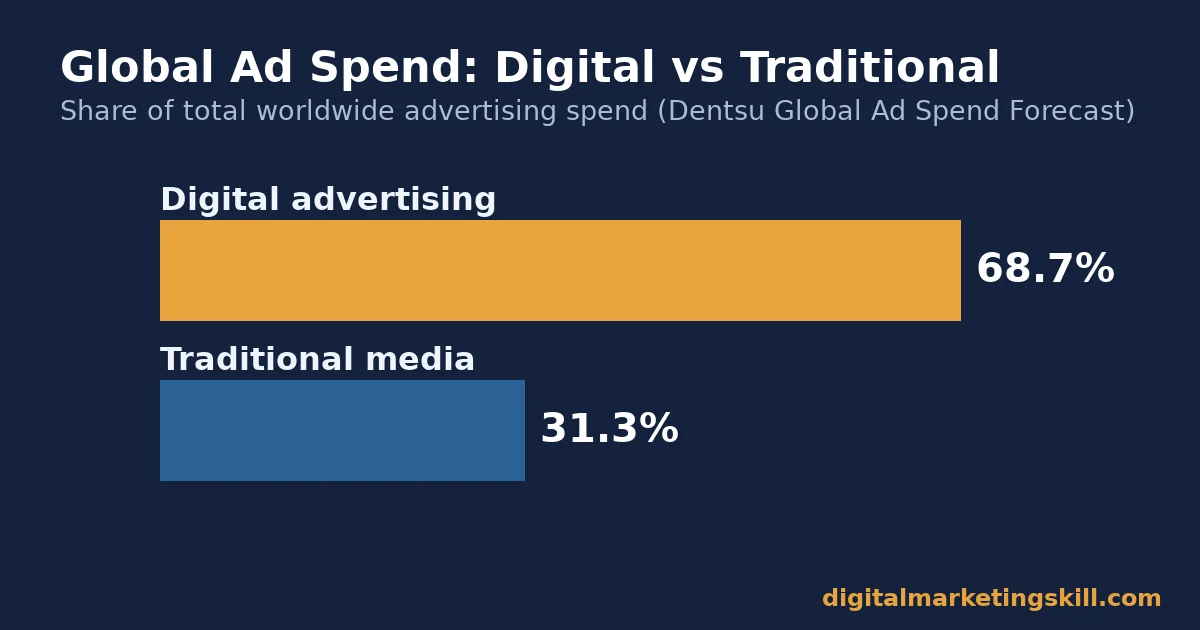
- Digital already dominates ad spend. Dentsu’s Global Ad Spend Forecast puts digital advertising at 68.7% of total global ad spend, against 31.3% for traditional media.
- Print is shrinking while out-of-home grows. The same Dentsu forecast found print spend falling 3.0%, while out-of-home advertising grows 4.1%.
- A documented content strategy pays off, but rarely feels perfect. In Content Marketing Institute’s B2B research, only 29% of marketers with a documented content strategy call it extremely or very effective. 58% call it only moderately effective.
- Email still returns the most per dollar, with a wide range. Litmus surveyed close to 500 marketing professionals. 35% report $10 to $36 back per $1 spent on email, and 30% report $36 to $50.
- Affiliate marketing is now a multi-billion-dollar channel. Forrester’s affiliate marketing forecast projects worldwide affiliate spend reaching $19.4 billion, up from $17.1 billion the year before. Other research firms estimate the total market higher, depending on what they count.
In this guide
- What Most “Types of Marketing” Lists Get Wrong
- How These Types of Marketing Actually Work Together
- The Three Groups Behind the Six Types of Marketing
- How to Lead With Each Group
- How to Measure What’s Actually Working
- The One Rule: Sequence by Trust Level, Not by Budget
- A Real Case: What Ad Spend Data Shows About the Shift to Digital
- Frequently Asked Questions About Types of Marketing
- Build the Skills Behind Every Type of Marketing on This List
What Most “Types of Marketing” Lists Get Wrong
Most lists of marketing types just define each one and move on. Digital marketing is this. Content marketing is that. The list ends there. It never answers the question that actually matters: which type should you use, and in what order.
This guide groups the six real types into three working categories. Each group is based on what it is actually built to do. It also gives you one rule for sequencing them. That way you are not running all six types of marketing at once with no plan, and no way to tell which one is actually earning its budget.
A few ground rules. Spend and ROI figures below come from named research firms and surveys, not a universal truth. Treat each one as a snapshot from its own sample. The affiliate industry size estimates vary widely by methodology, so compare the trend, not the exact dollar figure. No type of marketing guarantees a result on its own.
How These Types of Marketing Actually Work Together
Every type of marketing does one of three jobs. It reaches people who do not know you. It builds trust with people who are considering you. Or it converts people who already trust you into buyers. Confusing these jobs is the most common strategy mistake.
A business that only reaches people, through ads or broadcast, converts poorly even with a huge budget, if it has nothing to build trust. A business that only builds trust, through content, but never reaches anyone, builds a great asset nobody sees. The six types below map onto these three jobs in pairs.
Think of a local bakery as a simple, illustrative example. An ad or a flyer reaches people who have never heard of it. A review, a well-photographed menu, or a few helpful posts about ingredients build trust once someone is considering it.
A loyalty email or a well-timed discount converts a considering customer into a paying one. The same three jobs apply at any size, from a single shop to a national brand, even though the specific types of marketing used to do each job will differ.
The Four P’s Still Explain What You’re Marketing
Before picking a type, know what you are actually marketing. The marketing mix names four elements. Product is what you sell. Price is what it costs. Place is where people can get it. Promotion is how people learn about it. The six types of marketing below are all different ways of handling promotion. They assume product, price and place are already set.
The Three Groups Behind the Six Types of Marketing
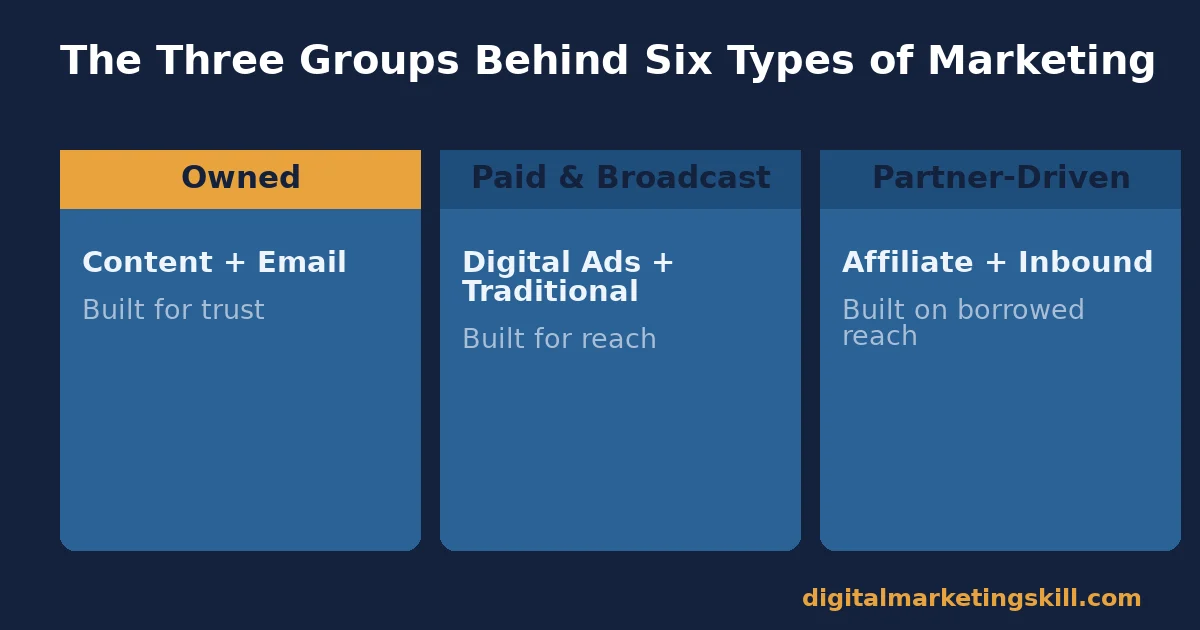
Group these six types by the job they do, not by their name. Each group below pairs a reach-focused job with its trust-focused or conversion-focused partner. Thinking in groups, rather than six separate line items, also makes budget conversations simpler. You are deciding how much to invest in each job, not debating six channels one at a time.
Owned Content Channels: Built for Trust Before the Sale
Content marketing and email marketing are owned channels. You control the platform, the message, and when it goes out. You are not renting attention from someone else’s ad auction or algorithm.
Content marketing uses blog posts, videos and guides to answer a prospect’s questions before they are ready to buy. It rarely drives a direct sale by itself. Email marketing then nurtures that same prospect over time, in a channel you own outright. That ownership is part of why Litmus found such strong returns per dollar spent: no platform is taking a cut of your reach.
The two types reinforce each other in practice. Content gives you something worth emailing about, and email gives your content a second, third and fourth chance to be seen, long after a social post has scrolled out of view. A business with neither struggles to build the kind of recurring, low-cost reach that owned channels are built for.
Paid and Broadcast Channels: Built for Reach at a Cost
Digital advertising and traditional marketing both buy reach instead of earning it. Digital marketing covers search ads, social ads and programmatic display, all trackable down to the click. Traditional marketing covers TV, radio, print and billboards, reaching an audience you cannot click-track the same way.
Dentsu’s forecast shows why digital increasingly wins this comparison. 68.7% of global ad spend now goes to digital, against 31.3% for traditional. Traditional still works for broad local awareness, but digital’s measurability is why budgets keep shifting its way.
Partner-Driven Channels: Built on Someone Else’s Audience or Intent
Affiliate marketing and inbound marketing both rely on something outside your own channels. That might be another person’s existing audience, or a stranger’s own search intent, rather than an audience you built or bought yourself.
Affiliate marketing pays a commission to other websites, creators or publishers who send you a customer. Inbound marketing attracts people who are already searching for an answer, through content, SEO and social. It does not interrupt people who were not looking for you.
Both types trade a share of control for a lower upfront cost. An affiliate partner already has the audience you would otherwise have to build from nothing. A searcher already has the intent you would otherwise have to create through an ad. The cost shows up later, as a commission paid per sale or as the time it takes content to rank well enough to attract that search traffic.
That trade-off is part of why these two types of marketing suit a lean, early-stage budget so well. Neither requires buying reach upfront, which matters most for a business that cannot yet afford a large paid campaign.
How to Lead With Each Group
Each group needs a different starting move. These three sections mirror the three groups above.
Owned Channels: Lead With One Useful Piece of Content
Start with one genuinely useful piece of content aimed at your actual customer’s real question, not a generic “ultimate guide.” Use it to earn an email address, then build the email relationship from there. A single strong piece beats ten thin ones for earning that first address.
Judge email by what people do, not whether they open it. Litmus’s own research shows a wide range of returns across companies. Track your own click and conversion numbers against your own past campaigns, not a single industry average.
Paid and Broadcast: Lead With the Channel You Can Measure
Start with digital advertising if you are new to paid reach. You can measure exactly what a dollar returned, and adjust within days. Add traditional media later, once you understand your own numbers well enough to judge whether a less measurable channel is worth the cost.
If you do use traditional channels, pick ones whose decline or growth you have actually checked. Print is shrinking industry-wide, while out-of-home is growing. The same traditional budget performs very differently depending on which traditional channel it funds.
Partner-Driven: Lead With Disclosure and a Narrow Search Intent
For affiliate marketing, disclose every paid or affiliate relationship clearly in the content itself, not buried in a footer. The FTC requires this disclosure in every post that promotes a product through an affiliate link, regardless of how small the audience is.
For inbound marketing, pick one narrow search intent you can genuinely answer better than existing results. Do not chase a broad term with thin content. Google’s own guidance on helpful, people-first content asks whether a reader will leave feeling they learned enough. That is a fair test for any inbound page before you publish it, and a far better one than simply checking whether a keyword appears enough times.
How to Measure What’s Actually Working
Each group has a different primary signal. Tracking the wrong one hides whether a type of marketing is actually working.
- Content engagement and email click rate show whether owned channels are building real trust, not just reach. A high open rate with a low click rate often means the subject line outperforms the content.
- Cost per result is the core signal for paid and broadcast channels. It is your spend divided by the outcome you actually wanted, not by clicks or impressions alone.
- Referral source quality matters most for partner-driven channels. An affiliate or inbound visitor who bounces immediately is not the same as one who converts, even though both show up as a “visit.”
- Customer acquisition cost ties every type of marketing together. It is your total marketing spend divided by new customers. It is the one number that shows whether the whole system, not just one channel, is working.
Read these together over months, not days. A single channel’s numbers can look great or terrible in a given week purely from normal variation, especially for a small business with modest volume. Comparing the same metric across the same calendar period each time, rather than cherry-picking a strong week, gives a far more honest view of which types of marketing are actually paying off.
The One Rule: Sequence by Trust Level, Not by Budget
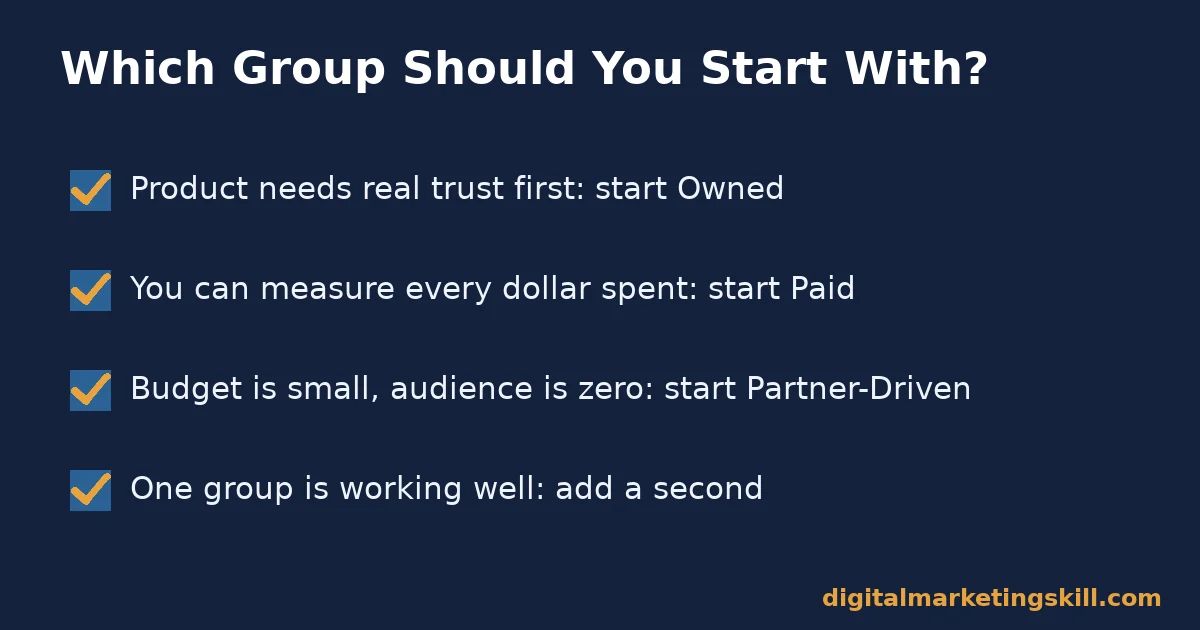
If there is one decision rule for choosing among these types of marketing, it is this. Sequence your spending by how much trust a stranger needs before they will buy from you. Do not simply pick whichever channel has the biggest budget available.
Here is an illustrative example with invented numbers. A $500 product that needs real trust to buy benefits more from content and email first, even on a small budget, than from a large traditional ad buy to strangers who have never heard of the brand. A $5 impulse product needs far less trust, so paid reach alone can work from day one.
Price is one signal for trust level, but not the only one. A $40 product that requires a recurring commitment, like a subscription, often needs as much trust-building as a far more expensive one-time purchase. Judge trust level by what you are actually asking someone to commit to, not only by the number on the price tag.
A Real Case: What Ad Spend Data Shows About the Shift to Digital
Dentsu’s Global Ad Spend Forecast tracks worldwide advertising investment across every major channel, not a single company’s campaign. It found total global ad spend set to surpass $1 trillion for the first time, with digital capturing 68.7% of that total.
Inside that shift, the detail matters more than the headline number. Television still grew 2.4%. Out-of-home grew 4.1%. Cinema grew 2.2%. Print fell 3.0%. Traditional marketing is not simply disappearing. Specific traditional channels are growing while others shrink, which is why “traditional marketing” as a single category hides more than it reveals.
The limit on this data matters too. It is a global industry forecast, not a guarantee for any one business or market. Your own customers, product and budget will decide which types of marketing actually earn a return for you.
What the forecast does make clear is that the old habit of treating “traditional marketing” as one declining block is outdated. A business choosing between a billboard campaign and a print magazine ad is really choosing between a growing channel and a shrinking one, even though both sit under the same traditional label.
Frequently Asked Questions About Types of Marketing
What is the most important type of marketing?
There is no single most important type, since each does a different job. For most small and growing businesses, content and email marketing offer a strong starting return, since they are owned channels with no auction cost.
But the right starting type still depends on how much trust your product needs before someone buys. A business selling a high-trust service, like consulting, usually needs a different starting type than one selling a low-trust impulse product.
Should a small business use all six types of marketing?
No, not at once. Running all six with a limited budget usually means doing each one poorly. Start with one from the owned-channel group. Add a paid or partner-driven channel once that is working, and expand from there. A business that masters two types of marketing well usually outperforms one spreading a similar budget across all six.
Is digital marketing replacing traditional marketing?
Largely, yes, in terms of spend. Digital now takes roughly two-thirds of global ad budgets, according to Dentsu’s forecast. But specific traditional channels, like out-of-home advertising, are still growing. The shift is uneven rather than a complete replacement, and for some products, especially ones that rely on local, physical foot traffic, a traditional channel can still outperform a digital one on a like-for-like budget.
How big is the affiliate marketing industry?
Estimates vary widely, from under $20 billion to over $28 billion worldwide. The gap depends on whether a report counts advertiser commissions alone, or the broader affiliate software and platform market around them. Compare the growth trend across years rather than trusting one headline figure. Every major estimate agrees on the direction, even where they disagree on the exact size: the channel is growing year over year, not shrinking.
What is the difference between inbound marketing and content marketing?
Content marketing is a tool: the actual blog posts, videos and guides you create. Inbound marketing is a strategy that uses content, SEO and social media together to attract people who are already searching. Content marketing is one of the tools inbound marketing uses, not a separate competing approach.
Which type of marketing gets results fastest?
Paid digital advertising typically shows measurable results fastest, often within days, because you can see clicks and conversions in real time. Content, email and inbound marketing usually take longer to compound. They often cost less per result once they are established.
Does traditional marketing still work?
Yes, for the right product and audience. Traditional marketing still reaches people who spend less time on digital platforms, and some traditional channels, like out-of-home advertising, are growing rather than shrinking. The mistake is assuming all traditional channels perform the same way, when the data shows they do not.
Build the Skills Behind Every Type of Marketing on This List
Content, email, paid advertising, SEO and partner-driven channels are not separate careers. They are one connected skill set, and the same person who understands all six types of marketing can move a business between them as its budget and trust level change.
The Master Diploma in Digital & AI Marketing at Digital Marketing Skill Institute teaches them together, across four AI-powered tracks built from ten courses: AI-Powered Social Media Management and Advertising, AI-Powered Lead Generation and Email Automation, AI-Powered Google Specialist, and AI-Powered WordPress and SEO Specialist, with a Full Stack option for completing all four.
Every track includes unlimited 1-on-1 coaching and mentoring, plus a U.S. Project Internship with a verified U.S. Work Reference Letter. The diploma is dual US and UK accredited, and recognised in more than 100 countries.
It is 100% online, so you can apply what you learn anywhere in your country. Our guide to starting in affiliate marketing is a good next read if partner-driven channels are your focus. Our guide to content marketing covers the owned-channel group in more depth.
Your Next Step
See the full curriculum on the Master Diploma program page, browse more guides on the blog, read real outcomes on the reviews page, and when you are ready, apply here. No type of marketing on this page guarantees a result by itself, so build the skill before you build the expectation. See our earnings disclaimer for more on that, and visit digitalmarketingskill.com to see the full range of tracks.
Every figure in this guide was checked against its original source before publication. Figures marked as illustrative are invented examples, not real results.
