Most lists of popular blog niche ideas just name topics. They skip the two things that actually decide whether a niche pays. First, whether Google will show your content to anyone. Second, whether advertisers or affiliates actually pay for that audience. This guide covers both, plus four ways to judge a niche, a measurement plan, and one validation rule to use before you write fifty posts in the wrong direction.
Key Takeaways
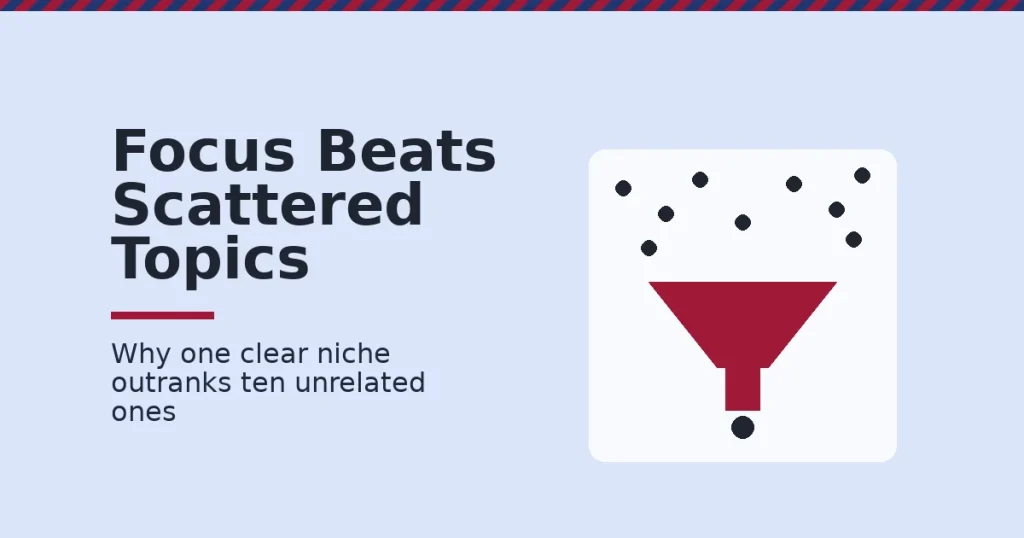
- Focus is a ranking signal, not just a branding choice. Google’s own guidance says it looks for content with “a primary purpose or focus.” It treats broad, unfocused coverage built mainly to attract search traffic as a negative signal.
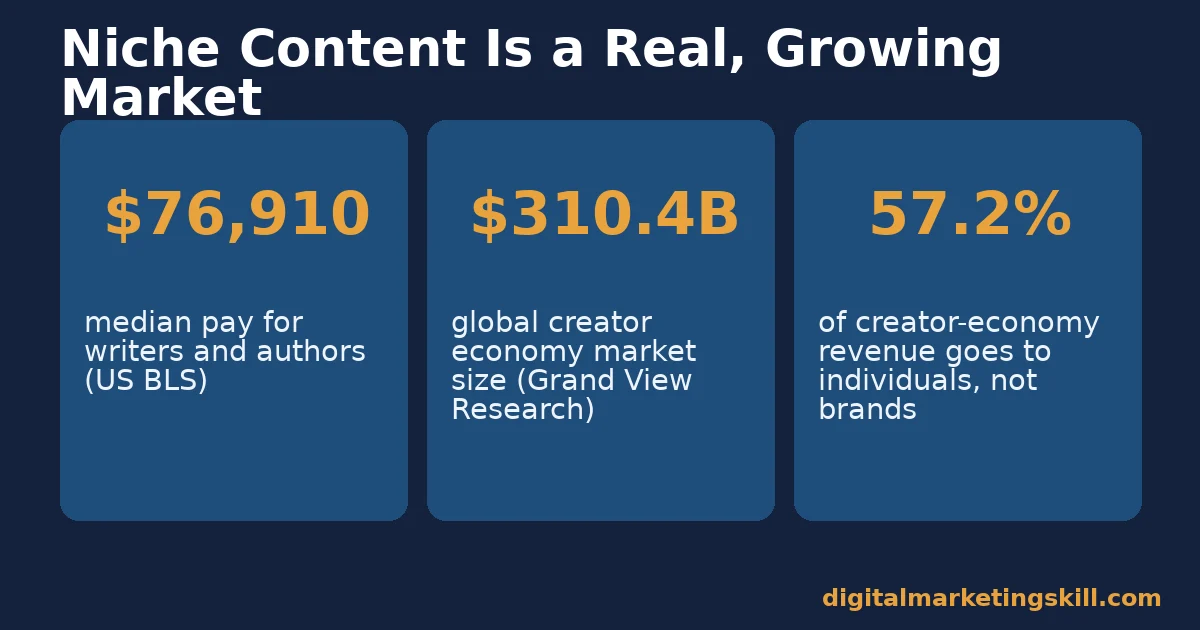
- Writing itself pays a real, trackable median wage. The US Bureau of Labor Statistics puts median pay for writers and authors at $76,910 a year. It also reports that 65% of people in the occupation are self-employed.
- The wider creator economy keeps growing fast. Grand View Research values the global creator economy at $310.4 billion. It projects a 23.3% yearly growth rate through the early 2030s.
- One real niche blogger scaled from zero to six figures a month. Personal finance blogger Michelle Schroeder-Gardner reportedly reached $10,000 a month after two years. She reportedly reached $100,000 a month after five years, according to a detailed profile of her blog.
- Audience size still beats topic popularity. Within the creator economy, individual creators capture 57.2% of total revenue. A smaller, well-served audience in a real niche can out-earn a broad, generic one.
In this guide
- What Most Popular Blog Niche Ideas Lists Get Wrong
- Why Niche Focus Decides Whether Google Shows Your Blog to Anyone
- Four Ways to Judge Popular Blog Niche Ideas, With Different Signals
- How to Lead With Each Factor
- Measuring Whether Your Popular Blog Niche Ideas Are Working
- The One Decision Rule: Validate With Five Posts Before You Commit Fifty
- A Real Case: How One Personal Finance Blog Scaled to Six Figures a Month
- Frequently Asked Questions About Popular Blog Niche Ideas
- Start With Five Posts, Not Fifty
What Most Popular Blog Niche Ideas Lists Get Wrong
Most lists of popular blog niche ideas stop at naming ten topics. Health. Finance. Travel. Food. That is not wrong. But it skips the two mechanisms that decide whether any of those topics actually makes money for you specifically.
This guide starts with those mechanisms instead. It explains why search engines reward focus and why advertiser demand varies by topic. Then it breaks down four ways to judge a niche before you commit months of writing to it.
Ground rules first. The pay and market-size figures below come from different sources measuring different things. One is a government labor survey. Another is a market-research forecast. A third is one blogger’s self-reported numbers. Treat each as a useful data point, not a guarantee of what your own blog will earn.
One more ground rule: these popular blog niche ideas are written for a worldwide audience, not one country’s advertisers or search behavior. Search volume, advertiser demand and even which niches pay well vary from market to market, so treat every figure below as directional, not as a fixed number for your specific audience.
Why Niche Focus Decides Whether Google Shows Your Blog to Anyone
Before a niche can make money, it has to get found. Google’s own guidance on helpful content states that it looks for sites with “a primary purpose or focus.” It asks site owners a pointed question directly: are you producing content on many different topics hoping some of it performs well in search?
That question is not rhetorical. Google treats scattered content as a signal. It suggests the content was built for search engines first and readers second. In its own words, that approach is “not aligned with what our systems seek to reward.”
The guidance also asks whether content shows real first-hand expertise. It gives an example: “expertise that comes from having actually used a product or service, or visiting a place.” A blog that stays inside one real niche can build that kind of depth over time. A blog that jumps between ten unrelated niches rarely can.
The Market You Are Entering Is Genuinely Large
This matters more now than it used to, because the audience for niche content keeps growing. Grand View Research values the global creator economy at $310.4 billion. Individual creators, not brands or agencies, capture 57.2% of that revenue. Advertising alone accounts for 36% of total revenue in the market. That means ad-supported blogs still have real monetization room even outside direct sponsorships.
Four Ways to Judge Popular Blog Niche Ideas, With Different Signals
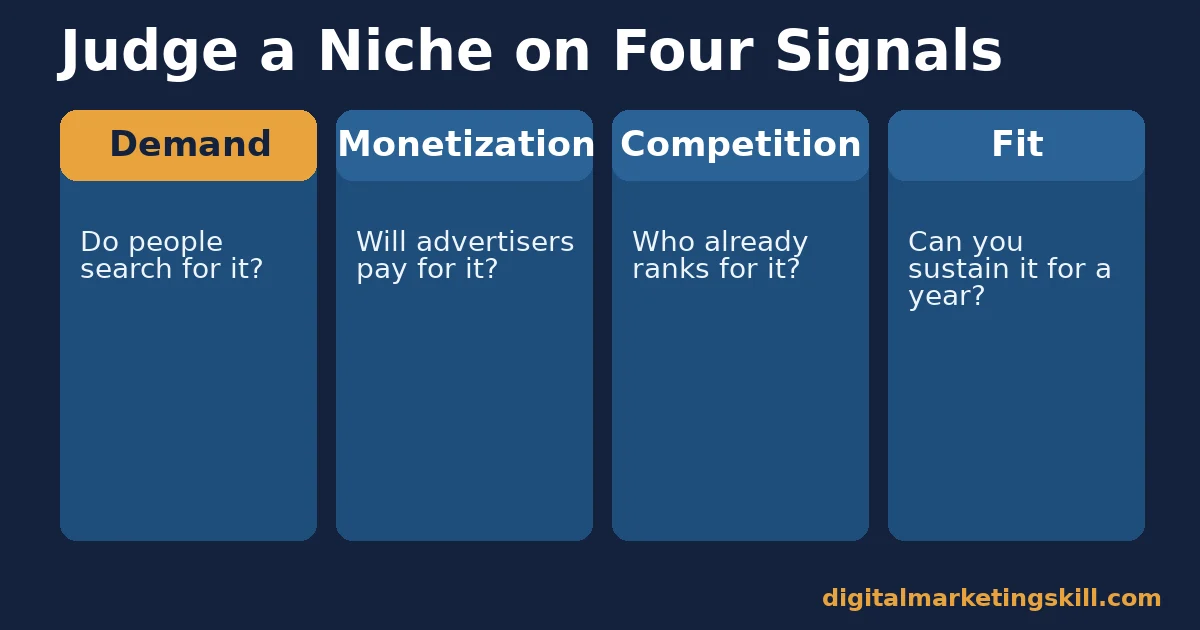
There is no single, universally “best” blog niche, which is why most ranked lists of popular blog niche ideas end up a weaker starting point than they first appear. Search demand, advertiser interest, competition and personal fit each reward a different kind of topic. A niche that scores well on one factor can still score poorly on another. Judging it on a single dimension, like how often it is searched online, misses most of the picture.
Some of the most popular blog niche ideas score high on search demand but surprisingly low on monetization potential, or the exact reverse pattern.
This guide covers four separate ways to judge any niche idea, and each one needs its own evidence before you commit real time to it.
Search Demand: Built on What People Already Look For
A popular niche idea is worthless if nobody searches for it. Before you write, check whether people in that topic regularly search for advice, comparisons or how-to content. A niche with real, recurring search demand gives every post a chance at ongoing traffic. That beats a single social-media spike that fades within a day.
This is the factor most rankings of popular blog niche ideas skip entirely, because a topic can trend heavily on social media for a week while barely registering in search volume the rest of the year. Search demand, not social buzz, is what keeps a blog post earning traffic months after you publish it.
This is also where focus compounds. Google’s own guidance rewards depth within a topic. A blog that answers twenty real questions inside one niche builds topical authority a scattered blog never reaches.
Monetization Potential: Built on Who Already Pays for This Audience
Some audiences are worth more to advertisers and affiliate programs than others. Usually that is because the audience is actively about to spend money. A reader researching insurance, software or a major purchase is closer to paying for something than a reader looking for a recipe. That is one reason finance and software niches draw heavier advertiser interest.
Michelle Schroeder-Gardner’s personal finance blog shows this in practice. Roughly half of her reported revenue comes from affiliate marketing, not display ads. Her audience is actively looking for financial products and services to act on.
Competition Level: Built on Who Already Ranks
A popular niche with ten established, well-funded sites already ranking for every obvious keyword is a harder entry point. A related niche with real demand but thinner competition is easier. Check who already ranks for your core topics before you commit, not after you have written fifty posts.
Competition is not a reason to avoid a popular niche entirely. It is a reason to enter it through a narrower angle first. Expand once you have some authority built up. Some of the most durable popular blog niche ideas are really narrow entry points into much larger topics, built that way on purpose.
Personal Fit: Built on What You Can Actually Sustain
The US Bureau of Labor Statistics notes that writing has a low barrier to entry. Anyone with internet access can start a blog and build real writing experience. Some of that work leads to paid opportunities, regardless of formal education. That open door only helps if you can sustain the writing itself.
A niche you cannot stay interested in for a year rarely survives long enough to pay off. That holds regardless of how strong its demand or monetization potential looks on paper.
How to Lead With Each Factor
Understanding why each factor matters only helps if it changes what you actually research before you write. The four sections below mirror the four factors above, each with one concrete next step.
Search Demand: Lead With a Real Keyword List, Not a Guess
Before naming your niche final, write down twenty real questions people in that topic actually ask. Then check whether people search for those exact phrases using a free tool like Google Trends. A niche that only sounds popular in conversation, with no searchable questions behind it, will struggle to earn organic traffic no matter how well you write about it.
Monetization Potential: Lead With How You Will Actually Get Paid
Decide your primary revenue path before you pick a final angle within your niche: affiliate marketing, display ads, products or services. Our guide to choosing affiliate programs and our guide to making money with WordPress cover the mechanics once you have settled on a direction.
Competition Level: Lead With a Narrower Angle First
Enter a competitive niche through one specific, underserved angle. Do not try to compete across the whole topic at once. Win that smaller angle first, and build real authority there. Then expand outward once you have traffic and trust behind you.
Personal Fit: Lead With a Publishing Pace You Can Actually Keep
Pick a realistic, sustainable writing cadence before you launch. Commit to it in writing somewhere you will see it. Consistency compounds in a real niche the same way Google’s own expertise signal does.
Both reward people who stay in one place long enough to actually know it well. Pair that consistency with a promotion plan. Our guide on ways to increase website traffic covers the free channels worth using from day one.
Measuring Whether Your Popular Blog Niche Ideas Are Working
Pick metrics that match the stage you are actually at. Do not just check total pageviews alone from month one. Each metric below is defined in a single sentence, with a note on how to read it.
- Organic session growth, month over month. The rate your search traffic grows once you have at least twenty published posts. Flat or falling organic traffic after that point usually means the niche or the keyword targeting needs a rethink, not just more volume.
- Revenue per session. Total blog income divided by total sessions in a period. This is the single clearest signal of whether your niche choice was a strong one. It accounts for both traffic and how valuable that traffic actually is.
- Email list growth rate. New subscribers gained per month relative to your total list. A growing list is one of the clearest signs a niche’s audience trusts you enough to hear from you again.
- Content published versus content planned. The share of your planned posting schedule you actually hit each month. A niche you keep abandoning your schedule in is rarely the right long-term fit, regardless of its theoretical potential.
- Keyword ranking movement. How your target keywords move in search results over a quarter, tracked in a free tool like Google Search Console. Rising rankings on real search terms are the clearest early signal that Google is rewarding your focus.
Read these five together, not one at a time. Rising traffic with flat revenue per session means your niche draws readers who do not convert. That often points to a monetization mismatch, not a traffic problem. Check all five on a monthly basis once you pass your first twenty posts, since niche-level patterns in popular blog niche ideas rarely show up clearly in the first few weeks of data.
The One Decision Rule: Validate With Five Posts Before You Commit Fifty
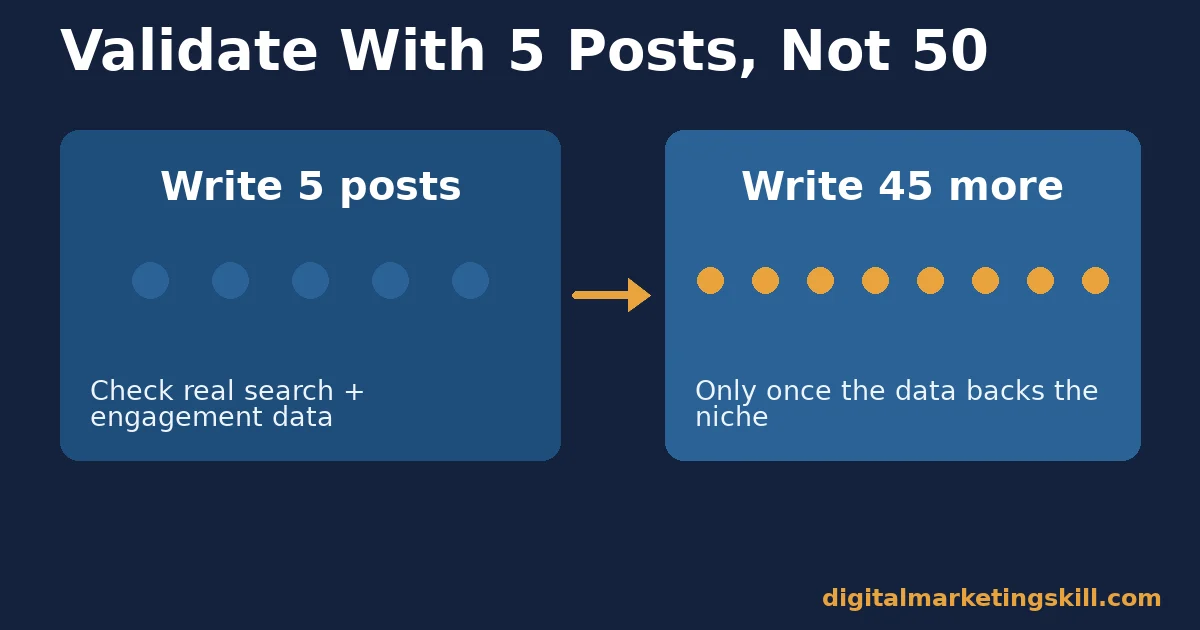
If you take one rule from this guide, make it this one. Before committing to a niche long-term, write five genuinely good posts inside it. Promote them honestly, then check real search and engagement data before writing fifty more. Committing to fifty posts in a niche on a guess alone is the single most common way new bloggers waste months of effort.
Here is an illustrative example, with invented numbers. A new blogger considers two niches: home organization and personal finance for freelancers.
After five posts in each, home organization draws more social shares but almost no organic search traffic. The freelancer-finance posts draw fewer shares but real, growing search traffic and two affiliate sign-ups. The data points toward personal finance for freelancers, even though it felt like the less exciting topic going in.
A Real Case: How One Personal Finance Blog Scaled to Six Figures a Month
Michelle Schroeder-Gardner’s blog, Making Sense of Cents, is one of the most publicly documented examples of a niche blog scaling into a full business. According to a detailed profile of her career, she built the blog inside a single, clear niche. That niche was personal finance, with a focus on helping readers earn more, save more and travel more.
The reported numbers show a long runway, not an overnight result. She reportedly reached $10,000 a month after about two years.
She reached roughly $50,000 a month after about four and a half years, and around $100,000 a month near the five-year mark. Roughly half of her revenue reportedly comes from affiliate marketing. About 20% comes from her own courses, and about 20% from sponsored partnerships, with display advertising making up a smaller share.
That mix, weighted toward affiliate income rather than display ads, is common among popular blog niche ideas that involve a real purchase decision, such as personal finance, insurance or software.
The limits here matter. These are one blogger’s self-reported figures, not an independently audited result. Her outcome is a documented success story, not a typical one.
The useful part is the mechanism, not the specific dollar figures: a single clear niche, consistent publishing, and a shift toward affiliate revenue once her audience’s purchase intent became clear. Among popular blog niche ideas, personal finance is unusually well documented this way, because several of its most successful bloggers have historically published income reports in public.
Frequently Asked Questions About Popular Blog Niche Ideas
What are the most popular blog niche ideas that actually make money?
Personal finance, health and wellness, software and business tools, and niches tied to a specific buying decision tend to draw stronger advertiser and affiliate interest. Their readers are closer to spending money. But search demand and your own ability to sustain the topic matter just as much as the category itself.
Should I pick a blog niche based on passion or profit potential?
Weigh both, but do not assume passion alone guarantees traffic or income. A topic needs real, searchable demand and a plausible way to monetize it. It also needs a workable level of personal interest to sustain the writing, not passion as the only test. Many strong, lasting blogs grow out of a topic the writer found only moderately interesting at first, then came to know deeply through consistent, specific research.
How do I know if a blog niche is too competitive?
Search your core topics and see who already ranks. If the same handful of large, well-resourced sites hold every top result, enter through a narrower, underserved angle first rather than competing head-on immediately.
How long does it take to make money from a blog niche?
Longer than most new bloggers expect. One widely cited example took roughly two years to reach a meaningful monthly income, then several more years to scale further. That case is a documented success story, not a typical timeline.
Can I blog about more than one niche at once?
You can, but Google’s own guidance treats broad, unfocused topic coverage as a negative signal in one specific case. That is when it looks like an attempt to capture more search traffic rather than serve a clear audience. A tightly focused niche blog generally builds topical authority faster than a scattered one.
What is the biggest mistake people make when choosing a blog niche?
Committing to fifty posts in a niche before checking whether real people search for it, or whether advertisers pay for that audience. Validate with a small batch of posts first, using the decision rule in this guide.
Do I need special skills to start a blog in a popular niche?
No formal qualification is required to start. The US Bureau of Labor Statistics notes that anyone with internet access can start a blog and build real writing experience.
Some of that work leads to paid opportunities over time. What matters more than credentials is picking from popular blog niche ideas you can realistically sustain, researching real search demand before you commit, and tracking the five metrics in this guide once you have real data to look at.
Start With Five Posts, Not Fifty
Pick the one niche idea from this guide with the strongest real search demand and a plausible way to monetize it. Then validate it with five genuinely good posts before you commit further.
These popular blog niche ideas only pay off once you test them against real data, not just a gut feeling about what sounds interesting. The sources in this guide, a government labor survey, a market-research forecast, Google’s own published guidance and one blogger’s documented income history, are a starting point for that testing, not a substitute for your own numbers.
If you want structured, hands-on practice building and growing a blog like this, the Digital Marketing Skill Institute teaches it inside the Master Diploma in Digital & AI Marketing. The program is built around four AI-powered tracks totalling ten courses, including AI-Powered Google Specialist and AI-Powered WordPress and SEO Specialist, with a Full Stack option for completing all four tracks.
It includes unlimited 1-on-1 coaching and mentoring and a U.S. Project Internship with a verified U.S. Work Reference Letter.
It is dual US and UK accredited and recognised in more than 100 countries, and fully online, so you can study from anywhere in your country. Browse more guides on the Digital Marketing Skill Institute blog, read real outcomes on the reviews page, or go straight to the Master Diploma program page and apply when you are ready. You can also start from the Digital Marketing Skill Institute homepage.
Every figure in this guide was checked against its original source before publication. Figures marked as illustrative are invented examples, not real results.