
Social media marketing ROI measures the profit a business earns back from the time, ad spend and content work it puts into social platforms. Most teams judge it by vanity metrics like likes and shares, which do not predict revenue. Fix that by tying each post to a stated goal, then tracking the metric that proves that goal, not every metric at once.
Key Takeaways
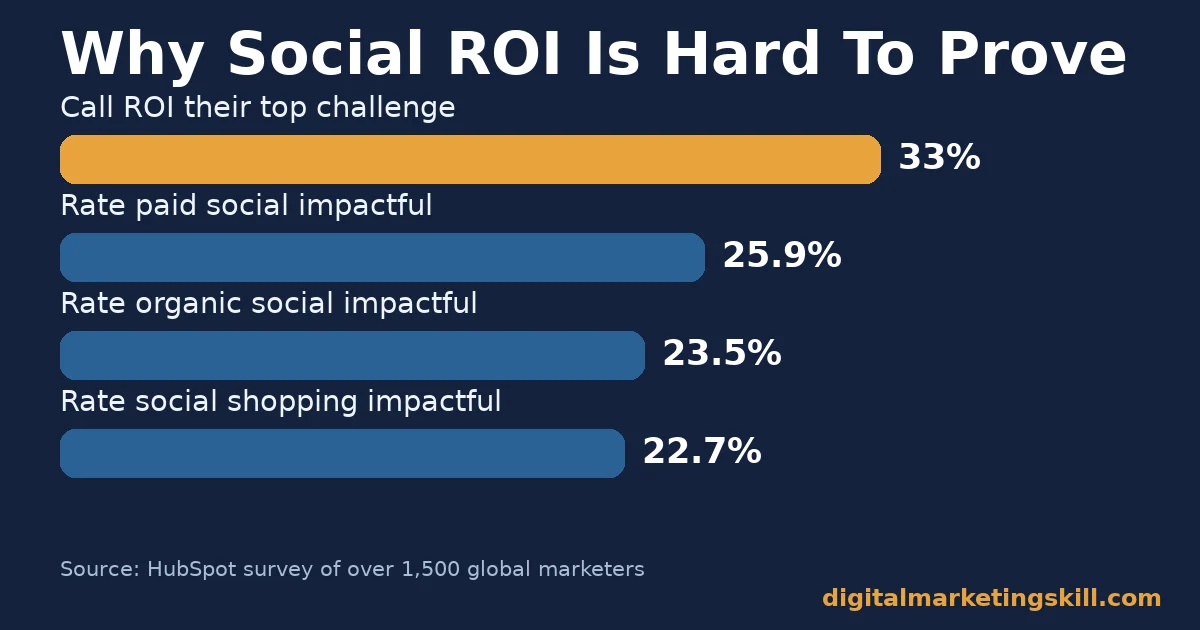
- Measuring ROI is the top challenge. HubSpot’s global survey of over 1,500 marketers found that measuring marketing ROI is the number one challenge marketers face, cited by 33% of respondents.
- Attribution tools decide what you can prove. Google Analytics builds its channel reports from UTM parameters attached to each link, splitting traffic into groups such as Organic Social and Paid Social.
- ROI varies widely by channel. In HubSpot’s data, marketers rank paid social media as impactful for ROI at 25.9%, organic social at 23.5% and social shopping tools at 22.7%.
- Short-form video leads the format mix. The same HubSpot survey found short-form video rated as the top ROI content format by 48.6% of marketers who ranked a format first.
- Leaders want fewer, clearer numbers. Sprout Social’s Index survey of marketing leaders in the US, UK, Canada and Australia found 65% want direct connections shown between social campaigns and business goals.
In this guide
- What Most Social Media ROI Advice Misses
- How Social Media ROI Attribution Actually Works
- How Social Media ROI Differs by Goal
- How to Lead With Each Goal
- Five Reasons Social Media ROI Looks Negative
- How to Measure Social Media Marketing ROI
- The One Rule: Match the Metric to the Goal First
- A Four-Week Plan to Prove Social Media ROI
- A Real Case: Why Buffer Stopped Chasing Direct ROI
- Frequently Asked Questions About Social Media Marketing ROI
- Start With One Goal, Then Prove It
What Most Social Media ROI Advice Misses
Most guides on social media marketing ROI repeat the same advice: post more, engage faster and track everything. That advice is not wrong, but it skips the step that decides whether any of it matters, which is picking one goal before you pick a metric.
This guide starts there. It explains how attribution tools assign credit to a social post. It shows how the right metric changes with the goal. And it walks through one real company’s decision to stop chasing a number that was lying to them.
The scale of the measurement problem is not small. HubSpot surveyed over 1,500 marketers worldwide. They named measuring marketing ROI as their number one challenge, ahead of generating leads or finding new customers. That single figure explains why so much social media marketing ROI advice focuses on dashboards instead of decisions.
Here are the ground rules. HubSpot’s and Sprout Social’s figures below come from large, named surveys of real marketers. Read them as self-reported snapshots, not settled facts. The Buffer case describes one company’s choice for its own situation, not a rule for every business. Treat every number here as current evidence, not a permanent ranking.
How Social Media ROI Attribution Actually Works
Before you can calculate social media marketing ROI, your tool has to know which visits and sales came from social. That tracking happens in two layers: the link itself, and the report that groups links into channels.
Tagging Every Link With UTM Parameters
Every link you share should carry UTM parameters, small tags added to the end of a URL. Google’s own guidance defines utm_source as the referrer, utm_medium as the marketing channel and utm_campaign as the specific promotion. Google recommends one unique source per platform, such as “facebook” or “instagram”, and one campaign name reused across every link in that push.
Skip this step and your tool has to guess. Guessed traffic lands in a generic “social” or “referral” bucket. That bucket blends your best post with your worst one. Tagged links let you compare single posts, not just whole platforms.
How Analytics Classifies Organic and Paid Social
Once a link is tagged, Google Analytics sorts the visit into a default channel group. Google’s documentation explains that channels are “rule-based definitions of your website’s traffic sources” used to monitor performance. Social traffic typically splits into Organic Social and Paid Social, based on the source and medium each link carries.
That split matters for social media marketing ROI. Paid social carries a cost you can subtract directly from the report. Organic social looks free on the surface. But it still costs the hours spent writing, filming and scheduling, so an honest ROI figure has to price that time in before you compare the two.
This is also where a programme like structured social media management earns its keep. A consistent publishing calendar plans those hours in advance. Planned hours are far easier to cost than work scattered across the week.
How Social Media ROI Differs by Goal
Not every social media push is trying to do the same job. A campaign built to get noticed behaves differently from one built to get a click. Each needs a different number to prove it worked.
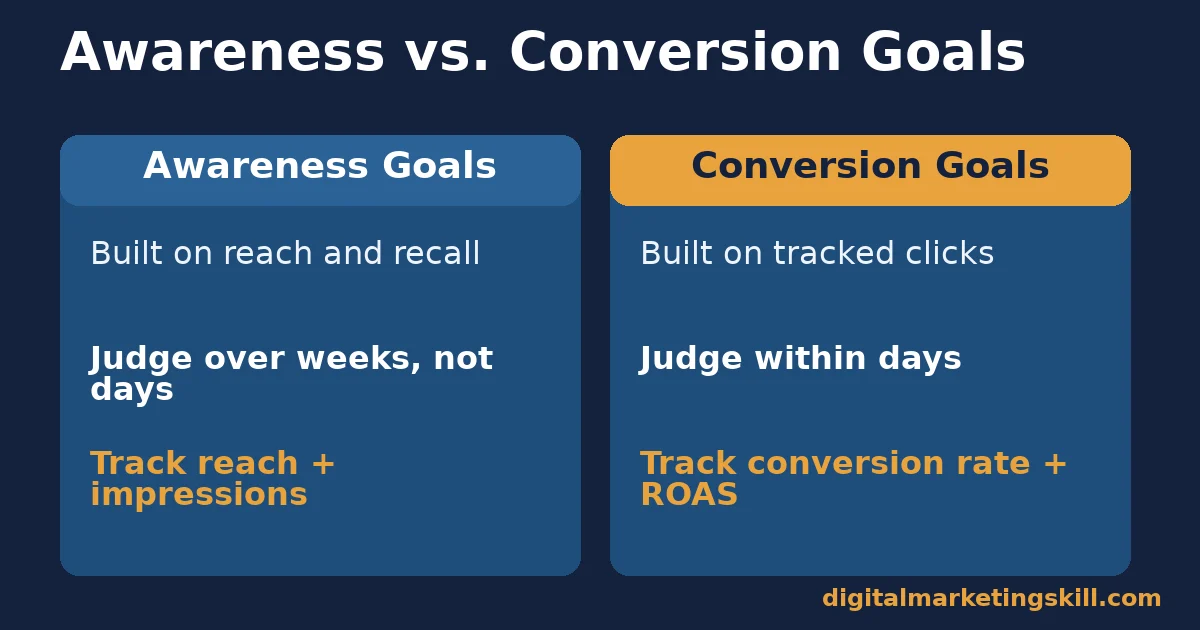
Awareness Goals: Built on Reach and Recall
Awareness campaigns aim to put a brand in front of new people who are not ready to buy yet. Success looks like growing reach, repeated impressions and people recognising the brand later, not an immediate sale.
Judging an awareness push by sales alone almost always makes its ROI look negative. That is because the payoff shows up weeks or months later, often through a different channel entirely. That gap is exactly why Buffer, covered later in this guide, stopped tracking direct conversions from its own social accounts.
Conversion Goals: Built on Tracked Clicks
Conversion campaigns aim to move a specific person to a specific action: a sign-up, a download or a purchase, usually within days. These campaigns are built to be tracked. Give each one a tagged link that points straight to a landing page built for that single action.
In HubSpot’s survey, marketers ranked paid social media as impactful for ROI at 25.9%, just ahead of organic social media at 23.5% and social shopping tools at 22.7%. Paid, trackable placements are easier to credit with a conversion than an organic post competing with an algorithm.
Platform choice shifts this further. Marketing leaders who measure ROI well tend to pick the platform that matches their goal, not a single “best” network. Treat any single-platform ROI claim, even a strong one, as a snapshot of one survey, not a guarantee for your own audience.
How to Lead With Each Goal
Each goal type needs a different first move once you start measuring. The sections below mirror the two goals above. Pick the goal your current campaign is actually built for before you choose which metric proves it.
Awareness Goals: Lead With Consistent Reach
Track reach, impressions and follower growth against a steady publishing pace, not a single post. Because short-form video rated as the top ROI format for 48.6% of marketers who named one format in HubSpot’s survey, an awareness push built around short clips has a reasonable base rate to work from.
Give an awareness campaign weeks, not days, before judging it. After all, recall builds through repetition, so a single post with low reach tells you little about whether the overall push is working. Instead, watch the trend across ten or twenty posts.
Conversion Goals: Lead With Tracked Links
Put a UTM-tagged link in every post that is meant to convert, pointing to a page built for that one action. Then watch Google Analytics’ Paid Social or Organic Social channel report for sessions, not just clicks, since a click can bounce before it ever reaches the page.
Keep the destination page short and specific. Otherwise, a conversion campaign that sends traffic to a general homepage instead of a matching landing page will always under-report, because the visitor has to do extra work to find the action you wanted.
Five Reasons Social Media ROI Looks Negative
When social media marketing ROI comes out negative, the cause is usually one of five mistakes. Check your last campaign against each one before you conclude that social does not work for your business.
- The goal was never named. Without a stated goal, every metric looks equally important and none of them proves anything. Name the goal before the campaign starts, not after you pull the report.
- Links were not tagged. Untagged links fall into a generic bucket that hides which post, platform or campaign actually drove the result.
- Time was left out of the cost. Organic social still costs staff hours. Leaving that cost out inflates ROI on the way up and makes a real dip look worse by comparison later.
- The wrong channel was blamed. Last-click reports hand all the credit to the final step before a sale, which usually is not social, even when social started the journey.
- It was judged too soon. Awareness and trust take weeks to show up in sales. Judging a brand-building campaign after three days measures patience, not performance.
Which Mistake to Fix First
Start with whichever mistake your own numbers point to. If you cannot say what the campaign was for, fix the goal first. If you have a goal but no tagged links, fix tracking next. Only move on to attribution models and timing once the first two are solid.
Fixing the earliest mistake in this list first saves weeks of arguing about which tool’s dashboard is “right.” Most dashboard disagreements actually trace back to untagged links or an unnamed goal, not to a flawed attribution model. For the same diagnose-first approach applied across a whole content programme, see our guide to content marketing challenges and how to fix each one.
Small teams feel these five mistakes hardest, because there is no spare time to untangle a messy report. If that describes your situation, our guide on social media marketing for small businesses covers a leaner version of the same goal-first approach.
How to Measure Social Media Marketing ROI
Once a link is tagged and a goal is named, measuring social media marketing ROI is mostly arithmetic. Each metric below is defined in one sentence, with a note on how to read it.
Five Metrics That Show Real Social Media ROI
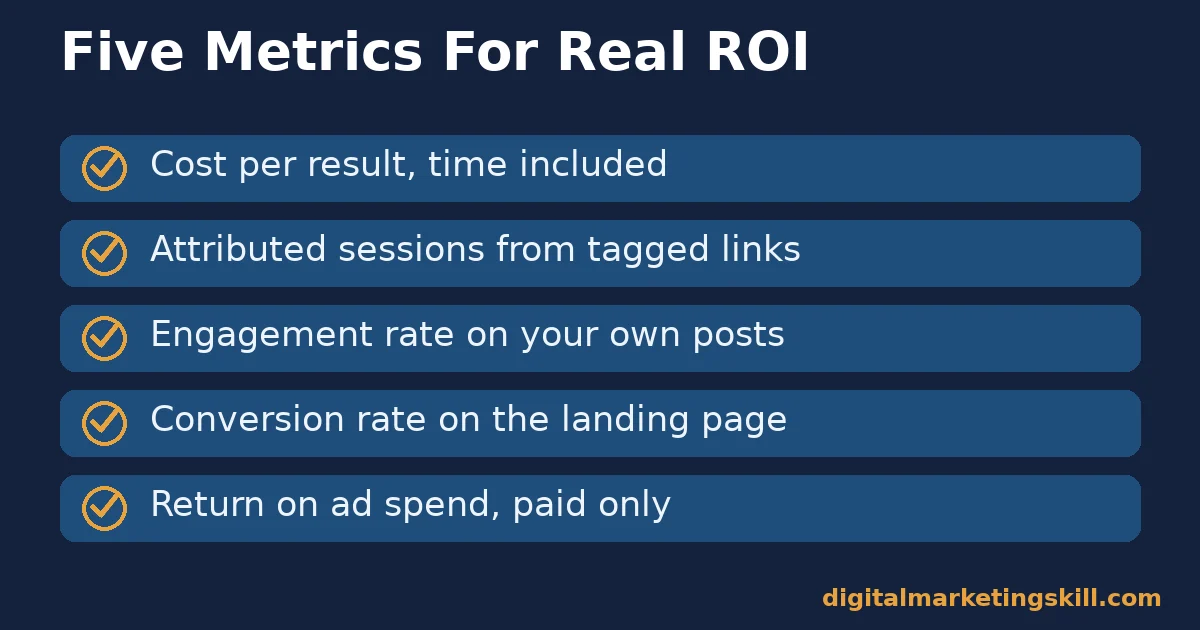
- Cost per result. Total spend, including staff time for organic posts, divided by the number of results that match your goal. Compare it against the value of one result to see if the channel pays for itself.
- Attributed sessions. Sessions that Google Analytics groups under Paid Social or Organic Social, drawn from your UTM-tagged links. Rising sessions with a stable cost per result is a healthy sign.
- Engagement rate. Buffer’s analysis of more than 52 million posts defines engagement as likes, comments, shares and saves divided by followers. Use it to compare your own posts over time, not to compare against another brand’s audience size.
- Conversion rate on the landing page. The share of tagged sessions that complete your named goal action. A low rate with healthy traffic usually points to the landing page, not the social post.
- Return on ad spend. Revenue from paid social divided by paid social spend. Keep this metric for paid campaigns only; applying it to organic posts forces a cost figure that is hard to defend.
How to Read These Numbers Together
Read the metrics in the order a visitor experiences them. If sessions are healthy but conversion rate is low, fix the landing page before touching the social post. If sessions are low, the problem sits further back, in reach or in tagging.
Track one goal at a time, and compare each campaign against your own past campaigns rather than an industry average. HubSpot’s ROI-by-channel figures are a starting context, not a target every business should hit.
Keep the list of metrics short on purpose. Our guide to digital marketing KPIs makes the same case for every channel, not just social: a handful of well-chosen numbers beats a dashboard full of metrics nobody checks.
The One Rule: Match the Metric to the Goal First
If you take one decision rule from this guide, make it this one. Before you calculate social media marketing ROI, confirm which goal the campaign was built for, then pick only the metric that proves that goal.
Here is an illustrative example, with invented numbers. A small skincare brand spends the equivalent of $2,000 a month on organic and paid social combined. Judged purely by last-click sales, the campaign looks like it returns $1,400, a loss.
Once the brand tags every link and checks assisted conversions, the picture changes. It finds social started 46% of the paths that ended in a sale through search or email. Measured against the right goal, awareness, the same spend looks like a reasonable investment rather than a failing one.
The lesson is about matching, not optimism. The spend did not change between the two views. However, the metric did, and that single change decided whether the campaign looked like a failure or a foundation.
A Four-Week Plan to Prove Social Media ROI
You do not need a new tool to start proving social media marketing ROI. This plan takes about an hour a week.
- Week one: name one goal per channel. Pick a single goal, awareness or conversion, for each platform you post on, and write it down.
- Week two: tag every link. Add UTM parameters to every link you share, using one source per platform and one campaign name per push.
- Week three: pick one metric per goal. Choose cost per result and attributed sessions for awareness, and conversion rate and return on ad spend for conversion goals.
- Week four: compare, don’t judge alone. Compare this month’s numbers to last month’s for the same goal, not to a competitor or an industry average.
At the end of the month, keep the goal-metric pairing that gave you a clear answer, and drop any metric that only added noise. Repeat the plan each month, and the picture of what social media marketing ROI actually looks like for your business gets sharper every cycle.
A Real Case: Why Buffer Stopped Chasing Direct ROI
Buffer, the social media scheduling company, publicly described why it stopped measuring social media marketing ROI by direct conversions. Its own team traced a real customer’s path to purchase: a Facebook post led to the blog, then guest posts, then a product integration, and only weeks later a sign-up.
According to Buffer’s own write-up, the company found that ninety percent of its social media updates were based on content from its blog, so it shifted its main measurement to blog traffic, email sign-ups and engagement rather than direct social conversions.
Buffer is explicit about the limit of its own case: the choice fit a small content team and a business where social sits at the top of the funnel. The company still recommends tracking direct ROI when a post points straight at a landing page, a product launch or a sign-up form, which is exactly the conversion-goal case covered earlier in this guide.
Frequently Asked Questions About Social Media Marketing ROI
What is a good social media marketing ROI?
There is no single good figure, because ROI depends on the goal, the channel and the cost of the time involved. Compare each campaign against your own past campaigns with the same goal rather than a published average.
Why does my social media ROI look negative?
It is often a measurement problem rather than a performance problem. Untagged links, an unnamed goal, or judging an awareness campaign by same-week sales are the most common causes.
How do I calculate social media marketing ROI?
Subtract total cost, including staff time for organic posts, from the value of the results the campaign produced, then divide by the cost. Match the result metric to the stated goal of the campaign.
Do likes and shares prove social media ROI?
No. Likes and shares show reaction, not revenue. Track cost per result, attributed sessions and conversion rate instead, and treat engagement rate as a trend to watch rather than proof of ROI.
Should small businesses track social media ROI differently?
The principle is the same, but the scale changes. A small content team, as in Buffer’s own case, may choose to track blog traffic and sign-ups instead of direct social conversions if social mainly brings people to other content first.
How long should I wait before judging a social campaign’s ROI?
It depends on the goal. A conversion campaign with tagged links can be judged within days. An awareness campaign needs weeks, because its effect on sales usually shows up through another channel later.
What is the most common mistake when calculating social media marketing ROI?
Leaving staff time out of the cost side. Organic posts feel free, but the hours spent planning, filming and scheduling are a real cost, and skipping them inflates the ROI figure in a way that will not survive scrutiny.
Can UTM tags alone fix bad social media ROI reporting?
Tags fix visibility, not strategy. A tagged link only tells you where a visit came from. You still need a named goal and the right metric for that goal before the tag means anything.
Start With One Goal, Then Prove It
Social media marketing ROI gets easier to prove the moment you stop measuring everything at once. Pick your most active platform, name the one goal it is actually for, tag every link for a month, and track only the metric that matches that goal.
If you want guided practice, Digital Marketing Skill Institute teaches this hands-on inside its Master Diploma in Digital & AI Marketing. The diploma spans four AI-powered tracks totalling ten courses, including the AI-Powered Social Media Management and Advertising track. Students who want every track can complete the Full Stack option covering all four.
The programme includes unlimited 1-on-1 coaching and mentoring and a U.S. Project Internship with a verified U.S. Work Reference Letter. The diploma is dual US and UK accredited and recognised in more than 100 countries.
The programme is fully online, so you can study and apply these measurement skills from anywhere in your country. Browse more guides on the Digital Marketing Skill Institute blog, check real outcomes on the reviews page, and when you are ready, apply for the Master Diploma or start from the Digital Marketing Skill Institute homepage.
Every figure in this guide was checked against its original source before publication. Figures marked as illustrative are invented examples, not real results.
