
Social media management is the ongoing work of planning, posting, replying and measuring results on platforms like Instagram, Facebook, TikTok and LinkedIn. It covers the content calendar and the real conversations in comments and messages. Done well, it turns a scattered presence into a steady channel for reach, trust and sales.
Key Takeaways
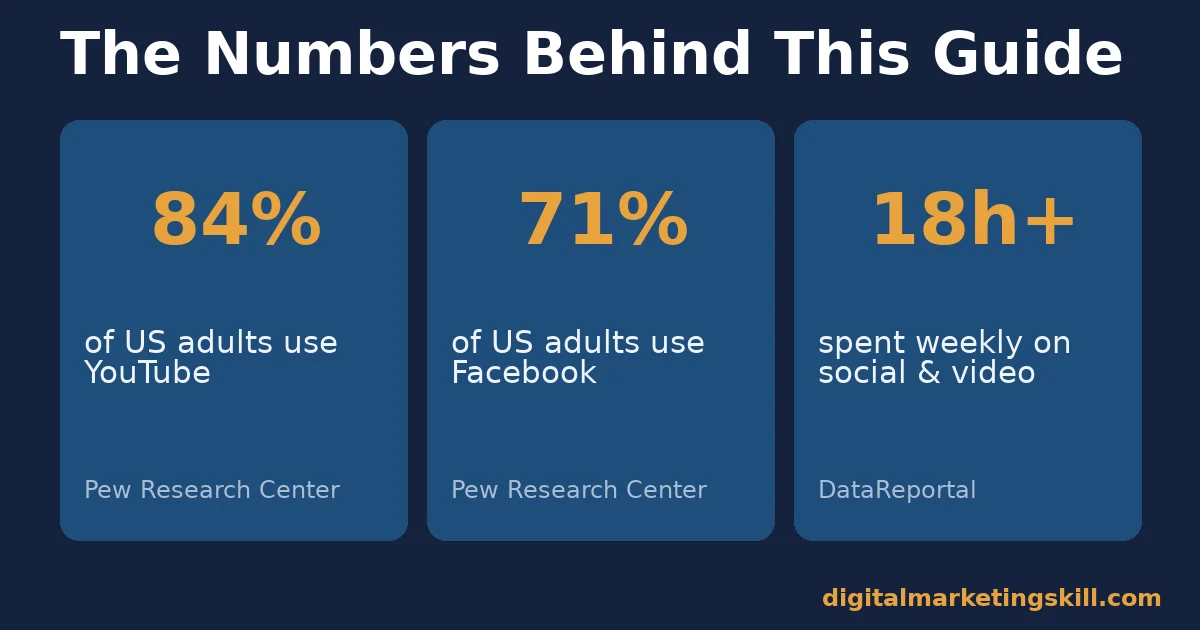
- In the US, YouTube reaches 84% of adults. Facebook reaches 71% (Pew Research Center). Platform choice should follow your audience, not guesswork.
- 6.12 billion people are online worldwide. That’s 73.8% of the world’s population (DataReportal). The average user spends over 18 hours a week on social and video combined.
- Facebook traffic ads average a 1.93% click-through rate and a $0.60 cost per click. The source: aggregated customer data from LocaliQ/WordStream.
- Mobile devices generate 51.6% of global web traffic (DataReportal). Content that isn’t mobile-first loses reach before it’s even read.
- Average email marketing ROI sits at $36 to $42 per $1 spent (Litmus data, via Omnisend’s report). That’s a useful comparison point for social’s own payoff.
In this guide
- Why Social Media Management Efforts Stall
- How Social Media Management Actually Works
- Which Platform Fits Your Audience
- How To Lead With Each Platform
- Measuring Social Media Management Results
- The One Decision Rule For Choosing Platforms
- A Real Social Media Management Case, And Its Limits
- Frequently Asked Questions About Social Media Management
- Where To Learn Social Media Management Properly
Why Social Media Management Efforts Stall
Most advice focuses on posting more. Or posting at the “best” time. That’s a small part of the job. The bigger gap is treating social as a broadcast channel instead of a two-way one.
In practice, many businesses post consistently. Then they wonder why engagement stays flat. Often the content is fine. What’s missing is a reply to every comment. A plan for messages. A way to tell which posts are worth repeating.
As a result, the same mistake repeats every week. More content gets made. Less of it gets a real reply. Eventually the account looks active but feels empty, and followers notice that nobody is actually listening.
Fixing this rarely needs a bigger content budget. It usually needs a smaller content calendar and a clear daily block of time set aside just for replies. Posting less, but replying to everything, tends to outperform posting more while replies pile up unanswered.
Two ground rules apply here. First, these benchmarks are a guide, not a fact about your audience. Results vary by industry and region. Second, platforms change constantly. Treat every figure here as a snapshot, not a fixed ranking. Overall, the specific numbers matter less than the habits that keep producing good numbers over time.
How Social Media Management Actually Works
Social media management runs in a loop. Plan content around your audience’s interests. Publish it in each platform’s native format. Respond to what comes back. Use that response to plan the next round. Skip the “respond” step and the loop breaks, no matter how good the content is.
In other words, the loop only works end to end. A great content plan with no reply strategy is only half a system. Likewise, fast replies on content nobody sees won’t build much either. Both halves need to run together, consistently, for the loop to actually compound over time. This is the core discipline behind good social media management: treating planning and listening as one job, not two.
Why The Same Post Performs Differently Everywhere
For example, picture one product announcement. As a short video on TikTok, it does well. As a static image on LinkedIn, it barely registers. On Facebook, it sparks a long comment thread. Each platform rewards a different format and tone. Therefore, reposting the exact same asset everywhere usually underperforms a version built for each one.
This is also why engagement matters, not just reach. A platform’s algorithm reads early comments and shares as a signal. It then shows that post to more people. A post nobody responds to quietly stops being shown. That happens regardless of how many people originally saw it.
As a result, the first hour after posting matters more than most businesses realise. A quick reply to an early comment can nudge the algorithm toward showing the post further. Waiting a day to respond often means the algorithm has already decided the post is done.
Which Platform Fits Your Audience
Not every platform suits every business. Here’s what each one is actually built for. Indeed, the right starting point depends far more on your audience than on which platform feels most familiar to you personally.
Instagram: Built For Visual Discovery
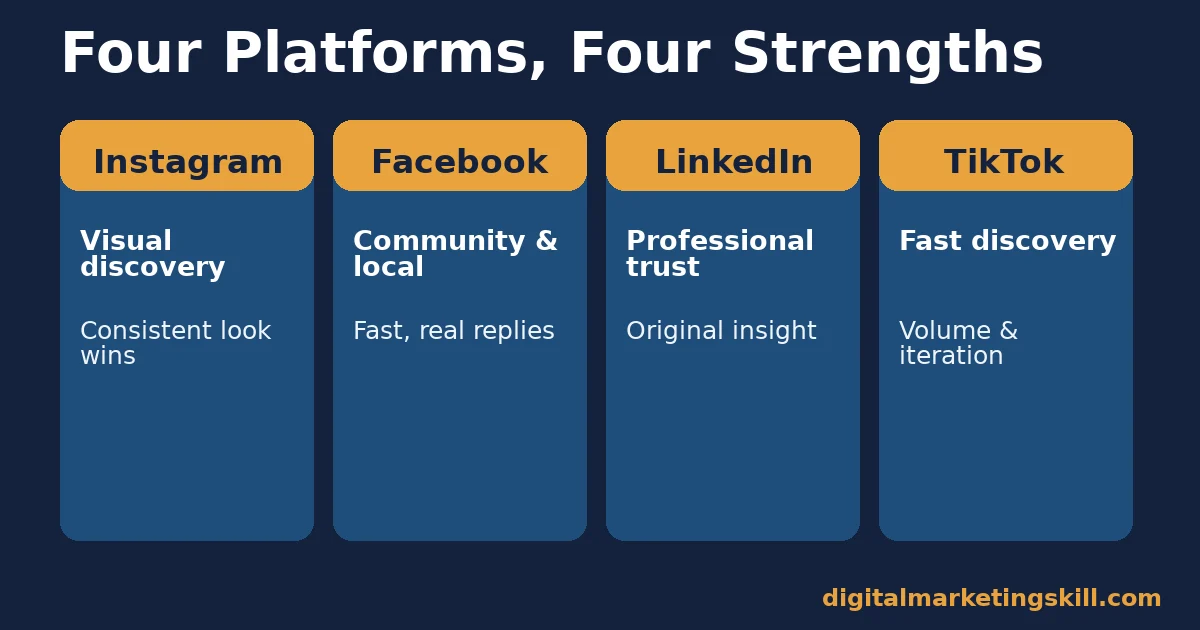
Instagram rewards strong visuals and short video. It’s a common place for people to discover a brand before they’ve heard of it elsewhere. It suits businesses with a genuinely visual product or process to show. In short, a business that can’t easily show its product in a photo or short clip will find less natural traction here than on a text-first platform.
Facebook: Built For Community and Local Reach
Facebook still reaches a large share of adults. It works especially well for groups, local business pages and longer updates. It suits businesses that benefit from a community feel or local visibility. Because its audience skews a bit older than Instagram or TikTok’s, it’s often a better fit for services aimed at established households rather than younger, trend-driven buyers.
LinkedIn: Built For Professional Trust
LinkedIn favours professional, expertise-led content. It performs best for B2B businesses, recruiting, and building a founder’s or expert’s credibility over time. Unlike Instagram or TikTok, a plain text post with a strong opinion can outperform a highly produced video here, since the audience comes for ideas first.
TikTok: Built For Fast, Native Discovery
TikTok’s algorithm can push a new account’s content to a large audience fast. That happens even without an existing following, as long as the content holds attention in TikTok’s own informal style. It rewards speed and authenticity over polish.
Because of this, a brand-new account can occasionally outperform an established one on TikTok. That rarely happens on other platforms, where an existing following still matters a great deal. This also means early TikTok metrics can be misleading, since one unusually lucky video can skew an account’s whole first month.
How To Lead With Each Platform
Knowing a platform’s strength is step one. Here’s the specific habit that makes it actually perform.
Instagram: Lead With Consistent Visual Identity
Use a recognisable colour palette, font and style across posts. Your content should be identifiable even without a logo in view. A consistent look builds recognition faster than any single viral post. Over time, that familiarity is what makes someone stop scrolling, even before they’ve read a single word.
Facebook: Lead With Fast, Real Replies
Facebook engagement rewards businesses that reply quickly and personally. Not with copy-pasted responses. A fast, specific reply to a comment often does more for trust than the original post. Overall, people remember how a brand treated them in a comment thread longer than they remember the post itself.
LinkedIn: Lead With Original Insight
Share a genuine opinion, lesson or result. Not a generic tip list. LinkedIn’s audience engages more with posts that sound like one real person’s experience, not polished corporate copy. Therefore, a founder’s personal account often outperforms the company page for the exact same idea.
TikTok: Lead With Volume and Iteration
Post more often than feels comfortable at first. Treat each video as a small test. The format is cheap to produce. So the fastest way to find what works is posting many variations and watching which ones the algorithm actually pushes out.
In other words, volume is itself a strategy on TikTok in a way it isn’t elsewhere. Ten quick, imperfect videos usually teach you more than one highly polished one.
Measuring Social Media Management Results
Four numbers matter most here.
Engagement rate is likes, comments and shares divided by reach or followers. It shows whether content is actually resonating, not just being seen. In practice, a smaller but highly engaged audience signals a healthier account than a larger, quieter one.
Response time is how long it takes to reply to a comment or message. It shows whether your audience feels heard. That directly affects trust and repeat engagement. Indeed, a brand that replies within the hour builds more loyalty than one that replies days later.
Click-through rate is the share of viewers who click through to your site or offer. It shows whether content is actually driving action, not just attention. So, a strong engagement rate with a weak click-through rate means the content entertains but doesn’t yet guide people toward a next step.
Follower growth quality is new followers who stay engaged over time, not just the raw count. A large, silent following contributes far less than a smaller, active one. Indeed, a sudden follower spike with no matching rise in engagement is often a sign of a one-off viral moment, not lasting growth.
Review Weekly, Decide Monthly
Review these weekly to catch a stalled format early. Review them monthly to judge a real trend. A single quiet week rarely means the strategy has failed.
For example, if engagement rate drops sharply the same week you tried a new content format, that’s useful information, not a verdict on the whole platform. Go back to the format that was working while you test the new one in parallel, rather than replacing it outright.
The One Decision Rule For Choosing Platforms
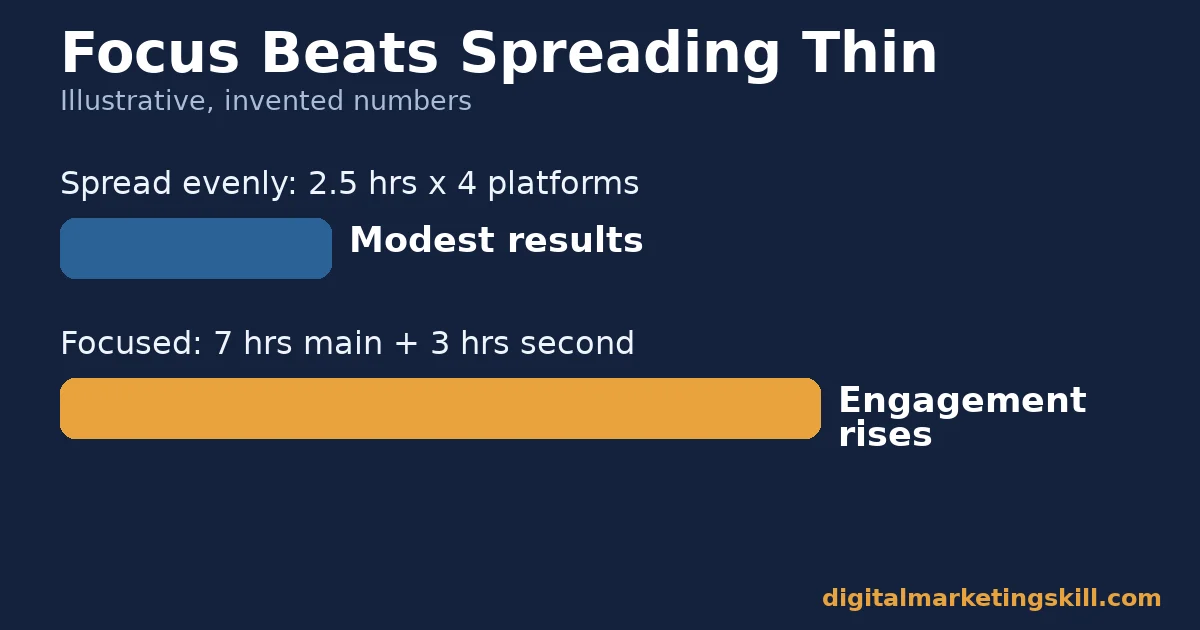
Go where your audience already spends time. Not where you personally prefer to post. Pick one or two platforms to do well, rather than four done poorly. In short, depth on one platform builds more trust than a thin presence spread across many.
Illustrative, invented numbers: picture a business splitting a 10-hour weekly budget evenly across four platforms. That’s about 2.5 hours each. Results end up modest and similar everywhere. Now picture that same business spending 7 hours on its strongest platform and 3 on a second. Engagement on the lead platform would likely rise well above the spread-thin version. Consistency and fast replies compound on a platform you can actually keep up with.
The same logic applies to a solo founder with far less time than a 10-hour budget. Even two focused hours a week on one platform, spent mostly replying rather than posting, usually beats four scattered hours spread across platforms nobody has time to properly manage.
Add A Second Platform Once The First One Works
Once your main platform shows steady engagement, add a second one that reaches a different part of your audience, rather than a near-duplicate of the first. For example, a business winning on Instagram can often add Facebook next, to reach an older or more local audience the first platform misses. Similarly, a business already strong on LinkedIn can add email next, since both audiences respond well to the same expertise-led tone.
A Real Social Media Management Case, And Its Limits
Chinelo E., a graduate of the Digital Marketing Skill Institute, now manages a $7,000 monthly ad and content budget for a US client’s social channels, as published on the Institute’s reviews page. That scale of budget is typically only trusted to someone who has already shown smaller campaigns working first.
The limits matter here. This is one named, published result, not a typical outcome. It reflects a client relationship built over time, not an overnight result from one tactic. Read it alongside the Institute’s earnings disclaimer, not as a guarantee of similar client budgets.
Still, the pattern holds a lesson. Managing a real budget responsibly, with visible reporting and fast communication, is what turns a first client into an ongoing one. Platform skill opens the door. Reliability is what keeps a client paying month after month. For anyone learning social media management as a career path, that reliability is worth practising as deliberately as any platform feature.
In fact, most of the work behind a result like this happens off the platform entirely: clear reporting, honest updates when something underperforms, and quick responses to the client’s own questions. Thus, the same habits that keep a brand’s followers engaged also keep a client relationship intact.
Frequently Asked Questions About Social Media Management
What does a social media manager actually do day to day?
A social media manager plans content, writes and schedules posts, and replies to comments and messages. They also monitor mentions and review performance data to adjust the plan. The mix shifts week to week depending on what’s working. In practice, more time goes toward replying and reviewing data than toward the original content itself. Overall, the job looks far more like ongoing customer service than like a creative-only role.
How many platforms should a small business manage at once?
Usually one or two, chosen by where the target audience actually spends time. Managing four platforms well takes far more time than managing two. A thin presence on many platforms tends to underperform a strong one on fewer. Therefore, narrowing down early is usually the better use of limited time.
How often should a business post on social media?
Consistency matters more than raw frequency. A realistic schedule you can keep up every week beats an ambitious one that collapses after a month. Quality and response speed matter more than hitting a specific post count. Even three well-made, well-supported posts a week can outperform daily posting with no follow-up.
What’s the difference between social media management and social media marketing?
Management is the ongoing operational work: posting, replying, scheduling and monitoring. Marketing is the broader strategy, including paid ads, campaigns and goals. Management is how the marketing plan gets executed day to day. In short, marketing sets the direction, and management does the daily work of getting there.
Do I need to respond to every comment?
Responding to genuine questions and complaints matters for trust. You don’t need to reply to every supportive comment. But ignoring questions or concerns damages trust faster than almost anything else on social media. Even a short, honest reply usually beats silence.
How do I know if my social media management is working?
Track engagement rate, response time, click-through rate and follower growth quality together. Don’t rely on follower count alone. A smaller, engaged audience usually beats a large, inactive one. Likewise, a rising response time is often an early warning sign worth acting on before engagement drops too.
Can social media management be outsourced affordably?
Yes, especially for one platform handled well rather than many handled thinly. Costs vary by scope. A focused presence on one or two platforms is often more affordable, and more effective, than a broad, unmanaged one. In short, paying for focus tends to produce a better return than paying for broad, shallow coverage.
Where To Learn Social Media Management Properly
Given everything above, the real skill here isn’t knowing every platform’s features. It’s reading engagement data correctly and replying fast enough to build real trust. That judgment comes from managing real accounts, not just reading about the platforms. No article, including this one, replaces the pattern recognition built by running real campaigns and real conversations over time.
Start Wherever You Are
The Digital Marketing Skill Institute’s Master Diploma in Digital & AI Marketing is built around that kind of hands-on practice. It has four AI-powered tracks: AI-Powered Social Media Management and Advertising, AI-Powered Lead Generation and Email Automation, AI-Powered Google Specialist, and AI-Powered WordPress and SEO Specialist. Together they total ten courses, with a Full Stack option for completing all four tracks.
Every track includes unlimited 1-on-1 coaching and mentoring, a U.S. Project Internship with a verified U.S. Work Reference Letter, and dual US and UK accreditation recognised in more than 100 countries. It is 100% online, so you can study from anywhere in your country.
Explore the Master Diploma program, browse more guides on the digital marketing blog, or go straight to the application page. Whatever your starting point, the team at digitalmarketingskill.com is there to help you turn social media management into a repeatable skill, wherever you live. Start today at digitalmarketingskill.com.
Every figure in this guide was checked against its original source before publication. Figures marked as illustrative are invented examples, not real results.
