
Businesses that increase sales consistently, quarter after quarter, rarely rely on one big trick. They fix eight small things that quietly cost them customers. A slow site, vague product claims and missing reviews each turn interested buyers away. This guide covers each one, the fix, and how to measure whether it worked.
Key Takeaways
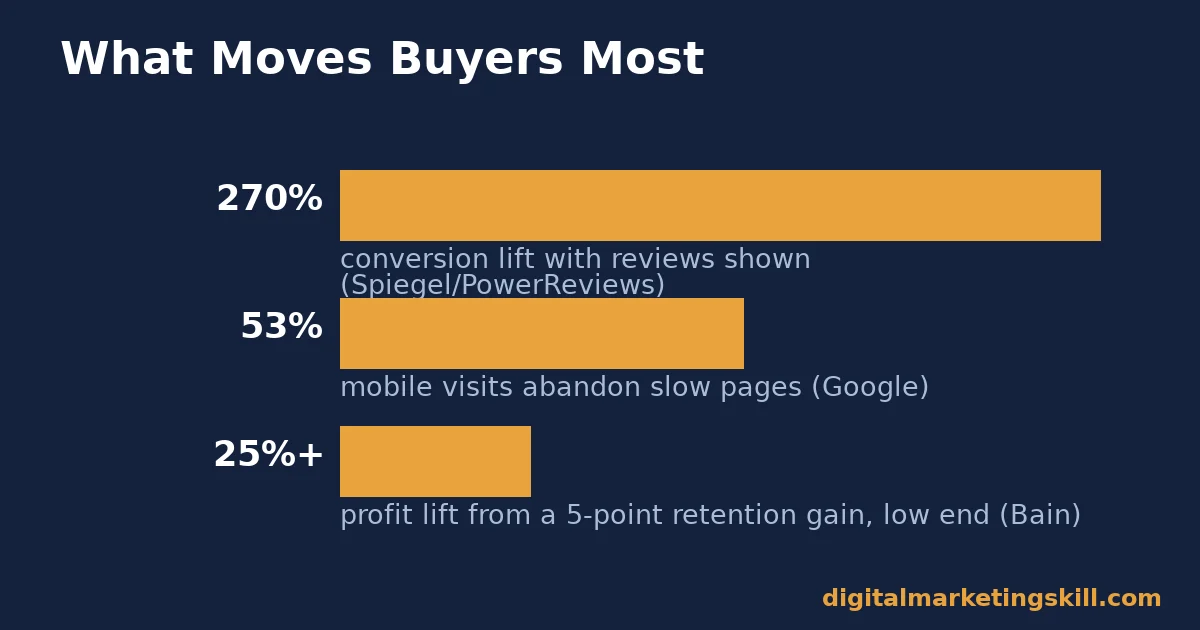
- Retention is the cheapest way to increase sales. Research by Frederick Reichheld of Bain & Company, published in Harvard Business Review, found that raising customer retention by 5% increases profits by 25% to 95%.
- Speed decides whether a visitor becomes a sale. Google’s study of over 10,000 mobile sites found that 53% of visits are abandoned if a page takes longer than three seconds to load.
- Reviews move buyers more than almost anything else on the page. The Spiegel Research Center and PowerReviews studied millions of customer experiences and found conversion rates rise by as much as 270% when reviews are displayed.
- Most shopping now happens on a phone. Statista reports mobile devices now account for the majority of retail orders, which makes a slow or cramped mobile site a direct tax on sales.
- Most checkouts are abandoned, not completed. Baymard Institute’s aggregate of 50 separate studies puts the average cart abandonment rate at 70.22%, which means fixing friction matters as much as driving traffic.
In this guide
- What Most Advice to Increase Sales Misses
- Why Sales Stall Even When You Are Trying
- Eight Tactics That Actually Increase Sales
- How to Put Each Tactic to Work
- Customers: Turn Buyers Into Repeat Buyers
- Honesty: Set Expectations You Can Keep
- Website: Build the One Page That Sells
- Speed: Fix the Three-Second Window
- Images: Show the Product as It Really Looks
- Reviews: Ask Right After the Purchase
- Social: Pick Two Platforms and Show Up
- Search: Target What Buyers Actually Type
- How to Measure Whether These Fixes Are Working
- The One Decision Rule Worth Remembering
- A Real Case: Turning a Small Ad Budget Into Sales
- Frequently Asked Questions About How to Increase Sales
- Start With the Weakest Link in Your Sales Process
What Most Advice to Increase Sales Misses
Search “how to increase sales” and you get the same list everywhere: post more, advertise more, follow up more. None of that is wrong. But it assumes the problem is effort. The real problem is usually a handful of specific leaks. Those leaks quietly turn interested buyers away before they pay.
This guide names eight of those leaks. It shows what each one actually costs. Then it pairs each one with a fix you can apply this week, not a vague instruction to “try harder.”
A quick note on the evidence. Every figure below names the company or study behind it, with its scope stated. A large traffic study and a self-reported survey carry different weight, so treat each number accordingly. The one invented example later in this guide is clearly labelled as illustrative, not a real result.
A quick self-check helps before you read further. Open your site on a phone, time how long the product page takes to load, and count how many reviews it shows. Those two numbers alone predict a lot about whether you will easily increase sales or keep struggling. Write down what you find now, so you have something to compare against once you start fixing things.
Why Sales Stall Even When You Are Trying
A sale only happens after a buyer clears several small hurdles, in order. First they find you. Next they decide to trust you. Then they reach your product quickly. Finally they check out without friction. Miss any one step, and the sale is lost, no matter how good the product is or how much you spent getting that buyer there.
Most businesses pour effort into the first hurdle: visibility through ads and content. Far fewer check whether the later hurdles are even survivable. A beautifully advertised product on a slow, review-free website still loses the sale at the final step, no matter how well the ad itself performed.
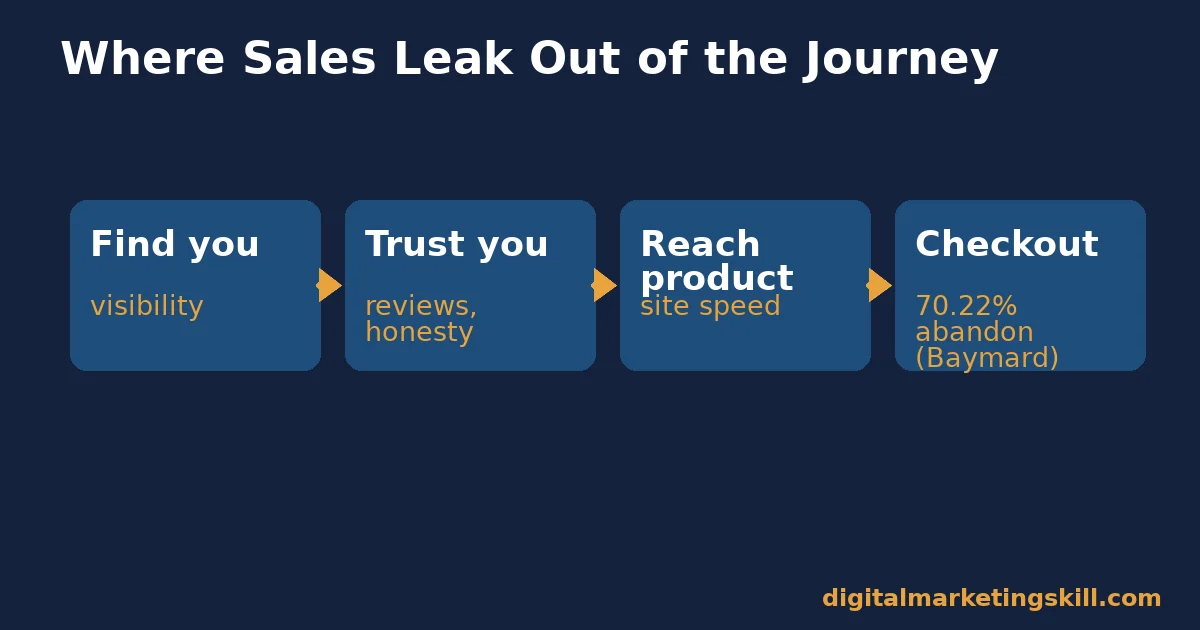
This is why order matters. A leak near the end of the journey, like checkout friction, often costs more sales than low traffic does. Fixing it first usually lifts sales faster than adding more traffic to a journey that already leaks badly.
Think of it as a funnel with holes at every stage. Pouring more visitors into the top does not help much if most of them fall through a hole near the bottom. Our guide to the digital marketing sales funnel breaks this journey down stage by stage. Patch the lowest hole first, then add traffic.
Eight Tactics That Actually Increase Sales
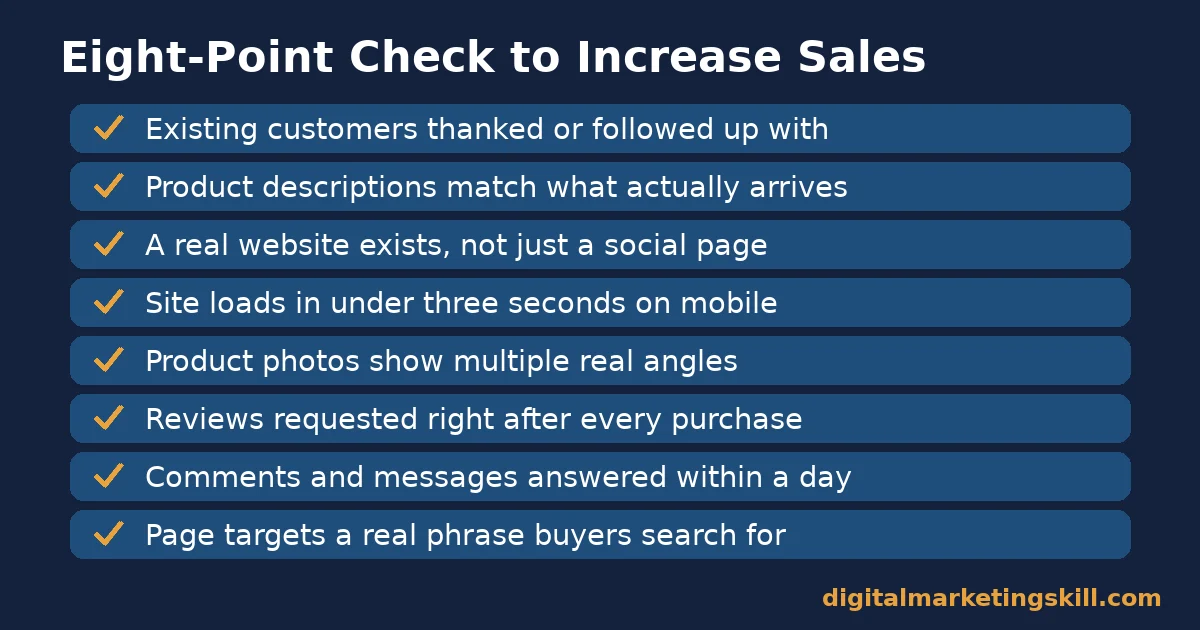
These eight areas cover the full buyer journey, from first impression to repeat purchase. Work down the list and mark which ones your business has not addressed yet. Most businesses that struggle to increase sales are missing two or three of these, not all eight, so this check usually takes less time than expected.
1. Appreciate Your Existing Customers
New customers get most of the marketing budget. Yet existing customers are far cheaper to sell to again. Reichheld’s research, cited above, explains why. A small lift in retention produces an outsized lift in profit, because you are not paying to win the same person twice.
A short thank-you message helps. So does a small bonus, or simply remembering a past order. Each does more for lifetime value than another discount aimed at strangers who have never bought from you.
2. Be Honest About the Product
Overselling a product gets the first sale and loses the next ten. When a buyer receives something that does not match the listing, they rarely say so quietly. They leave a public review, and that review is now part of your sales page for every future visitor.
Describe the product as it is, including its limits. A buyer who knew what to expect rarely asks for a refund, and a refund avoided is a sale kept.
3. Build a Real Website
A social media page is not a replacement for a website you control. Algorithms change. Accounts get restricted. A page’s layout is not yours to redesign around what actually converts visitors into buyers.
A website gives you a permanent address, a checkout you control, and a place search engines can actually index. It does not need to be elaborate. What it needs is speed, and a clear explanation of what you sell within the first screen a visitor sees. Even one well-built page beats five accounts on platforms you do not fully control.
4. Make the Site Fast on Mobile
Most retail traffic today arrives on a phone, often on a mobile connection slower than office wifi. Google’s research, cited above, found that over half of mobile visits leave if a page takes more than three seconds to load.
A slow site is not a minor technical detail. It is a sale that never gets the chance to happen, because the buyer left before your product even rendered on screen.
5. Use Quality Product Images
A buyer cannot touch the product, so the image has to do that job alone. Blurry, inconsistent or overly staged photos create the same mismatch problem as an overselling description. The buyer expects one thing and worries about getting another.
Show the product from multiple angles. Show it in use where relevant, at a size the buyer can actually examine closely. This single fix is inexpensive, and it directly reduces the hesitation that kills a sale at the last second.
6. Collect and Show Real Testimonials
The Spiegel Research Center and PowerReviews study, cited above, found conversion rates rise by as much as 270% when reviews appear on a product page. A handful of specific, real reviews outperforms a polished sales paragraph the business wrote about itself.
Buyers trust other buyers more than they trust you. That is exactly why this tactic works, even on a page where nothing else has changed.
7. Engage Your Audience on Social Media
Posting on social media without replying to comments or messages is a one-way broadcast, not marketing. Buyers who ask a question and get no answer rarely ask twice. They simply buy from whoever did answer them.
Consistency matters more than volume here. A smaller account that replies quickly builds more trust than a larger one that posts often but goes silent in the comments.
8. Optimize for Search
Ahrefs studied roughly one billion pages and found 96.55% earn zero traffic from Google, usually because the content never targeted a real search phrase. A product nobody can find cannot increase sales, no matter how good it is.
Search engine optimization for a sales page means matching the exact words a buyer types, not clever branding. Our guide on on-page SEO covers the technical side in depth.
How to Put Each Tactic to Work
Each fix below mirrors the tactic above it. Start wherever your business is weakest, since fixing one leak can lift sales within weeks.
Customers: Turn Buyers Into Repeat Buyers
Set up one simple habit: a short note or email a few days after every purchase, asking if everything arrived as expected. This single touch catches problems early and reminds the buyer you are there for the next purchase too.
Honesty: Set Expectations You Can Keep
Honesty is cheap to practice. A returned sale costs far more than the honesty would have.
Before publishing any product description, ask whether a buyer who read it closely would be surprised by what arrives. If the answer is yes, rewrite it. A boring, accurate description beats an exciting, misleading one every time a refund is counted.
Website: Build the One Page That Sells
If you only build one page, make it the product or service page a buyer lands on from an ad or a search result. It needs a clear headline, one strong image, the price, and a single obvious next step.
Speed: Fix the Three-Second Window
Run your site through a free mobile speed test and fix whatever it flags first: usually oversized images or unnecessary scripts. This is often the highest-leverage fix on this entire list, because it affects every single visitor, not just one segment.
Images: Show the Product as It Really Looks
Photograph the product in natural light, from the angles a buyer would check in person, and avoid heavy filters that misrepresent color or size. If you sell a service, use real screenshots or real work samples instead of generic stock graphics.
Reviews: Ask Right After the Purchase
Ask for a review at the moment satisfaction is highest, right after delivery or completion. Asking weeks later means asking after the memory has faded. Make the process one click; every extra step you add cuts how many buyers actually follow through. Our guide on what customer reviews are and how to get good ones covers the request wording that works best.
Social: Pick Two Platforms and Show Up
Choose the one or two platforms where your buyers already spend time, and commit to answering every comment and message within a day. Close or pause accounts you cannot keep up with; an abandoned account reads worse than no account at all.
Search: Target What Buyers Actually Type
List the exact phrases a buyer would type when they already want what you sell, not just your brand name. Write or edit one page to answer that exact phrase clearly, with the product or offer named near the top.
How to Measure Whether These Fixes Are Working
Each metric below is defined in one sentence, with a note on how to read it. Use them alongside whatever sales or analytics tool you already have. None of these require expensive software to track; a free analytics tool and your existing order history cover most of them.
- Conversion rate. This is the share of visitors who complete a purchase. A rising rate, with traffic held steady, shows the page itself is working better.
- Checkout abandonment rate. This is the share of started checkouts that never finish. A falling rate shows the speed and friction fixes are paying off.
- Repeat purchase rate. This is the share of customers who buy again within a few months. A rising rate shows the appreciation and honesty fixes are building trust.
- Review count and rating. Track both together. A rising count with a steady or rising rating shows the ask-for-reviews habit is working without masking a real problem.
- Average page load time on mobile. Most free analytics tools report this. Falling load times should track with a falling bounce rate on the same pages.
How to Read These Numbers Together
Read these together, not one at a time. When conversion rate is flat but checkout abandonment is falling, friction fixes are working and the next lever is traffic or offer strength. When repeat purchase rate stays flat despite more reviews, revisit the honesty and customer-appreciation fixes first.
Check these numbers monthly rather than daily. A single day of unusual traffic can make any one metric look better or worse than it really is. A month of data smooths out that noise and shows whether a fix genuinely helped you increase sales, or whether the change was within normal variation.
The One Decision Rule Worth Remembering
If you fix only one thing after reading this guide, fix page speed first. It touches every visitor, on every channel, before any other tactic even gets a chance to work.
Here is an illustrative example, with invented numbers. A shop gets 1,000 mobile visitors a month and converts 2%, for 20 sales. Its product page takes five seconds to load. After compressing images and removing unused scripts, the page loads in two seconds. The same 1,000 visitors now convert at 3.4%, producing 34 sales from the same traffic and the same ad spend.
Nothing about the product changed. Removing one piece of friction let more of the existing traffic finish what it already intended to do. That is the pattern worth remembering whenever you look for a fast way to increase sales: fix what is already broken before you pay for more visitors to find it.
A Real Case: Turning a Small Ad Budget Into Sales
Ayooluwa Osemi, a graduate of the Digital Marketing Skill Institute profiled in its published student reviews, described spending around $14 on a small Facebook and Instagram ad test and generating roughly $878 in sales from it.
The campaign worked because he matched the offer, the audience and the landing experience before the ad ever ran, not after. That sequencing meant none of the small budget went to waste sending traffic to a page that still needed basic fixes.
The lesson generalizes well beyond paid ads specifically. A small, well-targeted test that respects the buyer journey outperforms a larger budget poured into a page still leaking at checkout or speed. Read the full set of student outcomes on the DMSI reviews page; results vary by effort, market and starting point, and are not a guarantee of income, consistent with our earnings disclaimer.
Frequently Asked Questions About How to Increase Sales
What is the fastest way to increase sales?
Fixing page speed and checkout friction usually shows results fastest, because it improves conversion on traffic you already have, without needing a bigger ad budget.
Do customer reviews actually increase sales?
Yes. Research from the Spiegel Research Center and PowerReviews found conversion rates can rise by as much as 270% when reviews are displayed, because buyers trust other buyers more than a brand’s own claims.
Should I spend more on advertising to increase sales?
Only after fixing the obvious leaks first. More traffic sent to a slow page or one with no reviews mostly pays for visits that never convert.
How important is mobile speed for increasing sales?
Very. Google’s research found over half of mobile visits are abandoned if a page takes longer than three seconds to load, and most retail traffic now arrives on mobile.
Is it better to focus on new customers or existing ones?
Existing customers usually offer the better return. Research cited in this guide shows a small lift in retention produces a large lift in profit, because you are not paying acquisition costs again.
What is a good cart abandonment rate?
The industry average sits around 70%, so do not panic at that figure alone. Compare your own rate over time and focus on reducing it, rather than chasing a number far below the typical range.
Can small businesses increase sales without a big budget?
Yes. Several tactics in this guide, honesty, reviews, speed fixes and customer appreciation, cost little beyond time and directly affect conversion on the traffic a business already has.
How often should I review my sales metrics?
Check conversion rate, abandonment and repeat purchase rate monthly, not daily. Daily numbers swing too much from normal traffic variation to tell you whether a specific fix actually worked.
Does a nicer website design increase sales on its own?
Design helps, but speed and clarity usually matter more. A plain page that loads fast and explains the offer clearly will often outsell a beautiful page that loads slowly or buries the point.
Start With the Weakest Link in Your Sales Process
You do not need to fix all eight tactics at once to increase sales. Identify the one where your business leaks the most buyers, fix it, then measure for a month before moving to the next. Small, sequential fixes compound faster than a single large overhaul, and they are far easier to measure honestly one at a time.
If you want structured, hands-on practice with this, the Digital Marketing Skill Institute’s Master Diploma in Digital & AI Marketing is built around four AI-powered tracks: AI-Powered Social Media Management and Advertising, AI-Powered Lead Generation and Email Automation, AI-Powered Google Specialist, and AI-Powered WordPress and SEO Specialist. Together they total ten courses, with a Full Stack option for completing all four.
The program includes unlimited 1-on-1 coaching and mentoring, a U.S. Project Internship with a verified U.S. Work Reference Letter, and dual US and UK accreditation recognised in more than 100 countries. It is 100% online, so you can learn and apply these tactics to increase sales from anywhere in your country, at your own pace.
Learn more about the Master Diploma program, browse the digital marketing blog for more practical guides, or go straight to the application page to get started. Explore everything the Institute offers at digitalmarketingskill.com, wherever you live, and come back to digitalmarketingskill.com any time you need the next guide.
Every figure in this guide was checked against its original source before publication. Figures marked as illustrative are invented examples, not real results.
