
An online marketing strategy is the plan that decides which channels earn attention. It also decides which page converts that attention, and how you prove which parts paid off. Most plans list tactics only. They skip the proof step. Budget then drifts toward the loudest channel instead of the one that actually works.
Key Takeaways
- Marketing budgets average around 7.7% of company revenue. Paid media takes roughly 30.6% of that budget (Gartner CMO Spend Survey).
- 75.5% of marketers prefer a multi-touch attribution model. Most tools still default to single-touch reporting (Ruler Analytics).
- 90.2% of marketers use Google Analytics 4 as their main tool, and 63.5% base most decisions on it, even though its default view favors the last click (Ruler Analytics).
- 62% of marketers who generate phone-call leads say they struggle to trace those calls back to a channel (Ruler Analytics).
- Moving from position two to position one in search brings about 50% more organic traffic on average (Semrush).
In this guide
- The Online Marketing Strategy Gap Most Plans Miss
- How An Online Marketing Strategy Actually Compounds
- What Differs By Business Stage
- Fix Your Online Marketing Strategy, By Stage
- Measure What Matters For An Online Marketing Strategy
- The One Decision Rule
- A Real Case, And Its Limits
- Frequently Asked Questions About Online Marketing Strategy
- Your Next Step With Online Marketing Strategy
The Online Marketing Strategy Gap Most Plans Miss
A strategy document and a working system are not the same thing. Many businesses have a slide listing SEO, social, email and ads. Few can say which one actually produced a sale.
This guide is an informed inference. It is built from budget and attribution research, not a settled fact for every business. Results vary by industry, sales cycle and how much a team can measure.
An online marketing strategy only compounds when three things exist together. Channels reach the right audience. A page converts that attention. A measurement habit shows which channel deserves more budget next quarter.
Skipping the third part is the most common mistake. A business can run five channels at once and still not know, a year later, which one is worth keeping.
Marketing budgets are not small. They average around 7.7% of company revenue, with paid media alone taking roughly 30.6% of that total (Gartner CMO Spend Survey, via Sender). Running an online marketing strategy at that scale without a way to prove what it returns is a bigger risk than most businesses treat it as.
How An Online Marketing Strategy Actually Compounds
Three layers make a strategy work together instead of as five separate experiments.
The first layer is reach: content, SEO, social and ads that put the business in front of the right audience. The second layer is conversion: the landing pages, forms and offers that turn reach into a lead. Attribution is the third layer: the habit of tracking which touchpoints actually led to a sale.
Most businesses invest almost entirely in the first layer. They publish content and run ads, then stop there. Without the third layer, every result looks like a guess. Nobody can trace a sale back to the touchpoints that caused it.
This is not a small gap. It is the difference between a strategy that gets better every quarter and one that resets to zero every quarter. Nobody carried forward a reliable lesson about which channel actually earned its spend.
Why Single-Touch Reporting Misleads
90.2% of marketers use GA4 as their main tool. 63.5% base most decisions on it, per Ruler Analytics. GA4’s default view leans toward the last click. The touches that came before get little credit.
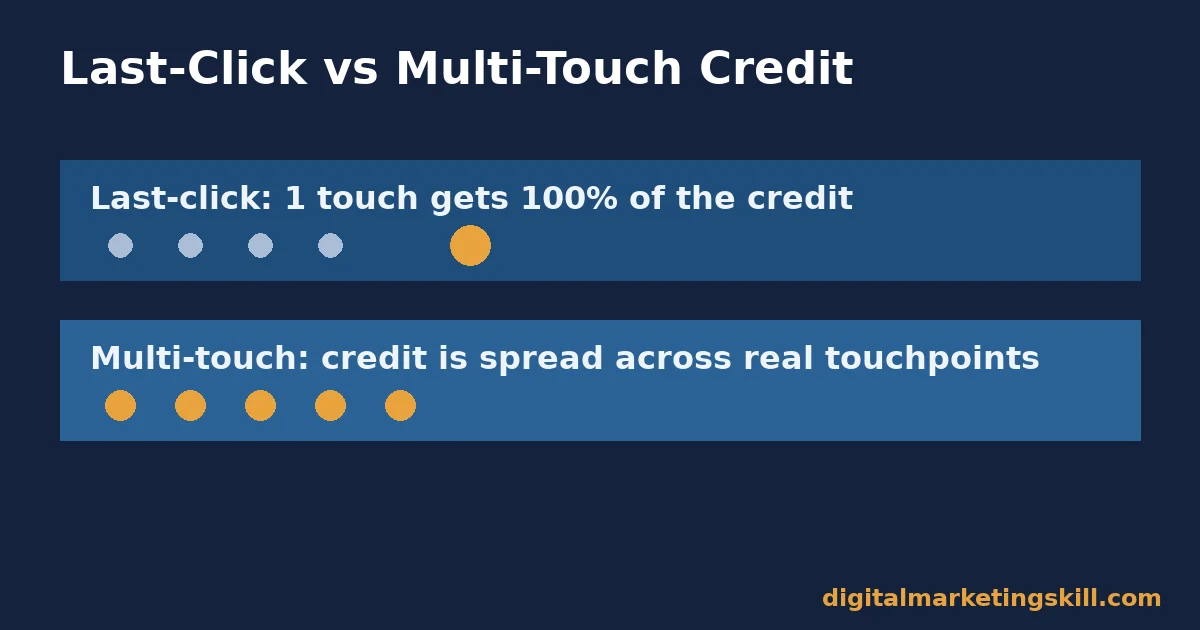
Picture a customer who reads three blog posts, opens two emails, then searches the brand name directly. Under last-click reporting, that final branded search gets all the credit. The three posts and two emails that built the decision get none.
This matters because budget usually follows credit. If the final click gets all the credit, the earlier touches that built the decision look like they did nothing. They get cut first when budget tightens.
The Attribution Gap Most Teams Accept
75.5% of marketers say they prefer a multi-touch model that credits more than one touchpoint. Roughly 52% report actually using one in practice (Invoca, citing MMA Global research). Multi-touch setups take more work to configure correctly. That gap between preference and practice is why many teams never get around to it.
Phone calls make this worse for service businesses. 62% of marketers who generate call leads say they cannot reliably trace those calls back to a channel (Ruler Analytics). A channel that drives real calls can look like it produces nothing at all.
The fix does not require expensive software. Use a dedicated phone number per major campaign. Pair it with a simple log of where each caller said they found the business. Together, these close most of the gap without a large budget.
What Differs By Business Stage
An early-stage business and an established one need the same three layers. The order they build them in should be different.
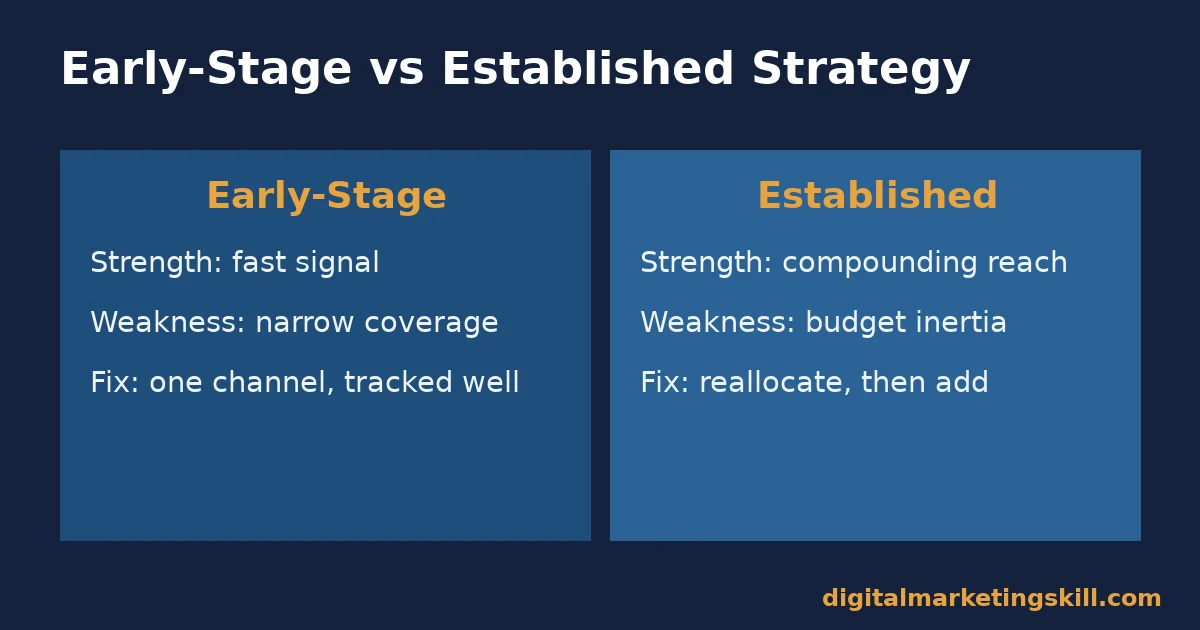
Early-Stage: Built For Fast Signal
A new business has no history to analyze. Speed of signal matters more than channel mix early on. One or two channels, run well and measured closely, teach more in eight weeks than five channels run loosely.
The weakness is coverage. A narrow channel mix misses audience segments a broader strategy would reach. Growth can plateau once the first channel’s easy wins run out.
Treat that plateau as a signal, not a failure. It usually means the first channel has taught what it can teach, and it is time to add a second channel with the same discipline, rather than switching away from the first one entirely.
A new business also has a cost advantage worth using: nobody expects a complex dashboard yet. A simple spreadsheet tracking spend, leads, and the answer to “how did you hear about us” is often more honest. Larger companies often inherit attribution reports built from years of patched-together tools, and those reports can mislead more than a clean spreadsheet does.
Established: Built For Compounding Reach
An established business has enough order history to build real attribution. It can afford to run more channels at once and trust the data to show which ones pull their weight.
That history is an asset most established businesses underuse. Years of past sales data can reveal patterns a newer business has no way to see yet, like which combination of channels tends to precede a large order rather than a small one.
The weakness is inertia. Budget tends to stay with whichever channel got the most credit previously. A multi-touch view would often show a different channel deserves more, but changing an established budget line takes more internal justification than starting a new one.
This inertia compounds over time. Each year the under-credited channel gets a smaller test budget, which produces smaller results, which makes it look even less worth funding the year after. Breaking that cycle usually takes a deliberate reallocation decision, not a gradual shift.
A practical trigger helps here: schedule one fixed meeting a year whose only job is to compare multi-touch attribution against the current budget split. Without a fixed trigger, this review quietly never happens, because every other meeting has a more urgent agenda item competing for the same hour.
Fix Your Online Marketing Strategy, By Stage
The fix for each stage targets its specific weakness, not a generic “do more everywhere” plan. Both versions of an online marketing strategy share the same underlying habit: measure before you expand.
Early-Stage: Lead With One Proven Channel
Pick the one channel most likely to reach your specific buyer, not the one that is trendiest. Run it consistently for at least eight weeks before judging it. Most channels need that long to produce a stable, readable pattern.
Resist the urge to add a second channel in week three because the first one feels slow. Switching early is the single most common reason an early-stage online marketing strategy never produces a clear result.
Set up basic multi-touch tracking from day one. UTM tags on every campaign link, following a consistent naming pattern, let analytics tools separate one campaign’s traffic from another’s instead of lumping it all together (Google Analytics help). A simple spreadsheet logging which touchpoints a new customer mentions covers the gaps UTM tags cannot reach, like a word-of-mouth referral. This habit is far easier to start early than to retrofit later.
Established: Lead With Reallocation, Not Addition
Before adding a new channel, build a proper multi-touch view of the channels already running. Reallocating existing budget toward what the data actually shows usually outperforms adding a new channel on top of an unmeasured mix.
Fix phone-call attribution specifically if your business takes sales calls. Call tracking numbers tied to campaigns close the 62% tracking gap. They often reveal that an under-credited channel, frequently content or organic search, is driving far more calls than the last-click report shows.
Document the reallocation decision itself, not just the new numbers. Write down why a channel’s budget changed, what the multi-touch data showed, and what result would count as proof the change worked. This record is what turns one good decision into a repeatable process the team can run again next time.
Measure What Matters For An Online Marketing Strategy
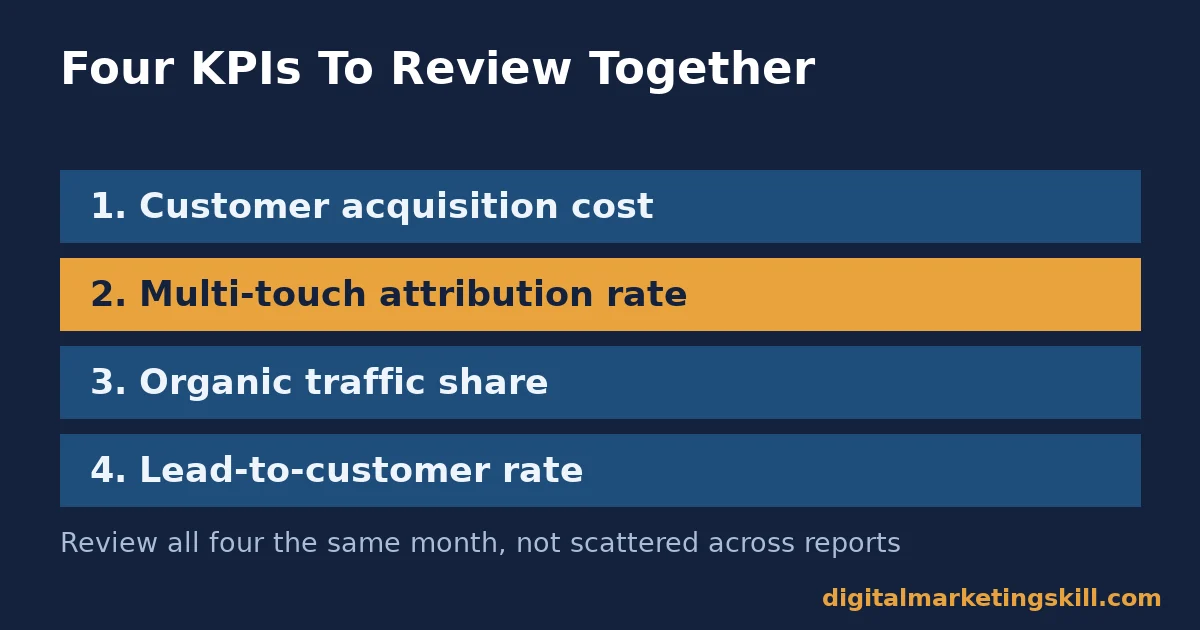
Four numbers show whether an online marketing strategy works as a system, not just produces isolated wins. Track all four the same month, not scattered across different reports.
- Customer acquisition cost (CAC): total marketing spend divided by new customers. Track it by channel and in total. A channel can look cheap alone and expensive once its full multi-touch contribution is counted.
- Multi-touch attribution rate: the share of conversions where you can reconstruct more than one real touchpoint. A rate near zero means budget decisions rest on last-click data alone.
- Organic traffic share: the percentage of total traffic coming from unpaid search. This number rises slowly and keeps rising after spend stops, unlike paid traffic.
- Lead-to-customer rate: the share of marketing-qualified leads that become paying customers. This number exposes a conversion-layer problem even when reach and attribution both look healthy.
Review all four together, not one at a time. A strong CAC with a weak lead-to-customer rate often means the channel is fine but the sales process after it is not. A weak organic traffic share next to a strong paid CAC often means the business is renting its traffic instead of owning any of it.
Set a baseline for each number before judging any change. A CAC that moves from $80 to $95 means little without knowing whether $80 was already unusually low for that channel. A baseline turns a single data point into a trend worth acting on.
The One Decision Rule
If a channel’s CAC looks high under last-click reporting but your multi-touch attribution rate is low, do not cut that channel yet. Fix the attribution first, then decide.
Illustrative, invented numbers: a content channel shows a last-click CAC of $400 against a $150 target. On paper it looks like a clear cut. Under a multi-touch view, that same channel turns out to assist 40% of sales that close through a different final channel. Its real CAC, once assisted sales are counted, falls closer to $140.
Cutting it on the last-click number alone would have removed a channel that was actually working. That is why the rule points at the measurement first, not the channel.
This mistake is common because last-click numbers are easy to pull and multi-touch numbers take setup work. The easy number wins by default, even when it points the wrong way. Build the harder view before making a cut you cannot undo.
The reverse applies too. If multi-touch attribution is already solid and a channel’s CAC is still above target, the channel itself is the problem. Cut or restructure it with confidence, since the data has already ruled out a measurement error as the cause.
A Real Case, And Its Limits
Ayooluwa Osemi, a Digital Marketing Skill Institute graduate, spent $14 on Facebook and Instagram ads for a client. That spend generated $878 in sales, as published on the Institute’s reviews page.
Content marketing shows a similar pattern at scale. 70% of B2B marketers report that it generates leads effectively (DemandSage). That only matters if those leads can be traced through to a sale, not just counted as a form fill.
This case is a single paid-social campaign, not a full multi-channel strategy. One result does not predict another business’s outcome. It is included because it shows a measured, attributable result: a specific spend tied to a specific return. That is the habit this guide argues every channel needs, not just the one that happens to convert obviously.
What this case does not show: whether other channels assisted that sale, what cost looks like at a larger budget, or whether the result repeats across a full quarter.
Treat it as an example of measurement discipline, not a guaranteed return. The habit of writing down the exact spend and the exact result is what makes the case usable at all, whatever the industry or channel. See the earnings disclaimer for how to read student results generally.
Frequently Asked Questions About Online Marketing Strategy
How many channels should an online marketing strategy include?
Start with one or two and measure them properly before adding more. A five-channel strategy with no attribution teaches less than a one-channel strategy that is actually tracked.
Is multi-touch attribution worth setting up for a small budget?
Yes, even a basic version. A spreadsheet that logs which touchpoints a new customer mentions costs nothing. It already beats relying on last-click data alone, which 63.5% of marketers do by default (Ruler Analytics).
Should paid ads or organic content come first in a new strategy?
Paid ads produce faster signal, which helps when a business needs to learn quickly. Organic content takes longer but keeps producing traffic after spend stops. Most strategies benefit from starting both, at a smaller scale, rather than only one.
How long before a channel’s results are trustworthy?
At least eight weeks of consistent activity, longer for channels with a slow sales cycle. Judging a channel after two weeks usually reflects random variation more than real performance.
What is the biggest sign that a strategy needs to change?
A customer acquisition cost that keeps rising while the multi-touch attribution rate stays flat or falls. That combination means spend is increasing without a matching gain in traceable results.
Does ranking position actually matter for an online marketing strategy?
Yes. Moving from position two to position one in search results brings about 50% more organic traffic on average (Semrush). That is a meaningful compounding gain for a channel that keeps paying off long after the work is done.
Should every lead be tracked through to a sale?
As many as practically possible. Even an imperfect system that traces most leads back to a channel is far more useful for budget decisions than a system that only captures the final click. Perfection is not the goal here. Coverage is.
What tools does an online marketing strategy need to start measuring correctly?
A free analytics tool, a UTM naming convention everyone on the team follows, and a shared spreadsheet are enough to begin. Paid attribution software helps once the channel count and budget grow large enough that a spreadsheet becomes hard to maintain by hand.
What is the single easiest first step for a small business?
Add UTM tags to every link used in marketing and ask every new customer one question: how did you first hear about us? That answer alone catches touchpoints that analytics tools miss entirely.
Can a small business run an online marketing strategy without hiring an agency?
Yes, especially in the early stage. The habits that matter most, consistent posting on one channel, UTM tags, and a simple customer-source log, cost time rather than money. An agency becomes more useful once there are enough channels and enough budget to justify managing them full time.
How often should an online marketing strategy be reviewed?
Monthly for the four KPIs above, with a deeper quarterly review that looks at whether budget allocation still matches what the data shows. Reviewing only once a year lets a losing channel run far longer than it should.
Your Next Step With Online Marketing Strategy
Building a measurable online marketing strategy, across content, paid channels and attribution, is covered across the Institute’s Master Diploma in Digital & AI Marketing. The AI-Powered Google Specialist track and the AI-Powered Social Media Management and Advertising track both apply directly, with a Full Stack option covering all four tracks together.
The program includes unlimited 1-on-1 coaching and mentoring, a U.S. Project Internship with a verified U.S. Work Reference Letter, and dual US and UK accreditation recognised in more than 100 countries. It runs 100% online from anywhere in your country.
Read more student outcomes on the reviews page, browse the blog for more guides like this one, or go straight to apply to start. Wherever you live, the program runs fully online. Explore Digital Marketing Skill Institute to see the full curriculum, and visit digitalmarketingskill.com for the rest of the blog.
For related guides, see our content marketing guide, our lead generation guide, and our guide to website SEO tips.
Every figure in this guide was checked against its original source before publication. Figures marked as illustrative are invented examples, not real results.
