
Content marketing strategies turn scattered blog posts and social updates into one repeatable plan. A good content marketing strategy names the audience, the formats and the way results get measured. Most organisations now have one, but few call it a clear success. This guide explains why, and gives a method you can copy.
Key Takeaways
Once the strategy is live, you still need to prove it works. See how to measure content marketing with a short scorecard instead of a long list of vanity numbers.
- Only 29% of marketers with a documented content strategy call it extremely or very effective, per Content Marketing Institute’s benchmarking research. A plan on paper is not the same as a plan that works.
- Marketers who call their content marketing extremely successful credit audience understanding (82%) and content quality (77%) well above the strategy document itself (47%).
- 96.55% of roughly 14 billion pages studied by Ahrefs get zero monthly Google traffic. Reach is a volume problem, not only a quality one.
- 42% of marketers name repurposing content into new formats as a reason their content marketing strategy succeeds, per Semrush’s research.
- Measuring ROI is the single most reported obstacle for marketers, named by a third of respondents in HubSpot’s State of Marketing research.
In this guide
- Why Content Marketing Strategies Underperform Their Own Plan
- How A Content Marketing Strategy Actually Works
- How Content Marketing Strategies Differ By Format
- How To Lead With Each Content Format
- How To Measure A Content Marketing Strategy
- The One Decision Rule For Prioritising Content
- A Real Case: What A Documented Approach Changed
- Frequently Asked Questions About Content Marketing Strategies
- Turning A Content Marketing Strategy Into A Habit
Why Content Marketing Strategies Underperform Their Own Plan
A strategy document and a working strategy are two different things. Content Marketing Institute’s B2B benchmarking research found that 29% of marketers with a documented content strategy call it extremely or very effective. 58% call it only moderately effective, while 13% call it ineffective.
So the gap sits between writing the plan and running it against real audience behaviour. It shows up in the same recurring content marketing challenges most teams face, no matter how polished the document looks.
Two Ground Rules Behind This Guide
Two ground rules keep this guide honest.
First, treat every percentage below as a directional signal, not a universal law. Survey panels skew toward marketers who already pay attention to content, and most large benchmarking studies lean on North American and B2B respondents. So a figure that fits a large enterprise team will not always fit a solo marketer.
Second, a content marketing strategy is a living plan, not a one-time document. The sections below describe a method to revisit often, not a form to file away once and forget.
Content Marketing Institute’s research also names what separates the minority who call their strategy extremely successful. 82% point to understanding their audience, and 77% point to producing high-quality content. 70% point to industry expertise, while 69% point to a strong team.
A documented strategy itself ranks lower, at 47%, which means the document matters less than what sits underneath it. In practice, that underlying work is what the rest of this guide on content marketing strategies breaks into a repeatable method.
How A Content Marketing Strategy Actually Works
A content marketing strategy connects three decisions. Who is the content for? What will you say to them, and in which formats? How will you know it worked?
The strategy sits above a content calendar, which only schedules dates, and above a single campaign, which is just one execution of the plan. For a fuller walkthrough of what belongs in that document, see what a content marketing strategy actually includes.
The Four-Part Loop
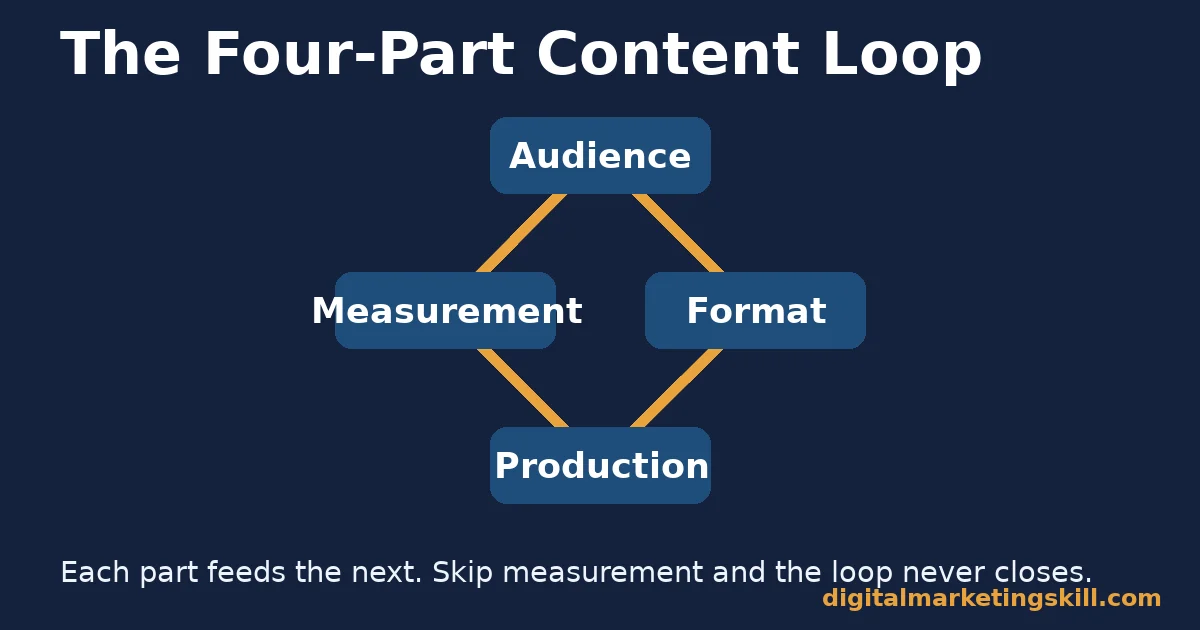
Four parts drive the mechanism behind every working content marketing strategy, and they run as a loop rather than a straight line:
- Audience definition. A written description of who the content serves, the problem they face, and where they look for answers.
- Format and channel selection. A choice between written, video, audio, visual or social content, matched to each stage of the audience’s decision.
- Production and distribution. The actual creation, publishing and promotion work, including how much content is new versus repurposed.
- Measurement and iteration. A short list of KPIs, checked on a fixed schedule, that tells you which topics and formats to repeat.
Recent B2B research from Content Marketing Institute and MarketingProfs surveyed 1,015 marketers, mostly North American. It found that 95% of respondents now use AI tools somewhere in that loop. Among those users, 87% report a productivity gain, and 58% report a quality improvement.
The same research names three friction points: prompting action from the audience (40%), limited resources (39%) and measuring effectiveness (33%). Each sits inside one of the four parts above, just under strain. That is exactly why a content marketing strategy needs the loop checked often, not built once and left alone.
Signs A Content Marketing Strategy Needs A Reset
A few warning signs show up well before a quarterly review catches them. Watch for these four, because each points back to one part of the loop above:
- Traffic grows, but leads do not. The audience definition or the conversion step has drifted apart from the content being produced.
- Every piece covers the same one or two topics. Production has outrun format and channel selection, so the strategy repeats itself instead of covering new ground.
- Nobody can say which post drove a sale last quarter. Measurement exists on paper but is not tied to a specific, agreed KPI.
- The content calendar changes every week. Without a stable audience definition, production reacts to trends instead of following a plan.
Content Marketing Strategies By Team Size
Team size changes execution, not the method itself. A solo marketer and a ten-person team need the same four parts, scaled differently. A solo marketer should narrow the strategy rather than skip it. Pick one clearly defined audience, lead with one or two formats consistently, and review the same four KPIs on schedule. That narrow plan is easier to sustain than a scattered, five-format calendar built for a bigger team.
A larger team can run more formats at once, but only if each one still reports back to the same audience definition and the same measurement rules. Without that shared base, a bigger team produces more content marketing strategies on paper and fewer that actually connect to each other.
How Content Marketing Strategies Differ By Format
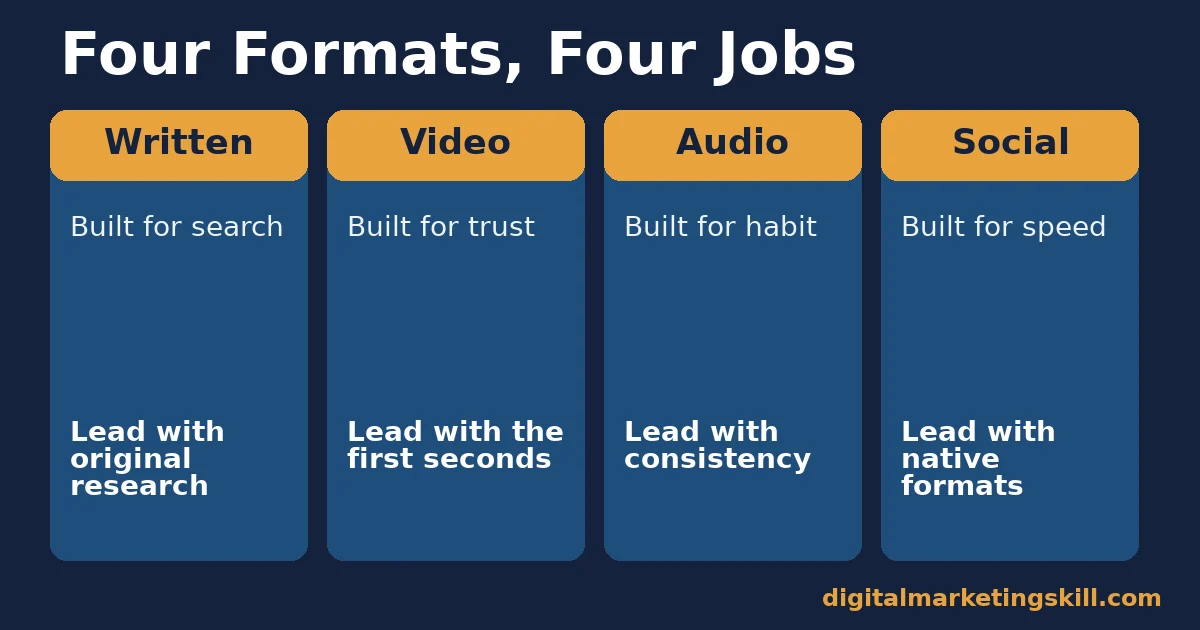
Four content formats sit behind most content marketing strategies: written, video, audio and social. They are not interchangeable, and treating them as interchangeable is one of the fastest ways a strategy loses its audience. Instead, each format fits a different moment in how people decide, search and scroll. A broader look at content marketing as a discipline covers this idea in more depth.
Written Content: Built For Search And Depth
Written content, including articles, guides and newsletters, earns search traffic and holds detail a reader can scan or skip around. The Nielsen Norman Group’s eyetracking research across multiple studies found that readers scan text in an F-shaped pattern. They read the first lines and the first words of each line more closely than the rest. That is why structure and subheadings carry as much weight as the sentences themselves.
Video Content: Built For Attention And Trust
Video demonstrates rather than describes. That makes it well suited to product walkthroughs, interviews and short explainers. Its cost is also its limit. One video takes longer to plan, shoot and edit than a written piece on the same topic. Most strategies reserve video for the highest-value few topics rather than the full calendar.
Audio Content: Built For Habit And Intimacy
Audio content, chiefly podcasts, builds habit. A listener who subscribes hears the same voice on a predictable schedule, in a format that fits around other tasks. That makes audio strong for building familiarity over months. It is weak for anyone searching for a quick, specific answer right now.
Social Content: Built For Reach And Speed
Social content moves fast inside platforms the audience already opens daily. DataReportal’s global digital research puts active social media users at 5.66 billion people, 68.7% of everyone on Earth. A strategy with no native social component misses most of that daily attention. The trade-off is a short shelf life. A social post usually fades within days. A written article can keep earning search traffic for years.
How To Lead With Each Content Format
Knowing what each format suits is only half of any content marketing strategy. The other half is which lever to pull first inside each one, because the same format can succeed or fail depending on what leads it.
Written Content: Lead With Original Research Or A Clear Answer
Google’s own guidance on people-first content asks creators one direct question. Does the content show depth that a reader cannot get from a dozen pages that already rank?
Ahrefs’ search traffic study of roughly 14 billion pages found that 96.55% get no monthly Google traffic at all. Most repeat an existing answer instead of adding one.
So leading with an original figure, a named example or a genuinely new angle is what moves a written piece out of that majority inside a working content marketing strategy. It is the same discipline behind writing for generative engine optimization, not classic search alone.
Video Content: Lead With The First Few Seconds
Video asks for continuous attention, not a glance. The opening seconds decide whether anyone finishes the rest. Lead with the outcome or the most useful moment instead of a slow introduction. That protects the format’s biggest cost: production time.
Audio Content: Lead With Consistency Over Production Value
Audio’s advantage is habit, so a strategy gets more from a predictable schedule than from a bigger production budget. A simple episode that publishes on the same day every week builds a listening habit. An occasional, polished one does not.
Social Content: Lead With Native Formats And Fast Iteration
Social content’s shelf life is short, so the format rewards fast, frequent posting in each platform’s native style, not a repurposed static link. That fast feedback loop has a second job inside measurement: it shows which topics deserve a deeper, longer-lived written or video piece next.
How To Measure A Content Marketing Strategy
A content marketing strategy needs a short list of KPIs. Define each one in a single sentence, and review all of them on the same schedule every time.
- Organic traffic. Visits arriving from unpaid search results, read monthly to catch both growth and sudden drops after a search algorithm change.
- Engagement rate. The share of viewers who take an action, such as a read, a click or a comment, which separates reach from real interest.
- Lead or email conversion. The share of content visitors who complete a defined next step, such as subscribing, which connects content to pipeline rather than traffic alone.
- Content ROI. The value a piece generates, in leads, sales or retained customers, measured against its production and distribution cost, reviewed quarterly rather than per post.
These four KPIs work together, not alone. A content marketing strategy that only tracks traffic can grow reach while losing money. One that only tracks ROI can starve the top of the loop that feeds it new readers in the first place.
Why Measurement Breaks So Many Content Marketing Strategies
HubSpot’s State of Marketing research found measuring ROI is the single most reported obstacle for marketers, named by a third of respondents. That ranks ahead of budget pressure, which 73% say has faced more scrutiny, and ahead of simply lacking content.
So the real obstacle is rarely missing data. Instead, it is a missing agreement, made in advance, on which of the four KPIs above defines success for a given piece. A simple content marketing audit can surface that gap before the next quarter starts, before it quietly breaks the rest of the content marketing strategy.
The One Decision Rule For Prioritising Content
Content marketing strategies often face more topic ideas than production time allows. When that happens, use one rule: pick the topic with the clearest, most specific audience question behind it. Build the format around the stage of decision that question represents, instead of picking the format first.
This rule matters most exactly when resources are tight, because a content marketing strategy with unlimited production time would not need to prioritise at all. Most teams never reach that point, so the rule earns its place as a permanent filter, not a one-time fix.
Illustrative, invented numbers: imagine two topics competing for next month’s one long-form slot. The first idea answers a broad question (“what is content marketing”) that thousands of pages already cover. By contrast, the second idea answers a narrow, decision-stage question (“which content format fits a two-person marketing team”) that almost nothing else addresses well.
Under the rule above, the second idea wins the slot. Its broader rival may get searched more often. Still, specificity near a real decision converts more reliably than reach alone. That is the entire point of running content marketing strategies on a rule, not a hunch.
A Real Case: What A Documented Approach Changed
The marketing agency Fractl published a case covering a client in the sports retail space. Over six months, the client’s organic search traffic rose 1,100%, and its ranking keywords rose 230%.
To get there, the approach combined three content types. It used articles timed to live sporting events, evergreen content built to rank for years, and fast-turnaround pieces responding to trending stories. The case also reports earned coverage on several major news and sports sites during the same period.
Even so, the limit on this case matters as much as the headline number. Fractl, the agency that ran the campaign, self-reports these figures. No independent audit, published client financials or third-party traffic verification accompanies the case.
So treat the percentages as a plausible outcome for a well-resourced, multi-format strategy applied to a large, pre-existing audience. They are not an expected result for every content marketing strategy, regardless of size or starting traffic.
Frequently Asked Questions About Content Marketing Strategies
What is the difference between a content marketing strategy and a content calendar?
A content marketing strategy defines the audience, goals, formats and measurement rules behind the content. A content calendar is only the scheduling tool that lists when each piece inside that strategy gets published.
How often should a content marketing strategy be reviewed?
Quarterly works well for most content marketing strategies. A review against the defined KPIs catches enough change in search behaviour and audience response, without reacting to short-term noise from a single post, a single week, or one slow month.
Does repurposing content count as a content marketing strategy?
Repurposing is one tactic inside a strategy, not a strategy by itself. 42% of marketers in Semrush’s State of Content Marketing research name repurposing as a reason their content marketing succeeds. It works because it extends content already built around a defined audience and goal.
What is the biggest reason content marketing strategies fail?
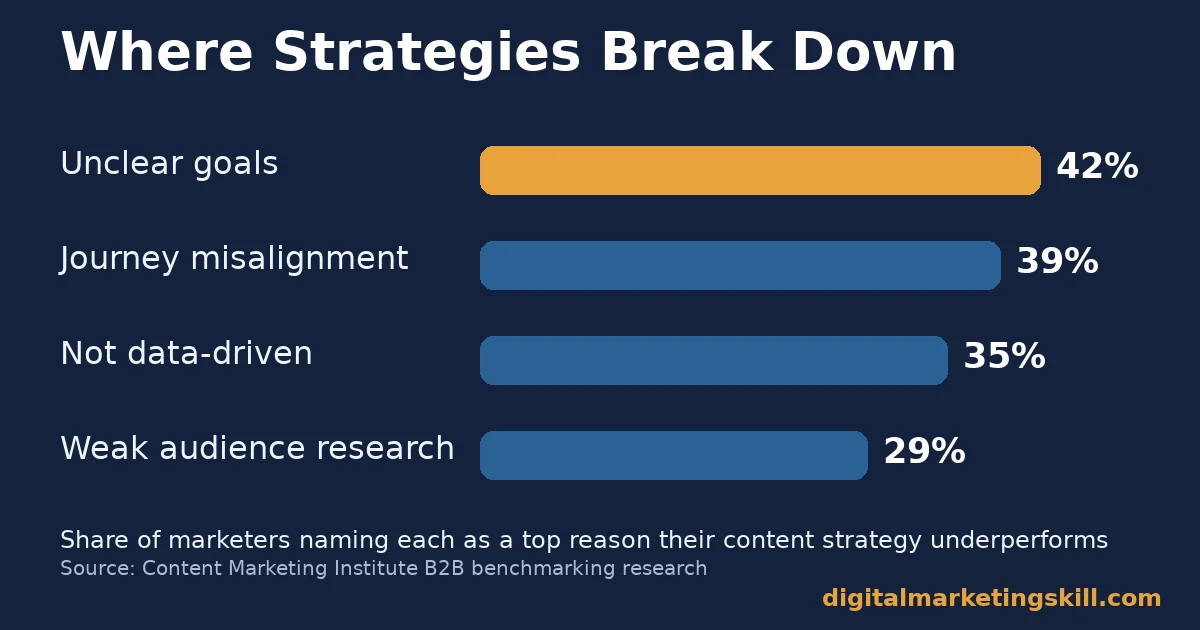
Content Marketing Institute’s research on underperforming strategies points to a lack of clearly defined goals, named by 42% of respondents. Misalignment with the customer’s decision journey and a lack of a data-driven approach follow close behind.
How does AI change a content marketing strategy?
Recent B2B research found 95% of marketers now use AI somewhere in their content process, most often for drafting and research. The marketers who report a quality gain also report that a human still edits and fact-checks before anything publishes. A separate Ahrefs study on AI-assisted content found no ranking penalty tied to AI use itself. The penalty fell on low-effort, unedited output instead.
What is the first step in building a content marketing strategy from scratch?
Write down the audience definition before anything else. Name the specific problem that audience is trying to solve, then pick the one format that reaches them fastest. Skipping this step is why so many content marketing strategies default to “publish more” instead of a clear plan.
How long does it take for a content marketing strategy to show results?
Written, search-driven content usually takes three to six months to show meaningful organic traffic, because search engines need time to crawl, index and trust new pages. Social and email formats can show engagement within weeks, which is why most content marketing strategies combine a slow-building format with a fast-feedback one rather than relying on either alone.
Is a content marketing strategy only for large companies?
No. The underlying method scales down as easily as it scales up. A content marketing strategy for a one-person brand looks like a narrower version of the same four-part loop, not a different method altogether. Budget changes how many formats run at once; it does not change whether the audience, format, production and measurement steps still apply.
Turning A Content Marketing Strategy Into A Habit
A content marketing strategy earns the word “strategy” once its four parts run as a repeating loop, not a one-time document: audience, format, production, measurement.
Marketers can build that loop practically anywhere in your country, because the method behind strong content marketing strategies depends on consistency, not on a particular platform or market size. The habit, more than any single post, is what separates the 29% who call their strategy genuinely effective from everyone else.
Learn The Method Behind This Guide
Digital Marketing Skill Institute’s Master Diploma in Digital & AI Marketing teaches this method as part of four AI-powered tracks across ten courses, including AI-Powered WordPress and SEO Specialist. The programme is dual US and UK accredited and recognised in more than 100 countries. Every learner gets unlimited 1-on-1 coaching and mentoring, and works on real projects inside a U.S. company, wherever you live, because the whole programme runs 100% online.
The method in this guide works the same whether a learner is writing their first post or running content marketing strategies for an existing team. The four-part loop, the format comparisons and the one decision rule do not change with experience.
Explore the Digital and AI Marketing Training Course, read more lessons on the digital marketing blog, or see student outcomes on the reviews page. Ready to build a content marketing strategy of your own, anywhere in your country? Apply to the program through Digital Marketing Skill Institute, or visit digitalmarketingskill.com to learn more.
Every figure in this guide was checked against its original source before publication. Figures marked as illustrative are invented examples, not real results.
