

A content marketing audit is a systematic review of every page on your site: what exists, how it performs, and whether it still earns its place. Done well, it needs three free tools, not a paid platform. This guide names a working free stack and shows the decision each piece of content needs.
Key Takeaways
- Most marketers audit on a schedule. Semrush’s State of Content Marketing report found 33% of marketers audit content twice a year, 24% once a year, and 21% more than three times a year.
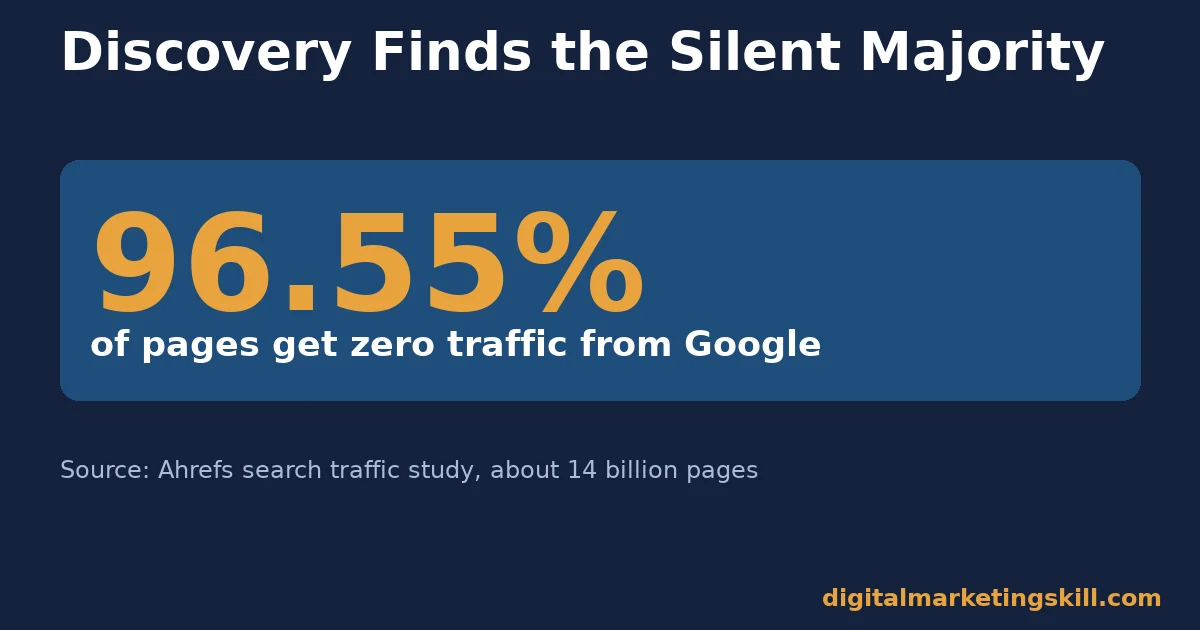
- Discovery is still the hard part. Ahrefs’ search traffic study of about 14 billion pages found that 96.55% get zero traffic from Google, so a content marketing audit often starts by finding pages that never earned any visitors.
- Free crawl tools have a real limit. Screaming Frog’s SEO Spider crawls up to 500 URLs for free, per its own documentation, enough for most small and mid-sized sites.
- Old content is now an AI-search risk too. The Content Marketing Institute warns that outdated pages are scraped and summarised by AI systems, so stale content can misrepresent a brand long after nobody reads it directly.
- The decision, not the inventory, is the real output. A content marketing audit only pays off when every page gets a keep, update, merge or remove decision, not just a row in a spreadsheet.
In this guide
- What Most Content Marketing Audit Tool Lists Get Wrong
- How a Content Marketing Audit Actually Works
- A Content Marketing Audit Needs Three Kinds of Tool
- How to Use Each Tool in a Content Marketing Audit
- Three Mistakes That Waste a Content Marketing Audit
- The Decision Rule: Fix Traffic-Earning Pages Before You Touch the Rest
- How to Measure Whether a Content Marketing Audit Worked
- A Simple Four-Week Content Marketing Audit Timeline
- A Real Case: Why Content Marketing Institute Flags AI Scraping as a New Risk
- Frequently Asked Questions About Content Marketing Audits
- Run the Discovery Step This Week, Then Build From There
What Most Content Marketing Audit Tool Lists Get Wrong
Many “free content audit tools” lists include software that quietly stopped being free. Others list a small utility that only does one narrow job. That wastes the first hour of an audit on tools that do not fit the task.
This guide sticks to a working three-tool stack. One tool finds every page, one pulls real performance data, and a plain scorecard judges quality. All three are free to start, and together they cover a full content marketing audit without a paid platform.
Ground rules before you read on. Tool limits and pricing change, so treat every figure here as a snapshot, not a permanent offer. Audit frequency figures are self-reported by marketers surveyed, not observed behaviour. One more rule: this guide skips the enterprise content-operations platforms that often appear on “free” lists, since most require a paid account within the first few projects.
How a Content Marketing Audit Actually Works
A content marketing audit has three stages, and skipping one weakens the whole process. The first stage is discovery: building a complete list of every page on the site. That list should include pages nobody remembers publishing.
The second stage is performance data: traffic, engagement and search visibility for each page on that list. The third stage is judgment. A human decides whether each page should stay as is, get updated, get merged with another page, or get removed.
The Content Marketing Institute frames that judgment using what it calls the ROT test: is a page Redundant, Outdated, or Trivial. That framing matters more now. CMI also warns that AI systems scrape and summarise old pages, so an outdated page can misrepresent a brand in an AI answer long after a human stopped reading it.
Each stage also needs a different mindset. Discovery rewards thoroughness over judgment, since the goal is simply to find everything. Performance data rewards patience, since a single month rarely tells the full story. Judgment rewards consistency, applying the same standard to page one hundred as page one.
A Content Marketing Audit Needs Three Kinds of Tool
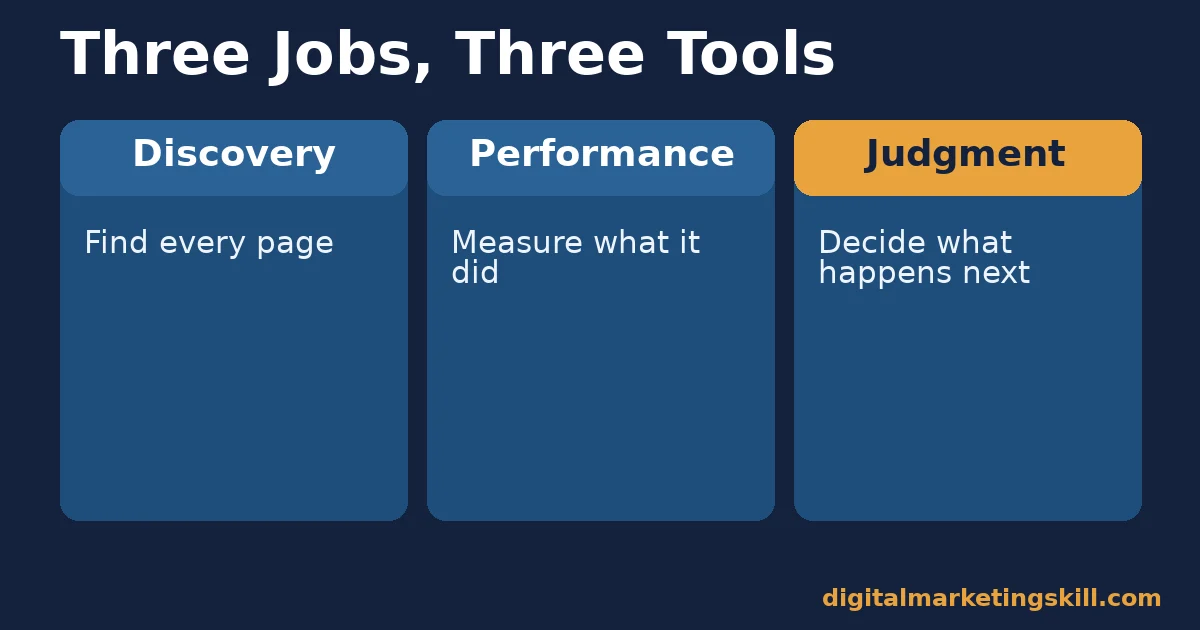
Treat a content marketing audit as three separate jobs, each suited to a different free tool. Mixing them up means either missing pages or drowning in data with no judgment applied.
Discovery Tools: Built to Find Every Page You Have
Discovery tools crawl your site and return every URL. That includes orphaned pages with no internal links pointing to them. Screaming Frog’s SEO Spider is the standard choice. Its free tier crawls up to 500 URLs, which covers most small and mid-sized sites in one pass.
For a page nobody remembers publishing, discovery is the only way to find it. A content marketing audit that skips this step only ever reviews the content you already had in mind. That defeats the purpose of running an audit at all.
An XML sitemap is a useful second source to cross-check against the crawl, since the two lists rarely match exactly. Pages missing from the sitemap but present in the crawl often turn out to be the orphaned ones worth the closest look.
Keep the raw export untouched as a reference copy before anyone starts scoring it. That way, if the scorecard gets reorganised midway through, nobody has to re-run the crawl to recover the original list.
Performance Tools: Built to Show What Each Page Actually Did
Performance tools attach real numbers to each page on your discovery list: search clicks, impressions, average position, and on-site engagement. Google Search Console is the primary free source for search performance, since it reflects exactly how Google sees each page.
Ahrefs’ search traffic study was built from roughly 14 billion pages in its Content Explorer database. It found that 96.55% get zero traffic from Google. That means a large share of any site’s pages will show flat performance data. That flat line is itself a useful signal, not a tooling failure.
Judgment Tools: Built to Turn Data Into a Decision
Judgment tools are the simplest of the three. A shared spreadsheet with a fixed scorecard does the job; you do not need more software. Discovery and performance data feed into it, but a person still has to decide what each page needs.
Skipping this stage is the most common content marketing audit failure. Teams gather excellent data, then never convert it into keep, update, merge or remove decisions. The audit produces a report nobody acts on, and the pages stay exactly as they were.
How to Use Each Tool in a Content Marketing Audit
Knowing the three tool categories does not run the audit itself. The sections below mirror the three categories above, with one practical step for each.
Discovery: Export Every URL Before You Judge Any of Them
Run Screaming Frog against your site and export the full URL list before you look at performance data. Judging pages as you discover them means early pages get less scrutiny than later ones, simply by order.
If your site has more than 500 URLs, run the crawl in sections by folder or content type, since the free tier’s limit applies per crawl, not per site. Our website audit tools guide covers options for larger sites.
Performance: Pull 12 Months, Not Just the Last 30 Days
Export at least 12 months of Search Console data for every URL on your discovery list, so seasonal content is not mistaken for dead content. A short window unfairly penalises pages that only perform well at certain times of year.
Our guide to Google Analytics for beginners covers how to pull matching engagement data for the same list. Line up both exports by URL in the same spreadsheet, so search and engagement numbers sit side by side for every page, rather than in two files you have to flip between.
Judgment: Score Every Page the Same Way
Give every page the same four columns: traffic trend, accuracy, redundancy with other pages, and SEO basics covered. Score every page against the same criteria, in the same order, so the audit does not drift into gut feeling by the two-hundredth row.
Resist the urge to add a fifth column halfway through, since that forces you back to re-score everything you already finished. Agree on the scorecard columns in week one, before anyone starts scoring. Treat any mid-audit addition as a note for the next cycle instead.
Our on-page SEO checklist is a ready-made set of criteria for the SEO-basics column.
Three Mistakes That Waste a Content Marketing Audit
Even with the right tools, a content marketing audit can still fail to produce results. These three mistakes show up repeatedly, across sites of every size.
No Deadline for the Judgment Stage
Discovery and performance data collection have a natural end point: the crawl finishes, the export downloads. Judgment does not, because a scorecard can always use one more pass. Set a fixed deadline for closing every decision, even an imperfect one, rather than letting the spreadsheet sit open indefinitely. An imperfect decision made on time beats a perfect one made after the audit has already lost momentum.
No Named Owner Per Decision
A spreadsheet full of “update” decisions with no name attached rarely gets actioned. Assign a specific person to each batch of pages before the audit ends, not after, so the handoff happens while the context is still fresh. A batch with no owner tends to sit untouched until the next audit makes the same recommendation again.
No Plan to Recheck the Work
Teams often audit, act, and never look back. Put a date on the calendar, matching the next audit cycle, to check whether the pages you updated actually moved. Without that recheck, you cannot tell whether the audit worked or whether traffic changed for unrelated reasons, such as a seasonal swing or an algorithm update unrelated to your changes.
The Decision Rule: Fix Traffic-Earning Pages Before You Touch the Rest
If you take one rule from this guide, make it this: update the pages that already earn some traffic before you touch the pages that earn none. A small fix on a page with existing visitors reaches more people than a full rewrite of a page nobody finds.
Here is an illustrative example, with invented numbers. A site has 400 pages. Twenty already bring in real traffic, and 380 bring in close to none. The team updates those twenty pages first, fixing outdated facts and weak titles. Their combined traffic rises by a third within two months. The other 380 pages still need decisions, but they were never sending meaningful traffic to lose.
The order matters because it protects what is already working while you work through the rest. Rewriting a zero-traffic page first feels productive. It changes nothing measurable, though, since there was no traffic there to grow.
How to Measure Whether a Content Marketing Audit Worked
Judge a finished audit by what changed afterward, not by how many rows the spreadsheet has. Each metric below is defined in one sentence.
Four Metrics That Show a Content Marketing Audit Paid Off
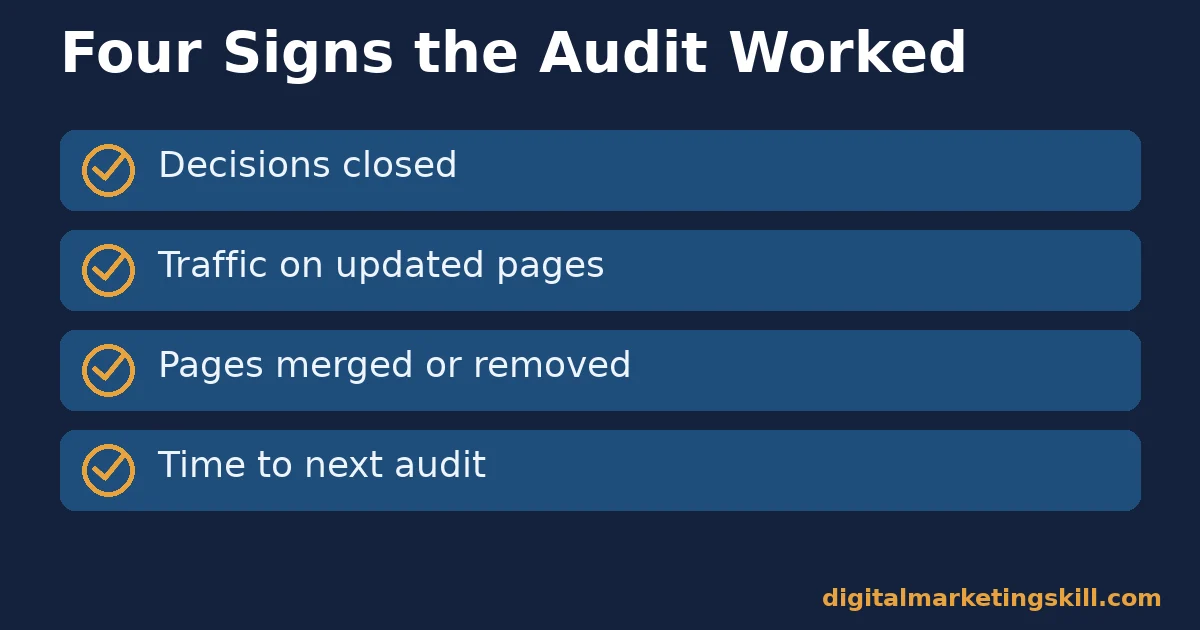
- Decisions closed. The share of audited pages that received and completed a keep, update, merge or remove action. A long list of decisions nobody acted on is not a finished audit.
- Traffic on updated pages. The change in clicks or sessions on pages you updated, compared with the period before the audit. This isolates the effect of the audit itself.
- Pages merged or removed. The count of redundant or outdated pages consolidated into stronger ones. Fewer competing pages usually means clearer rankings for the ones that remain.
- Time to next audit. How soon you can realistically repeat the process. If it is too slow to repeat, the process itself needs simplifying, not just the content.
How to Read These Metrics Together
Start with decisions closed, since the other three depend on the audit actually finishing. A high percentage of closed decisions with flat traffic points to weak updates, not a weak process.
Track time to next audit honestly. A content marketing audit that takes three months to run will not happen quarterly, no matter what the plan says. A faster, simpler process beats a thorough one that nobody repeats.
Review pages merged or removed alongside traffic on updated pages, not separately. A rising traffic number alongside a shrinking page count usually means the audit genuinely concentrated authority, rather than just adding more content on top of what was already there.
A Simple Four-Week Content Marketing Audit Timeline
You do not need a dedicated team to run a content marketing audit. This timeline fits around a normal workload, using the free tools named earlier.
- Week one: discovery. Crawl the site with Screaming Frog, cross-check against the XML sitemap, and export a clean URL list as your reference copy.
- Week two: performance data. Pull 12 months of Search Console and analytics data for every URL, and line both up in the same spreadsheet by page.
- Week three: judgment. Score every page against the same four columns, assign an owner to each batch of decisions, and set a hard deadline for closing the scorecard.
- Week four: execution and recheck date. Act on the highest-traffic pages first, per the decision rule below, and put the next recheck date on the calendar before the audit is considered finished.
Treat this timeline as a starting point, not a fixed schedule. A small site with fewer than 100 pages can often compress all four weeks into one, while a much larger site may need to split discovery and judgment across several sprints. What matters most is keeping the four stages in order, since skipping ahead to execution before judgment is finished is how audits lose their standard halfway through.
A Real Case: Why Content Marketing Institute Flags AI Scraping as a New Risk
The Content Marketing Institute’s analysis makes a case that extends the reason for running a content marketing audit beyond SEO. It argues that AI search and chat tools now read, summarise and cite old content, not just index it for ranking.
That changes what an outdated page can cost a brand. An old statistic, a discontinued product mention, or an outdated policy no longer just sits quietly unread. It can resurface inside an AI-generated summary, attributed to the brand as if it were current.
The limit on this case is scope. It is an analysis and argument, not a measured study with a sample size. Treat it as a reasoned warning, not a quantified risk.
It does, however, give content marketing audits a second purpose beyond traffic. Accuracy control for how AI systems represent a brand now sits alongside the older goal of ranking well in search.
Frequently Asked Questions About Content Marketing Audits
What is a content marketing audit?
A content marketing audit is a systematic review of every piece of content a brand has published. It covers what exists, how each page performs, and whether it still serves its purpose. It ends with a decision for each page: keep, update, merge or remove.
How often should you run a content marketing audit?
Semrush’s State of Content Marketing report found 33% of marketers audit twice a year and 24% once a year. A faster-publishing site benefits from a shorter cycle; a smaller, slower site can usually audit annually.
What free tools do I need for a content marketing audit?
A crawler to find every page, such as Screaming Frog’s free tier, which covers up to 500 URLs; a performance source, such as Google Search Console; and a shared spreadsheet scorecard to turn the data into decisions.
What is the ROT framework in a content audit?
ROT stands for Redundant, Outdated and Trivial, a framework the Content Marketing Institute uses to judge whether a page should be merged, updated or removed. It gives an audit a consistent standard instead of a case-by-case judgment call.
Does a content marketing audit still matter if AI tools answer search questions now?
It matters more, not less. The Content Marketing Institute notes that AI systems scrape and summarise existing content, so an outdated page can misrepresent a brand inside an AI answer long after it stops getting direct visits.
How many pages should a free content audit tool handle?
Screaming Frog’s free tier handles up to 500 URLs in one crawl, which covers most small and mid-sized sites. Larger sites need to crawl in sections or move to a paid tier for a single full-site pass.
Run the Discovery Step This Week, Then Build From There
Start with the discovery step alone: crawl your site, export every URL, and see how many pages you actually have before you judge any of them. That single step usually reveals more forgotten content than teams expect.
If you want to build this process into a repeatable skill rather than a one-off project, Digital Marketing Skill Institute‘s Master Diploma in Digital & AI Marketing includes an AI-Powered WordPress and SEO Specialist track inside ten courses across four AI-powered tracks, with a Full Stack option for completing all four.
It comes with unlimited 1-on-1 coaching and mentoring and a U.S. Project Internship that ends with a verified U.S. Work Reference Letter.
The diploma is dual US and UK accredited, and recognised in more than 100 countries, so you can build this skill from anywhere in your country. Browse more guides on the Digital Marketing Skill Institute blog, or when you are ready, apply for the Master Diploma from the Digital Marketing Skill Institute homepage.
Every figure in this guide was checked against its original source before publication. Figures marked as illustrative are invented examples, not real results.
![9 Amazing Digital Marketing Skills to Make Money Online [With Proof]](https://digitalmarketingskill.com/wp-content/uploads/2019/07/9-Amazing-Digital-Marketing-Skills-to-Make-Money-Online-With-Proof-17.png)






