
PPC ads are advertisements you pay for only when someone clicks them, most commonly run through Google Ads or Microsoft Ads. The real skill is not writing a clever headline. It is matching bid, Quality Score, and landing page so your cost per click stays low while your conversion rate stays high. This guide covers the auction mechanics, the real benchmark numbers, and the decisions that actually move results.
Key Takeaways
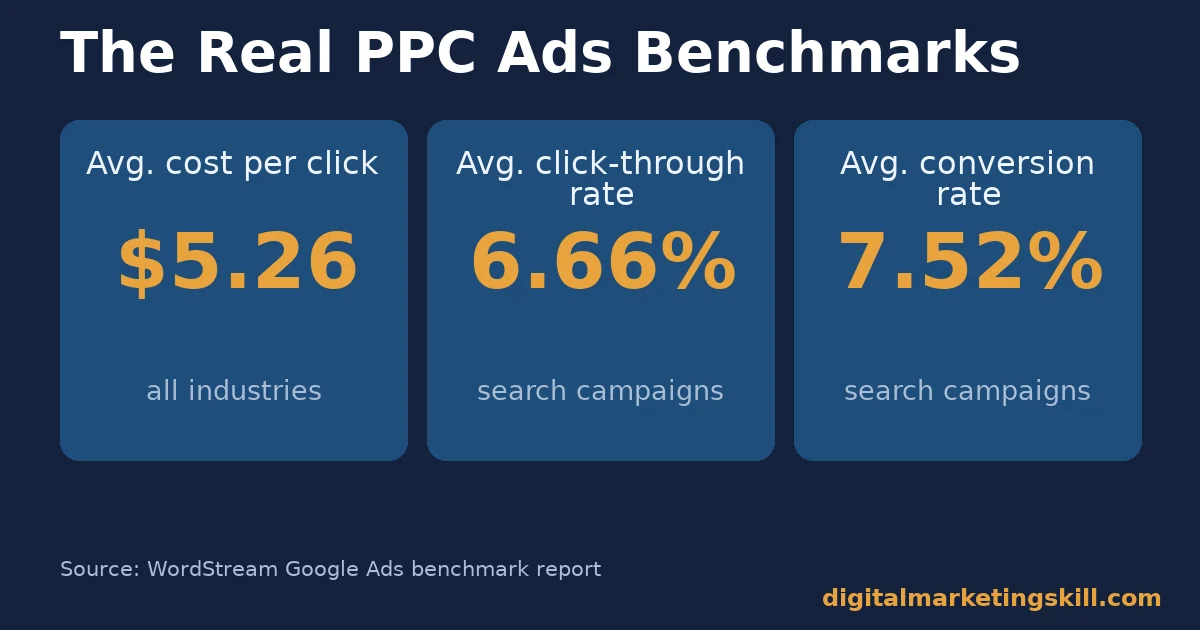
- Average cost per click across industries on Google Ads search campaigns runs around $5.26, according to WordStream’s benchmark report. Legal services run far higher, near $9.87 per click.
- Average click-through rate on Google Ads search campaigns runs around 6.66%. Arts & Entertainment advertisers see rates closer to 12.75%, per the same benchmark report.
- Average conversion rate on Google Ads search campaigns runs around 7.52%, per WordStream’s benchmark data.
- Quality Score is a 1-10 diagnostic built from three parts: expected click-through rate, ad relevance, and landing page experience. Google states it is not itself an auction input, per Google Ads Help.
- Google estimates advertisers see about $8 in profit for every $1 spent on Google Ads and Search, per Google’s own Economic Impact report. Treat this as Google’s self-reported estimate, not an independent audit.
In this guide
- Why Most PPC Ads Advice Skips The Auction
- How The PPC Ads Auction Actually Works
- The Real PPC Ads Benchmark Numbers
- Three Ways PPC Ads Waste Money, And How To Fix Each
- The One Decision Rule Worth Writing Down
- Measuring What Actually Matters In A PPC Ads Account
- A Realistic Case, And Its Limits
- Manual Versus Automated Bidding, By Account Stage
- PPC Ads Beyond Google Search
- A Quick Checklist Before You Raise Any Bid
- Frequently Asked Questions About PPC Ads
- Build The PPC Skill Set, Not Just The Budget
Why Most PPC Ads Advice Skips The Auction
Most PPC ads advice says the same three things: write a strong headline, use exact match keywords, and set a daily budget. None of that is wrong. But it skips the mechanism that actually decides your cost.
That mechanism is the auction itself. PPC ads do not simply go to the highest bidder. Google’s own auction overview combines bid with quality signals to decide who shows and what they pay. Skip that mechanism and you end up guessing at budgets instead of controlling them.
Treat every benchmark figure in this guide as a checked snapshot from a named source, not a permanent target. Averages vary by industry, region, and season. Use them as a starting comparison, not a goal to hit exactly. A campaign in a competitive category that sits below the blended average is not automatically failing; it may simply be competing in a category where every advertiser pays more.
How The PPC Ads Auction Actually Works
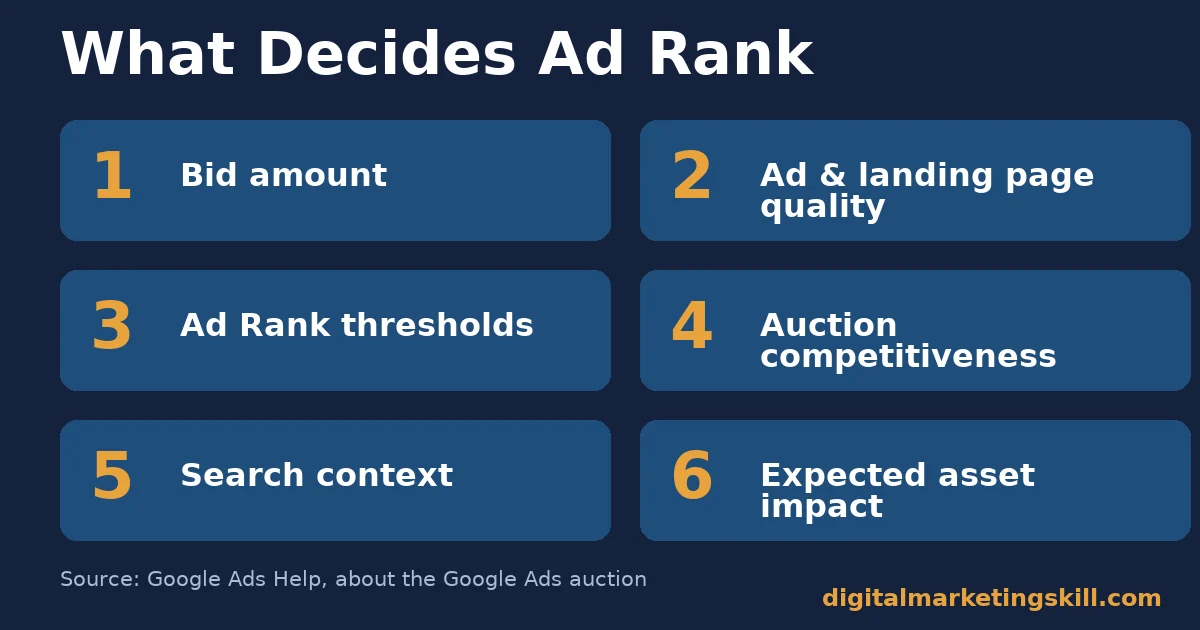
Every time a search happens, eligible advertisers enter an instant auction. Google’s own documentation names six inputs to Ad Rank. They are your bid amount, the quality of your ad and landing page, Ad Rank thresholds, the competitiveness of the auction, the context of the search, and the expected impact of your ad assets and formats. Search context itself covers location, device, time, and the query.
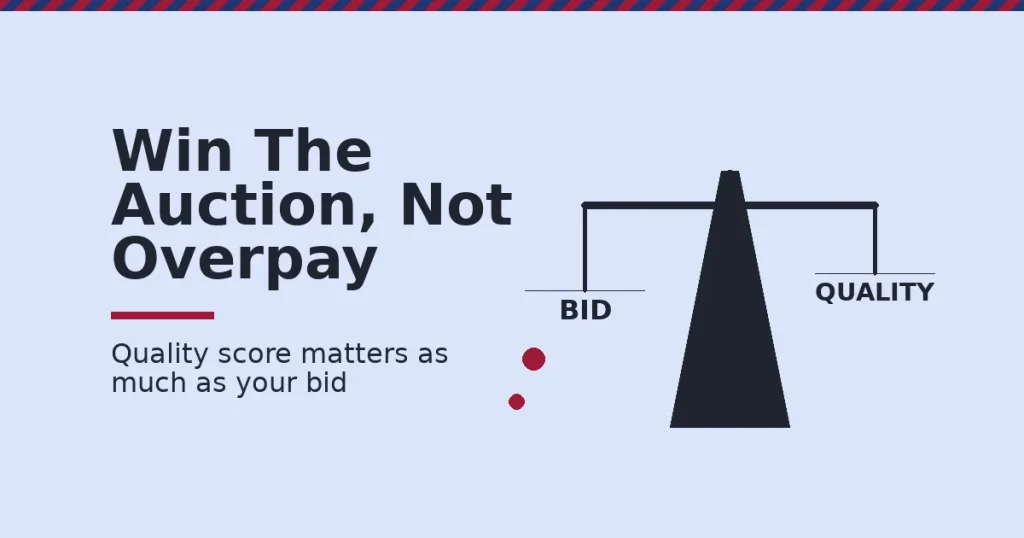
Bid is only one input among six. A lower bid with a strong Quality Score can beat a higher bid with a weak one. This is the single most misunderstood fact in PPC ads. It is also the easiest lever to pull once you understand it.
What Quality Score Actually Measures
Quality Score is a 1-10 diagnostic metric, visible at the keyword level. Google Ads Help names three components: expected click-through rate, ad relevance to the search term, and landing page experience.
Google is explicit that Quality Score itself is a diagnostic tool, not a direct input into the auction. The three underlying signals it reflects are what actually affect Ad Rank. In practice, a tightly themed ad group scores higher than a broad one stuffed with loosely related terms. The keyword, the ad copy, and the landing page all say the same thing, in similar words, inside that tight group.
How The Score Moves Over Time
Quality Score is not fixed at campaign launch. It updates as Google collects more data on how searchers respond to your ad and your landing page. A new ad group often starts with an average score, then moves up or down over the first few weeks as real click and conversion data accumulates.
This means early performance should not be judged too harshly. Give a new ad group at least two to three weeks of consistent spend before deciding whether its structure needs to change.
The Real PPC Ads Benchmark Numbers
Three numbers matter more than any single platform’s marketing claims.
Cost per click averages around $5.26 across industries on Google Ads search campaigns, per WordStream’s benchmark report. That average hides enormous spread. Legal services average closer to $9.87 per click. Lower-competition categories run far below the overall average.
Click-through rate, covered in more depth in this guide to Google Ads match types, averages around 6.66% on search campaigns. Arts & Entertainment advertisers, among the highest-performing categories tracked, see rates closer to 12.75%. That gap shows how much category competition shapes what a “good” CTR even means.
Once conversion data is reliable, Google’s Target ROAS bidding can automate bid adjustments toward a specific return target. It only works well once a campaign has enough conversion history to train on.
Conversion rate averages around 7.52% on search campaigns, per the same report. A campaign sitting well below this average on a comparable industry is usually a landing page problem, not a keyword problem. A campaign sitting well above it is usually converting on branded or high-intent terms.
Three Ways PPC Ads Waste Money, And How To Fix Each
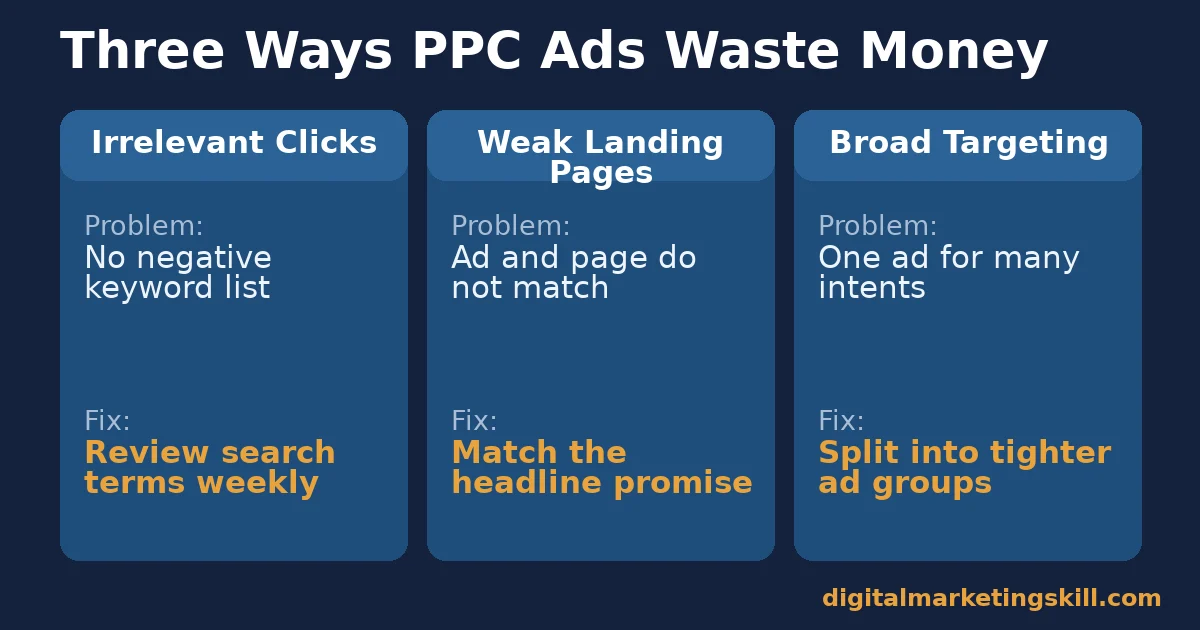
Most wasted PPC ads spend traces back to one of three causes.
Irrelevant Clicks: Built For Negative Keywords
Google Ads Help describes negative keywords as the tool that stops your ad from triggering on searches you do not want. This reduces irrelevant impressions and clicks. A campaign with no negative keyword list is almost always paying for clicks from searchers who were never going to convert.
Fix: review the search terms report weekly for the first month of a new campaign. Add any clearly irrelevant query as a negative keyword immediately, rather than waiting for a monthly review. A clear Google Ads strategy builds this review into the campaign plan from day one, not as an afterthought.
Weak Landing Pages: Built For Message Match
A landing page that does not repeat the exact promise made in the ad copy loses visitors in the first few seconds. It also drags down the Quality Score component tied to landing page experience. Message match, using the same words and offer on the page that appeared in the ad, is a bigger lever than most advertisers realize.
Fix: open your top five ads side by side with their landing pages. Confirm the headline promise matches within the first screen, not three scrolls down. The keyword research behind the ad follows the same logic covered in this guide on search engine optimization. Paid and organic intent-matching rely on the same underlying skill.
Broad Targeting: Built For Tighter Ad Groups
A single ad group covering dozens of loosely related keywords forces one generic ad to serve many different search intents. That drags down both relevance and click-through rate. Splitting that group into smaller, tightly themed groups lets each ad speak directly to a narrower set of searches.
Fix: group keywords by the specific product, service, or problem they describe, not by broad category. Write one ad per group that uses the group’s own language. If search ads alone feel limiting, pairing PPC ads with the fundamentals in this guide to pay-per-click advertising rounds out the full channel picture.
The One Decision Rule Worth Writing Down
Decision rule: fix message match and negative keywords before you touch your bids. Raising a bid on a campaign with weak message match or no negative keyword list just means paying more for the same wasted clicks.
Illustrative, invented numbers: imagine a campaign spending $3,000 a month at a $6 average cost per click. That generates 500 clicks and 25 conversions, a 5% conversion rate below the 7.52% benchmark. Raising bids to win more impressions would only buy more clicks at the same weak conversion rate.
Fixing message match and adding 40 negative keywords first, then re-measuring, is the move that actually changes the economics. The bid increase only makes sense after that fix, not before it.
Measuring What Actually Matters In A PPC Ads Account
Three numbers tell you more about account health than impressions or raw click count ever will.
Cost per conversion is your total spend divided by the number of conversions it produced. This is the number that actually connects to your budget and your margin, unlike cost per click alone, which says nothing about whether those clicks turned into anything.
Search impression share shows what percentage of eligible auctions your ad actually appeared in. A low impression share on your best-converting keywords usually means your budget or your Ad Rank is capping your reach, not that demand is weak. Raising budget on a keyword with a strong conversion rate and low impression share is often a safer move than raising bids broadly across an entire campaign.
Quality Score trend, tracked over weeks rather than days, tells you whether your recent changes are helping or hurting. A score that climbs after a landing page change confirms the fix worked; a score that falls points you back to the ad group structure.
Google Ads also surfaces an account-level Optimization Score, a 0-100% estimate of how well the account is set up to perform, alongside specific recommendations. Treat it as a checklist to review, not a target to max out blindly; some recommendations trade relevance for reach in ways that do not fit every account.
A Realistic Case, And Its Limits
Illustrative, invented numbers: a local service business runs PPC ads with one broad ad group covering ten different services. Conversion rate sits at 3%, well below the 7.52% category benchmark.
Splitting the ad group into five tighter groups, one per service, each with its own ad copy matching its own landing page, lifts conversion rate to 6.8% over two months.
The limits of this example matter. It assumes the underlying services are genuinely different enough to split cleanly, which is not true for every account. It also does not account for seasonal demand shifts that can move conversion rate independent of any campaign change.
A business with highly overlapping services might see a smaller lift from the same restructuring, or need a different fix entirely. Treat it as a pattern to test, not a guaranteed result.
Manual Versus Automated Bidding, By Account Stage
Bidding strategy is one of the most debated PPC ads decisions, and the right answer depends on how much conversion data an account already has.
Manual CPC: Built For New Accounts With Little History
A brand-new campaign has no conversion history for Google’s automated systems to learn from. Manual CPC bidding, where you set the maximum bid yourself per keyword or ad group, gives you direct control while that history accumulates. It is slower to manage, but it avoids handing control to an algorithm that has nothing to learn from yet.
Target ROAS: Built For Accounts With Steady Conversion Volume
Once an account has enough conversion history, typically weeks of consistent data rather than days, Target ROAS bidding can start making bid decisions faster than a human reviewing the account manually. The system adjusts bids per auction based on the predicted likelihood and value of a conversion. No manual bidding approach can match that speed.
The common mistake is switching to automated bidding too early, before the account has enough data to train on. A campaign with fewer than roughly 15 conversions a month in most categories is usually still too thin for Target ROAS to perform well. Manual CPC, or a simpler automated strategy, is the safer choice until volume grows.
Matching The Strategy To The Budget, Not Just The Data
Budget size interacts with this decision too. A small daily budget limits how much data accumulates each week. That means a small-budget account needs more calendar time before automated bidding has enough signal to work well, even if the underlying conversion rate is strong. Patience here is a strategy choice, not a weakness.
PPC Ads Beyond Google Search
Google Ads search campaigns are the default starting point for most PPC ads programs, but they are not the only channel worth testing once the fundamentals are solid.
Microsoft Ads runs on a similar auction logic to Google Ads. It often has lower competition and a lower average cost per click in many categories. That makes it a reasonable second channel to test once a Google Ads account is performing at or above its category benchmark.
Social platforms run a different auction model, built around audience targeting rather than search intent. Message match still applies there too. Audience and interest signals simply replace the “keyword” layer.
One rule carries across every one of these channels: fix relevance and targeting before you raise spend, regardless of which platform is running the PPC ads campaign.
A Quick Checklist Before You Raise Any Bid
Before you touch a single bid, run through four checks. First, confirm your negative keyword list has been reviewed in the last seven days. So if it has not, that review comes before any bid change.
Second, open your top three ads next to their landing pages and check message match. Therefore a mismatch here is worth fixing before anything else on this list.
Third, compare your conversion rate against your specific industry’s benchmark, not the blended average. As a result, you will know whether the real problem is traffic quality or landing page performance.
Fourth, check Quality Score trend over the last two weeks, not just today’s snapshot. A single bad day rarely means much on its own.
Run through these four checks before every bid change, not just the first time. Accounts that revisit this checklist monthly tend to waste far less budget than accounts that only check it once at launch and never again. Set a recurring calendar reminder if that is what it takes to make the habit stick.
Frequently Asked Questions About PPC Ads
What does PPC ads mean?
PPC stands for pay-per-click. PPC ads are advertisements where you pay only when someone clicks, most commonly run through Google Ads or Microsoft Ads, rather than paying a flat fee for impressions. This is different from display or social ads sold purely on impressions. You pay for those regardless of whether anyone clicks at all.
How much do PPC ads cost per click?
It varies widely by industry. The overall average across industries on Google Ads search campaigns runs around $5.26 per click, per WordStream’s benchmark report. Legal services average closer to $9.87, while lower-competition categories run well below the overall average.
What is a good conversion rate for PPC ads?
The overall average on Google Ads search campaigns runs around 7.52%, per benchmark data. A “good” rate depends heavily on industry and offer, so compare your own rate against your specific category’s benchmark, not the blended average. A B2B service with a high-value, low-volume sale will naturally convert differently than an e-commerce store selling low-cost items.
Does a higher bid always win the PPC ads auction?
No. Google’s own documentation names six Ad Rank inputs, and bid is only one of them. A lower bid paired with strong ad and landing page quality can outrank a higher bid with weak quality. This is why two advertisers bidding the same amount can see very different ad positions and costs.
What are negative keywords in PPC ads?
Negative keywords are search terms you tell Google Ads not to show your ad for. Google Ads Help describes them as a way to reduce irrelevant impressions and clicks, which protects your budget from searches that were never going to convert. A common example is adding “free” or “jobs” as negative keywords when selling a paid service. Those searchers are rarely ready to buy.
Is PPC ads spend worth it?
Google’s own Economic Impact report estimates advertisers see about $8 in profit for every $1 spent on Google Ads and Search. Treat that as Google’s self-reported estimate rather than an independent audit.
Measure your own return against your own conversion and margin numbers before trusting any blended industry figure. A business with thin margins may find even a strong-looking blended average does not translate into profit once its own costs are factored in. Calculate your own break-even cost per conversion before trusting any industry-wide figure.
Build The PPC Skill Set, Not Just The Budget
Running PPC ads well is a measurable skill, not a budget size.
Digital Marketing Skill Institute’s Master Diploma in Digital & AI Marketing is built to teach exactly this kind of execution. It has four AI-powered tracks, built from ten execution-first courses, with a Full Stack option for completing all four. The AI-Powered Google Specialist track in particular covers the auction mechanics, Quality Score, and campaign structure a serious PPC ads practitioner needs beyond platform defaults.
Every student gets unlimited 1-on-1 coaching and mentoring, plus a U.S. Project Internship with a verified U.S. Work Reference Letter. The diploma is dual US and UK accredited and recognised in more than 100 countries, 100% online. The same auction logic applies whether you are managing a local client’s budget or a global account.
Start Where You Are
Whether you are launching your first PPC ads campaign or auditing an underperforming one anywhere in your country, the fundamentals are the same. Fix message match and negative keywords before chasing bids. Measure against your own category’s benchmark, not a blended average.
Explore the program on the Master Diploma page. Read real outcomes on the reviews page. Browse more guides on the blog hub. When you are ready, apply here. Learn more at digitalmarketingskill.com, wherever you live, and start turning PPC skill into managed-budget income at digitalmarketingskill.com.
Every figure in this guide was checked against its original source before publication. Figures marked as illustrative are invented examples, not real results.
