
Brand storytelling is the practice of sharing a consistent, human narrative about why your brand exists, who it serves, and what it stands for. Done well, it turns a list of product features into something customers remember and repeat. Most brands skip the hard part: picking one true story and telling it everywhere.
Key Takeaways
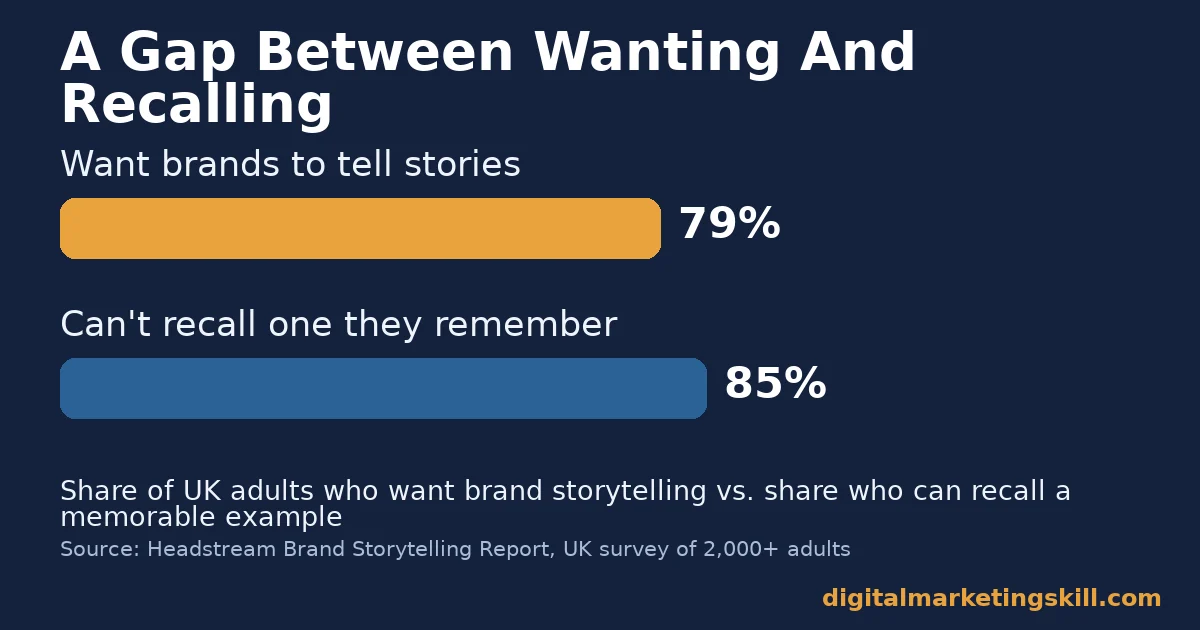
- In a UK study of over 2,000 adults, 79% wanted brands to tell stories, yet 85% could not recall a single memorable one.
- The same study found people prefer stories about real people over fictional ones, by 57% to 43%.
- Nearly 40% of consumers say they like seeing customer testimonials or real demos from brands on social media.
- 33% of consumers find it embarrassing when a brand jumps on a viral trend instead of telling its own story.
- One well-known skincare brand’s self-perception video reached 163 million global views and won a top Cannes Lions award.
In this guide
- The Real Gap In Most Brand Storytelling Advice
- How Brand Storytelling Actually Works
- What Differs By Story Type
- How To Actually Craft Each Story Type
- Common Brand Storytelling Mistakes To Avoid
- How To Measure Whether Brand Storytelling Is Working
- The One Decision Rule For Brand Storytelling
- A Real Case, With Its Limits
- Frequently Asked Questions About Brand Storytelling
- Your Next Step With Brand Storytelling
The Real Gap In Most Brand Storytelling Advice
Most brand storytelling guides list traits of a “good story”: emotional, authentic, simple. That is true but useless on its own. It does not tell you which story to start with, or how to know if it is working.
This guide is a practical framework, not a guaranteed formula. Brand storytelling does not replace product quality or customer service. A great story about a bad product fails fast, because customers test the story against their own experience every time they use what you sell. Every figure below is a snapshot from a named study, not a permanent ranking, so treat it as an informed benchmark, not a fixed rule.
How Brand Storytelling Actually Works
Brand storytelling works because people remember narrative structure better than isolated claims. A story gives a fact a place to live: a character, a problem, a change. “Fast shipping” is a claim. “A customer who needed a gift by tomorrow, and got it” is a story.
The mechanism is simple but easy to skip. Pick one true thing about your brand. Attach it to a specific person, moment, or problem. Repeat that same story, in different formats, until your audience can repeat it back to you. Stanford Graduate School of Business research on storytelling makes a related point: a vivid, specific story moves an audience more than statistics alone.
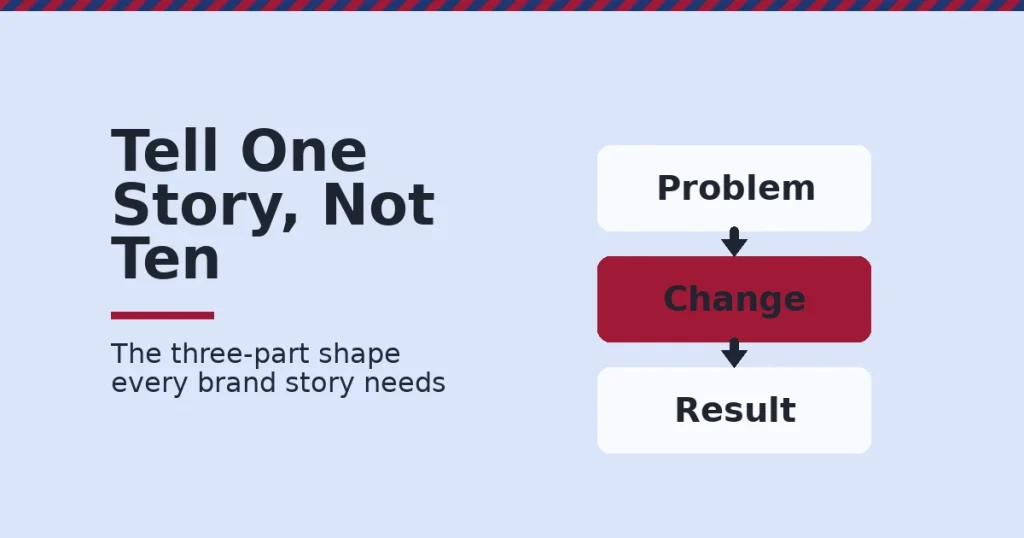
Every working brand story shares the same three-part shape: a problem, a change, and a result. The problem names something your audience already feels. A good change shows what your brand actually did about that problem. A credible result then proves the change was real, with a specific outcome rather than a vague claim.
Skip any one of the three parts and the story weakens. A problem with no change is just a complaint, and a change with no result is just an activity. Worst of all is a result with no problem attached, since a number with no context gives the reader nothing to care about.
A Worked Example Of The Three-Part Shape
A short, illustrative, invented example makes this concrete. Problem: a customer kept missing appointments because reminders arrived too late. Change: the brand built a reminder that sends 24 hours and one hour before the appointment. Result: that customer’s no-show rate dropped from one in five visits to almost none. Each part is a single, checkable sentence, and together they form a complete brand story worth repeating.
Notice what the example leaves out. It does not mention the brand’s founding date, its office, or its mission statement. None of that belongs in a customer-facing story; it belongs on an internal slide deck, if anywhere at all.
Why Most Brand Storytelling Is Forgotten
The UK Headstream study found that while 79% of adults wanted brands to tell stories, 85% could not name one they remembered. The gap was not effort; it was focus. Brands that change their story every quarter never let one story take hold.
Most brands do have a story somewhere: in a founder’s interview, an About page nobody reads, or a slide in an old pitch deck. The problem is rarely a missing story. It is a story that exists in one place and never gets repeated anywhere a customer would actually encounter it.
What Differs By Story Type
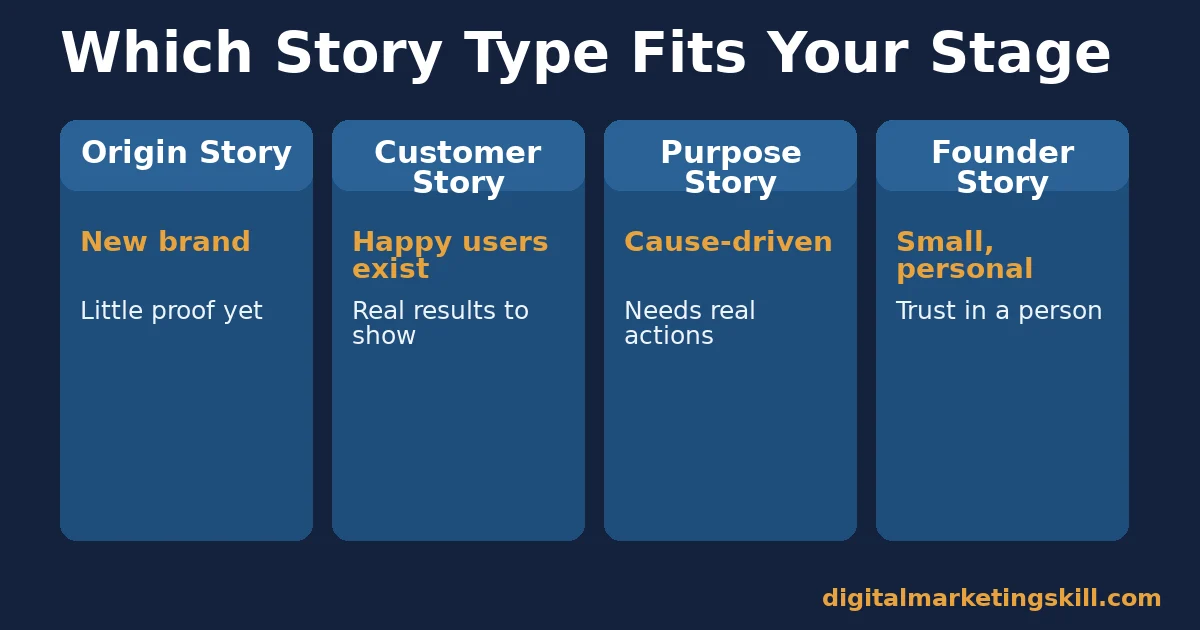
Four story types cover most brand storytelling needs. Each fits a different stage and kind of brand. Pick one to lead with, not all four at once.
The Origin Story: Built For New, Unproven Brands
An origin story explains why your brand started: a problem the founder could not find a solution for, a gap they saw. It works best when you have little social proof yet, because the story itself is the proof of intent.
The risk is making it about you instead of the customer. An origin story only works if the problem it describes is a problem your audience actually recognizes in their own life.
The Customer Story: Built For Brands With Happy Users
A customer story hands the narrative to someone who already uses your product. Nearly 40% of consumers say they specifically like seeing customer testimonials or real demos from brands, more than almost any other content type measured.
This story type needs real customers, not actors, and real outcomes, not vague praise. A single specific result from one named customer beats five generic five-star quotes, and works well inside a broader content marketing plan.
The Purpose Story: Built For Cause-Driven Brands
A purpose story ties your brand to a value or cause beyond profit: sustainability, access, fairness. It works when the cause is backed by real action, not a slogan added to packaging.
Only about a quarter of consumers, per the same Sprout Social Index cited above, say a brand must take a public stand on a cause to be memorable. This story type is optional, not mandatory. It should fit the brand honestly or not be used at all. Treat it as one layer of a wider brand identity strategy, not the whole strategy.
The Founder Story: Built For Small, Personal Brands
A founder story puts a real person’s face and voice behind the brand. It works especially well for small or service businesses, where customers are really choosing to trust a person. Many founders tell this story most often through social media management rather than a static About page.
It fails when the founder becomes a celebrity instead of a guide. The founder’s story should point back to the customer’s problem, not away from it. Nielsen Norman Group’s research on page visits found the first ten seconds decide whether a visitor stays. The opening line of a founder story carries most of the weight.
How To Actually Craft Each Story Type
Picking a story type is step one. Here is the practical move for each, in the same order as above.
Origin Story: Lead With The Specific Problem
Write down the exact moment the problem became obvious to the founder: a bad experience, a missing option, a frustration. Use that single scene as the opening line of every version of your story, from your About page to your elevator pitch.
Keep the scene concrete. Name the place, the task, and what went wrong, rather than a general statement like “we saw a gap in the market.” A reader should be able to picture the moment, not just agree with the conclusion.
Customer Story: Lead With One Named Result
Interview one real customer about a specific before-and-after. Ask what changed, not just how they feel. Publish their name, their actual result, and a direct quote, with their permission, rather than an anonymous testimonial.
One detailed story from one named customer, with a specific number and a specific obstacle, carries more weight than ten short quotes that all say “great service.” Depth beats volume in this story type.
Purpose Story: Lead With Proof, Not A Slogan
Before you publish a purpose story, list three concrete actions that back the claim: a policy, a donation, a changed process. If you cannot list three, the story is not ready to tell yet.
Publish the proof alongside the story, not buried in a separate report. A single sentence naming the specific action, with a number attached where possible, does more work than a paragraph of good intentions.
Founder Story: Lead With The Customer’s Problem
Open the founder’s story with the customer’s frustration, not the founder’s biography. Let the founder’s background explain why they were able to solve it, as the second beat of the story, not the first.
Keep the founder visible but not central. The story should end on what the customer gained, not on the founder’s achievement, even though the founder is telling it.
Common Brand Storytelling Mistakes To Avoid
These four mistakes account for most brand storytelling that falls flat, across all four story types above.
- Switching the story too often. A new campaign idea every quarter means no single story has time to become memorable, which is the exact gap the Headstream recall study measured.
- Making the brand the hero. The strongest brand stories make the customer the hero and the brand the guide who helped them, not the other way round. Readers skim past stories where a company praises itself.
- Using stock language instead of specifics. Words like “passionate,” “innovative,” and “world-class” carry no story weight; a specific scene, name, or number does.
- Telling the story once and stopping. A good brand story earns repetition across formats: a line on the homepage, a longer version on an About page, a short version in a sales pitch.
- Letting the legal or sales team flatten the story. Caveats and disclaimers matter, but a story edited until it is safe from every objection usually loses the specific detail that made it memorable in the first place.
How To Measure Whether Brand Storytelling Is Working
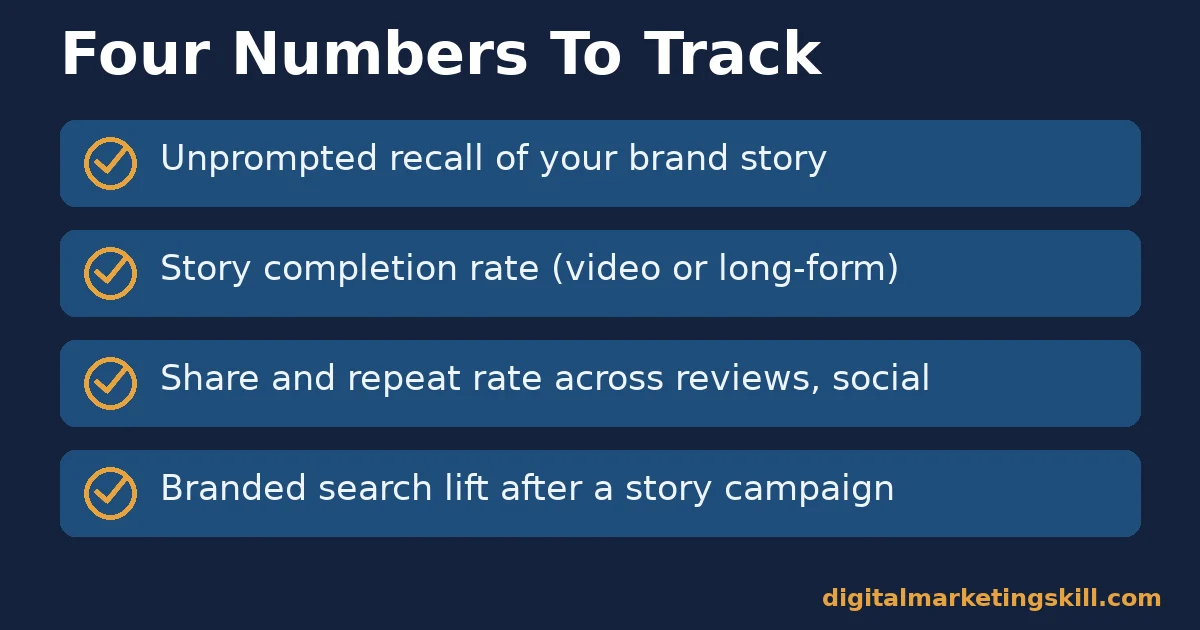
Track these numbers regardless of which story type you choose; together they show whether the story is landing.
- Unprompted recall: ask customers, with no hints, to describe your brand in one sentence. A consistent, repeated phrase back is a working story.
- Story completion rate: for video or long-form content, the share of people who watch or read to the end. A story that loses most of its audience early needs a stronger opening scene.
- Share and repeat rate: how often people share or retell the story unprompted, in reviews, social posts, or referrals.
- Branded search lift: a rise in people searching your brand name directly after a story campaign runs, compared to before.
None of these numbers matter alone. A high completion rate on a story nobody shares is a well-made video, not working brand storytelling. For the fuller picture, pair these with the standard brand awareness metrics your team already tracks.
Review On A Fixed Schedule, Not After One Campaign
Review these numbers on a fixed schedule rather than only after a single campaign. A story that recalls well in month one but fades by month six is telling you the story needs refreshing in new formats, not replacing entirely. The goal is one durable story told many ways, not a new story every time engagement dips.
Refreshing a story means a new format for the same underlying problem, change, and result, such as turning a written customer story into a short video, or a founder story into a live Q&A. Replacing a story means abandoning the underlying narrative itself, which resets any recall you had already built and should be rare.
The One Decision Rule For Brand Storytelling
If your brand is under two years old with few customers yet, start with an origin story. If you already have customers getting real results, start with a customer story before any other type. Purpose and founder stories work best as a second story, once the first one is established.
This order exists because evidence beats intention. An origin story is honest about intent when you have nothing else to show yet. A customer story is stronger proof once it exists, so once you have one, lead with it instead.
Illustrative, invented example: a small software brand with twelve customers leads with a founder story about why the product was built. It gets modest, polite engagement. A similar brand instead publishes one detailed customer result, naming the customer and the specific number that changed. That single post outperforms six months of founder content combined.
The lesson is not that founder stories never work. It is that a story needs evidence behind it, and twelve customers is not yet enough evidence to carry a founder’s claim on its own. Once that same software brand reaches a few dozen customers with strong results, a founder story and a customer story can run side by side, each reinforcing the other.
A Real Case, With Its Limits
A well-known personal-care brand built a short film around a simple idea. It compared how people describe their own appearance to how a stranger describes them, using a trained sketch artist to draw both versions. The film reached 163 million global views within months. It also won the Titanium Grand Prix at the Cannes Lions advertising awards, alongside more than 4.6 billion public relations and blogger media impressions.
This is one campaign from a company with a large production budget and global media reach. Most brands cannot replicate its scale, and a small business should not try to. Its lesson still transfers regardless of budget. The story worked because it was built on a real, specific insight about how people see themselves, not on a product claim.
The same insight-first approach scales down. A local business does not need a film crew to apply it. It needs one genuine, specific observation about its customers that nobody else has bothered to name out loud.
Frequently Asked Questions About Brand Storytelling
Is brand storytelling the same as content marketing?
No. Content marketing is the broader practice of publishing useful material to attract an audience. Brand storytelling is one ingredient inside that practice. It is the consistent narrative that ties individual pieces of content back to who your brand is and why it exists. You can run content marketing without a clear brand story, but the content tends to feel interchangeable with a competitor’s.
Do small businesses need brand storytelling?
Yes, often more than large brands. A small business rarely competes on price or scale. A specific, honest story about why it exists and who it serves is one of the few advantages it can control directly. Telling it well costs time, not a media budget, which makes it one of the more accessible tools a small business has.
How long should a brand story be?
There is no fixed length. The right length is however long it takes to establish the problem, the change, and the result, and no longer. A one-sentence version should exist alongside a longer version for your About page or a video.
Can brand storytelling work without video?
Yes. Text, photos, and audio all carry narrative structure. Video is popular because it is easy to consume, not because it is the only format that works. A well-written customer story in text can outperform a generic video.
What is the biggest mistake brands make with storytelling?
Changing the story too often. A brand that tells a new story every campaign never gives any single story time to become memorable. That is the exact gap the Headstream recall study points to.
How do you find a brand story if nothing dramatic happened?
Most brand stories are not dramatic; they are specific. A founder who got tired of a slow, confusing process, or a customer who solved a small but real problem, is enough. The specificity, not the drama, is what makes it memorable.
Ask a handful of real customers one open question: what almost stopped them from using you? The answer is usually the start of a true story. Asking several customers the same question often turns up the same obstacle, which is a strong sign it belongs in your main brand story rather than a one-off post.
Should every piece of marketing include the brand story?
No. A product page needs clear product information first, not a narrative detour, because a shopper comparing specs wants an answer, not an anecdote. Save the full story for places built for it: an About page, a founder video, a longer social post, or a sales conversation where there is room to tell it properly.
Who should be responsible for brand storytelling inside a company?
One person or a small team should own the story, even if many people help tell it. When everyone owns the story, nobody protects its consistency, and the brand drifts back toward generic language within a few campaigns.
In a small business this is often the founder. In a larger one it is usually whoever leads brand or content strategy, with final say over any new story before it goes out.
Your Next Step With Brand Storytelling
Picking a story type is the easy part. Building the skill to craft and distribute it consistently is what actually changes how customers see your brand. The Master Diploma in Digital & AI Marketing at Digital Marketing Skill Institute includes an AI-Powered Social Media Management and Advertising track. It is one of four AI-powered tracks across ten total courses, with a Full Stack option if you want all four.
Every track includes unlimited one-on-one coaching and mentoring, plus a U.S. Project Internship that leaves you with a verified U.S. work reference letter, not just a certificate.
The program carries dual US and UK accreditation, and is recognised in more than 100 countries. It runs 100% online, so you can build this skill wherever you live, anywhere in your country. See student reviews on the Institute’s homepage, or apply to start, from Digital Marketing Skill Institute.
Every figure in this guide was checked against its original source before publication. Figures marked as illustrative are invented examples, not real results.
