

To upskill in digital marketing, pick one skill gap. Learn it from a structured source. Then prove it on a real project within two weeks. That is the loop: identify, learn, apply, show. Most people stop after “learn,” which is why a pile of saved videos never turns into a better career.
Key Takeaways
- Skills do not stay fixed. To upskill in digital marketing on an ongoing basis matters: Pew Research Center found that 54% of US workers in the labor force say ongoing training will be essential throughout their career.
- Demand for marketing leadership keeps growing. The US Bureau of Labor Statistics projects 7% job growth for marketing managers over the next decade, faster than the average occupation.
- Research-heavy roles are growing too. BLS projects the same 7% growth for market research analysts over the same decade, adding roughly 66,300 US jobs.
- Content skills alone do not guarantee visibility. Ahrefs’ analysis of about 14 billion pages found that 96.55% get no traffic from Google, so distribution skills matter as much as content skills.
- Training does not always close the gap. In the same Pew Research Center survey, 35% of US workers said they lack the education or training they need to get ahead, even though 45% had taken extra training in the past year.
In this guide
- What Most Upskilling Advice Gets Wrong
- How Upskilling in Digital Marketing Actually Works
- Three Paths to Upskill in Digital Marketing
- How to Get the Most From Each Path
- How to Measure Whether You Are Actually Upskilling
- The One Rule: If You Cannot Point to a Finished Project, You Consumed Content
- A Real Case: Leaving a Job After Building Proof, Not Just Knowledge
- Frequently Asked Questions About Upskilling in Digital Marketing
- Your Next Step: Apply What You Already Know This Week
What Most Upskilling Advice Gets Wrong
Most advice on how to upskill in digital marketing lists activities. Watch videos. Read blogs. Join communities. Take a course. None of that is wrong. But a list of activities is not a plan, because it never says which skill to learn first, how to know a skill actually landed, or when to stop consuming and start applying.
This guide treats upskilling as a loop with four steps. It compares the three main ways to learn a skill. Then it gives you a way to measure whether the loop is working.
Treat the evidence below as named, not universal: the Pew Research Center figures describe the US labor force, the BLS projections are US forecasts, and the “three paths” framework is our own way of organizing the evidence, not a settled fact.
One more ground rule: upskilling is never finished. The skills worth having now, especially around AI tools inside marketing platforms, will keep shifting. So the goal here is not a final checklist. It is a repeatable way to close whichever gap shows up next.
How Upskilling in Digital Marketing Actually Works
To upskill in digital marketing in a way that sticks, you work through four steps. First, you identify the specific gap. Next, you learn through a chosen source. Then you apply it on a real task. Finally, you document the result, so you and others can see the proof. Skip any step and the loop breaks before it changes your career.
Identify: Find the Gap That Costs You the Most
Start by listing the tasks you already do. Mark the ones you do slowly, avoid, or hand off to someone else. Ask a manager, client or mentor which gap is costing you the most opportunities right now. Our guide to in-demand digital marketing skills breaks down which skills are actually tied to hiring data, which is a faster filter than guessing.
The US government’s own O*NET occupational database lists critical thinking, complex problem solving and judgment alongside sales and marketing knowledge as core competencies for the role, which is a useful starting checklist.
Pick one gap, not five. A single, clearly named gap, for example “I cannot build a paid search campaign from scratch,” is something you can learn and prove in weeks. A vague goal like “get better at marketing” never resolves, because there is no finish line to test against.
Write the gap down in one sentence before you choose how to learn it. If you cannot state the gap in a sentence, you have not identified it yet. Any course or video you pick next will feel generically useful, not directly relevant to your next step.
Why the Loop Usually Breaks
The loop almost always breaks in the same place: between learning and applying. Watching a tutorial feels like progress, because it is easy and easy to measure by time spent. Applying the same idea to a real campaign is harder and slower. It exposes what you still do not understand.
That gap matters. Google’s own guidance on helpful, people-first content rewards work that shows “first-hand expertise,” not surface familiarity. The same logic applies to your own skill-building. A reviewer, client or hiring manager can tell the difference between someone who watched a course and someone who shipped a result from it.
Apply and Show: The Two Steps Most People Skip
Applying means using the new skill on a task with a real constraint: a real budget, a real deadline, or a real audience, even a small one. A $20 test ad campaign teaches more than an hour of theory about ad campaigns, because it forces decisions a video cannot make for you.
Showing means turning that work into something another person can review in under a minute: a short write-up, a before-and-after screenshot, or a one-page summary of what you changed and what happened. Skills nobody sees rarely get credited, no matter how real they are.
Three Paths to Upskill in Digital Marketing
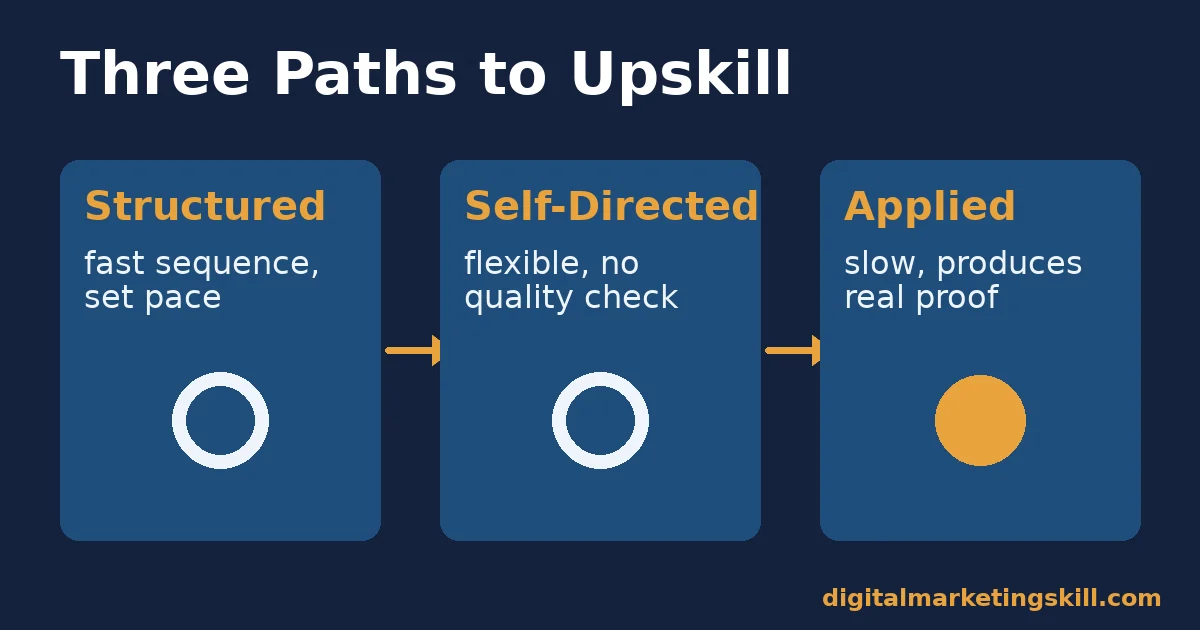
Not every learning method builds skill the same way. Structured courses, self-directed reading, and applied project work each do a different job. Each one deserves a different kind of attention and a different kind of follow-through.
Structured Learning: Built for Speed and Structure
Structured learning is usually the fastest way to upskill in digital marketing from a cold start. A structured course, whether a short workshop or a full accredited program, sequences the material for you. Our guide on how to start a digital marketing career covers how structured programs typically compare with self-teaching for a true beginner.
A good course tells you what to learn first, what comes next, and how the pieces connect.
The trade-off is pace. Structure moves as slowly as the weakest module for you personally. A good program compensates with live coaching, because a human can redirect you the moment you get stuck, which a pre-recorded video cannot do.
Self-Directed Learning: Built for Flexibility
Blogs, documentation, podcasts and videos let you learn exactly what you need, exactly when you need it, often at no cost. This path works best for narrow, well-defined gaps, such as one new ad platform feature or one analytics report.
Its weakness is the lack of a sequence or a quality check. Nobody tells you when a source is outdated, incomplete or simply wrong. So self-directed learners can build confidence in a skill that is thinner than it feels.
This path also competes for your time in small, easy-to-ignore pieces: a ten-minute article here, a podcast episode there. Without a running list of what you have finished, self-directed learning can feel productive for months while covering the same topics on repeat.
Applied Learning: Built for Proof of Work
Working on a real project, whether a paid client, a freelance gig, or a freelance practice project, is the only path that produces evidence a stranger can judge. It is also the slowest and least comfortable path. Real projects have real constraints: budgets, deadlines and other people’s expectations.
Applied learning rarely works alone. It needs a base of structured or self-directed learning first. Otherwise you are experimenting on a real budget or a real deadline without the fundamentals to recover from mistakes.
Most People Need All Three, in Sequence
The three paths are not competitors. They are stages. Use self-directed learning to explore a topic cheaply. Use structured learning to fill gaps a search engine cannot sequence for you. Then use applied work to prove the result.
Skipping straight to applied work on an unfamiliar skill, such as jumping into content creation for a paying client with no foundation, usually costs more in redone work than it saves in time.
Revisit the mix as your career stage changes. A beginner leans on structured learning for sequencing. Someone five years in often only needs self-directed learning plus a steady stream of applied projects to upskill in digital marketing and stay current.
How to Get the Most From Each Path
Each path above needs a different habit to pay off. The sections below mirror the three paths, and show how to upskill in digital marketing through each one without wasting the effort you already put in. Match the fix to whichever path you lean on most right now.
Structured Learning: Pick for Depth, Not Just a Certificate
Choose a course by what you will be able to do at the end, not by the certificate name. Look for programs with hands-on project work, feedback from a real instructor, and a visible outcome, such as a portfolio piece or a verified work reference.
Finish what you start before adding a second course. Partially completed programs rarely turn into usable skill. They also crowd out the applied practice that proves the skill is real.
Self-Directed Learning: Curate Ruthlessly
Limit yourself to two or three trusted sources per topic, instead of an endless feed of videos and articles. Prioritize sources that show their work: a platform’s own documentation, a named study, or a practitioner publishing real campaign numbers, over generic listicles.
Set a stop rule before you start. Decide in advance how many hours you will spend researching a topic before you move to applying it. That way curiosity does not quietly replace progress.
Applied Learning: Document Everything You Build
Applied practice is where most people actually upskill in digital marketing, even though it gets the least attention in generic advice. Keep a simple log for every project: the goal, what you tried, what happened, and what you would change. This one habit turns a one-off task into a reusable case study, which is what you will actually show an employer or client later.
Ask for feedback while the work is still fresh. A short debrief with a manager, mentor or client captures detail that fades within days. It often reveals a second skill gap you did not know you had.
How to Measure Whether You Are Actually Upskilling
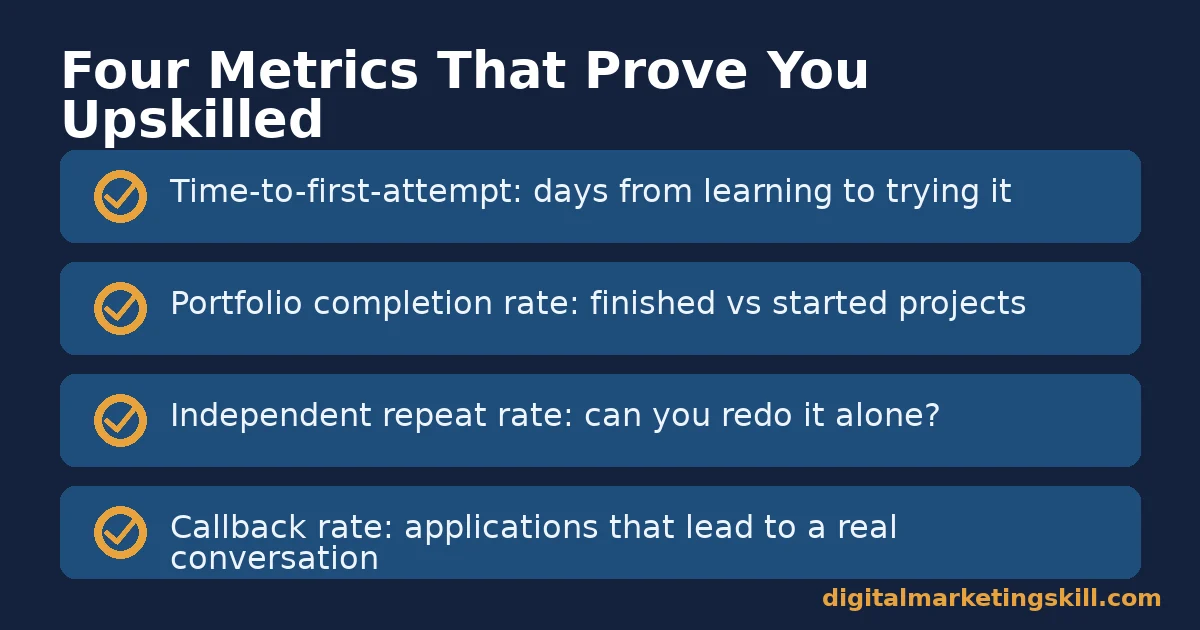
Hours spent learning is a poor measure of upskilling, because it rewards activity, not capability. If you want real proof that you upskill in digital marketing rather than just consume it, track these four metrics instead.
Read the numbers together, not in isolation. A fast time-to-first-attempt paired with a low portfolio completion rate often means you start projects impulsively and abandon them. A high completion rate paired with a low independent repeat rate often means a mentor or template is doing more of the work than you realize.
Four Metrics That Show Real Progress
Time-to-first-attempt. The number of days between learning a concept and trying it on a real task. A short gap means the loop is working. Weeks or months usually means the skill is stalling at the learning stage.
Portfolio completion rate. The share of started projects you actually finish and can show, out of everything you start. A low rate signals you are beginning more than you are proving.
Independent repeat rate. Whether you can repeat the task a second time without the original course, article or mentor open beside you. If you cannot, the skill has not transferred yet.
Interview or client callback rate. Once you apply for roles or pitch clients, the share that leads to a real conversation is the slowest, but most honest, signal that your new skill reads as real to someone outside your own head.
The One Rule: If You Cannot Point to a Finished Project, You Consumed Content
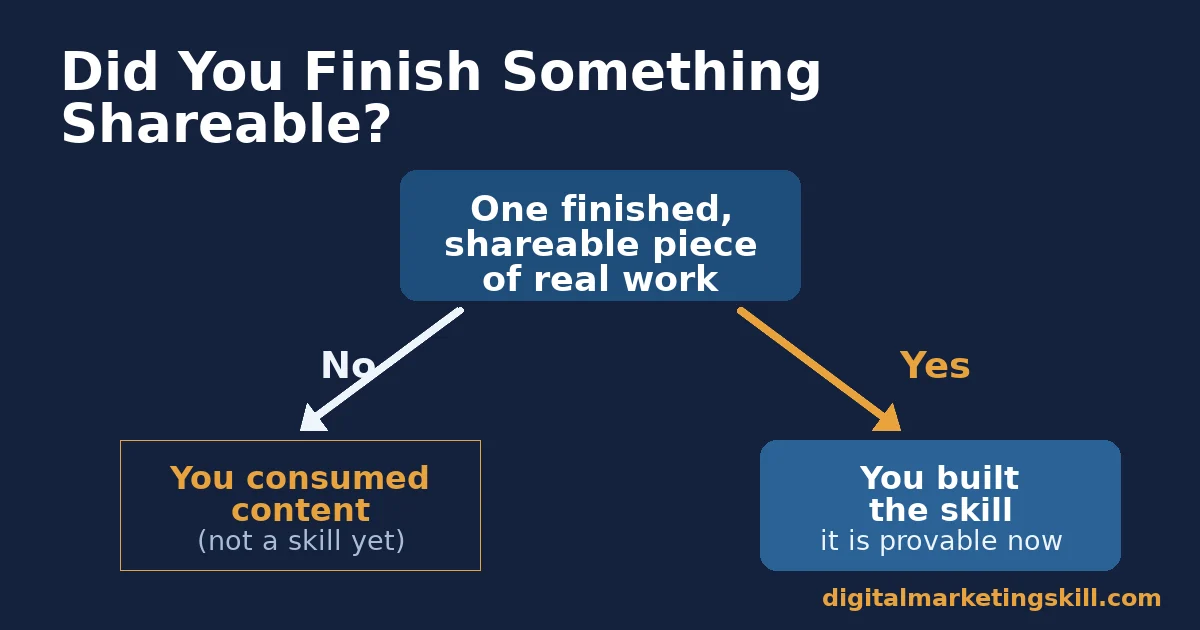
Here is the rule worth keeping on a sticky note. If you cannot point to one finished, shareable piece of work for a skill, you consumed content about that skill. You did not build it. This single test is the fastest way to upskill in digital marketing honestly, instead of by feel.
Illustrative, invented example: two marketers each spend twenty hours learning paid search. The first watches every available video on the topic. The second watches four hours of the same material, then spends sixteen hours building and running a small test campaign on a $50 invented budget.
Only the second marketer has a campaign, a cost-per-result number, and a decision about what to change next time. That is what a hiring manager or client actually wants to see.
A Real Case: Leaving a Job After Building Proof, Not Just Knowledge
Here is one example of what it looks like to upskill in digital marketing all the way through to a career change, as published on the Digital Marketing Skill Institute’s reviews page. Former student Damola Akanbi left his job after building a track record of managing real campaigns during training. He now runs client work averaging around $1,500 per client.
This is one published, self-reported result. It is not a typical or guaranteed outcome, and income will vary by niche, experience and market. Our earnings disclaimer explains why no course, including ours, can promise a specific income, and it applies to every figure in this guide.
What the case does show is the sequence this guide describes, not a shortcut around it: structured learning for the fundamentals, followed by applied work real enough to leave a job for. It is one named example, not a prediction for every reader.
Frequently Asked Questions About Upskilling in Digital Marketing
What is the fastest way to upskill in digital marketing?
The fastest path combines a structured source for sequencing with applied practice for proof. Pick one narrow skill gap. Learn the core concept from a trusted structured source. Then apply it on a small real or practice project within one to two weeks, rather than studying it indefinitely.
Do I need a certificate to upskill in digital marketing?
No single certificate is required. A credential from a program with hands-on project work and mentoring can speed up the sequence and add a verifiable line to your resume. What matters most to employers and clients is evidence you can do the work, not the certificate alone.
Do digital marketers get paid well?
Pay varies by specialization, experience and location. In the US, the Bureau of Labor Statistics puts the median pay for marketing managers at $166,790 per year, projected to grow 7% over the next decade. Market research analysts earn a median of $78,760, with the same 7% projected growth.
Which digital marketing skill should I learn first?
Learn the skill tied to the work you already do, not the most talked-about trend. If you run social media, paid social advertising builds on what you know. If you write, content strategy and basic SEO compound your existing strength.
How long does it take to become job-ready in digital marketing?
It depends on your starting point and how consistently you apply what you learn. Most structured programs are built around a few months of focused study, paired with ongoing applied practice afterward. Job-readiness is better measured by a finished portfolio than by a calendar date.
Can I upskill in digital marketing without quitting my job?
Yes. Most of this guide’s loop, identifying a gap, learning a concept, and applying it, fits around a full-time job using evenings, weekends or lunch breaks, especially with a self-paced program or a part-time freelance project.
How do I know if my upskilling is actually working?
Track the four metrics in this guide instead of hours studied: how fast you move from learning to attempting, how many projects you finish, whether you can repeat the task alone, and whether applications or pitches lead to real conversations.
Is it better to specialize or stay general in digital marketing?
Early on, general skills across content, social, email and basic analytics help you find what fits you best. Once you can show finished work in one area, specializing tends to upskill your career faster, because employers and clients pay more for proven depth than broad familiarity.
What if I upskill in the wrong thing?
Treat the first skill you pick as a test, not a permanent bet. The identify-learn-apply-show loop in this guide is short by design, usually weeks, so a wrong guess costs you one cycle, not a year. Use what you learned about the gap to pick a better target next time.
Your Next Step: Apply What You Already Know This Week
Pick the one skill gap costing you the most opportunities right now. Give yourself two weeks to learn it and apply it to a real or practice project, wherever you live in your country. More than 6 billion people now use the internet worldwide, according to DataReportal’s global digital overview, so the loop in this guide works whether your market is local or global.
Build the Loop With Support, if You Want It
If you want that loop built for you, with sequencing, mentoring and real project work already in place, the Digital Marketing Skill Institute’s Master Diploma in Digital & AI Marketing can help.
It is organized into four AI-powered tracks: AI-Powered Social Media Management and Advertising, AI-Powered Lead Generation and Email Automation, AI-Powered Google Specialist, and AI-Powered WordPress and SEO Specialist. The four tracks are built from ten courses, with a Full Stack option to complete all four.
The program includes unlimited 1-on-1 coaching and mentoring, a U.S. Project Internship with a verified U.S. Work Reference Letter, and dual US and UK accreditation recognised in more than 100 countries, delivered 100% online.
See the full program details on the Master Diploma program page, browse more guides on the digital marketing blog, or go straight to the application page to start your own loop of learning and proof, anywhere in your country. Learn more about the Institute at digitalmarketingskill.com, and start wherever you are today at digitalmarketingskill.com.
Every figure in this guide was checked against its original source before publication. Figures marked as illustrative are invented examples, not real results.
