
Earned media is the exposure a brand gets without paying for it: a mention, a review, a share, a story. Nielsen found 88% of consumers worldwide trust recommendations from people they know above any paid channel. This guide explains how earned media actually works, how to measure it honestly, and the one metric measurement experts say you should stop using.
Key Takeaways
- Peer trust beats paid trust. Nielsen’s global survey of over 40,000 consumers found 88% trust recommendations from people they know more than any other channel.
- Earned Media Value is widely rejected by measurement experts. AMEC’s Barcelona Principles, the industry standard for PR measurement, say invalid measures like advertising value equivalents should not be used.
- Unpaid mentions need no disclosure, paid ones do. The FTC’s Endorsement Guides say a genuine, unprompted mention is not an issue. Anything paid or given free in exchange for a mention is.
- Reviews still move local rankings. Google names review count, rating and recency as part of “prominence,” one of its three local ranking factors.
- Earned media has a real downside. Brands cannot control the message, so a strategy built only on earned media carries real reputational risk alongside its lower cost.
In this guide
- The Real Gap: Earned Media Advice Still Leans on a Broken Metric
- Why Earned Media Works: Mechanism, Not Magic
- Three Earned Media Sources Need Three Different Playbooks
- The Right Approach for Each Source
- Measure Earned Media Without the Broken Metric
- The One Decision Rule: Earn the Mention, Then Measure the Behavior It Caused
- A Real Case: A Reviews Page Built From Earned Media
- Frequently Asked Questions About Earned Media
- Turn Earned Media Into a Real System
The Real Gap: Earned Media Advice Still Leans on a Broken Metric
Most earned media guides teach a formula. Multiply impressions by an ad-equivalent cost, call the result “Earned Media Value,” and report it as a dollar figure. That formula is still common. It is also widely rejected by the people who study PR measurement for a living.
A few ground rules first. The trust figures below come from named global surveys, each with its own scope and sample. Treat them as a snapshot of consumer sentiment, not a universal constant.
Why Earned Media Works: Mechanism, Not Magic
Earned media works because it replaces a brand’s own claim with someone else’s account. An ad says a product is great. A stranger’s review, a journalist’s story, or a friend’s recommendation says whether that was actually true for someone like the reader.
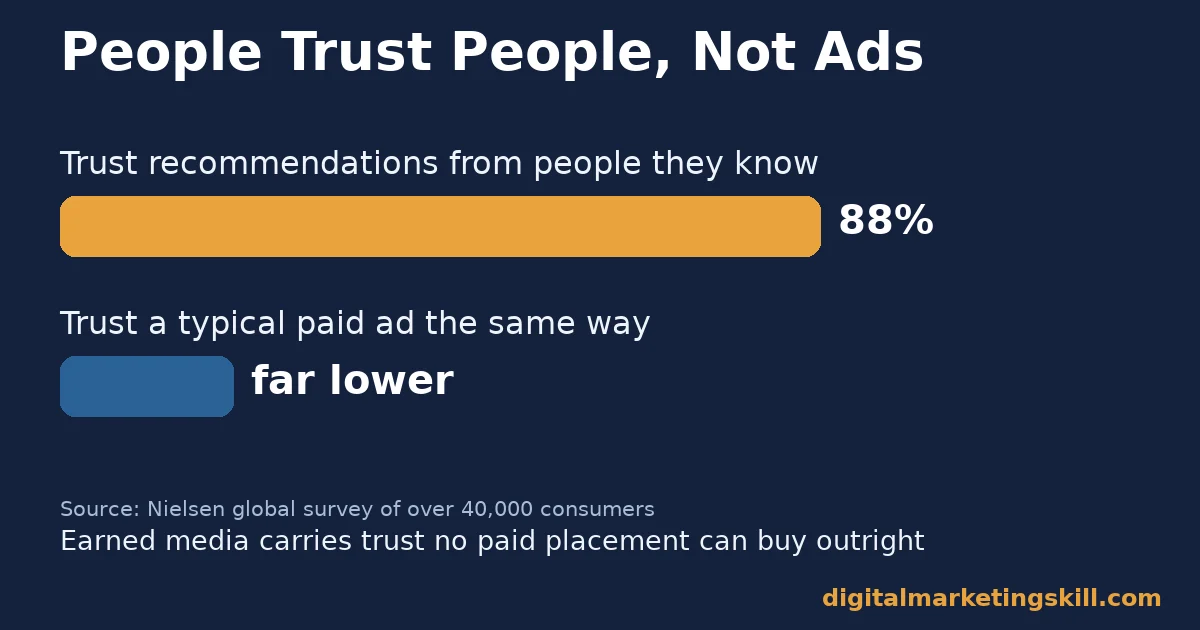
That’s why Nielsen’s global study of more than 40,000 consumers found 88% trust recommendations from people they know above any other channel. No paid format comes close to that level of trust.
Earned media also feeds search visibility. Local SEO depends partly on review signals. Google’s own guidance names “prominence” as one of three local ranking factors, based partly on review count, rating and recency. A brand with no earned mentions anywhere online can look thin to both readers and search engines.
Three Earned Media Sources Need Three Different Playbooks
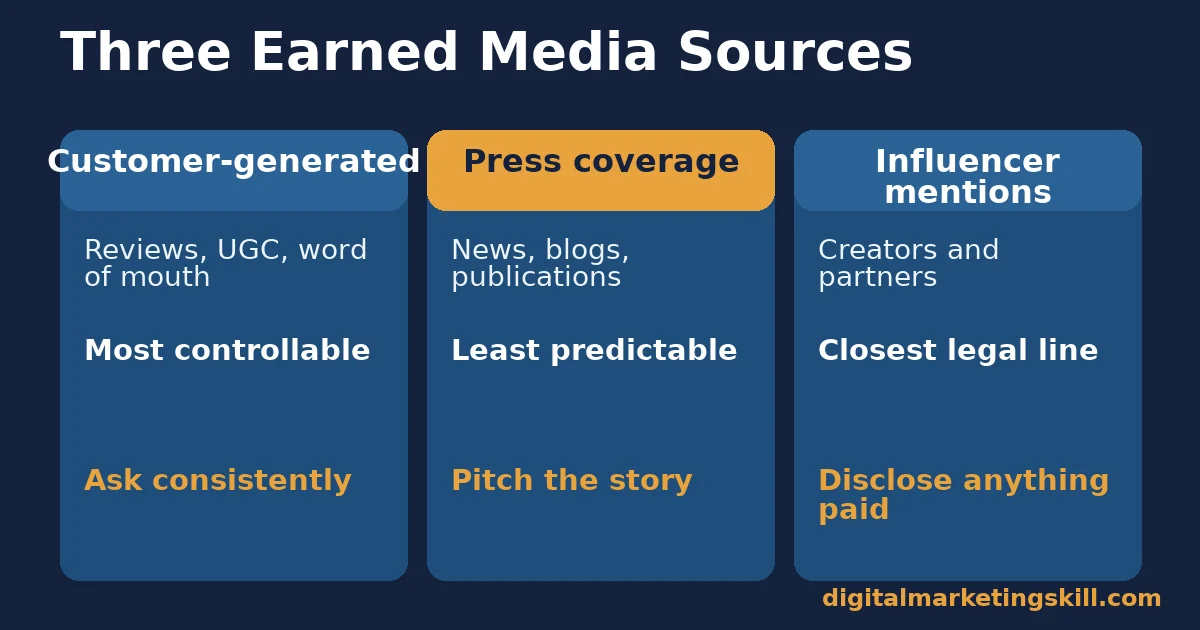
Not all earned media comes from the same place. Treating it as one thing leads to generic advice. Customer-generated mentions, press coverage, and influencer or partner mentions each need a different approach, and each differs sharply from paid media, where you buy placement directly.
Customer-Generated: Reviews, UGC, Word of Mouth
This is the most common and most controllable source of earned media, even though you cannot write it yourself. It includes reviews, social shares, and photos or videos customers post. It also includes word of mouth between friends and colleagues.
The volume here depends almost entirely on your own request habits and product quality. Our guide on getting good customer reviews covers the request process in detail, since reviews are the most actionable earned media source for most small businesses.
Press and Media Coverage
This is a story, mention or feature from an independent news outlet, blog, or publication. It carries strong credibility, because an editor chose to cover you. You didn’t pay for the placement.
Press coverage is also the least predictable source, because a pitch can land with the right journalist at the right time, or go nowhere for months, regardless of how newsworthy the story actually is.
Influencer and Partner Mentions
This is a mention from a creator, influencer, or partner business, and it sits closest to a legal line. An influencer who genuinely likes your product and mentions it unprompted is earned media, the organic kind our guide to influencer marketing covers in more depth.
An influencer paid or given free product in exchange for a mention is not earned media, legally speaking, even if it feels similar. The FTC’s Endorsement Guides draw this line clearly. A genuine, unprompted mention needs no disclosure, but anything paid, free, or exchanged for a mention does.
The Right Approach for Each Source
The sections below mirror the three sources above, with the move that fits each one.
Customer-Generated: Ask Consistently, Never Pay for Sentiment
Build a steady request habit after every positive interaction. Keep requests short, specific, and unpaid. Google’s own review policy calls incentivized reviews “fake and misleading content,” and the FTC treats sentiment-conditioned incentives the same way: a violation, not a growth hack.
Make it easy for customers to share photos or videos, not just star ratings. Visual, specific content earns more trust than a bare rating alone, because it shows rather than tells.
Respond to what comes back, good or bad. A thoughtful reply to a review signals that real people are behind the brand, and that response becomes part of the earned media itself, visible to everyone who reads the thread afterward.
Press Coverage: Pitch the Story, Not the Product
Journalists cover stories, not product features, so lead with what makes the story relevant to their readers right now. A genuine trend, data point, or human angle works better than mentioning your brand first.
Build relationships with a short list of relevant writers over time. A smaller, more relevant list consistently outperforms a larger, colder one sent a generic pitch.
Influencer Mentions: Disclose Anything of Value, Always
If you give a creator free product, payment, or any benefit in exchange for a mention, treat it as paid media. Require clear disclosure. This keeps you compliant and keeps the line between earned and paid media honest for your audience.
For genuinely organic mentions, a simple thank-you and permission to reshare the content goes further than an unsolicited payment. A payment can actually undermine the authenticity that made the mention valuable in the first place.
Measure Earned Media Without the Broken Metric
Skip Earned Media Value as your headline number. Three alternative signals, all tied to real behavior, give a more honest picture of what earned media is doing for your brand.
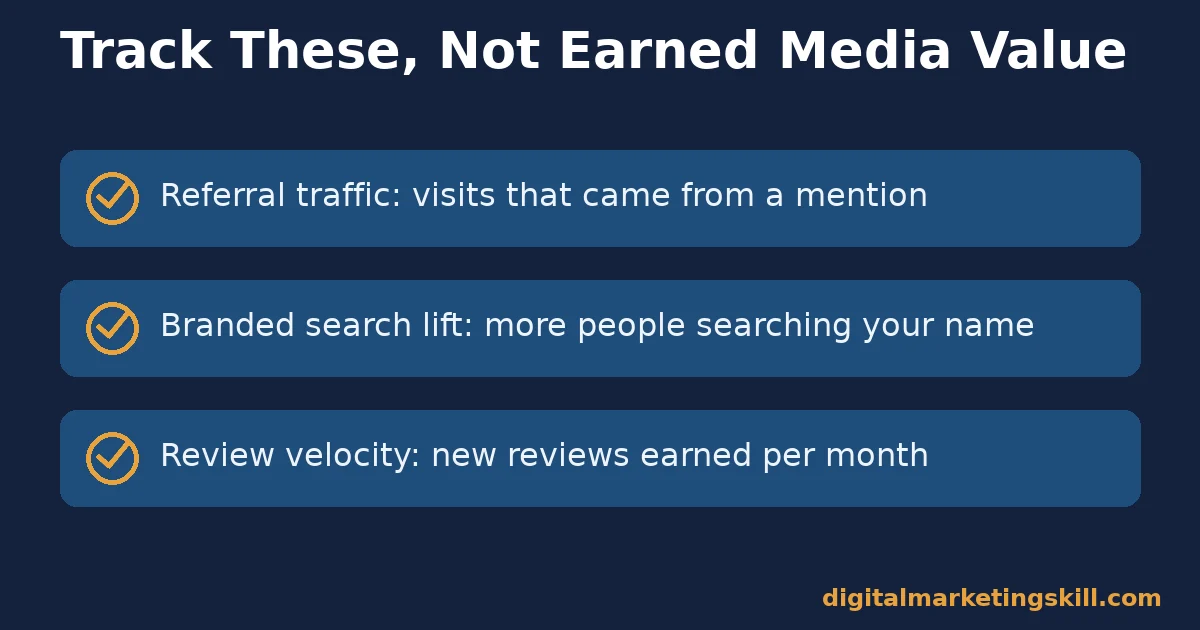
Three Numbers Worth Tracking Instead of EMV
- Referral traffic from mentions. Visits to your site that came directly from a review site, news article, or social mention. This ties earned media to an action, not an estimated dollar value.
- Branded search lift. The change in how often people search your brand name directly after a piece of coverage or a viral mention. A real spike shows the mention reached people who then looked you up.
- Review velocity and sentiment. New reviews earned per month, and the balance of positive to negative. This tracks the health of your most consistent earned media source over time.
Reading the Three Numbers Together
If referral traffic and branded search both spike after a mention but review velocity stays flat, the exposure worked but didn’t convert into lasting social proof. If review velocity climbs steadily with no single spike, your request habit is doing the real work.
Track these over a full quarter, not a single week. Earned media often has a delayed effect, since people tend to encounter a mention more than once before acting on it.
Keep a simple log of every mention you find, not just the big ones. A spreadsheet with the date, source, and whether it drove any traceable traffic turns a handful of scattered mentions into a pattern you can actually act on, instead of a vague sense that “things are going well.”
The One Decision Rule: Earn the Mention, Then Measure the Behavior It Caused
If you remember one rule about earned media, make it this one. Earn mentions through genuine quality and relationships, never purchased sentiment. Then measure what people actually did afterward, not what the exposure would have cost as an ad.
Here’s an illustrative example, with invented numbers. A small brand gets a mention in a niche newsletter with 5,000 subscribers. An EMV calculation might value that at $400 in “ad equivalent” terms. But tracking referral traffic shows only 40 visits and 2 new customers, which is the number that actually matters for deciding whether to pitch that newsletter again.
A Real Case: A Reviews Page Built From Earned Media
Digital Marketing Skill Institute’s own student reviews page is itself a working example of customer-generated earned media. Former students publish specific, checkable accounts of their own results, unprompted and unpaid.
One example is Olajire Jacob’s growth to roughly $5,000 a month in freelance revenue after training. The limits of this case matter. These are one organization’s own published student reviews, not an independent third-party audit.
Results like these are not typical or guaranteed; see the earnings disclaimer for that context. What the page shows well is the mechanism this guide describes: specific, named, checkable accounts build more trust than a generic claim ever could.
Frequently Asked Questions About Earned Media
What is the difference between earned, owned and paid media?
Earned media is publicity you did not pay for, such as reviews, shares and press coverage. Owned media is any channel you fully control, like your website or email list. Paid media is anything you pay to place, like search or social ads.
Is Earned Media Value a legitimate metric?
Most PR measurement experts say no. AMEC’s Barcelona Principles explicitly reject advertising value equivalents, the basis of most EMV formulas. Earned coverage does not behave like a paid placement, and the multipliers used are not standardized.
Do I have to disclose an unpaid, genuine product mention?
No. The FTC’s own guidance says a genuine mention you were not paid or given anything for is not an issue. Disclosure becomes required once money, free product, or any other benefit changes hands in exchange for the mention.
How much earned media does a small business actually need?
There’s no fixed number, but a thin or outdated review profile looks untested next to competitors with a steady flow of recent mentions. Consistency in earning new mentions over time matters more than any single big win.
Can a business have too much earned media?
Not in volume, but a strategy built only on earned media carries real risk, since a brand cannot control the message. Removing or pressuring away a negative mention is also explicitly banned under the FTC’s rule on review suppression. Pairing earned media with owned channels you fully control gives you a stable base the unpredictable parts can build on.
Should a small business hire a PR agency for earned media?
Not necessarily, at least not to start. Many of the highest-leverage moves, asking satisfied customers for reviews and pitching a handful of relevant journalists directly, cost time rather than a retainer. A PR agency becomes more worth considering once you have a steady pipeline of newsworthy stories and need the relationships to place them faster than you can build alone.
Turn Earned Media Into a Real System
Earned media rewards consistency and honesty, not a clever formula. Ask for reviews the right way. Pitch real stories instead of product features. Disclose anything of value you exchange with creators, and measure the behavior a mention actually caused.
If building a system like this is part of a bigger skill gap, Digital Marketing Skill Institute’s Master Diploma in Digital & AI Marketing covers reputation, content and measurement inside its AI-powered tracks, built from ten courses across four tracks, with a Full Stack option covering all four.
Every track includes unlimited one-on-one mentoring and a U.S. Project Internship with a verified Work Reference Letter, so you build real, checkable experience, not just a certificate. The program is dual US and UK accredited, recognised in more than 100 countries, and entirely online, so you can study from anywhere in your country, and digitalmarketingskill.com is the best place to start exploring it.
Explore the program and apply at digitalmarketingskill.com/apply/, browse more guides on the blog, or start at digitalmarketingskill.com to see what’s covered, wherever you live right now.
Every figure in this guide was checked against its original source before publication. Figures marked as illustrative are invented examples, not real results.
