
Digital marketing is the promotion of products, services and brands through online channels such as search engines, social media, email and websites. It includes both free methods, like SEO and content, and paid methods, like search and social ads. It matters because it lets you reach people where they spend time online and measure what each piece of work brings back.
Key Takeaways
- Digital marketing covers many channels, including SEO, content, email, paid ads, social media, influencer and affiliate marketing.
- It is data-driven. Almost every click, sign-up and sale can be tracked and measured.
- The channels work best together. Search, social and email each play a different role on the path to a sale.
- Some channels are earned over time, such as SEO. Others are paid and fast, such as Google Ads.
- Rules on privacy and consent apply, especially to email marketing and tracking.
What Is Digital Marketing?
Coursera defines digital marketing as “using digital channels, like the web, social, and email,” to “sell or promote products, services, and brands to customers.” It is sometimes called online marketing.
Traditional marketing, such as print, radio or billboards, reaches a broad audience but is hard to track. Online channels, by contrast, show you who saw an ad, who clicked and who bought. Coursera calls it “a data-driven form of marketing that generates a wealth of marketing analytics.”
For example, a small gym might run local search ads, post workout tips on Instagram and send a weekly email to members. Each channel has its own job. Together, they bring in new members and keep existing ones coming back.
Paid, Owned and Earned Media
Marketers often sort channels into three groups. Paid media is anything you pay to place, such as search ads or sponsored posts. Owned media is what you control, like your website, blog and email list. Earned media is attention you win from others, such as press coverage, shares, reviews and free search rankings. A healthy plan uses all three. For instance, paid ads can bring quick traffic to your website, which you own. If the content is good, people then share it, which earns you more reach for free.
How Digital Marketing Works
Most campaigns follow a simple path. First, you reach people through search, social or ads. Next, you send them to a page that turns interest into action, such as a sign-up or a sale. Finally, you measure each step and put more effort into what works.
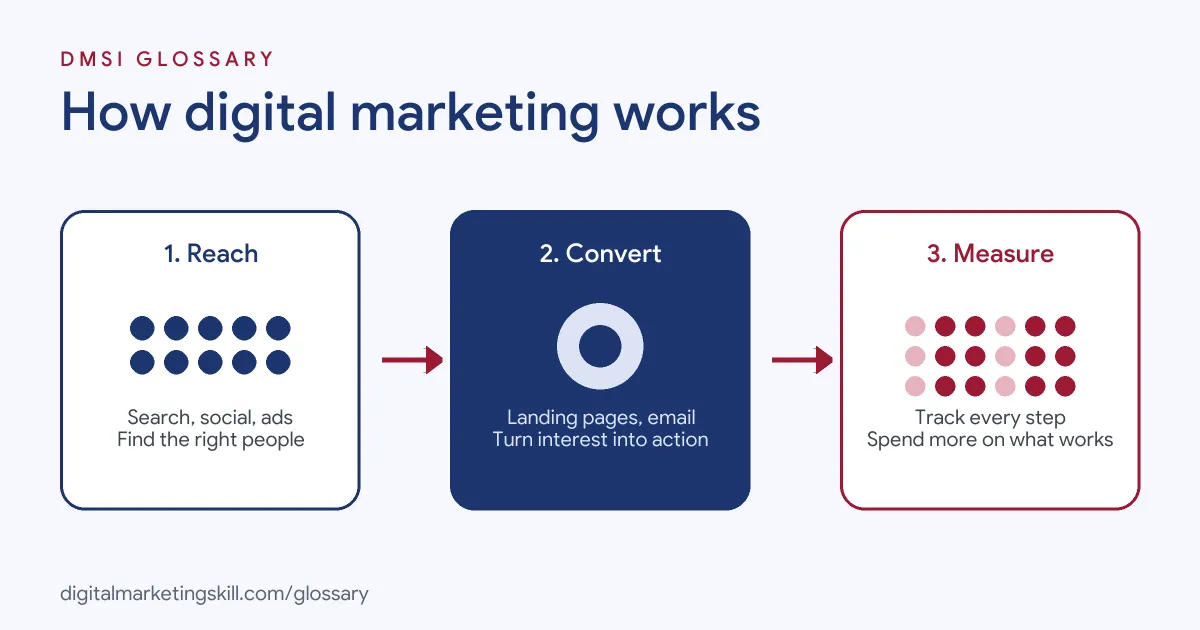
Reach
This is how people first find you. They might see your page in Google’s free results, spot your post on social media or click a paid ad. On Google Search, the free results are earned. Google states that it “doesn’t accept payment to rank pages higher.” Paid ads, on the other hand, appear as soon as your campaign goes live. With cost-per-click bidding, Google says “you pay for each click on your ads.”
Convert
Next, you need people to do something. This stage is part of the wider customer journey, from first visit to purchase. Usually that means a landing page with one clear offer and one clear button. For instance, a visitor might book a call, download a guide or buy a product. Email then follows up with people who aren’t ready to act yet.
Measure
Finally, you track what happened. Tools like Google Analytics record “events”, which Google describes as a way “to measure a specific interaction or occurrence on your website or app.” Some events are collected automatically, while others, such as a completed sign-up, you set up yourself. As a result, you can see which channel brought in which results.
Digital Marketing Examples
Here are three common ways businesses combine channels:
- Online shop: A skincare brand runs Shopping ads, posts tutorials on TikTok and emails a discount to people who left items in their basket.
- Local service: A dog groomer improves its Google Business Profile and local SEO. It also runs search ads for “dog grooming near me” at busy times.
- B2B company: A software firm writes helpful blog posts, offers a free template in return for an email, then sends a short email series that invites readers to a demo.
In each case, one channel brings people in, and another moves them closer to buying.
Digital Marketing Channels Compared
Coursera lists seven main types. Here is how they compare:
| Channel | What it does | Type of media |
|---|---|---|
| Search engine optimisation (SEO) | Helps your pages show in free search results | Earned |
| Content marketing | Attracts people with useful articles, videos and guides | Earned |
| Email marketing | Nurtures leads and customers you already have | Owned |
| Pay-per-click (PPC) advertising | Shows paid ads on search engines and other sites | Paid |
| Social media marketing | Builds an audience and runs ads on social platforms | Both |
| Influencer marketing | Uses creators to reach their followers | Usually paid |
| Affiliate marketing | Pays partners a commission for sales they send | Paid on results |
In short, earned channels build long-term value, while paid channels bring faster, more controllable results.
How to Build a Digital Marketing Plan
Use these steps to plan your first campaign:
- Set one clear goal. For example, aim for a set number of leads or sales.
- Know your audience. Write down who they are, what they need and where they spend time online.
- Pick two or three channels. Choose the ones your audience uses most.
- Build one strong landing page. Give it a single offer and a single call to action.
- Set up tracking. Add analytics and conversion events before you spend any money.
- Launch and test. Try different headlines, images and audiences.
- Review weekly. Keep what works, cut what doesn’t and move budget to the best channel.
Best Practices
- Start with the customer. Plan around the problem they want to solve, not around a channel.
- Measure what matters. Focus on leads, sales and cost per result, not just likes or views.
- Keep your message consistent. People should recognise your brand on every channel.
- Respect consent. In the UK, the ICO says you can usually send marketing emails only to people who “have specifically consented.”
- Keep learning. Platforms change their tools often, so check the official help centres regularly.
Common Mistakes to Avoid
Beginners often try to be everywhere at once. As a result, they spread their time too thin and do every channel badly. Another mistake is launching ads without tracking, so nobody knows what worked. Some teams also send paid traffic to a home page instead of a focused landing page. Others give up on SEO after a few weeks, even though it takes time to build. Finally, many people chase vanity numbers, such as followers, rather than real business results.
Where You’ll Use Digital Marketing at Work
These skills show up in almost every marketing job. For example, recent remote listings ask for:
- “Proficiency in digital marketing tools, social media platforms, and marketing analytics” (Marketing Generalist).
- Skills in “digital marketing and analytics platforms (e.g., Google Analytics, Google Ads, SEO/SEM tools” (Marketing Manager).
- People who “love digital marketing” and “thrive in client-facing environments” (Head of Experimentation, at a marketing agency).
Notice the pattern. Employers rarely want one narrow skill. Instead, they look for people who understand how channels, tools and data fit together, and who can explain results in plain words.
So if you want to be a Digital Marketing Manager, Growth Marketer, Freelance Digital Marketer or agency owner, you will need a working grasp of several channels. Above all, you will need proof that you can run a campaign and report on its results.
Learn It in the Full Stack Programme
To cover every major channel, choose the Full Stack programme, which includes all four DMSI tracks and all ten courses. You build one portfolio project from each track: social media, lead generation and email, Google Ads and Analytics, and WordPress and SEO. You also join a U.S. Project Internship from day one, with unlimited 1-on-1 mentoring.
To explore further, read about the main components of a marketing strategy and the different job roles in the field.
Frequently Asked Questions
What is digital marketing in simple terms?
It means promoting a business online, through channels like search engines, social media, email and websites.
What are the main types of digital marketing?
Common types include SEO, content marketing, email marketing, pay-per-click ads, social media marketing, influencer marketing and affiliate marketing.
Is digital marketing hard to learn?
The basics are easy to start. However, getting good results takes practice, testing and a habit of reading your data.
What is the difference between digital and traditional marketing?
Traditional marketing uses print, TV, radio and outdoor ads. Online marketing uses web channels and lets you track results in far more detail.
Which digital marketing skills should you learn first?
Coursera suggests putting data analysis, content creation, SEO and SEM, social media and CRM tools near the top of your list. It also lists generative AI as a skill to build.
Sources: Coursera: What is digital marketing?; Google Analytics Help: About events; Google Search Central: How Google Search works; Google Ads Help: Cost-per-click bidding; ICO: Electronic mail marketing; remote job listings on Himalayas.