
Digital marketing components only pay off when they work as one system instead of five separate projects. A website, SEO, social media, a blog and email marketing each do a different job. The businesses that grow fastest connect them on purpose, rather than running each one alone. This guide shows how digital marketing components fit together, what to measure for each, and which one to fix first.
Key Takeaways
- Websites and SEO lead for impact. HubSpot’s State of Marketing research names websites, blogs and SEO the most popular and impactful channels. That is especially true for B2B companies.
- Most content is never found. Ahrefs studied roughly 14 billion pages and found 96.55% get no organic traffic from Google. So SEO is a plan, not an afterthought.
- Email still pays per message. Mailchimp’s all-industry benchmarks put the average email click rate at 2.62%. That is a channel that keeps earning without a fresh ad budget.
- Social reach is huge but rented. DataReportal counts 5.66 billion social media user identities worldwide, about 68.7% of the global population. None of that audience belongs to the business.
- Checkout friction undercuts every component. Baymard Institute’s aggregate of 50 studies puts average online cart abandonment at 70.22%. That can erase gains from every other channel.
In this guide
- What Most Lists of Digital Marketing Components Miss
- How Digital Marketing Components Work as a System
- The Five Core Digital Marketing Components
- Why Components Compound When They Are Connected
- How to Run Each Digital Marketing Component Well
- How to Measure Each Digital Marketing Component
- The One Decision Rule: Fix the Weakest Link Before Adding a New Component
- A Real Case: Building Components Together, Not One at a Time
- Frequently Asked Questions About Digital Marketing Components
- Start With the Weakest Component, Not the Newest One
What Most Lists of Digital Marketing Components Miss
Most articles list five or six digital marketing components and move on, as if naming them were the hard part. Naming them is easy. The hard part is making them work together. A visitor from social media should land on a website built to convert them. A subscriber who opens an email should find the blog post that email promised.
This guide treats the components as one system. It explains the mechanism that connects them, what differs between each one, how to run each well, and what to measure. Treat every statistic as a snapshot from the source named, not a permanent ranking. Treat the framework as a guide for decisions, not a fixed rulebook.
How Digital Marketing Components Work as a System
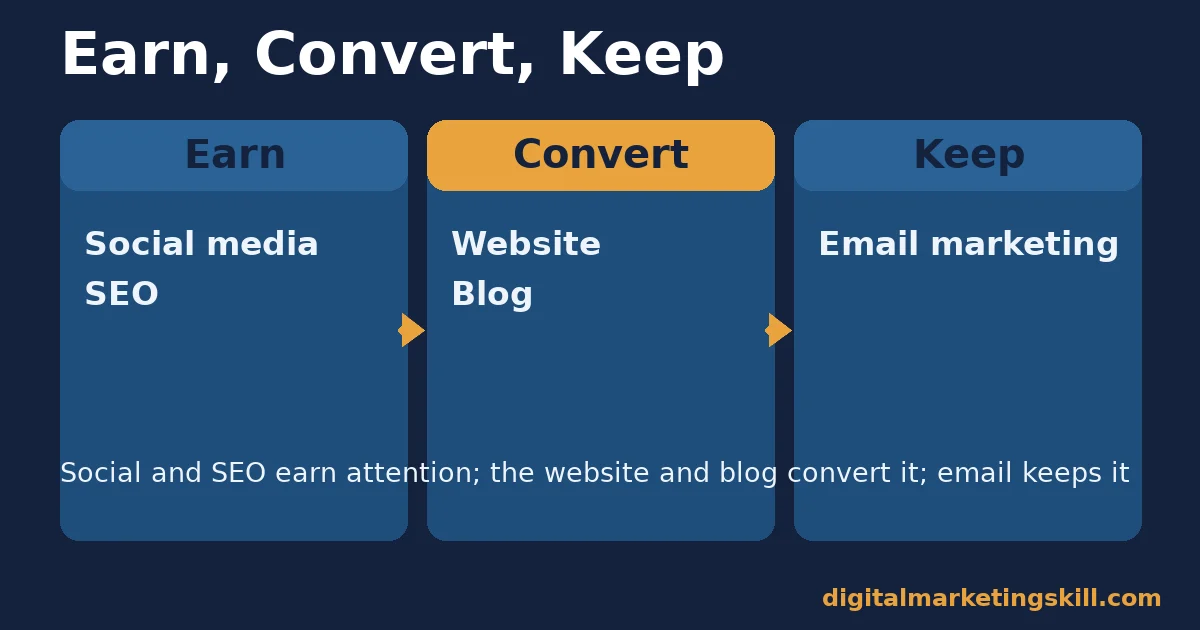
Each component plays a different role in a simple cycle. Social media and SEO earn attention. The website and blog convert that attention into a result. Email keeps the relationship going after the first visit, without paying for attention again.
Earn, Convert, Keep
Treat every component as belonging to one of three jobs: earning a new visit, converting that visit, or keeping the person engaged afterward. A business that only earns attention, with a weak website and no email list, pays for the same visitor again and again. A business that only focuses on conversion has nothing filling the top of that funnel.
HubSpot’s State of Marketing research found that websites, blogs and SEO remain the most popular and impactful channels, especially for B2B companies. That result fits this framework. Those are the components that do the converting and keeping, which is where earned attention actually turns into a result.
Why Integration, Not Addition, Drives Growth
Adding a sixth component rarely helps a business that has not connected the first five. A new social channel just feeds the same weak website. A new email sequence just promotes a blog nobody optimised for search. Integration means each component hands its visitor to the next one with a clear next step.
This is also where effort gets wasted. The same HubSpot research found that 49.4% of marketers reuse the same content across every platform. Only 39.5% adapt it for each one. Reused, unadapted content is a sign that components are being run separately, not as one system.
The Five Core Digital Marketing Components
These five components cover most of what a small or growing business needs. Each has its own job, strengths and limits.
None of them is optional in the long run, but none has to be perfect on day one either. A new business can launch with just a website and one channel that earns attention, then add the others as the first two start working together.
What matters is matching each component’s actual job to what it is being asked to do. Do not expect a blog to earn new visitors the way social media does. Do not expect email to find people who have never heard of the business.
Social Media: Built for Reach, Not Ownership
Social media is the fastest way to put a brand in front of new people. DataReportal’s global digital overview report counts 5.66 billion social media user identities worldwide, about 68.7% of the global population. So the audience is there. The limit is ownership: the account, the algorithm and the rules all belong to the platform, not the business.
SEO: Built for Compounding Return, Not Speed
Search engine optimisation is slow to start and durable once it works. A page that ranks keeps earning visits without a fresh ad every week. The limit is competition and patience. Ahrefs’ study of roughly 14 billion pages found 96.55% earn no organic traffic from Google at all. Ranking takes a real plan, not a few keywords added after the fact.
Website: Built to Convert, Not to Attract
The website is where every other component sends its traffic, and it is the one property a business fully owns. Its job is not to attract visitors. It is to convert the visitors other components already earned. A website that is slow or confusing wastes the work every other component did to bring someone there.
Blog: Built to Teach and Rank, Not to Sell Directly
A blog gives SEO something to rank and gives social media something worth sharing. Its job is to teach, answer a real question and demonstrate expertise, not to pitch directly. Backlinko’s content study found that articles over 3,000 words earn 77.2% more referring-domain backlinks than articles under 1,000 words. That rewards blogs that go deep on a topic instead of skimming it.
Email Marketing: Built to Keep, Not to Find
Email rarely finds new people, but it is the most reliable way to keep the people a business already earned. Mailchimp’s all-industry benchmarks put the average click rate at 2.62%. That figure is worth tracking over opens, since Apple’s Mail Privacy Protection can distort open-rate data.
Why Components Compound When They Are Connected
A single working component is useful. Several connected components are worth more than the sum of their parts, because each one lowers the cost of the next. A blog post that ranks in search also gives social media something worth sharing. A sharp social post also gives email subscribers something worth forwarding.
Content Marketing Institute’s B2B benchmarks found that 95% of B2B marketers now have a documented content strategy, yet only 29% rate that strategy extremely or very effective. That gap is telling: having a strategy for each component is common, but connecting the components into one system is not.
So the payoff from digital marketing components rarely comes from adding a new one. It comes from tightening the handoffs between the ones a business already runs. A website that loads fast turns more of the traffic SEO and social already earn into leads, without spending a cent more on either channel.
How to Run Each Digital Marketing Component Well
Naming the five components is the easy part. Running each one so it feeds the next is where growth actually happens.
Social Media: Lead With a Click to Your Website
Treat every social post as a short advertisement for a page you control. Write the post after the page is finished. Pull the hook from the page’s strongest point, so the click delivers exactly what the post promised.
SEO: Lead With the Topics People Actually Search
Choose topics with real, verifiable search demand before writing, not after. Build each page around one clear question. Answer it directly near the top, then let the rest of the page support that answer with detail and examples.
Website: Lead With a Fast, Clear First Screen
Match the page to what brought the visitor there. Remove anything that distracts from the one action you want. Keep the page fast. A slow or cluttered page undoes the work of every component that sent a visitor to it.
Blog: Lead With Depth on One Topic at a Time
Go deep on a narrow question instead of skimming a broad one. A thorough answer earns more links, more shares and more trust than a shallow post that tries to cover everything in 600 words.
Email: Lead With a Promise You Keep Every Time
Tell subscribers what they will get and how often, then keep that promise. A consistent, useful email builds a habit that a one-off promotional blast never will. Segment the list where it is practical, so a subscriber who bought once gets a different message from someone who has only read a blog post, since a generic email to everyone tends to perform worse than one written for a specific reader.
How to Measure Each Digital Marketing Component
Track one or two numbers per component instead of a long dashboard nobody reads. Each metric below is defined in one sentence.
One Core Metric per Component
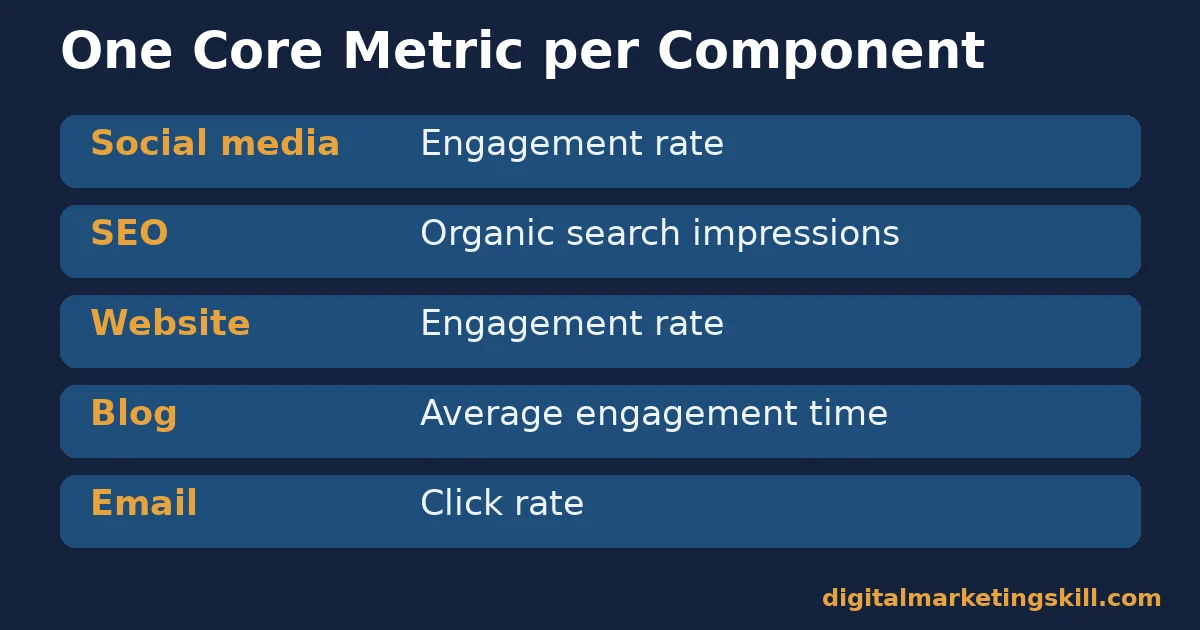
Pick one number for each component and review it on a fixed schedule, such as the first Monday of the month. A metric nobody looks at regularly is not actually being tracked, no matter how carefully it was defined.
- Social media: engagement rate. The share of followers who like, comment or share. It shows whether content is actually landing, not just being seen.
- SEO: organic search impressions. Search Console counts how often your pages appeared in Google results, a direct read on whether SEO work is making pages findable.
- Website: engagement rate. Google Analytics counts a session as engaged when it lasts longer than 10 seconds, includes a key event, or has two or more page views.
- Blog: average engagement time. How long a page stayed in focus on a reader’s screen, compared with the time a typical reader needs to finish the post.
- Email: click rate. The share of subscribers who click through to a page. It is a more reliable signal than open rate, since privacy features can distort opens.
Reading the Five Numbers Together
Weak social engagement points to a content or targeting problem, not a platform problem. Weak search impressions point to a topic-selection or technical SEO problem. Weak website engagement points to a page-speed or clarity problem. Weak blog time-on-page points to thin or padded content. Weak email clicks point to a mismatch between what was promised and what was delivered.
Fix components in the order the data points to, not the order you like working in. A business with strong social and weak website engagement should fix the website before spending more on social ads. More traffic to a weak page only wastes the social spend faster.
In practice this means working from the outside in. Check the component that is earning attention first: is social engagement or search impressions actually healthy? If so, move to the website and blog, since that is where earned attention gets converted or lost. Only check email last, because it depends on an audience the other components already built.
The One Decision Rule: Fix the Weakest Link Before Adding a New Component
If you remember one rule from this guide, make it this one: never add a sixth digital marketing component while one of the first five is clearly underperforming. A new channel cannot fix a problem inside an existing one.
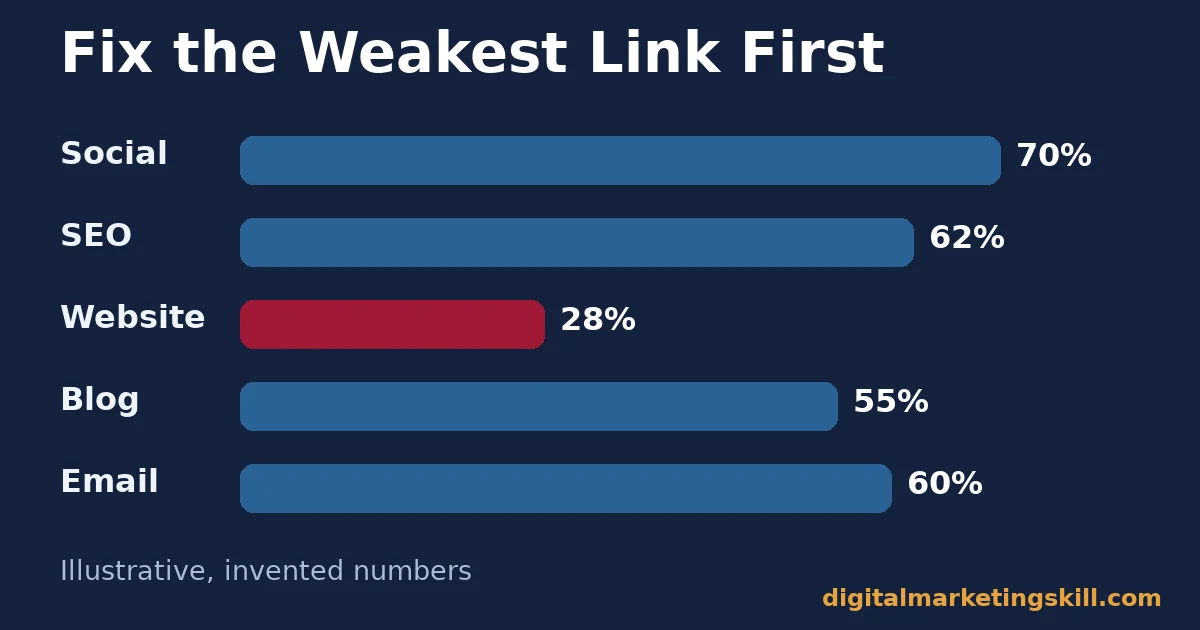
Here is an illustrative example, with invented numbers. A small retailer runs social ads that bring 2,000 monthly visitors to its website. The site’s engagement rate is only 28%, well below its other pages.
Instead of adding a paid search campaign, the owner spends two weeks fixing the website: faster images, a clearer headline and one visible next step. Engagement rises to 48%. The same 2,000 monthly visitors convert into roughly twice as many leads, without any new ad spend.
The lesson is about sequence. Fixing the weakest component first means every other component, including the ones already working, gets more value from the same traffic.
A Real Case: Building Components Together, Not One at a Time
Esther Elueme, a student on the Digital Marketing Skill Institute’s training programme, described building several components together early in her course. “In just a month, I am able to build a website, post scheduled ads on social media platforms, added my business niche on google search engine and optimized my page for keywords search on google,” she wrote, as published on the Institute’s reviews page.
Her account covers four components: a website, paid social, a local search listing and SEO, built in close succession rather than months apart. Treat this as one student’s account, not a controlled study. It still illustrates the core idea in this guide. Components built close together, each one feeding the next, compound faster than components added one at a time with long gaps between them.
Frequently Asked Questions About Digital Marketing Components
What are the main digital marketing components?
Social media, search engine optimisation, a website, a blog and email marketing. Together they cover earning attention, converting it and keeping the relationship going afterward.
Which digital marketing component should a small business start with?
A website, because every other component eventually sends traffic there. A business with strong social media but no usable website is paying to lose visitors at the last step.
Do I need all five digital marketing components at once?
No. Start with the website and one channel that earns attention, usually social media or SEO. Add the others once those two are working together.
Why does SEO take longer than social media to show results?
Search engines need to find, evaluate and rank a page before it earns steady traffic, which usually takes months. Most pages never earn Google traffic at all, which is why topic choice matters as much as patience.
Is email marketing still worth it alongside social media?
Yes. Email reaches people who already chose to hear from a business, so it keeps paying off without a fresh ad budget. That is a different job from the attention-earning role social media plays.
How do digital marketing components work together?
Social media and SEO earn attention. The website converts it. The blog gives SEO and social something worth ranking and sharing, and email keeps the relationship going afterward without paying for attention again.
What is the most common mistake with digital marketing components?
Adding a new component instead of fixing a weak one. More traffic into a broken website or an unclear offer wastes the effort spent earning that traffic in the first place.
How long should a blog post be to perform well as a digital marketing component?
Long enough to answer the question fully. Posts over 3,000 words earn notably more backlinks than posts under 1,000 words, though usefulness matters more than length alone.
Start With the Weakest Component, Not the Newest One
Digital marketing components work best as a connected system, not five separate projects competing for budget. Pick the component with the weakest number from the metrics above. Fix it first, and only then consider adding something new.
If you want guided, hands-on practice building every one of these digital marketing components, Digital Marketing Skill Institute teaches them step by step. The Master Diploma in Digital & AI Marketing covers four AI-powered tracks totalling ten courses, spanning social media management and advertising, lead generation and email automation, Google specialisation, and WordPress and SEO, with a Full Stack option for completing all four.
It comes with unlimited 1-on-1 coaching and mentoring, plus a U.S. Project Internship with a verified U.S. Work Reference Letter. The diploma is dual US and UK accredited and recognised in more than 100 countries.
The programme is fully online, so you can build these components from anywhere in your country. Browse more guides on the Digital Marketing Skill Institute blog, and read more stories on the reviews page. When you are ready, apply for the Master Diploma or start from the Digital Marketing Skill Institute homepage.
Every figure in this guide was checked against its original source before publication. Figures marked as illustrative are invented examples, not real results.
