
Impressions are the number of times your ad or post is shown on a screen, whether or not anyone clicks or even notices it. If one person sees your post three times, that counts three times. They matter because they tell you how often your content is getting in front of people, which is the first step before any click, lead or sale.
Key Takeaways
- An impression is counted each time your content is shown, including repeat showings to the same person.
- Reach counts unique people. This metric counts total showings, so it is usually higher.
- A “viewable” impression has stricter rules. On Google, at least half of a display ad must be on screen for at least one second.
- High impressions with few clicks often point to weak creative or the wrong audience.
- Many ads are bought per thousand impressions, so this metric links straight to cost.
What Are Impressions?
An impression is a single showing. Google Ads Help puts it simply: “An impression is counted each time your ad is shown on a search result page or other site on the Google Network.” Social platforms work in a similar way for posts, Stories and videos.
For example, imagine you run a bakery’s Instagram account. You post a photo of a new cake. Over a day, 800 different people see it, and some of them scroll past it twice. Your reach might be 800, while your total showings might be 1,100.
So this number tells you about exposure, not attention. In other words, it shows that your content had the chance to be seen. It doesn’t prove that anyone read it, liked it or remembered it.
How Impressions Work
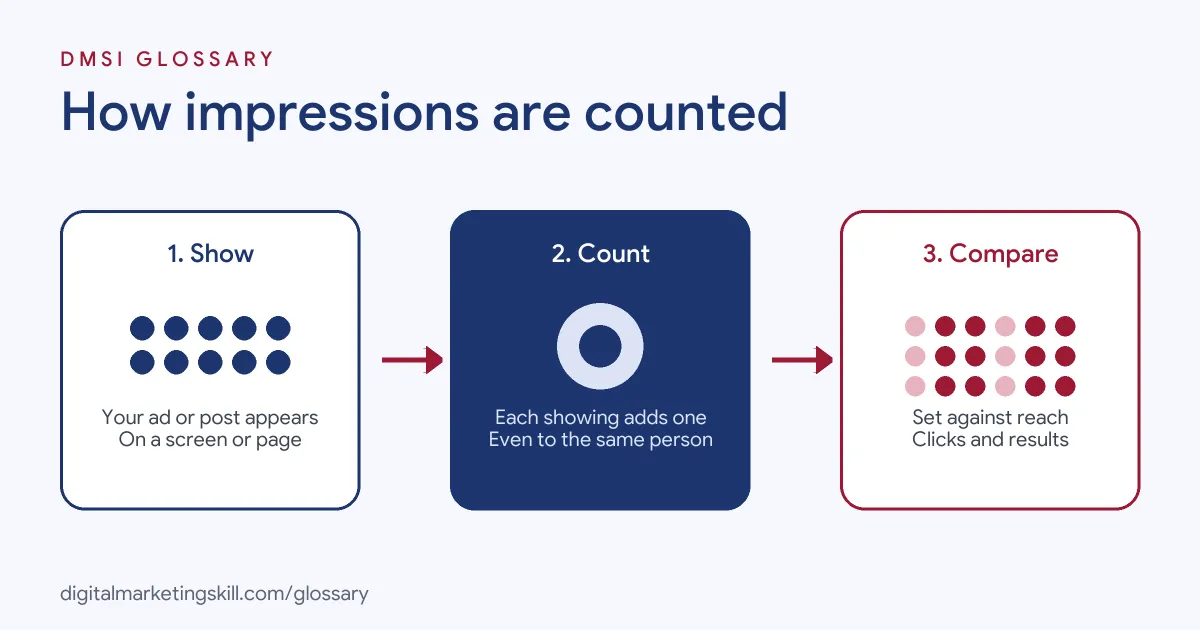
Every platform follows three steps. First, it decides to show your ad or post. Next, the content loads on someone’s screen. Then the platform adds one to your count and saves it in your reports.
How Search Ads Count Them
In Google Ads, every appearance on Google or the Google Network counts as one impression. However, the full ad isn’t always shown. Google notes that in Google Maps, for instance, it may show only your business name and location. That still counts.
Search Console uses the word too, but for free results. There, it means how many times your site appeared in Google Search results. Click-through rate (CTR) is then the click count divided by the impression count.
Viewable Impressions
Because an impression doesn’t mean someone saw the ad, Google also measures viewability with a tool called Active View. According to Google Ads Help, a display ad is viewable when at least 50% of it is on screen for at least one second. For large display ads of 242,500 pixels or more, the bar drops to 30% of the ad. A video ad needs at least 50% on screen while it plays for at least two seconds.
As a result, viewability gives you a more honest picture. If a big share of your showings are non-viewable, your ads may be showing low on the page, where people rarely scroll.
How Social Platforms Count Them
On social platforms, this metric usually sits next to reach in your insights. Hootsuite explains that it is the total number of times your content was displayed, “including multiple views from individual users.” Meanwhile, reach counts unique accounts. If your impressions are much higher than your reach, people are seeing your post more than once.
Impressions Examples
Here are three common situations where impressions guide a decision:
- Brand awareness campaign: A new gym runs a video campaign to get its name known. The team tracks total and viewable showings to check that the ads are actually on screen.
- Search ads: An online shop sees thousands of impressions but very few clicks. As a result, it rewrites the headline and adds clearer offers to lift CTR.
- Organic social: A coach compares showings with reach on each post. She then turns posts that people view several times into ads, since they clearly hold attention.
In each case, the count is only the starting point. The real decisions come from comparing it with clicks, reach and results.
Impressions vs Reach vs Clicks
These metrics are often confused, so here is a quick comparison:
| Metric | What it counts | What it tells you |
|---|---|---|
| Impressions | Every time content is shown, including repeats | How much exposure you got |
| Reach | Unique people or accounts who saw it | How many different people you reached |
| Viewable impressions | Showings that met a minimum on-screen time and size | How many showings had a real chance to be noticed |
| Clicks and CTR | People who clicked, and clicks divided by impressions | Whether the content made people act |
A useful bit of maths follows from this. If you divide total showings by reach, you get the average number of times each person saw your content. This is often called frequency.
How to Measure and Use Impressions
You can find this metric in almost any ads or social dashboard. The steps below keep your analysis useful:
- Find the metric. Open your campaign report, page insights or Search Console Performance report.
- Add reach next to it. This shows whether you are reaching new people or the same people again.
- Add viewability for display and video. This filters out showings nobody had a chance to see.
- Add clicks and CTR. Then you can see whether exposure turns into action.
- Compare by placement, ad and audience. Look for the groups with strong exposure and strong results.
- Act on the gaps. For example, refresh the creative if exposure is high but CTR keeps falling.
After that, report the numbers alongside the business goal. On their own, they rarely answer the question your manager is asking.
Best Practices for Impressions
- Match the metric to the goal. For awareness, exposure and reach matter most. For sales, they are only an early signal.
- Watch frequency. If the same people see an ad too often, they may start to ignore it.
- Check viewability. Above all, make sure paid ads are actually on screen.
- Understand pricing. On YouTube, for instance, Target CPM bidding means you pay based on impressions, not views or clicks.
- Use the same date range. Otherwise, comparisons between ads or posts can mislead you.
Common Mistakes to Avoid
Many beginners treat impressions as a success metric on their own. In fact, a post can earn thousands of showings and no sales. Another mistake is mixing up the two metrics in reports, which makes results look bigger than they are. Some people also ignore viewability, so they pay for ads that sat below the fold. Finally, many forget that each platform defines and labels the metric in its own way. So always check the platform’s help page before you compare numbers across channels.
Where You’ll Use Impressions at Work
This metric appears in almost every paid social and media buying report. For example, recent remote job listings ask candidates to:
- “Analyze and report campaign results, including impressions, reach, engagement, click-through rates, video views, conversion metrics, and overall campaign effectiveness” (Senior Media Buyer and Planner).
- “Own the GMV, impressions, and retention that top-tier creator investment generates” (Creator Partnerships and Growth Manager).
- Prioritise creators “by GMV potential, impressions, conversion strength, and brand fit” (Creator Partnerships and Growth Manager).
So if you want to work as a Social Media Manager, Paid Social Specialist or Content Creator, you need to read these numbers with confidence. More importantly, you need to explain what they mean for the goal.
Learn It in the Social Media Track
You can learn to read and act on impressions in the AI-Powered Social Media Management and Advertising track. It covers social media marketing and analytics, plus social media advertising. Your portfolio project is to plan, create and run a paid social campaign for a real brand. You also join a U.S. Project Internship from day one, with unlimited 1-on-1 mentoring.
To go further, read about the Facebook marketing mistakes that limit your reach, and our glossary entry on social media marketing.
Frequently Asked Questions
What are impressions in simple terms?
They are the number of times your ad or post was shown on a screen. Every showing counts, even if the same person sees it twice.
What is the difference between impressions and reach?
Reach counts unique people who saw your content. The other metric counts every showing, so one person can create several impressions.
Do impressions mean people saw my ad?
Not always. An impression means the ad was served. Viewable impressions are a better sign, because they require part of the ad to stay on screen for a set time.
Are more impressions always better?
No. More showings help awareness, but they only matter if they lead to clicks, leads or sales. Too many repeat showings can also tire your audience.
What does CPM mean for impressions?
CPM means cost per thousand impressions. It is a common way to buy and compare awareness ads across platforms.
Sources: Google Ads Help: Impressions; Google Ads Help: About Active View metrics; Search Console Help: Performance report; Hootsuite: Reach vs impressions; remote job listings on Himalayas.