Facebook marketing mistakes rarely look like mistakes at first. A half-finished profile, a post that begs for comments, a complaint left unanswered: each one looks small. But each one quietly tells Facebook, and your audience, that your Page is not worth showing. This guide explains why these mistakes cost reach, and which one to fix first.
Key Takeaways
- Begging for engagement backfires. Meta’s own policy states that posts using engagement bait, tactics like vote baiting or comment baiting, are shown less in News Feed. Repeat offenders face stricter, Page-wide demotion.
- Silence costs customers, not just likes. Per the Sprout Social Index, about three in four consumers expect a brand to respond on social media within 24 hours. In fact, 73% say they will buy from a competitor if a brand does not respond at all.
- Review responses change buying decisions. BrightLocal’s Local Consumer Review Survey found 80% of consumers favor businesses that respond to every review, while templated, copy-paste replies make a business 50% less likely to be chosen.
- Response and promotion work together, not apart. In LYFE Marketing’s own published case study, Domino’s grew Facebook fans by 197.87% and post engagement by 137% across 75 Washington locations in four months. It combined boosted posts with daily comment responses.
- Most mistakes are fixable without a bigger budget. Profile completeness, posting variety, and response habits cost time, not ad spend. They compound before any paid campaign does.
In this guide
- What Most Facebook Marketing Mistakes Advice Gets Backwards
- How Facebook Actually Penalizes These Mistakes
- Three Categories of Facebook Marketing Mistakes, Built on Different Causes
- How to Lead With Each Fix, Not Just List the Problem
- How to Measure Whether You Are Still Making Facebook Marketing Mistakes
- The One Rule: Audit Response Time Before You Change Posting Frequency
- A Real Case: Response and Promotion, Combined
- Frequently Asked Questions About Facebook Marketing Mistakes
- Fixing Facebook Marketing Mistakes Fits a Broader Social Media Skill Set
What Most Facebook Marketing Mistakes Advice Gets Backwards
Most lists of Facebook marketing mistakes read like a checklist. Post more. Use better photos. Fill out your profile. They name the symptom, but they rarely explain why Facebook, or your audience, punishes it.
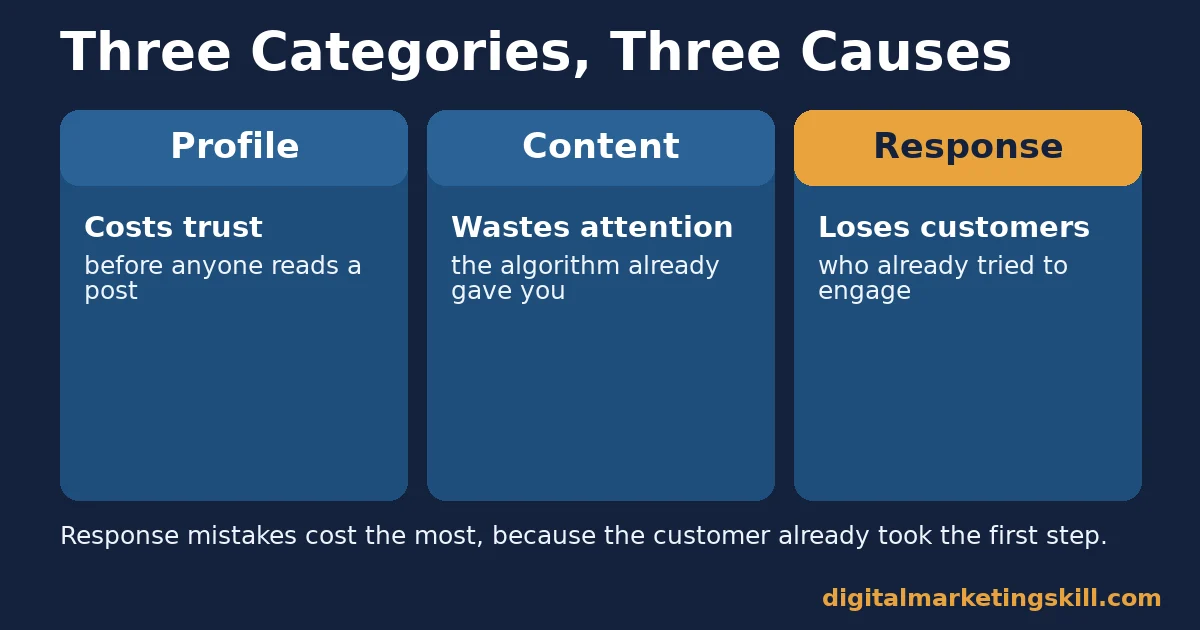
That gap matters, because the fix is different depending on the cause. A profile mistake costs you trust before anyone reads a single post. Meanwhile, a content mistake wastes the limited attention Facebook’s algorithm gives any one post. And a response mistake costs you customers who already found you and tried to engage. Treating all three the same way, by just “posting more,” fixes none of them.
This reading comes from Meta’s own policy pages and independent survey data. It is not a claim to know Facebook’s full ranking algorithm, which Meta does not publish in full. What follows is the mechanism behind the costliest mistakes, grouped by cause, and the one place to start.
Most of these mistakes also compound quietly. A single unanswered comment rarely sinks a Page on its own, but a pattern of unanswered comments, alongside a thin profile and repetitive content, tells both Facebook and your audience the same thing at once: this Page is not actively managed. By the time that pattern shows up in a reach report, it has usually been costing customers for months. None of these Facebook marketing mistakes require a redesign or a bigger budget to fix. They require someone to check the Page daily, fill in what is missing, and reply like a person rather than a brand account.
How Facebook Actually Penalizes These Mistakes
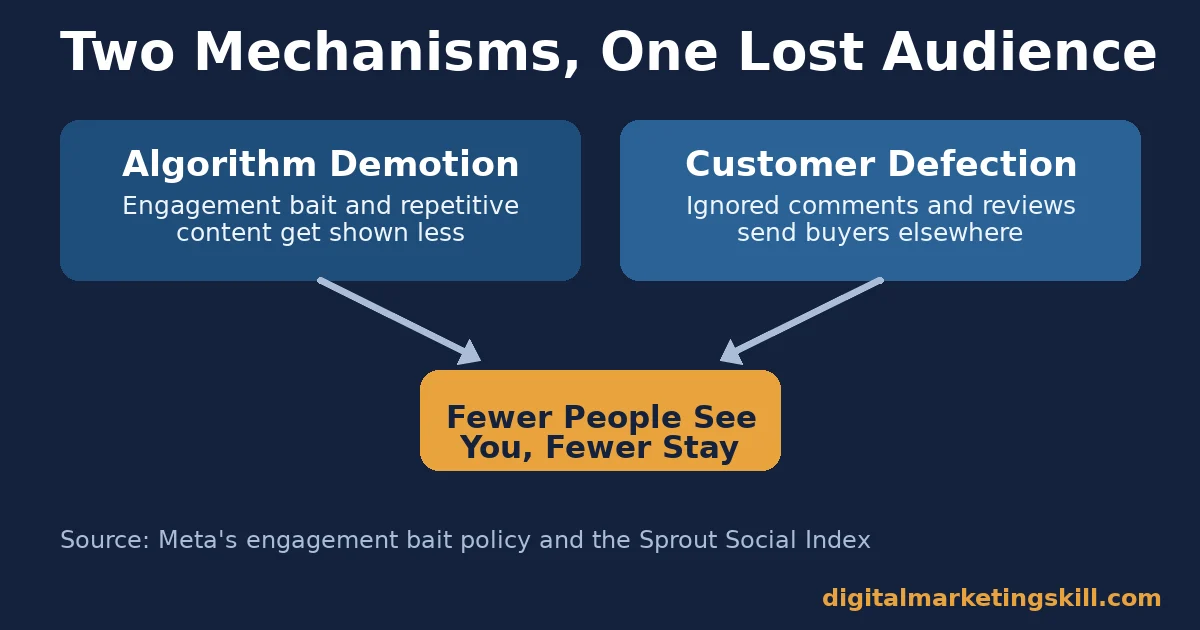
Two mechanisms explain most of the damage. First is what the News Feed algorithm demotes. Second is what customers do when a business ignores them.
Engagement Bait Is Explicitly Penalized, Not Just Ineffective
Meta’s own announcement on fighting engagement bait, and its Business Help Centre guide to avoiding engagement bait, describes it as a tactic that tries to game the News Feed algorithm. It does this by boosting engagement purely to gain reach, such as “Like this if you’re an Aries.” Posts that do this are shown less. Pages that do it systematically face stricter, Page-wide demotion, not just a penalty on that one post. A direct, honest question to your audience is not the problem. Instead, a request engineered only to trigger a reaction is. The distinction sits in intent, not phrasing. Asking “which color would you choose for this product?” invites a genuine opinion. “React with 😮 if you’d never do this” exists only to inflate a reaction count. Meta’s own systems are built to tell the two apart at scale.
An Unanswered Comment Has a Customer Cost, Not Just a Visibility Cost
The algorithm problem is only half the mechanism, because Sprout Social’s Index research finds that about three in four consumers expect a response within 24 hours or sooner. 73% say they will buy from a competitor if a brand does not respond to them on social. A Page that posts consistently but never replies is still losing customers it already reached. That loss happens quietly, outside any analytics dashboard that only counts reach and likes.
Three Categories of Facebook Marketing Mistakes, Built on Different Causes
Not every Facebook marketing mistake comes from the same root cause, so grouping them this way shows which fix actually addresses the problem.
Profile Mistakes: Built to Undermine Trust Before You Post
Per Meta’s own Help Centre guidance on Page photos, a profile picture displays small, and it is often cropped into a circle, across Facebook. A logo with fine detail or text near the edges gets cut off before anyone reads a post. An incomplete Page, missing a category, description, or contact details, reads as abandoned or untrustworthy, even if the content underneath is strong. These mistakes cost trust before your content gets a chance to work. A category field left blank, or a website link that points to a dead page, has the same effect, since a visitor who was ready to trust the business quietly decides not to, and never tells you why.
Content Mistakes: Built to Waste the Algorithm’s Limited Attention
Posting only product photos and prices, with no variety, gives the algorithm little reason to treat your Page as worth showing repeatedly. Inconsistent posting does the same. A burst of activity followed by silence breaks the habit. Followers stop checking your Page, and the algorithm has less recent engagement data to work from. Content mistakes do not break a rule the way engagement bait does. They simply give Facebook nothing worth amplifying. A Page that only ever shares price lists and product shots is optimizing for the business’s convenience, not the algorithm’s incentives. Those incentives reward posts that hold attention and prompt a genuine reaction.
Response Mistakes: Built to Lose Customers You Already Reached
Turning off the setting that lets fans post on your wall silences real feedback before it starts. Ignoring negative reviews or comments does the same thing publicly, in front of every future visitor who reads that thread. Both mistakes happen after the hard work of reaching someone is already done. That timing makes them the most expensive kind to leave unfixed.
How to Lead With Each Fix, Not Just List the Problem
Knowing the category is only useful if it changes what you do first. Each category has a different starting move, which is why fixing Facebook marketing mistakes in the wrong order wastes effort.
Profile Mistakes: Lead With the Fields Customers Check First
Before redesigning any graphic, fill in category, description, website, and contact details completely. A customer deciding whether to trust a Page checks these fields before they read a single post. An incomplete one costs you before your content gets evaluated at all. Then fit your logo and key text inside the center of your profile picture, since the edges crop first on different devices. Review these fields on a quarterly schedule too, not just once at setup. A changed phone number, an old address, or a discontinued offer left visible does the same damage as never filling the field in at all.
Content Mistakes: Lead With a Content Mix, Not a Posting Count
A fixed number of posts per week matters less than what fills them. Mix product posts with behind-the-scenes content, direct questions, and user-generated content. That mix gives the algorithm varied engagement instead of the same flat response to the same post type. Consistency matters too. But consistency around repetitive content still under-performs variety on a lighter schedule. A simple way to check your own mix: list your last ten posts and label each one product, behind-the-scenes, question, or user-generated. If one label covers more than half the list, that is the gap to close first, before adding more posts of the same type.
Response Mistakes: Lead With a Response Habit, Not a Review Policy Document
Set a daily check for comments, messages, and reviews, even five minutes, rather than writing a policy nobody follows. Per BrightLocal’s Local Consumer Review Survey, a templated, copy-paste reply makes a business 50% less likely to be chosen than one with no response at all. A short, specific acknowledgement beats a generic script every time. Thank positive feedback by name where appropriate. Address negative feedback by naming the issue and what you will do about it. A reply that simply says “thanks for your feedback” reads as templated even when it is not. Naming the specific product, order, or question shows a visitor that a person actually read the comment.
How to Measure Whether You Are Still Making Facebook Marketing Mistakes
Spotting Facebook marketing mistakes early means watching the right numbers. Facebook’s own Page Insights cover most of what you need. Read them together. Reach alone hides a response problem, and engagement rate alone hides a profile problem.
- Reach: how many accounts saw your post. A flat or falling reach, with no change in posting frequency, often signals content that the algorithm is not amplifying. That is a content mistake, not a response one.
- Engagement rate: reactions, comments, and shares divided by reach. Rising reach with falling engagement rate usually means your content mix has gone stale, even if more people are seeing it.
- Average response time: the time between a comment or message and your reply. This is the one Page Insights metric tied directly to the Sprout Social finding that most consumers expect a reply within 24 hours.
- Follower growth rate: new followers over a period, as a percentage of your existing base. Flat growth despite steady posting often points to a profile mistake turning away new visitors before they follow.
- Click-through rate on links: clicks divided by reach, for posts that link off Facebook. This is a reliable way to see whether content, not just engagement, is driving real traffic back to your website from Facebook.
Check these monthly at minimum. Check response time weekly, since a slow reply pattern is the easiest mistake to let slide unnoticed. Pair the Facebook numbers with site-side data where you can. Reading Google Analytics reports alongside Page Insights shows whether a visitor who clicked through from Facebook behaves differently from one who arrived through search.
The One Rule: Audit Response Time Before You Change Posting Frequency
If you fix only one thing from this guide, check how fast, and how personally, your Page responds to comments and messages. Do that before you touch your posting schedule. A content mistake costs you reach on posts people never see, while a response mistake costs you customers who already found you, decided to engage, and got silence back. So the second is more expensive. It is usually invisible in a reach-only report.
Illustrative, invented numbers to show why: a Page with 10,000 monthly reach and a 2% engagement rate gets about 200 interactions. Say 5% of those interactions are comments or messages that go unanswered. If the Sprout Social figure holds, 73% of those ignored customers would buy elsewhere. That is a measurable number of lost customers every month, hidden inside a report that otherwise looks healthy.
A Real Case: Response and Promotion, Combined
In LYFE Marketing’s own published case study, the goal for 75 Domino’s locations in Washington state was explicit. Every comment, good or bad, had to get a timely reply. The agency paired that daily response habit with boosted posts and localized video targeting. Over four months, Facebook fans grew 197.87% and post engagement grew 137%.
The case does not isolate how much of that growth came from daily responses alone, versus the paid boosting that ran alongside it. Treat it as one agency’s documented account of combining both, not proof that response habits alone produce this scale of result. What is repeatable is the sequence. Daily response monitoring was treated as a requirement from day one, not an afterthought layered on top of paid promotion. The same sequence applies to a Page with no advertising budget at all. The response habit itself is free. So the only real cost is the discipline to check daily, and that discipline is what most Facebook marketing mistakes in this guide actually come down to.
Frequently Asked Questions About Facebook Marketing Mistakes
What is the single most common Facebook marketing mistake?
Inconsistent response to comments and messages is the most expensive. It is invisible in reach and engagement reports, yet directly tied to lost customers. Per the Sprout Social Index, about three in four consumers expect a reply within 24 hours. Most Page owners never measure how long their own replies actually take.
Does asking questions in a post count as engagement bait?
No, not by Meta’s own definition. Engagement bait specifically means requesting reactions, shares, comments, or tags purely to game the algorithm, phrases like “React with a heart if you agree.” A genuine question tied to your content and audience is normal engagement, not bait.
How often should a Facebook Page post to avoid content mistakes?
There is no single safe number. A fixed frequency without variety still under-performs a lighter, more varied schedule. Prioritize mixing content types, product posts, behind-the-scenes content, and direct questions, over hitting an exact post count each week.
Should a business respond to every negative review or comment?
Yes, with a specific, non-templated reply. BrightLocal’s research found that templated, copy-paste responses make a business 50% less likely to be chosen than one that responds with no template at all. A short, specific acknowledgement matters more than a polished script.
Is a poorly sized profile picture really a significant mistake?
It is a trust mistake, not a visibility one. A profile picture displays small and is commonly cropped. A logo with text or detail near the edges gets cut off before a visitor forms an impression of your Page, independent of how strong your content is underneath it.
What should be fixed first: profile, content, or response habits?
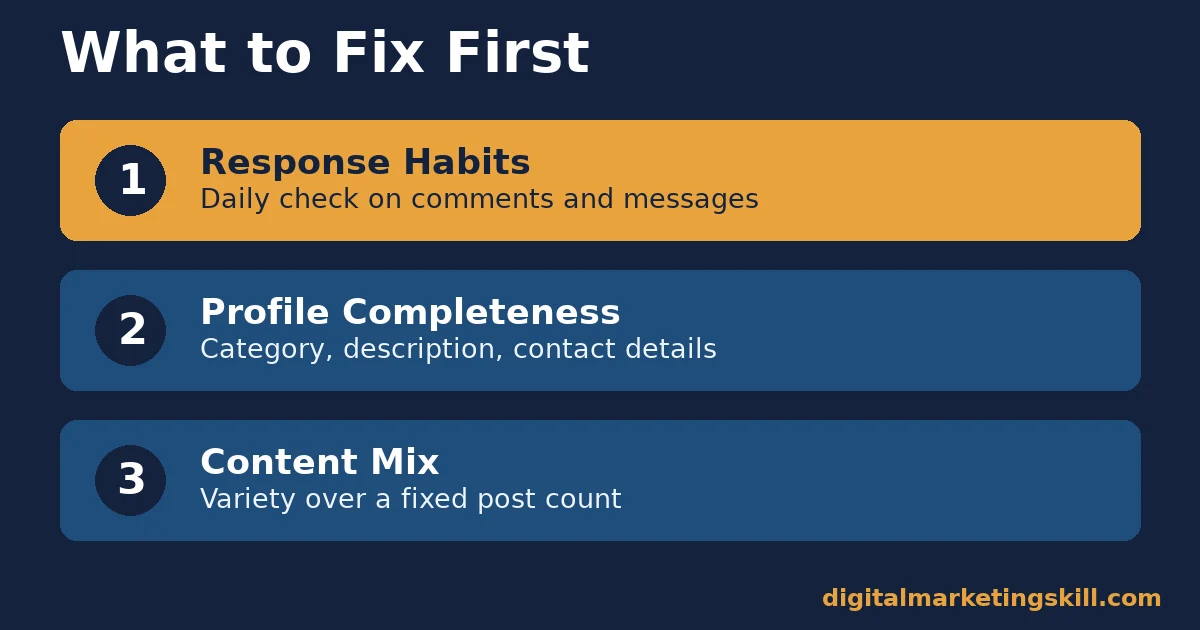
Start with response habits, since they cost customers who already engaged, not just reach on a future post. Fix the profile next, since it affects every new visitor’s first impression. Content mix is a longer-term fix that compounds once the first two are in order. Trying to fix all three at once usually means none of them gets the daily attention it needs to actually change.
Can fixing these mistakes replace paid Facebook advertising?
Not entirely. The documented Domino’s case combined response habits with paid boosted posts, not organic fixes alone. Treat these fixes as what makes a Facebook ad campaign perform better, not as a free substitute for one. A Page with a thin profile and slow response times will waste a larger share of any ad budget spent driving new visitors to it.
Does fixing profile mistakes help with Facebook lead generation too?
Yes. A visitor evaluating whether to message a business or fill out a lead form checks the same trust signals. A complete profile, recent activity, and visible responses to other customers all matter before that next step. The same fixes that reduce Facebook marketing mistakes also support generating qualified leads on Facebook, since both depend on a visitor trusting the Page enough to act.
How long does it take to see results after fixing these mistakes?
Response-related fixes can affect customer sentiment within days, since the next comment or message gets a better reply immediately. Reach and follower growth typically take several weeks to a few months to shift. That is the timeframe the documented Domino’s case also covered.
Fixing Facebook Marketing Mistakes Fits a Broader Social Media Skill Set
Facebook marketing mistakes are rarely a content problem alone. Avoiding Facebook marketing mistakes is really a trust and response discipline that happens to show up on a social Page. They are a mix of trust signals, algorithm mechanics, and customer response habits. Fixing them in the right order matters more than fixing all of them at once.
The Digital Marketing Skill Institute’s Master Diploma in Digital & AI Marketing covers this inside its Social Media Management and Advertising track. That track is one of four AI-powered tracks in a ten-course program. The program is dual US and UK accredited, and recognised in more than 100 countries. Every student gets unlimited 1-on-1 coaching and mentoring, plus real project work inside a US partner company, 100% online. Page audits like this one get practiced on a live account, not just read about at digitalmarketingskill.com. See the full curriculum at Digital Marketing Skill Institute, or go straight to the Master Diploma in Digital & AI Marketing program page for every track in detail.
If you manage a Facebook Page for a business anywhere in your country, these mechanics apply the same way. Meta’s engagement bait policy and News Feed ranking are not region-specific. Start by timing how long your last ten comments took to get a reply. Fix that first. Then move to the profile, then the content mix. Apply to the Master Diploma program, or browse more guides on the Digital Marketing Skill Institute blog, to build the rest of the skill set around it.
Every figure in this guide was checked against its original source before publication. Figures marked as illustrative are invented examples, not real results.
![9 Amazing Digital Marketing Skills to Make Money Online [With Proof]](https://digitalmarketingskill.com/wp-content/uploads/2019/07/9-Amazing-Digital-Marketing-Skills-to-Make-Money-Online-With-Proof-17.png)