
A large language model (LLM) is a type of AI that has learned from huge amounts of text so it can predict and generate language. You give it a prompt, and it writes a reply one small piece at a time, based on patterns it learned during training. It matters to marketers because it is the engine behind tools such as ChatGPT, Claude and Gemini, which many teams now use to draft, research and analyse.
Key Takeaways
- An LLM predicts the next token, such as a word or part of a word, again and again until it has written a full answer.
- “Large” refers to the model’s size. Google notes that transformer models can have hundreds of billions of parameters.
- Most modern LLMs use the transformer design, which relies on a method called self-attention to understand context.
- LLMs can make mistakes, known as hallucinations, so you must check facts before you publish.
- Clear prompts and good context make a big difference to the quality of the output.
What Is a Large Language Model?
Google’s machine learning course explains that a language model “estimates the probability of a token or sequence of tokens occurring within a longer sequence of tokens.” In other words, it guesses what text is most likely to come next.
A large language model does the same thing at a much bigger scale. It learns from vast amounts of text, and it has far more internal settings, called parameters, than older models. As a result, it can write whole paragraphs, follow instructions and answer questions in a natural style.
LLMs are one kind of generative AI. Other generative tools create images, audio or video, while an LLM works mainly with text.
Because the model predicts text rather than looking up facts, its answers can sound confident even when they are wrong. That is the main reason every output needs a human check.
How a Large Language Model Works
Every LLM follows the same basic loop. First, it breaks your prompt into tokens. Next, it works out how those tokens relate to each other. Then it predicts the most suitable next token and repeats the process until the reply is complete.
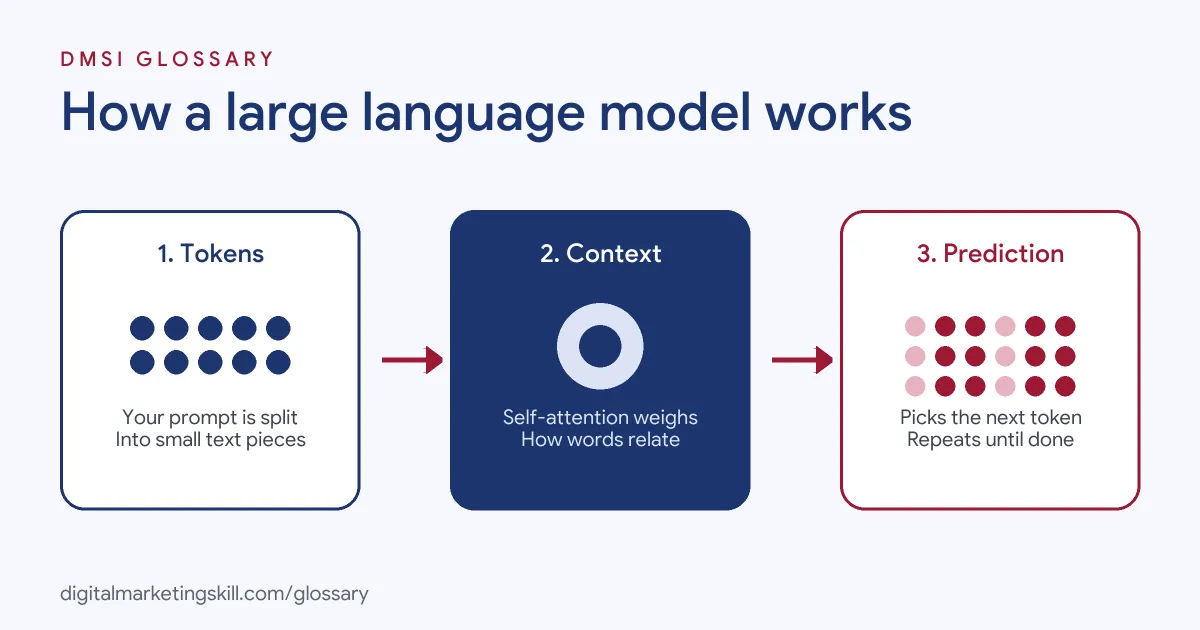
Tokens
A token is the small unit of text a model reads and writes. According to Google, “a token could be a word, a subword (a subset of a word), or even a single character.” OpenAI gives a handy rule of thumb for English: one token is about four characters, and 100 tokens is roughly 75 words. Tools often set limits, and charge, by tokens, so this unit matters in practice.
Transformers and Self-Attention
Most LLMs use an architecture called the transformer. Its key idea is self-attention. For each token, the model asks, in Google’s words, “How much does each other token of input affect the interpretation of this token?”
For example, in the sentence “The animal didn’t cross the street because it was too tired”, the model learns that “it” refers to the animal. However, if the sentence ends “because it was too wide”, “it” refers to the street. That is how an LLM keeps track of meaning across a long passage.
Training and Size
During training, the model sees enormous amounts of text and adjusts its parameters to make better predictions. Google’s course notes that transformers can have hundreds of billions of parameters, and that larger models tend to outperform smaller ones. Still, bigger models also need more computing power, so smaller models are often a sensible choice for simple tasks.
Large Language Model Examples in Marketing
Here are three common ways marketing teams use LLMs:
- Drafting copy: A social media manager asks an LLM for ten caption ideas for a product launch. Then she edits the best two to fit the brand voice.
- Summarising research: An SEO specialist pastes in customer reviews and asks for the most common complaints. As a result, he finds topics for new help articles.
- Personalising email: An email marketer uses an LLM to write subject line variations for different segments. After that, she tests them against each other.
In each case, a person sets the task, checks the output and makes the final decision.
Large Language Model vs Generative AI vs Chatbot
These terms overlap, so here is a quick comparison:
| Term | What it means | Example |
|---|---|---|
| Generative AI | Any AI that creates new content | Text, image, audio and video tools |
| Large language model | A generative model trained on text that predicts tokens | The GPT, Claude and Gemini model families |
| Chatbot or assistant | An app people chat with, often built on an LLM | ChatGPT, the Claude app, the Gemini app |
In short, generative AI is the broad field, the LLM is the engine, and the chatbot is the product you type into.
How to Use a Large Language Model Well
You do not need to code to get value from an LLM. Instead, follow these steps:
- Decide what a good result looks like, such as length, tone and format.
- Give the model a role and the context, for example your audience and product details.
- Write a clear, specific instruction. Say what to do, not just what to avoid.
- Add one or two examples of the style you want.
- Review the output, then ask for changes in follow-up messages.
- Check every fact, name and number against a trusted source before you use it.
It also helps to break a large job into smaller parts. For instance, ask for an outline first, then for each section in turn. Google’s Gemini prompting guide recommends this approach, because simpler steps are easier for the model to manage.
Over time, save the prompts that work well, so your team can reuse them.
Best Practices for Using LLMs at Work
A few habits help you get reliable results:
- Keep a human in the loop. Google warns that “LLMs hallucinate, meaning their predictions often contain mistakes.”
- Watch for bias. According to Google, “LLMs can exhibit all sorts of bias,” so review content for fairness and tone.
- Protect private data. Do not paste customer details or confidential plans into tools your company has not approved.
- Pick the right size of model. A smaller, faster model is often enough for simple tasks such as rewording.
- Be open about AI use. Follow your employer’s and each platform’s rules on AI-generated content.
Common Mistakes to Avoid
New users often trust the first answer. Instead, treat it as a draft. Many also write vague prompts such as “write a post”, then wonder why the result feels generic. Another common error is asking for statistics without checking them, which can lead to false claims in published content. Finally, some teams forget that every LLM has a limit on how much text it can handle at once, so very long documents may need splitting.
Where You’ll Use Large Language Models at Work
LLM skills now appear in job listings well beyond engineering. For example, recent remote listings ask for:
- “Hands-on experience using AI models or large language models” (AI Product Evaluator).
- “Familiarity with LLM APIs, prompt engineering, and AI orchestration frameworks” (AI Implementation and Automation Engineer).
- Experience “integrating machine learning and large language model (LLM) capabilities into business solutions” (AI Engineer).
In marketing roles, the expectation is usually practical. Employers want people who can use LLM tools to work faster while still checking quality and accuracy. In a social media or email role, for example, that might mean drafting first versions with an assistant, then editing them to match the brand and checking every claim.
Learn It in the Full Stack Programme
AI fundamentals, including strategy and planning with AI tools, are part of every DMSI track. To apply them across every channel, choose the Full Stack (all four tracks) programme. It covers all ten courses, with one portfolio project from each track. You also join a U.S. Project Internship from day one and get unlimited 1-on-1 mentoring.
Ready to try it yourself? Our guide on how to write ChatGPT prompts shows you how to get better answers.
Frequently Asked Questions
What is a large language model in simple terms?
It is an AI system that has learned from huge amounts of text, so it can predict and write language. It powers chat tools such as ChatGPT, Claude and Gemini.
Is ChatGPT a large language model?
ChatGPT is an app built on top of OpenAI’s GPT models, which are LLMs. So the app is the product, and the model is the engine inside it.
What is a token in an LLM?
A token is a small piece of text, such as a word, part of a word or a character. In English, 100 tokens is roughly 75 words.
Why do LLMs make things up?
An LLM predicts likely text rather than looking up facts, so it can produce confident but wrong answers. That is why you should always check its output.
Do I need to code to use a large language model?
No. Most marketers use LLMs through chat apps or tools that have them built in. Coding only matters if you want to connect a model to other software.
Sources: Google for Developers: Introduction to large language models; Google Machine Learning Crash Course: LLMs and transformers; OpenAI Help: What are tokens?; Google AI for Developers: Prompt design strategies; remote job listings on Himalayas.