
A target audience is the specific group of people your marketing message is designed to reach, because they are the most likely to want what you offer. You usually describe them by shared traits, such as age, location, interests, needs or buying behaviour. It matters because a message written for a clear group lands far better than one written for everyone.
Key Takeaways
- A target audience is a group of people who share traits that make them likely to respond to your message.
- It is narrower than your target market, which is the broader group of potential customers.
- A buyer persona is a fictional profile of one typical member of that audience.
- You can define audiences by demographics, interests, values, subcultures or stage in the customer journey.
- Ad platforms such as Google Ads let you reach audience segments based on interests, intent and your own customer data.
What Is a Target Audience?
HubSpot describes a target audience as “a group of consumers characterized by shared qualities like demographic data, behaviors, interests, etc.” Wikipedia quotes Tom Duncan, who calls it “a group that has significant potential to respond positively to a brand message.”
Both definitions point to the same idea. You cannot speak to everyone at once, so you choose the people you most want to reach. Then you shape your words, images, channels and offers around them.
For example, a language app might focus on young professionals who want to work abroad. That choice affects everything, from the ads it runs on social media to the examples it uses in lessons.
How a Target Audience Works
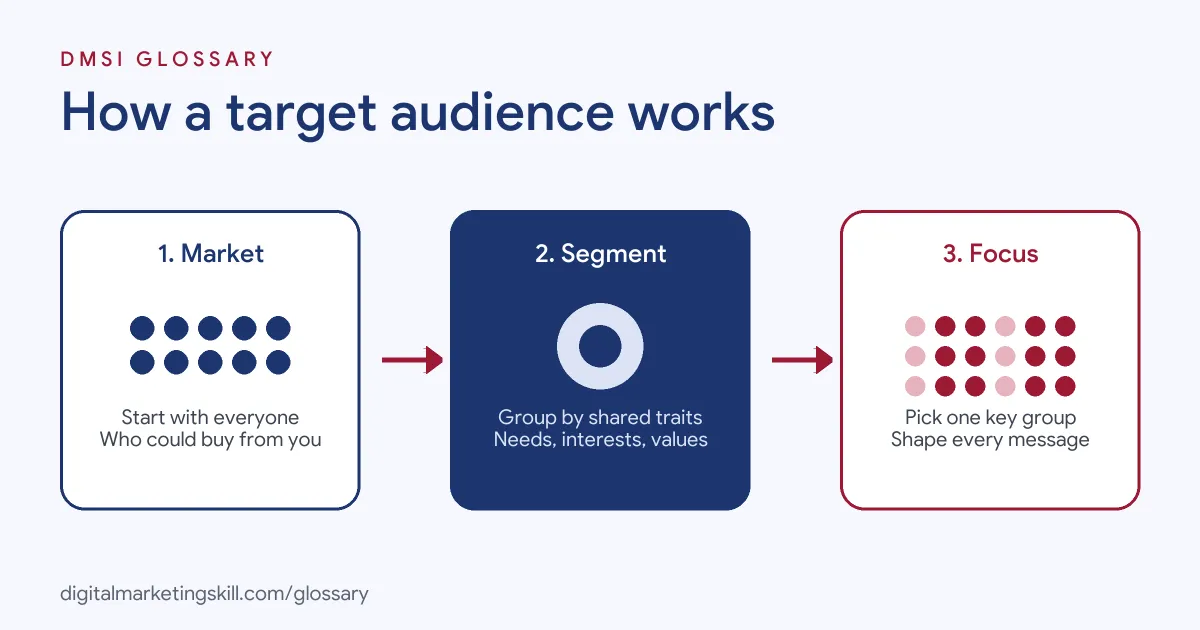
Defining an audience is a process of narrowing down. First, you start with your broad market. Next, you look for groups within it who share needs and traits. Finally, you pick the group you will focus on and build your message around them.
Target Market and Audience
HubSpot calls the target market “the broader group of potential customers,” while the audience is a narrower segment inside it. Wikipedia makes a similar point: the market is the wider group a business pursues, and the audience is the group a specific message or campaign reaches. So one market can contain several audiences, each with its own campaign.
Ways to Describe an Audience
Marketers use several kinds of traits. Demographics are measurable facts, which Wikipedia describes as “statistical aspects of consumers such as gender, ethnicity, income.” Psychographics, by contrast, look at lifestyle, attitudes and values. HubSpot also lists interests, subcultures, values and customer journey stage as useful ways to group people.
Behaviour is another useful lens. What people buy, how often they buy and which channels they use all help you decide where and when to reach them. For instance, someone who reads reviews before every purchase may respond best to proof and comparisons.
Buyer Personas
Once you know your audience, you can turn it into one or more personas. HubSpot explains that “your buyer persona is a fictional representation of one target audience member.” In other words, the audience is the group, while the persona is a single, named example that helps your team picture who they are writing for.
Target Audience Examples
Here are three examples of how a business might define its audience:
- Meal kit company: Busy working parents in large cities who want healthy dinners but have little time to plan. As a result, its ads stress speed and family-friendly recipes.
- Accounting software: Freelancers and small business owners who handle their own bookkeeping. Then its content focuses on saving time at tax deadlines.
- Online career course: Career changers who want remote digital work and need practical skills. After that, its emails share real job listings and portfolio tips.
In each case, the audience description tells the team what to say, where to say it and which problems to solve.
Audience Segments in Google Ads
Ad platforms turn these ideas into targeting options. Google Ads, for example, groups people into audience segments. Here is a summary of the main types, in Google’s own words where possible:
| Segment type | Who it reaches |
|---|---|
| Affinity | People based on “what they’re passionate about and their habits and interests” |
| In-market | People based on “their recent purchase intent” |
| Life events | People “in the midst of important life milestones” |
| Detailed demographics | People based on “long-term life facts” |
| Custom segments | People found through keywords, URLs and apps you enter |
| Your data | People who “have interacted with your business,” including Customer Match lists |
Keep in mind that these segments are estimates. Google explains that it shows ads to people who are likely to fit the categories you choose, so you still need to check the results.
Meanwhile, social platforms offer similar tools. For instance, a lookalike audience finds new people who resemble your existing customers.
How to Find Your Target Audience
HubSpot suggests a five-step approach. Here is a version you can follow with any set of tools:
- Study your current customers. Look for patterns in who buys, how often and why.
- Use website analytics to see where visitors come from and which pages interest them.
- Check your social media insights for age, location and the posts people engage with.
- Talk to your followers and customers. Short surveys and replies to comments reveal real needs.
- Define who you are not targeting. HubSpot calls this an “inverted audience” or negative persona.
Then write a short audience statement, such as “first-time home buyers in their late twenties who feel unsure about mortgages”. Share it with everyone who creates content or ads.
Best Practices for Defining an Audience
A few habits keep your audience work useful:
- Use real data. Base your choices on analytics, sales records and conversations, not assumptions.
- Focus on needs. Knowing what problem people want to solve is often more useful than knowing their age.
- Keep it specific. “Women aged 18 to 65” is too broad to guide a message.
- Review it regularly. Audiences shift as your product, prices and markets change.
- Test and learn. Run campaigns to different segments and compare the results.
Common Mistakes to Avoid
Many beginners say their audience is “everyone”. As a result, their message feels generic and appeals to no one in particular. Others build an audience around who they wish would buy, rather than who actually does. Another mistake is relying only on demographics, while ignoring interests, values and buying stage. Finally, some teams define an audience once and never look at it again. Each of these weakens results, but all of them are easy to fix with fresh data.
It also helps to watch for overlap. If two campaigns aim at almost the same people, they can end up competing with each other. So give each campaign a clearly different group or message.
Where You’ll Use a Target Audience at Work
Audience thinking sits behind almost every marketing task. For example, one remote job listing for a Director Marketing role describes “creating compelling and engaging content that resonates with their target audience.”
In practice, Social Media Managers use audience research to choose platforms and posting styles. Google Ads Specialists choose audience segments and keywords. Email marketers split lists into segments with different messages. Meanwhile, Digital Marketing Managers and Growth Marketers use audience insights to plan budgets and test new markets. So whichever path you choose, employers will expect you to explain who a campaign is for and why. When you apply for roles, a short audience profile for a real brand is a simple way to show this skill in your portfolio.
Learn It in the Full Stack Programme
You can practise audience research across every channel in the Full Stack (all four tracks) programme. It includes all ten courses and one portfolio project from each track, from paid social and Google Ads to email and SEO. You also join a U.S. Project Internship from day one and get unlimited 1-on-1 mentoring.
Want a step-by-step guide? Read our post on how to identify your target audience.
Frequently Asked Questions
What is a target audience in simple terms?
It is the specific group of people your marketing is aimed at. They share traits that make them likely to want your product or service.
What is the difference between a target audience and a target market?
A target market is the broad group of potential customers. An audience is a narrower group within it that a particular message or campaign is built for.
Is a buyer persona the same as a target audience?
No. The audience is the whole group, while a buyer persona is a fictional profile of one typical member of that group.
Can a business have more than one target audience?
Yes. Many businesses have a main audience and one or more secondary groups, and they often run separate campaigns for each.
How do I find my target audience?
Start with your current customers, then use website analytics, social media insights and direct conversations to spot patterns. Finally, decide who you will not target.
Sources: HubSpot: How to find your target audience; Wikipedia: Target audience; Google Ads Help: About audience segments; remote job listings on Himalayas.