
A marketing budget is the amount of money a business sets aside for marketing over a period, along with a plan for how it will be split across channels, tools, people and campaigns. It turns a marketing plan into numbers you can track. It matters because it forces clear choices about where to spend, and it gives you a baseline to measure return on investment.
Key Takeaways
- The U.S. Small Business Administration (SBA) lists the budget as a core section of any marketing plan.
- Its advice is to “include a complete breakdown of the costs of your marketing plan.”
- In Gartner’s CMO Spend Survey of 402 marketing leaders, budgets averaged 7.7% of company revenue.
- The same survey found paid media took 30.6% of marketing budgets, the largest single share.
- Compare spending with the revenue it brings in, and review the plan at least once a year.
What Is a Marketing Budget?
Think of it as the price tag of your marketing plan. The plan says what you will do, and the budget says what each part will cost. Together, they show whether your goals are realistic.
The SBA’s guide to writing a marketing plan includes eight sections: target market, competitive advantage, sales plan, marketing and sales goals, marketing action plan, budget, measuring and updating the plan, and operations. For the budget section, it says simply: “Include a complete breakdown of the costs of your marketing plan.”
A budget usually covers several cost types. For example, it might include paid ads, software, content production, agency fees, events and staff time. Each line should link back to a goal in the plan.
How a Marketing Budget Works
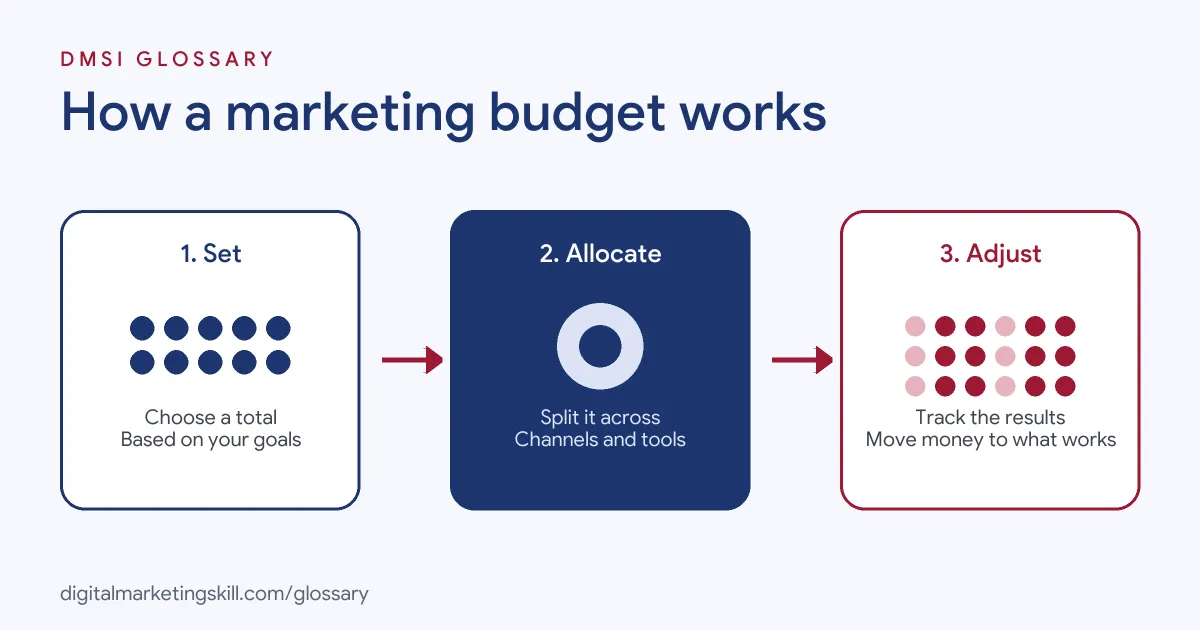
Most budgets follow a simple cycle. First, you set a total based on goals and what the business can afford. Next, you split it across channels and activities. Finally, you track results and move money towards what works.
Setting the Total
There is no single right amount. Some businesses start from a share of revenue. Others start from goals, such as the number of leads they need and what each one costs. For context, Gartner’s CMO Spend Survey of 402 marketing leaders in North America, the UK and Europe found budgets averaged 7.7% of overall company revenue. Every business is different, so treat that figure as a reference point, not a rule.
Splitting It Up
Next, you divide the total. In the same Gartner survey, paid media was the largest area, “accounting for 30.6% of marketing budgets or 2.4% of company revenue.” The rest typically goes on technology, people, agencies and other programmes. Gartner also reported that 39% of CMOs planned to cut back on agency budgets.
Measuring Return
Finally, the budget needs a feedback loop. The SBA advises: “Plan to compare your marketing and sales costs to the revenue it generates.” It adds that “measuring ROI will help you know which part of the plan is working and which part needs to be updated.” This links your budget directly to return on investment.
Marketing Budget Examples
Here are three made-up examples of how different businesses might plan:
- Local café: It sets a small monthly amount, mostly for social media ads and printed flyers. Then it tracks which offer codes customers use.
- Online shop: It plans spend by goal. For instance, it needs 200 sales a month, and past data shows each sale costs about $15 in ads, so it sets aside about $3,000 for paid media.
- B2B software firm: It splits its budget between content, search ads, events and a CRM tool. As a result, it can compare the cost per lead from each channel.
A Simple Marketing Budget Template
You do not need complex software to start. A spreadsheet with five columns is enough:
- Activity: for example, search ads, email software or a monthly blog post.
- Goal: the result it should support, such as leads or sales.
- Planned cost: what you expect to spend each month.
- Actual cost: what you really spent.
- Result: what it delivered, such as 40 leads or 12 sales.
Fill it in every month. Then compare planned and actual costs, and divide cost by result for each line. Over time, the sheet shows which activities earn their place and which ones need a rethink. It also makes it easy to explain your choices to a manager or client, because every number has a clear reason behind it.
Marketing Budget Approaches Compared
This table compares three common ways to set a total:
| Approach | How it works | Watch out for |
|---|---|---|
| Percentage of revenue | Spend a set share of current or expected revenue | Spending falls just when you may need growth |
| Goal-based | Work back from targets, such as leads or sales, and their expected cost | Needs reliable data on costs per result |
| Test and scale | Start small, then add money to channels that prove themselves | Slower to reach full scale |
How to Create a Marketing Budget
Follow these steps to build a simple, useful budget:
- Start with goals. Write down what you want to achieve, such as sales, leads or sign-ups.
- Review past results. Look at what each channel cost and what it returned.
- Set the total. Choose a share of revenue, a goal-based figure, or a test budget.
- List every cost. Include ads, tools, content, freelancers, agencies and staff time.
- Allocate by channel. Give more to proven channels, and keep a small amount for tests.
- Turn it into monthly amounts. For ad platforms, you may need daily figures, such as a campaign budget in Google Ads. Google suggests dividing a monthly amount by 30.4 to get the daily figure.
- Track and adjust. After that, compare costs with revenue each month and move money where it works.
Best Practices for a Marketing Budget
- Tie every line to a goal. If a cost does not support a goal, question it.
- Keep a test fund. A small, separate amount lets you try new channels without risking the core plan.
- Measure cost per result. Track cost per lead or customer acquisition cost, not just total spend.
- Review regularly. The SBA says marketing plans “should be maintained on an annual basis, at minimum.”
- Allow for hard-to-measure work. The SBA notes that some tactics, “like print advertising or word-of-mouth campaigns,” are hard to measure.
Common Marketing Budget Mistakes
Several errors make budgets less useful. First, businesses copy a percentage from another company without checking their own goals. Second, they forget hidden costs, such as software, design or staff time. Third, they spread money thinly across too many channels, so none of them gets enough to work. Finally, they set the budget once and never check results, so poor channels keep their share. A short monthly review with the simple template above fixes most of these problems before they grow.
Where You’ll Use a Marketing Budget at Work
Budget skills appear in many marketing leadership roles. For example, recent remote job listings ask candidates to:
- “Monitor marketing budgets and ensure effective allocation of resources to maximize return on investment (ROI)” (Group Marketing Manager).
- “Develop and manage regional marketing budgets, ensuring effective allocation of resources and measurable ROI” (Senior Marketing Manager).
- “Establish baseline performance metrics and work with the CEO to set realistic growth targets and marketing budgets” (Marketing Lead).
So whether you aim to be a Digital Marketing Manager, Growth Marketer or Agency Owner, you will plan budgets, defend them and report on what they delivered.
Learn It in the Full Stack Programme
You can learn to plan and measure spend across every channel in the Full Stack programme, which covers all four tracks and all ten courses. Along the way, you complete one portfolio project from each track, so you can show how you used a budget to get results. You also join a U.S. Project Internship from day one, with unlimited 1-on-1 mentoring.
For practical help, read our guide to building a small business marketing budget.
Frequently Asked Questions
What is a marketing budget in simple terms?
It is the money you plan to spend on marketing over a period, broken down by channel and activity, so you can track what it delivers.
How much should a business spend on marketing?
It depends on goals, margins and growth plans. For reference, Gartner’s CMO Spend Survey found marketing budgets averaged 7.7% of company revenue.
What should a marketing budget include?
All costs linked to your marketing plan, such as ads, tools, content, agencies, events and staff time. The SBA calls for “a complete breakdown.”
How often should I review my marketing budget?
Check results monthly and adjust as needed. The SBA says marketing plans should be updated at least once a year.
Where does most marketing money go?
In Gartner’s survey, paid media was the largest share, at 30.6% of marketing budgets.
Sources: U.S. Small Business Administration: Marketing and sales; Gartner: CMO Spend Survey press release; Google Ads Help: About average daily budgets; remote job listings on Himalayas.