
Ad Rank is the set of values Google Ads uses in each auction to decide whether your ad can show and where it appears compared with other ads. It is not just your bid; it also weighs the quality of your ad and landing page, the search itself and the competition. It matters because a strong rank can win you a better position, sometimes at a lower cost than rivals who simply bid more.
Key Takeaways
- Google recalculates this score every time your ad is eligible for an auction, so your position can change from one search to the next.
- Google works it out twice in each auction: first to check whether your ad can show, then to set its position.
- Inputs include your bid, ad and landing page quality, minimum thresholds, the context of the search, competition and the expected impact of assets.
- Quality Score is a 1–10 diagnostic tool. Google says it is not an input in the auction itself.
- Your bid is a maximum. Google says the amount you actually pay is often less.
What Is Ad Rank?
Every time someone searches on Google, an auction takes place in a fraction of a second. Many advertisers may want to show an ad for the same search. Google needs a way to decide who shows, in what order, and who doesn’t show at all. That decision rests on each ad’s rank.
A common mistake is to think the highest bid always wins. It doesn’t. Google’s help centre says relevant keywords and ads mean “you can still win a higher position at a lower price” than a competitor with a higher bid. So quality and relevance carry real weight.
You won’t see a single rank number in your account. Instead, you see its effects: impression share, top-of-page rates and the cost per click you pay. That’s why it helps to understand what goes into it.
How Ad Rank Works
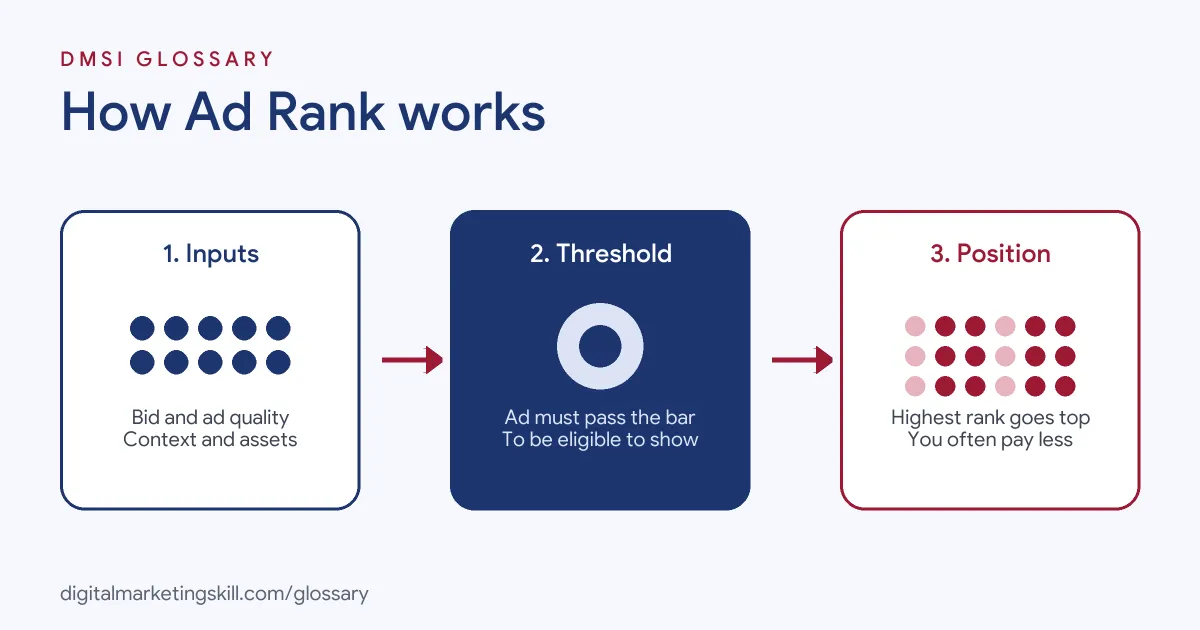
Google runs the process in three stages. First, it checks whether your ad meets the minimum bar to show. Next, it ranks every eligible ad. Finally, it places the ads in order on the results page and sets what each advertiser pays.
What Goes Into Ad Rank
Google lists six main factors:
- Your bid: the most you’re willing to pay for a click.
- Quality of your ads and landing page: how relevant and useful they are to the searcher.
- Ad Rank thresholds: minimum quality bars an ad must reach to show in a given position.
- Competitiveness of the auction: how close your ad is to the ads around it.
- Context of the search: for example, the search terms, location, device and time of day.
- Expected impact of assets and formats: extras such as sitelinks or phone numbers, judged on relevance, clickthrough rate and prominence.
Eligibility, Then Position
Google explains that it runs the calculation first to see whether your ad can show at all. If the ad passes, Google calculates it again to decide where it appears. As a result, a low-quality ad may never enter the auction, however high the bid.
How It Affects What You Pay
Your maximum bid sets a ceiling, not a fixed price. Google says that “How much you actually end up paying is often less.” On the other hand, it also notes that in a very close auction, a higher-ranked ad is more likely to win but may pay a higher cost per click for that certainty.
Ad Rank Examples
- Two plumbers: One bids more, but its ad talks about kitchens and links to a generic home page. The other bids less, but its ad matches “emergency plumber” and links to an emergency page. The second ad can still win the higher spot.
- Adding assets: A florist adds sitelinks for “Same-day delivery” and “Wedding flowers”. Because Google counts the expected impact of assets, this can lift the ad’s position without a bid change.
- Location matters: A gym’s ad ranks well for searches near its branch, yet poorly for searches across town. The same keyword can produce different results because the context of the search changes.
These cases are simplified, but they show the main point. Relevance can matter as much as money.
Ad Rank vs Quality Score vs Max CPC
These three terms are easy to mix up:
| Term | What it is | Role in the auction |
|---|---|---|
| Ad Rank | The set of values that decides eligibility and position | Used directly in each auction |
| Quality Score | A 1–10 rating per keyword, based on expected CTR, ad relevance and landing page experience | A diagnostic tool; Google says it is not an auction input |
| Max CPC bid | The most you will pay for a click | One input; you often pay less |
In short, Quality Score is a report card that hints at your ad quality. The rank itself is the live calculation Google runs each time.
How to Improve Ad Rank
- Check Quality Score components. Look at expected CTR, ad relevance and landing page experience for each keyword. Google rates each one “Above average”, “Average” or “Below average”.
- Tighten keyword groups. Group close keywords together, so each ad can speak directly to the search.
- Rewrite ads around intent. Use the searcher’s words in your headline and make the next step clear.
- Improve the landing page. Make sure it delivers what the ad promised and loads quickly.
- Add relevant assets. Sitelinks, callouts and calls can all raise the expected impact of your ad.
- Review bids last. Once quality is strong, adjust bids for the keywords that bring results.
Signs Your Rank Is Holding You Back
Because you can’t see the score itself, look for clues in your reports. For example, a low share of impressions on your main keywords often means your ads lose auctions. Similarly, a high cost per click with few top-of-page appearances suggests you are paying for position rather than earning it. If you spot these signs, check the Quality Score columns first. They show which part of the ad experience needs work.
Best Practices
- Fix quality before raising bids. A higher bid on a weak ad is an expensive way to buy position.
- Compare like with like. Google rates Quality Score components against other advertisers whose ads showed for the same search over the last 90 days.
- Watch position metrics over time. Your rank changes with every auction, so look at trends rather than single searches.
- Remember Performance Max. Google notes that when a search doesn’t exactly match an eligible Search keyword, it picks the campaign or ad with the highest rank.
Common Mistakes to Avoid
Many advertisers treat ad position as a bidding problem only. They raise bids, pay more per click and still lose to more relevant ads. Others chase a perfect Quality Score, even though Google calls it a diagnostic tool. Some forget assets entirely. Finally, many send all ads to the home page, which hurts landing page experience.
Where You’ll Use Ad Rank at Work
Job listings rarely name this term directly. Instead, they ask for the skills that drive it. For example, one remote listing asks for a “Solid understanding of bid management, ad placement, keyword relevance, and quality score” (PPC Specialist).
In practice, a Google Ads Specialist or PPC Specialist spends much of the week on exactly these levers. You will rewrite ads, test landing pages, add assets and explain to clients why a cheaper click can still win a better spot.
Learn It in the Google Specialist Track
You can learn how Ad Rank shapes real campaigns in the AI-Powered Google Specialist track. It covers Google Ads across Search, Display, Discovery, Gmail and YouTube, plus Google Analytics. Your portfolio project is to launch and measure a Google Ads campaign with conversion tracking. You also work on a U.S. Project Internship from day one, with unlimited 1-on-1 mentoring.
For more, read our guide to how the Google Ads auction works and our article on PPC campaign optimisation. You can also brush up on search ads.
Frequently Asked Questions
What is Ad Rank in Google Ads?
It is the set of values Google uses in each auction to decide whether your ad can show and where it appears against other ads.
Is Ad Rank the same as Quality Score?
No. Quality Score is a 1–10 diagnostic rating for each keyword. Google says it is not an input in the auction, while the rank calculation is.
Can I win a higher position with a lower bid?
Yes. Google says relevant keywords and ads can help you win a higher position at a lower price than a rival with a higher bid.
How often does Ad Rank change?
Google calculates it every time your ad is eligible for an auction. So your position can change from one search to the next.
Where can I see my Ad Rank?
Google doesn’t show it as one number. Instead, track Quality Score components, impression share and top-of-page metrics.
Sources: Google Ads Help: About Ad Rank; Google Ads Help: About Ad Rank thresholds and ad position; Google Ads Help: About Quality Score; remote job listings on Himalayas.