
The middle of funnel (MOFU) is the stage of the marketing funnel where people already know their problem and are comparing ways to solve it. Here, your job is to help them weigh their options, stay in touch and show why your offer fits. It matters because this is where most leads are won or lost, long before anyone talks to sales.
Key Takeaways
- MOFU sits between awareness at the top and the buying decision at the bottom.
- People in the middle are researching and comparing, so they need depth, proof and reassurance.
- Typical tactics include guides, webinars, case studies, email nurture sequences and retargeting.
- Success is measured with leads, engagement, lead quality and how many people move on to the next stage.
- Google’s research calls this stage the “messy middle”, because people loop back and forth rather than move in a straight line.
What Is the Middle of Funnel?
Picture a funnel that is wide at the top and narrow at the bottom. At the top, many people find you for the first time. At the bottom, a smaller group buys. The middle is everything in between, where interest turns into serious consideration.
For example, someone who read your blog post about saving time on social media has passed the top. Next, they might download your checklist, join a webinar or read a comparison of tools. That research is the middle of the funnel in action.
In other words, the middle is about trust. People are not ready to buy yet, but they are ready to listen. So the content you offer must be more detailed than a quick social post, and it must answer the questions people ask before they commit. If you are new to the funnel idea, start with the top of funnel first, then come back here.
How the Middle of Funnel Works
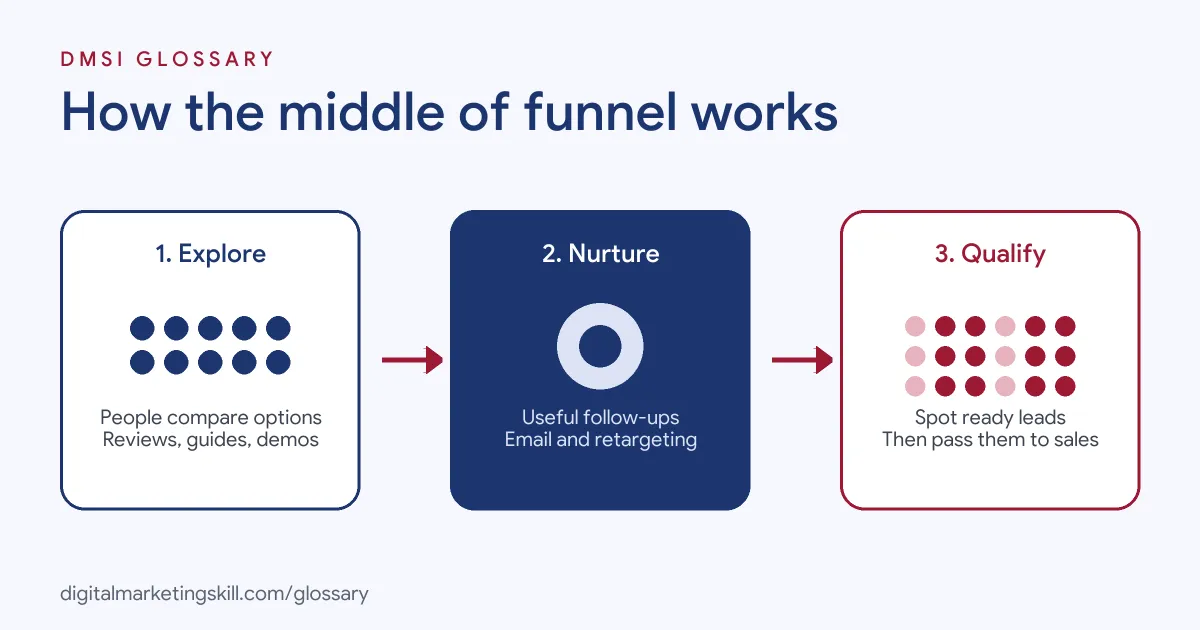
The middle stage has three jobs. First, it helps people explore their options. Next, it keeps your brand in front of them while they decide. Finally, it sorts the leads who are ready from those who need more time.
Explore and Evaluate
Google’s consumer research describes the space between a trigger and a purchase as the “messy middle”. In it, people switch between two modes. Exploration is “an expansive activity”, where they add brands and ideas to their list. Evaluation is “a reductive activity”, where they narrow that list down. Shoppers loop between the two until they are ready to decide.
That’s why a single blog post rarely does the whole job. Instead, you need content for both modes: broad guides for exploring, and comparisons or proof for evaluating.
Nurture the Lead
Once someone gives you their email address, you can follow up. A nurture sequence sends a few helpful emails over days or weeks. Meanwhile, retargeting ads remind visitors about content they viewed. Together, these keep you in mind without asking for a sale too early.
Qualify the Lead
Not every lead is ready for a sales call. HubSpot’s lifecycle stages make this clear. A lead is a contact who “has converted on your website”. A marketing qualified lead is one “that your marketing team has qualified as ready for the sales team.” The middle of funnel is where that sorting happens.
Middle of Funnel Examples
Here are three concrete ways businesses work the middle of the funnel:
- Software company: A project tool runs a live webinar on planning a product launch. Afterwards, it emails attendees the slides and a template, then invites them to a free trial.
- Online course: A training school offers a free career guide. Then it sends a five-email sequence with student stories, a syllabus outline and answers to common questions.
- Local service: A home renovation firm publishes a cost-planning guide and a gallery of finished projects. As a result, visitors can compare styles before they ask for a quote.
In each case, the content goes deeper than awareness content. It also gives the person a reason to take a small next step.
Top, Middle and Bottom of Funnel Compared
This table shows how the middle stage differs from the stages on either side:
| Stage | What people are doing | Typical content | Typical measures |
|---|---|---|---|
| Top (TOFU) | Discovering a problem or a brand | Blog posts, short videos, social posts | Reach, traffic, new visitors |
| Middle (MOFU) | Researching and comparing options | Guides, webinars, case studies, email sequences | Leads, engagement, lead quality |
| Bottom (BOFU) | Choosing who to buy from | Demos, trials, pricing pages, consultations | Sales, conversion rate, cost per sale |
Google Ads reflects a similar split in its campaign goals. For instance, its Leads objective aims to “encourage relevant customers to express interest in your products or services”, which is classic middle-stage work.
How to Build a Middle of Funnel Strategy
Use these steps to plan your middle stage from scratch:
- List the questions people ask before buying. Talk to sales or support, and read reviews of your product and your rivals.
- Create one strong piece for each big question. For example, a comparison guide, a case study or a short webinar.
- Add a clear capture point. Offer a lead magnet in return for an email address, so you can follow up.
- Write a nurture sequence. Send three to six helpful emails, each with one idea and one next step.
- Set up retargeting. Show ads to people who read your content but did not sign up.
- Agree what “qualified” means. With sales, decide which actions mark a lead as ready, such as attending a webinar and visiting the pricing page.
- Measure and adjust. Track how many leads move on, then improve the weakest step first.
How to Measure the Middle of Funnel
Because people in the middle are not buying yet, sales alone will not tell you much. Instead, track these signals:
- Leads captured: the number of sign-ups for guides, webinars or trials.
- Email engagement: clicks on nurture emails, not just opens.
- Stage progression: the share of leads who become marketing qualified leads.
- Drop-off points: where people leave your sequence or your site.
Google Analytics can help with that last point. Its funnel exploration report lets you define up to 10 steps. According to Google, “if the user misses a step, they fall out of the funnel”, so you can see exactly where interest fades.
Best Practices for the Middle of Funnel
- Answer real objections. Use the doubts people raise with sales as your content plan.
- Show proof. Google’s research lists social proof and authority among the biases that shape choices. So case studies, reviews and expert input help here.
- Stay present. Google advises brands to be “strategically front of mind while your customers explore.”
- Keep each email focused. One idea and one link usually work better than a newsletter of everything.
- Shorten the gap. Make the next step obvious, whether that is a demo, a trial or a call.
Common Mistakes to Avoid
Many teams make the same errors. First, they push for a sale straight after a sign-up, which can feel pushy. Second, they send generic content that does not match what the lead downloaded. Third, they pass every lead to sales, so sales wastes time on people who are not ready. Finally, they judge the stage on sales alone and cut content that was quietly building trust.
Where You’ll Use the Middle of Funnel at Work
Middle-stage work is a core part of lead generation and email roles. For example, one remote listing for a Growth and Conversion Specialist says:
- “We’re on the hunt for an entrepreneurial and versatile marketer to dominate our middle-of-the-funnel strategy.” (Growth and Conversion Specialist, Middle-of-Funnel Marketer)
- “You’ll interpret data, track funnel health, optimize campaigns, and relentlessly seek improvements to conversion rates.” (Growth and Conversion Specialist, Middle-of-Funnel Marketer)
So if you want to work as an Email Marketing Specialist, Marketing Automation Specialist or Lead Generation Specialist, you will plan nurture content, build sequences and report on how leads move through the middle.
Learn It in the Lead Generation Track
You can learn to build the middle of the funnel in the AI-Powered Lead Generation and Email Automation track. There, you build a lead magnet and an automated email sequence that converts, so you finish with work you can show an employer. You also join a U.S. Project Internship from day one, with unlimited 1-on-1 mentoring.
For more on matching content to each stage, read our guide to lead generation content strategy.
Frequently Asked Questions
What does MOFU mean in marketing?
MOFU stands for middle of funnel. It is the stage where people know their problem and are comparing solutions before they buy.
What content works best in the middle of funnel?
Detailed content works best, such as guides, webinars, case studies, comparison pages and email sequences. It should answer the questions people ask before they commit.
How is MOFU different from TOFU?
The top of funnel builds awareness with broad content. By contrast, the middle helps people who already know you to research, compare and trust you.
How do you know a lead is ready to leave the middle stage?
You agree on signals with sales, such as webinar attendance or visits to a pricing page. When a lead meets them, marketing marks it as qualified and passes it on.
Is the funnel always a straight line?
No. Google’s research shows people loop between exploring and evaluating. So treat the funnel as a guide, not a fixed path.
Sources: Think with Google: Navigating purchase behaviour and the messy middle; HubSpot Knowledge Base: Lifecycle stages; Google Analytics Help: Funnel exploration; Google Ads Help: About campaign objectives; remote job listings on Himalayas.