A lead generation content strategy matches the content format to the stage a prospect is at. It does not work the other way round. Most teams build whatever is easiest, then wonder why a whitepaper gets ignored or a webinar gets no sign-ups. Match the format to the stage first. The numbers below show why that single change matters most.
Key Takeaways
- Webinars convert less than half of sign-ups. Livestorm’s analysis of 7 million-plus registrations across 33,000 sessions puts average attendance at 46%. A lead generation content strategy built only on registrations overstates real reach.
- The median landing page converts under 7%. Unbounce’s benchmark report is built from over 57 million conversions and 41,000-plus landing pages. It puts the median conversion rate across all industries at 6.6%.
- Relevance beats format choice. A Content Marketing Institute and MarketingProfs survey asked 1,015 B2B marketers what drives results. 65% of the most effective teams named content relevance and quality first. Format choice came second.
- Prompting action is the real bottleneck. The same survey asked about top challenges. 40% of B2B marketers named getting content to prompt action. That beat both resources and measurement.
- Short-form video leads on reported ROI. HubSpot’s State of Marketing research found marketers rate short-form video the best-performing content format, at 48.6%.
In this guide
- What Most Lead Generation Content Strategy Advice Misses
- How a Lead Generation Content Strategy Actually Converts
- Three Groups of Content Power a Lead Generation Content Strategy
- A Worked Example Across All Three Stages
- How to Lead With Each Content Group
- Five Mistakes That Quietly Waste a Lead Generation Content Strategy
- Two Content Formats Worth Retiring From Most Strategies
- How to Measure a Lead Generation Content Strategy
- The Lead Generation Content Strategy Rule: Diagnose the Stage First
- You Do Not Need a Big Budget to Start
- A One-Week Plan to Fix the Biggest Gap
- A Real Case: Content Skills Built Into a Lead Pipeline
- Frequently Asked Questions About Lead Generation Content Strategy
- Fill the Thinnest Stage, Then Measure It
What Most Lead Generation Content Strategy Advice Misses
Most advice on this topic lists content types. Write an ebook. Run a webinar. Publish an infographic. The list is not wrong. But it skips the question that actually decides results. Which format fits where a prospect already is, before you build anything?
This guide groups formats by funnel stage and shows what to lead with at each one. You get one decision rule for diagnosing a lead generation content strategy that is not converting. It also names the content types worth retiring.
A few ground rules first. The Livestorm and Wistia figures come from each company’s own platform data, not an independent audit. Read them as a snapshot, not a settled ranking.
The Content Marketing Institute figures come from a survey sponsored by a software vendor, so treat the percentages as directional. The three-stage grouping in this guide is our own framework, an informed inference from that evidence.
How a Lead Generation Content Strategy Actually Converts
A prospect moves through three rough stages before they become a lead worth your time. First they realise they have a problem. Then they compare ways to solve it. Finally they decide which specific option to choose. Each stage calls for a different kind of content. Offering the wrong one wastes both the content and the prospect’s attention.
This is not a rigid funnel every prospect follows in order. Some skip straight to decision-stage content because they already know they have a problem. Others loop back to awareness content later, to confirm their choice. The stages describe the content’s job, not a fixed path every visitor takes.
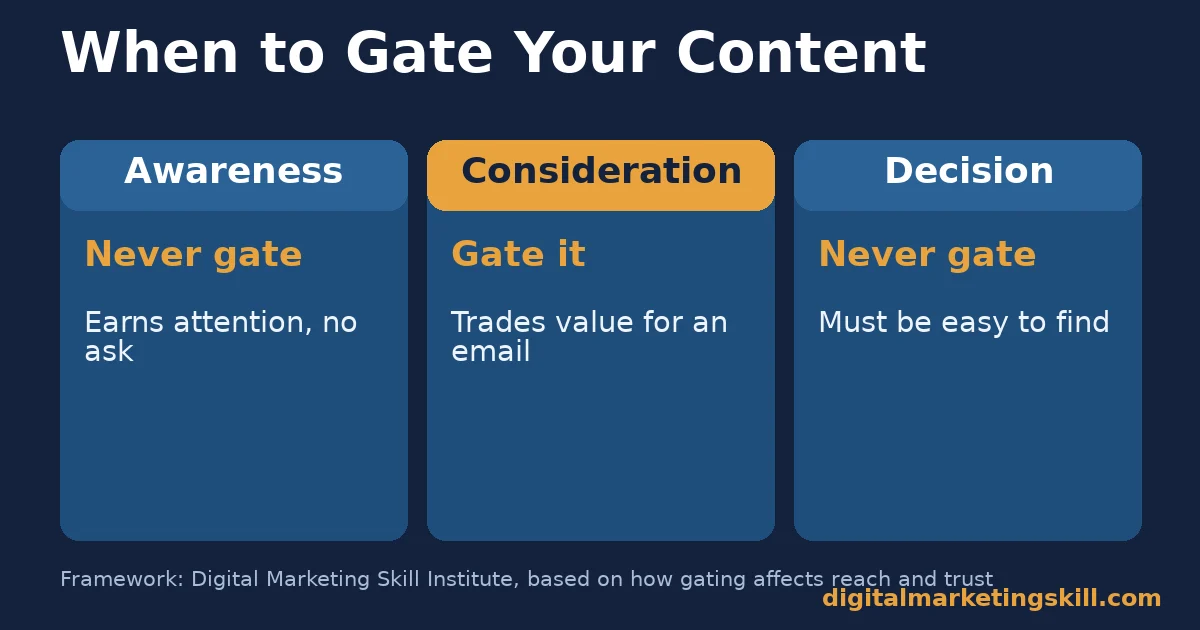
Gating matters here too. A gated piece asks for an email before access. That only works once a prospect already sees enough value to trade their contact details for it. Gate an awareness-stage blog post, and you block the traffic that should be building trust. Leave a decision-stage comparison guide ungated, and you hand a sales-ready prospect to a competitor’s form instead of yours.
This is also why relevance outperforms format choice. That same Content Marketing Institute survey put content relevance and quality ahead of format for 65% of the most effective teams. A plain one-page guide that answers the exact question a prospect has will beat a polished ebook that does not.
Three Groups of Content Power a Lead Generation Content Strategy
Not every format belongs at every stage. Grouping formats by the stage they serve best makes a gap in your current content strategy far easier to spot.
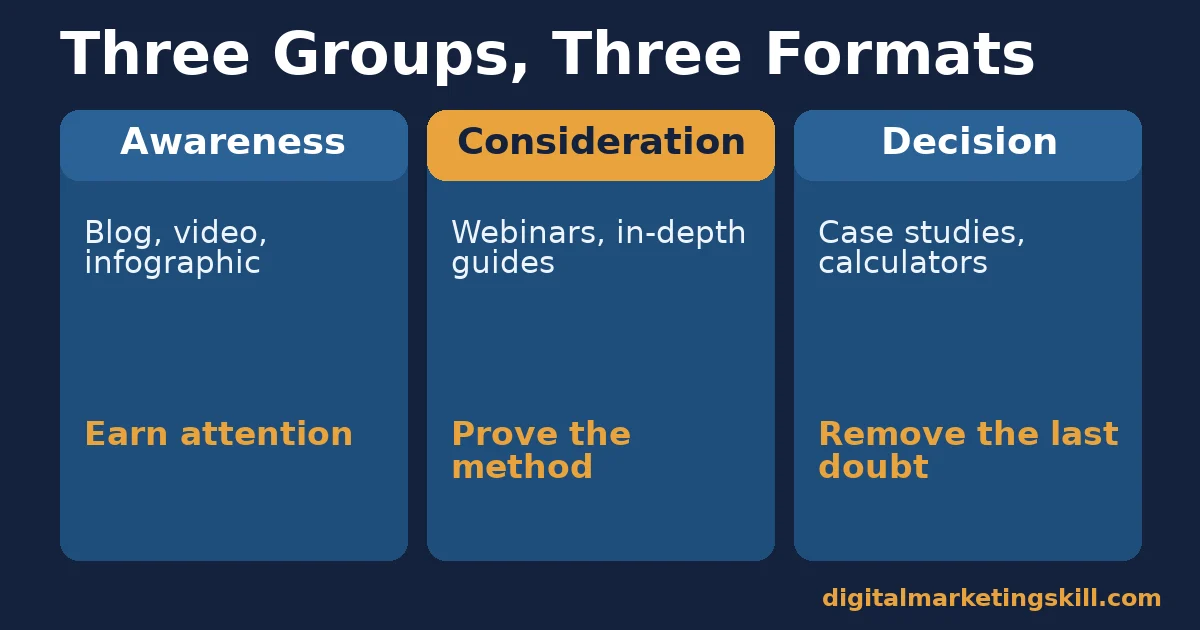
Awareness Content: Built to Earn Attention Without an Ask
Awareness content includes blog posts, short videos and infographics. None of it should sit behind a form. Its only job is to earn attention and show that you understand the prospect’s problem. Google’s own guidance on helpful, people-first content asks something close: will a reader leave feeling they learned something useful? Gating this content trades a small amount of reach for nothing in return.
Consideration Content: Built to Prove a Method Works
Consideration content includes webinars, in-depth guides and benchmark data. A prospect here already believes they have a problem and is comparing solutions. This is where gating starts to make sense, in exchange for a genuinely useful piece.
Decision Content: Built to Remove the Last Doubt
Decision content includes case studies, comparison pages, interactive calculators and testimonial video. Wistia’s survey of 900-plus marketing professionals found customer testimonial videos are among the formats most commonly planned. That fits the stage: a prospect here wants proof it will work for someone like them. This content should always be easy to find and link to directly from a pricing or demo page.
A Worked Example Across All Three Stages
Here is an illustrative example, with invented numbers, showing how one topic can serve all three stages instead of just one.
A project management tool company picks the topic “missed deadlines.” At the awareness stage, they publish a short blog post titled “Why Teams Miss Deadlines, and What the Data Actually Shows.” No form, just a useful read.
At the consideration stage, the same company runs a webinar called “The Five-Step Review That Catches a Slipping Deadline Early.” This one sits behind a short registration form, because a prospect here already wants a specific method, not general awareness.
At the decision stage, they publish one detailed case study: a real customer who cut missed deadlines by a third after changing their review process. It links directly from the pricing page, where a prospect who is almost ready to buy can find it in one click.
How to Lead With Each Content Group
Each group above needs a different first move. The sections below mirror the three groups. That lets you fix the stage that is actually underperforming, instead of producing more of everything.
Awareness Content: Lead With the Problem, Not the Brand
Open with the exact problem a prospect is searching for, in their own words, before introducing your product at all. An infographic or short video that teaches something useful earns a share and a return visit, something a gated piece never gets the chance to do.
Consideration Content: Lead With a Specific, Narrow Promise
Promise one specific outcome, not a broad topic, in the title of a guide or the description of a webinar. Livestorm’s data shows average attendance sits at 46%. So write the registration page assuming more than half of sign-ups will watch the recording instead, and make sure that recording is just as easy to find.
Decision Content: Lead With a Case Like the Prospect’s Own
Match the case study or comparison to the prospect’s own size, industry or problem as closely as possible. A general success story convinces far less than one that mirrors the reader’s exact situation. It removes the objection “that would not work for a business like mine.”
Five Mistakes That Quietly Waste a Lead Generation Content Strategy
Most underperforming content strategies share the same handful of mistakes. Check your current content list against this before you plan anything new.
- Gating awareness-stage content. A blog post or short explainer behind a form blocks the exact traffic that should be building trust in your brand. Save the form for consideration and decision content.
- One title promising everything. A guide that claims to cover an entire topic attracts browsers, not leads. A narrow, specific promise attracts the prospect who actually needs that exact answer.
- No promotion plan beyond publishing. Content without a distribution plan, email, social, internal links, rarely reaches enough of the right audience to generate leads worth counting.
- Ignoring the buying stage entirely. Producing only one kind of content, usually blog posts, leaves consideration and decision-stage prospects with nothing built specifically for them.
- No follow-up after the download. A lead who downloads a guide and never hears from you again was rarely worth the cost of producing that guide in the first place.
- Treating every lead the same after they convert. A lead who downloaded an awareness-stage infographic is not ready for a sales call yet. Route them into a nurture sequence instead of handing them straight to sales.
Two Content Formats Worth Retiring From Most Strategies
Not every format from the old content marketing playbook still earns its place. Two in particular rarely justify the effort most teams still put into them.
Static slide decks shared as standalone assets have lost much of their pull. Readers now expect a short video or an interactive page over a slide deck they must click through one screen at a time. If you already have strong slide content, turn it into a short video instead of publishing it as is.
Generic industry overviews are the second format worth retiring. A broad “introduction to X” piece competes with thousands of nearly identical pages and rarely ranks or converts. Replace it with a narrow guide that answers one specific question your own prospects actually ask.
How to Measure a Lead Generation Content Strategy
Measure each content group by what it is actually meant to do, not by one shared metric. Each metric below is defined in one sentence, with a note on how to read it.
Proving these numbers actually trace back to revenue, not just traffic, is its own challenge; our guide to content marketing ROI covers the attribution models that make that possible.
Four Metrics That Show Real Performance
- Form conversion rate. The share of visitors to a gated landing page who complete the form. Unbounce’s benchmark report puts the median across all industries at 6.6%, a useful outside baseline.
- Attendance or completion rate. For webinars, the share of registrants who actually show up. Livestorm’s platform data puts the average at 46%, a reasonable baseline until you have your own history.
- Lead-to-opportunity rate. The share of leads from a specific piece of content that become a real sales conversation. This is the number that shows whether a format attracts the right prospects, not just more of them.
- Content engagement time. Time spent on a guide, or minutes watched in a video or webinar. Rising engagement with flat conversion usually means the content is good but the next step is unclear.
How to Read These Numbers Together
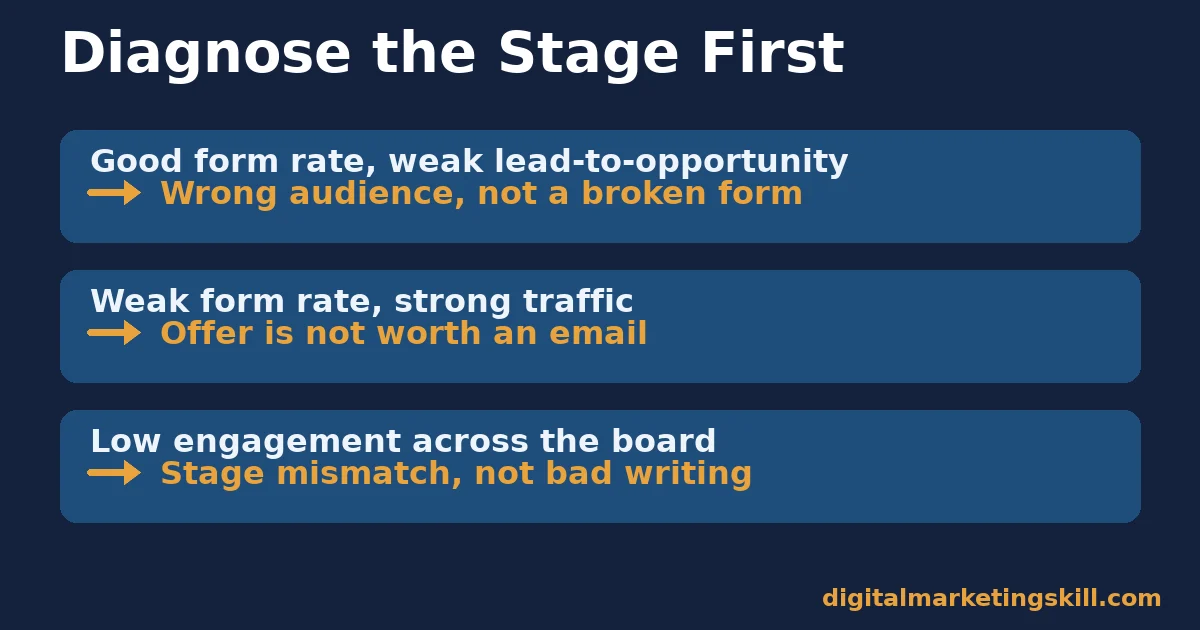
Read the four metrics as a chain. A healthy form conversion rate with a weak lead-to-opportunity rate usually means the content attracted the wrong audience, not that the form failed. A weak form conversion rate with strong traffic usually means the offer itself is not compelling enough to trade an email for.
Low engagement time across the board often points back to a stage mismatch. Check whether you offered consideration-stage depth to an audience that was still at the awareness stage, before you blame the writing.
Review these four metrics together at least once a month, not after every single piece of content. One webinar or one guide rarely tells you enough. A month of data across several pieces shows a real pattern instead of noise from one unusual result.
The Lead Generation Content Strategy Rule: Diagnose the Stage First
If you take one decision rule from this guide, make it this one. Before producing another piece of content, name the exact stage it targets. Then check whether you already have something for that stage.
Here is an illustrative example, with invented numbers. A small software company publishes five awareness-stage blog posts a month but has no consideration-stage guide and no decision-stage case study. Traffic is strong, with thousands of monthly visitors reading the blog, yet almost nothing converts to a sales conversation.
The team pauses new blog posts for one month. Instead, they build one consideration-stage guide and two decision-stage case studies. Traffic stays flat, but lead-to-opportunity rate more than doubles, because prospects who were ready to act finally had something to act on.
You Do Not Need a Big Budget to Start
A lead generation content strategy does not require an agency or a large team. Most of the formats in this guide can be built with a writer, a simple landing page tool and an email platform you likely already have.
Spend your limited time on the thinnest stage, not on the format that looks most impressive. One well-targeted case study usually outperforms an expensive video series aimed at the wrong stage of the funnel.
If you outsource any part of this, outsource the format you are weakest at, not the one you enjoy least. A freelance writer or designer can usually fill a single format gap faster and cheaper than your own team learning it from scratch.
A One-Week Plan to Fix the Biggest Gap
You do not need a full content calendar to start. Spend about an hour a day for one week identifying and filling your single biggest stage gap.
- Day one: map what you already have. List every piece of content from the past year and sort each into awareness, consideration or decision.
- Day two: find the thinnest stage. Most teams are heavy on awareness content and thin on decision-stage proof. Confirm which stage is actually thinnest for you.
- Days three and four: outline one piece for that stage. Use the narrow-promise rule from above, built around one specific prospect question.
- Day five: draft it. Keep the format simple. A clear one-page guide or a single detailed case study beats an elaborate piece that takes months.
- Day six: set up the landing page and follow-up. Confirm there is a clear next step and at least one follow-up email after the download or registration.
- Day seven: set your baseline. Record form conversion rate and, if relevant, attendance rate, so you can judge the next piece against this one.
A Real Case: Content Skills Built Into a Lead Pipeline
Oluwatosin Jegede is a graduate of Digital Marketing Skill Institute, featured on its reviews page. They describe the outcome plainly: “Now I have skills to monetize, sell any product, drive traffic, generate converting leads that have a positive ROI on any business.” The case reflects the same principle this guide covers. Content built to generate and convert leads, not just attract traffic, is what paid off.
Treat this as one published outcome rather than a typical result. A lead generation content strategy transfers well into freelance, agency or in-house work, but results depend on the market, the offer and consistent execution. The Institute’s earnings disclaimer applies to any income or outcome figure shared by a graduate.
Frequently Asked Questions About Lead Generation Content Strategy
Should all gated content require an email address?
No. Save gating for consideration and decision-stage content that a prospect already sees real value in. Gating awareness content blocks the traffic that should be building trust first.
What is a good webinar attendance rate?
Livestorm’s platform data puts average attendance across industries at 46%, so treat anything close to that as normal rather than a failure. Always publish the recording, since most registrants will not attend live.
How many content formats does a small team actually need?
Fewer than most teams think. One strong piece per funnel stage, built around a specific prospect question, outperforms a long list of thin content spread across every format.
Do infographics still generate leads?
They can, mainly at the awareness stage, where their job is to earn attention and shares rather than a form fill. Gating an infographic usually reduces its reach more than it increases leads.
Why does my gated content get downloads but few sales conversations?
Usually a stage mismatch. The content attracted an awareness-stage audience with a consideration-stage offer. Check the lead-to-opportunity rate, not just the download count, before changing the content itself.
Is video required for a modern lead generation content strategy?
It helps, but adoption is now so common that video alone no longer sets you apart. Relevance and a clear next step matter more than the format you choose.
How long should a case study be?
Long enough to name the specific problem, the method used and a clear result, usually one page. A short, specific case study beats a long one that buries the result in background detail.
Who should own a lead generation content strategy in a small team?
One person should own the stage map and decide what gets built next, even if writers, designers and freelancers produce the actual pieces. Without a single owner, most teams default back to whatever format feels easiest that week.
Fill the Thinnest Stage, Then Measure It
A lead generation content strategy works when every stage of the buying journey has something built specifically for it. Map what you already have, find the thinnest stage, and build one piece for it using the plan above before you add anything else.
Revisit this process every few months, not just once. A lead generation content strategy that worked before can thin out again as your audience, product or market shifts, so treat the stage map as something you update, not a one-time exercise.
If you want to build this skill properly, Digital Marketing Skill Institute teaches it hands-on inside the Master Diploma in Digital & AI Marketing. It covers lead generation and content alongside email automation, Google Ads, and WordPress and SEO.
It comes with unlimited 1-on-1 coaching and mentoring, plus real project work inside a U.S. partner company. The diploma is dual US and UK accredited, and recognised in more than 100 countries.
The programme is 100% online, so you can study from anywhere in your country. Explore more guides on the Digital Marketing Skill Institute blog, including our breakdowns of email marketing lead conversion and fixing a leaking sales funnel. Or go straight to the Master Diploma application.
Every figure in this guide was checked against its original source before publication. Figures marked as illustrative are invented examples, not real results.
![9 Amazing Digital Marketing Skills to Make Money Online [With Proof]](https://digitalmarketingskill.com/wp-content/uploads/2019/07/9-Amazing-Digital-Marketing-Skills-to-Make-Money-Online-With-Proof-17.png)