
Customer acquisition cost (CAC) is the average amount a business spends on sales and marketing to win one new customer. You find it by adding up those costs for a period and dividing by the number of new customers in the same period. It matters because it tells you whether growth is affordable, and whether each customer is worth more than they cost to win.
Key Takeaways
- CAC = (sales costs + marketing costs) ÷ new customers, for the same period.
- Count only first-time customers, not repeat buyers.
- Include more than ad spend: salaries, tools, creative work and agency fees all count.
- Compare CAC with customer lifetime value (CLV). HubSpot suggests a ratio of about 3:1.
- A lower CAC is not always better. It can mean you are under-investing in growth.
What Is Customer Acquisition Cost?
Shopify defines it as “the total cost of acquiring a single customer.” That includes spending on sales, marketing and anything else that turns a lead into a paying customer.
For example, imagine an online tea shop spends £3,000 in one month on ads, email software and a part-time marketer. That month, it wins 100 new customers. Its CAC is £3,000 ÷ 100, which is £30 per customer.
On its own, £30 means little. However, if the average customer spends £150 over their time with the shop, the business is in good shape. By contrast, if they spend £25 and never return, every new customer loses money.
How Customer Acquisition Cost Works
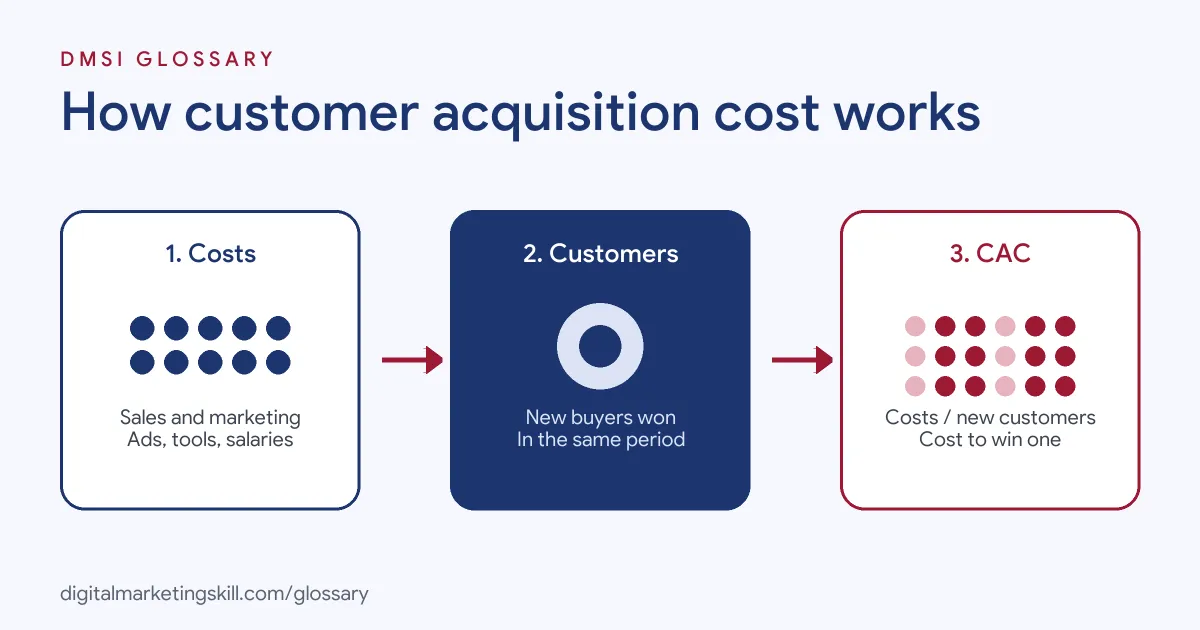
Working out CAC takes three steps. First, add up your sales and marketing costs for a set period. Next, count the new customers you won in that period. Finally, divide the costs by the customers.
The Formula
HubSpot gives the formula as “CAC = (Cost of sales + cost of marketing) ÷ Number of new customers.” It advises that you pick the time period first, such as a month, a quarter or a year. Then use the same period for both costs and customers.
What to Include
The most common mistake is counting ad spend alone. HubSpot and Shopify both list a wider set of costs:
- Advertising, such as search, social and traditional media.
- Sales and marketing salaries, benefits and contract work.
- Software and tools, such as a CRM, analytics or email platform.
- Creative and content costs, including freelance design and video.
- Agency fees, training and overheads.
- Discounts and offers used to attract new customers, which Shopify includes.
Which Customers Count
Shopify notes that you should count first-time customers only. Repeat buyers don’t count, because you have already paid to win them. Otherwise, your CAC will look lower than it really is. Likewise, if you sell to businesses, count new paying accounts rather than every new contact.
Blended vs Paid CAC
Metabase explains that there are two common versions. Blended CAC divides all sales and marketing costs by all new customers, including those who found you for free. Paid CAC, by contrast, divides paid media spend by only the customers who came from paid channels. As Metabase puts it, “Blended CAC is always lower than paid CAC when organic works.” So always label which one you are reporting.
CAC Payback
Payback asks how long it takes to earn back what you spent to win a customer. Metabase works it out as CAC divided by the monthly gross profit each customer brings in. For example, a £120 customer acquisition cost and £10 of monthly gross profit per customer gives a 12-month payback. Metabase calls 12 months or less “comfortable for most subscription businesses.”
Customer Acquisition Cost Examples
HubSpot’s article works through three examples:
- Software company: It spends $30,000 on marketing and sales plus $50,000 on tech and production, and wins 2,000 customers. Its CAC is $40.
- Drinks brand: It spends $9,000 on sales and $15,000 on marketing, and wins 4,000 customers. So its CAC is $6.
- Quarterly view: A business spends $300,000 on sales and $100,000 on marketing in a quarter, and wins 500 customers. Its CAC is $800.
As you can see, CAC varies hugely by business model. That is why you should compare it with what each customer is worth, not with other industries.
Customer Acquisition Cost vs CPA vs CLV
These metrics often appear in the same report, so here is how they differ:
| Metric | What it measures | Typical scope |
|---|---|---|
| CAC | Total cost to win one new customer | All sales and marketing costs |
| CPA (cost per acquisition) | Ad cost for each conversion, such as a lead or sale | One campaign or channel |
| CLV (customer lifetime value) | Revenue a customer brings over their whole time with you | The customer relationship |
Shopify works out CLV as average revenue per customer multiplied by average customer lifespan. Then you divide CLV by CAC to get the ratio.
How to Calculate and Use Customer Acquisition Cost
Follow these steps to measure CAC and act on it:
- Choose a period. A month or a quarter works for most businesses.
- Collect all costs. Pull ad spend, salaries, tools, agency fees and discounts for that period.
- Count new customers. Use first-time buyers only, from your store or CRM.
- Divide. Total costs ÷ new customers gives your CAC.
- Split by channel. Where you can, work out CAC for search, social and email separately.
- Compare with CLV. HubSpot suggests aiming for a CLV:CAC ratio of about 3:1, and ideally earning back the cost within a year.
- Act on it. Move budget towards the channels with the best ratio, then measure again.
Best Practices for Lowering CAC
- Know your audience. HubSpot suggests interviews, surveys and a clear ideal customer profile, so you stop paying to reach the wrong people.
- Improve conversion rates. A better landing page wins more customers from the same spend.
- Invest in SEO. Organic traffic keeps arriving without a cost for each click.
- Build referrals. HubSpot notes that referred customers are often cheaper to win and more loyal.
- Automate manual work. Tools can take over tasks that would otherwise add salary costs.
- Segment your CAC. Metabase advises breaking it down by customer segment, because large business clients and self-serve buyers can cost very different amounts to win.
Common Mistakes to Avoid
CAC is easy to get wrong. First, many teams count only ad spend, which makes CAC look far lower than it is. Second, they include repeat customers in the total. Third, they compare a monthly cost with customers won over a different period. Metabase stresses that spend and the customers it produced should fall in the same window, and that you should use a consistent attribution window. Finally, they cut CAC at any price. HubSpot warns that a ratio well above 3:1, such as 5:1, may mean you are missing growth by spending too little.
Where You’ll Use Customer Acquisition Cost at Work
CAC is a core number in growth and performance marketing. For example, remote job listings ask for:
- “Deep fluency in unit economics: CAC, MER, contribution margin, payback and LTV” (Director of Performance Marketing).
- The ability to pull “the right platform levers to hit our Customer Acquisition Cost (CAC) targets” (Manager, Paid Acquisition and Investment).
- Skill to “Set channel strategy and budgets based on CAC, LTV, conversion and incremental returns” (VP, Marketing).
So whether you aim to be a Growth Marketer, a Digital Marketing Manager or a freelancer, clients will judge your work by what each new customer costs.
Learn It in the Full Stack Programme
CAC draws on every channel, so it fits the Full Stack (all four tracks) option. There, you take all ten courses and complete one portfolio project from each track, covering social, lead generation, Google Ads and SEO. You also work on a U.S. Project Internship from day one, with unlimited 1-on-1 mentoring.
Want to choose channels by cost? Read our guide to customer acquisition strategy, or see how to fix leaks in your customer acquisition funnel.
Frequently Asked Questions
How do you calculate customer acquisition cost?
Add up your sales and marketing costs for a period, then divide by the number of new customers you won in that period. For example, £5,000 ÷ 200 customers is £25.
What is a good CAC?
It depends on what a customer is worth. HubSpot suggests customer lifetime value should be about three times CAC, while Shopify calls 3:1 to 5:1 efficient.
Is CAC the same as cost per acquisition?
No. CPA usually measures the ad cost of one conversion in a campaign. CAC includes all sales and marketing costs to win a new customer.
Should CAC include salaries?
Yes. HubSpot and Shopify both include sales and marketing salaries, along with tools, creative work and other costs.
How can I lower my CAC?
Target your ideal customers more closely, improve your conversion rate, invest in SEO and referrals, and move budget to the channels that win customers most cheaply.
Sources: HubSpot: What does CAC stand for?; Shopify: Customer acquisition cost; Metabase: CAC; remote job listings on Himalayas and Himalayas.