
Natural language processing (NLP) is the branch of artificial intelligence that helps computers read, understand and produce human language. It turns text and speech into data a machine can work with, then turns results back into words. It matters to marketers because search engines, chatbots, review tools and AI writing tools all depend on it.
Key Takeaways
- IBM describes NLP as a subfield of computer science and AI that uses machine learning to work with human language.
- It blends computational linguistics, which studies language with data, with machine learning and deep learning.
- Common tasks include sentiment analysis, entity recognition, translation and summaries.
- Google uses NLP models such as BERT to understand what a search really means.
- Large language models, such as those behind ChatGPT and Claude, are a modern form of NLP.
What Is Natural Language Processing?
Computers handle numbers well, but human language is messy. Words have several meanings, and the same idea can be said in many ways. NLP is the set of methods that helps a computer cope with that.
For example, think about a hotel review that says, “The room was small, but the staff were brilliant.” A person can see the mixed feeling at once. An NLP tool, in turn, can split the sentence, spot “room” and “staff” as the things being judged, and score the feeling towards each one.
IBM puts it this way: NLP “combines the power of computational linguistics together with machine learning algorithms and deep learning.” In other words, it mixes rules about language with machine learning models that learn from huge amounts of text.
How Natural Language Processing Works
Most NLP follows three broad steps. First, the system takes in raw text. Next, it breaks the text down and analyses it. Finally, it returns a result, such as a label, a score or new text.
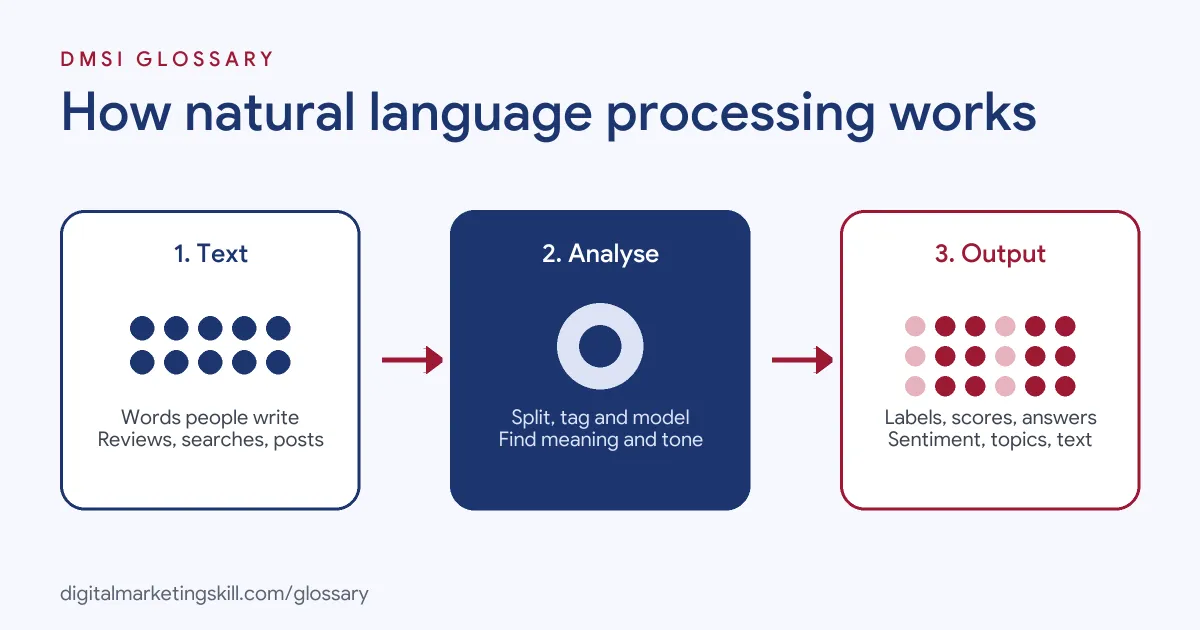
Breaking Text Down
The first job is usually tokenisation, which IBM describes as “splitting the text into smaller units.” Then the system can tag each word’s part of speech, such as noun or verb. It can also spot named entities, such as people, places and brands, and work out which meaning of a word fits.
Finding Meaning and Tone
Next, the system looks for meaning. Google Cloud’s Natural Language API, for instance, offers sentiment analysis, entity analysis, entity sentiment, syntax analysis and content classification. Its sentiment score runs from -1.0, which is negative, to 1.0, which is positive. A separate magnitude number shows how strong the feeling is.
Working With an NLP API
Many marketing tools call an API like Google’s behind the scenes. So it helps to know a few of its rules. First, the API detects the language of the text if you don’t set one. Second, one request can run sentiment, entity and syntax analysis together. Third, content classification needs at least twenty tokens, so a single short comment may be too brief to sort into a topic. Finally, entity sentiment scores each mention of a brand or product, then combines them into one result for that entity. That is how a tool can report the mood around your brand name, even inside a long, mixed review.
From Rules to Transformers
NLP has changed a lot over time. IBM explains that early systems used “simple if-then decision trees” with hand-written rules. Later, statistical methods learned the likely meaning of words from data. Then deep learning took over. Modern transformer models train on massive amounts of text, and they power large language models such as GPT, Llama, Claude and Mistral.
Natural Language Processing Examples in Marketing
You already use NLP every day. Here are three examples from marketing work:
- Search engines: Google describes BERT, short for Bidirectional Encoder Representations from Transformers, as “a neural network-based technique for natural language processing pre-training.” It reads the words before and after each word. As a result, Google can tell that “stand” in “do estheticians stand a lot at work” means standing up.
- Review and social listening: A brand runs thousands of reviews or comments through sentiment analysis. Then it sees which products or topics draw the most negative feeling.
- Chatbots and AI writing tools: IBM lists customer support and drafting articles, emails and marketing copy among common business uses. Both depend on a model that can read a question and write an answer.
In each case, natural language processing turns unstructured words into something a team can act on. IBM also notes that it improves search by working out what the user intends, which is why search intent matters so much in SEO.
Common NLP Tasks and What They Do
Here are the tasks you are most likely to meet:
| Task | What it does | Marketing use |
|---|---|---|
| Sentiment analysis | Scores whether text is positive, negative or neutral | Tracking how people feel about a brand |
| Entity recognition | Finds names of people, places, products and brands | Spotting which products people mention |
| Content classification | Sorts text into topic categories | Tagging support tickets or articles |
| Summarisation | Shortens long text into key points | Turning reports or calls into notes |
| Text generation | Writes new text from a prompt | Drafting ads, emails and posts |
How to Use Natural Language Processing in Your Marketing
You don’t need to build models to benefit. Instead, follow these steps:
- Pick one question. For example, “What do customers complain about most?”
- Gather the text. Export reviews, survey answers, support chats or social comments.
- Choose a tool. Use a sentiment or text analysis feature in your social or survey tool, an API, or an AI assistant.
- Run a small test. Analyse a sample first and check the labels by hand.
- Group the results. Sort by topic and sentiment, then count what comes up most.
- Act and report. Share the top themes with product or content teams, then measure again later.
Best Practices for NLP at Work
- Check a sample by hand. Models miss sarcasm and slang, so spot-check before you trust the totals.
- Read score and strength together. Google notes that a score near zero can mean neutral text or mixed feelings. So check the magnitude too.
- Write for meaning, not keywords. Because search engines understand context, clear answers beat repeated phrases.
- Protect personal data. Remove names and contact details before you upload customer text to any tool.
- Keep a human editor. Always review AI-written copy before it goes live.
Common Mistakes to Avoid
Teams new to NLP often trip up in the same places. First, they trust sentiment scores without reading any of the text. Second, they feed tools tiny samples and draw big conclusions. Third, they stuff keywords into pages, even though modern search reads meaning. Finally, they publish AI drafts without checking facts, which can spread errors under their brand name.
Where You’ll Use Natural Language Processing at Work
NLP skills now show up in marketing and content job listings. For example, remote roles mention:
- “Experience with NLP techniques for sentiment and text analysis” (Social Media Analyst).
- The need to “track new AI and NLP methods for legal text work” (Staff Content Manager).
- “Experience with natural language processing (NLP) and conversational AI, including chatbot development and voice/chat automation” (AWS Senior Developer).
So in roles such as SEO Specialist, Content Creator or Social Media Manager, you will use NLP tools to research topics, write for search and read what customers say.
Learn It in the WordPress and SEO Track
AI fundamentals, including strategy and planning, is part of every DMSI track. You will see natural language processing most in the AI-Powered WordPress and SEO Specialist track, where search engines read your content for meaning. There, you build a WordPress site or store and rank it with an SEO content plan. You also work on a U.S. Project Internship from day one, with unlimited 1-on-1 mentoring.
Want to go deeper? See our glossary entry on large language models, or read how brands use chatbot marketing.
Frequently Asked Questions
What is natural language processing in simple terms?
It is the part of AI that helps computers understand and use human language. It lets software read text, find meaning and write replies.
Is NLP the same as a large language model?
No. NLP is the wider field. Large language models are one modern type of NLP model, trained on huge amounts of text to understand and generate language.
How does Google use NLP?
Google uses models such as BERT to understand the meaning of searches. BERT looks at the words before and after each word, so it can grasp context.
What is sentiment analysis?
It is an NLP task that scores the emotional tone of text. Google’s Natural Language API scores sentiment from -1.0, negative, to 1.0, positive.
Do marketers need to code to use NLP?
Usually not. Many social, survey and SEO tools include NLP features, and AI assistants can analyse text for you. Still, you need to check the results.
Sources: IBM: What is NLP?; Google Cloud: Natural Language API basics; Google: Understanding searches better than ever before; remote job listings on Himalayas.