
Omnichannel marketing is an approach where a business connects all its channels, such as its website, app, social media, email and shop, so customers get one joined-up journey with the brand. Each channel knows what happened in the others, so the message picks up where the last one left off. It matters because people rarely buy through just one channel. When the steps link up, it is easier for them to keep going than to start again.
Key Takeaways
- The key word is connected. Having lots of channels is not enough on its own.
- McKinsey describes it as “a set of seamlessly integrated channels, catering to customer preferences.”
- Multichannel marketing puts the product first and runs each channel on its own. Omnichannel puts the customer first.
- McKinsey research found that more than half of B2C customers use three to five channels for each purchase or request.
- Shared data and joint tracking across channels are what make it work.
What Is Omnichannel Marketing?
“Omni” means all. So the idea is to treat every channel as part of one system, built around the person. McKinsey defines it as reaching customers through the channels they like best. That might be a shop, a website, a text or social media.
McKinsey gives a simple example. A shopper adds an item to their basket online, then leaves without buying. Later, they see an ad for that exact item on social media. The ad knows what happened on the website, so it continues the same conversation.
The opposite is a business where each channel works alone. As one insurance boss told McKinsey, having lots of channels is not enough if each one gives customers a different result.
How Omnichannel Marketing Works
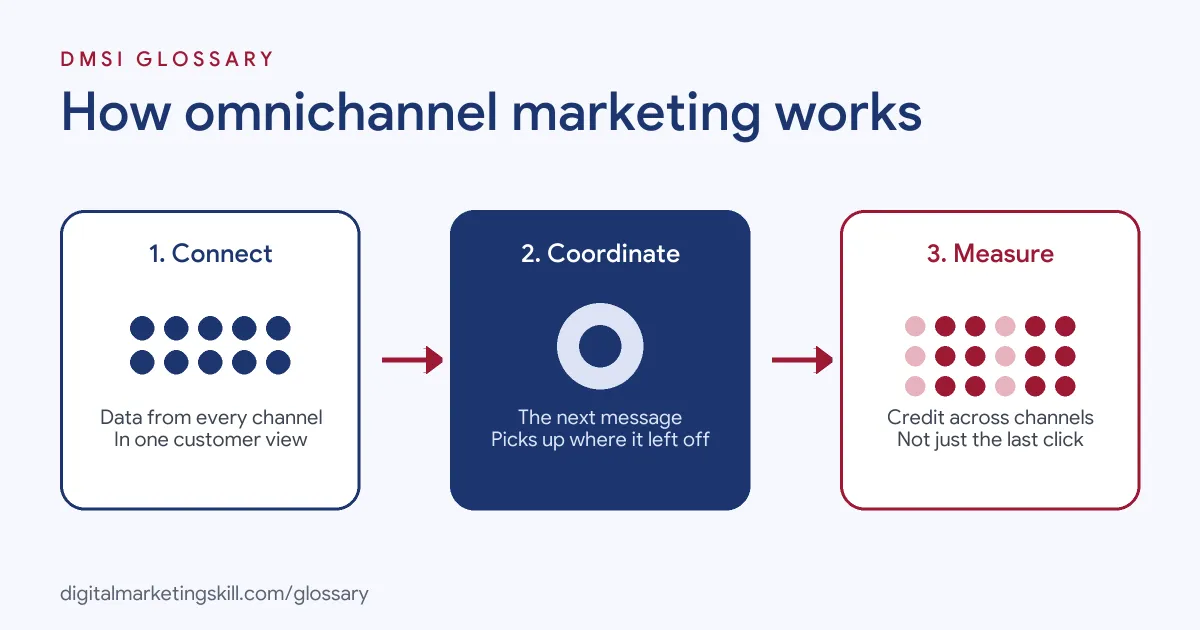
Every set-up like this rests on three parts. First, the business pulls data from each channel into one view of the customer. Next, it uses that view to decide the next message for each person. Finally, it measures results across all channels together, not one at a time.
One Customer View
The base is shared data. Usually, a CRM or customer database pulls together sign-ups, site visits, orders and support chats. As a result, the shop assistant, the email system and the ad platform can all “see” the same customer. Without this step, each channel guesses.
Consistent, Connected Messages
Next, the brand keeps its message the same while it adapts the format to each channel. For instance, a promotion might appear as a short video on social media, a fuller email and a sign in the shop. If a customer already bought, every channel should stop pushing that product. Instead, they can move on to helpful follow-ups.
Cross-Channel Measurement
Tracking results is harder when people switch channels. Google Analytics Help explains that attribution is “the act of assigning credit for important user actions to different ads, clicks, and factors” along a customer’s path. Its data-driven model uses your own data to share credit between channels. By contrast, last-click models give all the credit to the final channel.
Offline sales need linking too. Google Ads Help notes that you can import offline conversions, such as sales made in physical stores, from files or an API. That way, a shop sale can count towards the ad that started the journey.
Omnichannel Marketing Examples
McKinsey describes a few well-known retailers that connect their channels:
- Sephora: It links its app, push messages, loyalty programme and in-store tools. McKinsey reports that customers who visited the website within 24 hours of a store visit were three times more likely to buy, and their orders were 13 percent higher.
- Best Buy: It combines in-store advice, app features such as buying online and picking up in store, and its Geek Squad support service.
- Nike: It uses apps such as SNKRS and Run Club, which connect to in-person events and group runs.
Here is also a smaller, made-up example. A local bakery takes online pre-orders, sends a text when the order is ready, and gives loyalty points in the shop and online alike. In every case, the customer never has to repeat themselves.
Omnichannel vs Multichannel Marketing
These two terms are often confused. McKinsey separates them like this:
| Feature | Multichannel | Omnichannel |
|---|---|---|
| Focus | The product | The customer |
| Goal | Reach as many people as it can | Give each person a smooth journey |
| How channels work | Apart, often giving mixed results | Linked, so they share data |
| Typical result | A customer may have to start again in each channel | A customer can pick up where they left off |
In short, multichannel is about being in many places. Omnichannel, on the other hand, is about those places working together.
Why Omnichannel Marketing Matters
McKinsey’s research gives several reasons. It found that omnichannel shoppers shop 1.7 times more than single-channel shoppers. It also reports that about 60 to 70 percent of consumers research and shop both in stores and online. On top of that, McKinsey estimates that getting omnichannel personalisation right could lift revenue by 5 to 15 percent across a company’s customer base.
B2B buyers behave the same way. McKinsey found that B2B customers use ten or more channels to deal with their suppliers. So even businesses that never sell to the public need connected channels.
How to Build Omnichannel Marketing
You don’t need a huge budget to start. Work through these steps:
- Map the customer journey. List every place people meet your brand, from search and social to the shop and support.
- Find the gaps. Look for moments where a customer has to repeat themselves or gets mixed messages.
- Connect your data. Bring sign-ups, orders and service records into one CRM or customer record.
- Set shared rules. For example, stop ads for a product once someone buys it, and pause offers during an open complaint.
- Keep the brand the same. Use the same offer, tone and look everywhere, sized to each format.
- Track across channels. For example, use the data-driven model in Google Analytics.
- Improve one link at a time. Fix the gap that costs the most sales first, then move on.
Best Practices
- Start from the customer, not the channel. Ask what the person needs next, then pick the channel.
- Personalise with care. Use what people have shared with you, and respect their consent choices in every channel.
- Train every team. Shop staff, support agents and marketers should all know the current offers.
- Don’t forget offline. McKinsey notes that most retail sales still happen in physical locations.
Common Mistakes
Many businesses add channels without connecting them, which is really multichannel. Others send the same message to everyone in every channel, so it feels like spam. Some keep separate teams with separate targets, so channels fight instead of help each other. Finally, many judge each channel only on last-click results, which hides the channels that start the journey. Luckily, each of these is easy to spot once you map the journey.
Where You’ll Use Omnichannel Marketing at Work
Omnichannel thinking appears in strategy, media and marketing roles. For example, real remote job listings ask candidates to:
- “Develop sophisticated omnichannel strategies tailored to each client’s unique goals” (Commerce Media Strategist).
- “Develop differentiated positioning, messaging and customer-centric omnichannel campaigns” (Marketing Lead).
- “Tailor communications according to channel preferences, utilising the full omnichannel experience” (Key Account and Access Manager).
So whether you aim to be a Digital Marketing Manager, a Growth Marketer or an Agency Owner, you will need to plan how channels work together and prove it with data.
Learn It in the Full Stack Programme
You can learn to connect channels in the Full Stack programme, which covers all four tracks and all ten courses. Along the way, you do one portfolio project from each track, across social, email, Google and WordPress. So you see how each channel fits into the whole. You also join a U.S. Project Internship from day one, with unlimited 1-on-1 mentoring.
Want to go deeper? Read our full guide to omnichannel marketing, or see how to plan your marketing channel mix.
Frequently Asked Questions
What is omnichannel marketing in simple terms?
It means connecting all the ways customers meet your brand, so they get one smooth experience instead of several separate ones.
What is the difference between omnichannel and multichannel?
Multichannel uses several channels that work apart. Omnichannel links them around the customer, so each one knows what happened in the others.
Is omnichannel only for big retailers?
No. Small businesses can start by linking their website, email and shop data, and by keeping offers consistent everywhere.
How do you measure omnichannel marketing?
Use a model that shares credit across channels, such as the data-driven one in Google Analytics. Also track sales and repeat orders from each customer.
What tools do you need?
Most teams need a CRM or customer database, an email platform, analytics and ad accounts that can share audiences and results.
Sources: McKinsey: What is omnichannel marketing?; Google Analytics Help: About attribution and attribution modelling; Google Ads Help: About conversion measurement; remote job listings on Himalayas.