
AI copywriting is the use of generative AI tools to draft, edit or test marketing text, such as ad headlines, emails, product descriptions and social captions. A person gives the tool a brief, then reviews, fact-checks and improves what it writes. It matters because it can speed up first drafts and variations, while the human stays responsible for accuracy and brand voice.
Key Takeaways
- AI copywriting works best as a drafting partner, not as a final author.
- Generative models predict likely words. They don’t look up facts, so they can make things up.
- Google says to fact-check and review all AI-generated content before you publish it.
- Mass-producing pages without adding value can break Google’s scaled content abuse policy.
- Ad platforms set strict limits, such as 30 characters for a Google responsive search ad headline.
- Clear briefs, examples and success criteria give far better results than one-line prompts.
What Is AI Copywriting?
Copywriting is writing that aims to make someone act, such as click, sign up or buy. AI copywriting simply adds a generative AI tool to that process. You describe the product, the audience and the goal. Then the tool suggests words you can shape into finished copy.
For example, a skincare brand needs 15 headline ideas for a new serum. A copywriter gives an AI tool the product facts, the target customer and a few past headlines that worked. In seconds, the tool offers 30 options. The copywriter then cuts the weak ones, checks every claim and rewrites the best five in the brand’s voice.
That last step is the important one. As Google’s guidance puts it, generative models “don’t retrieve facts, but predict a likely sequence of words”. So a human still owns the result. If you want the basics of how these tools work, see our glossary entry on generative AI.
How AI Copywriting Works
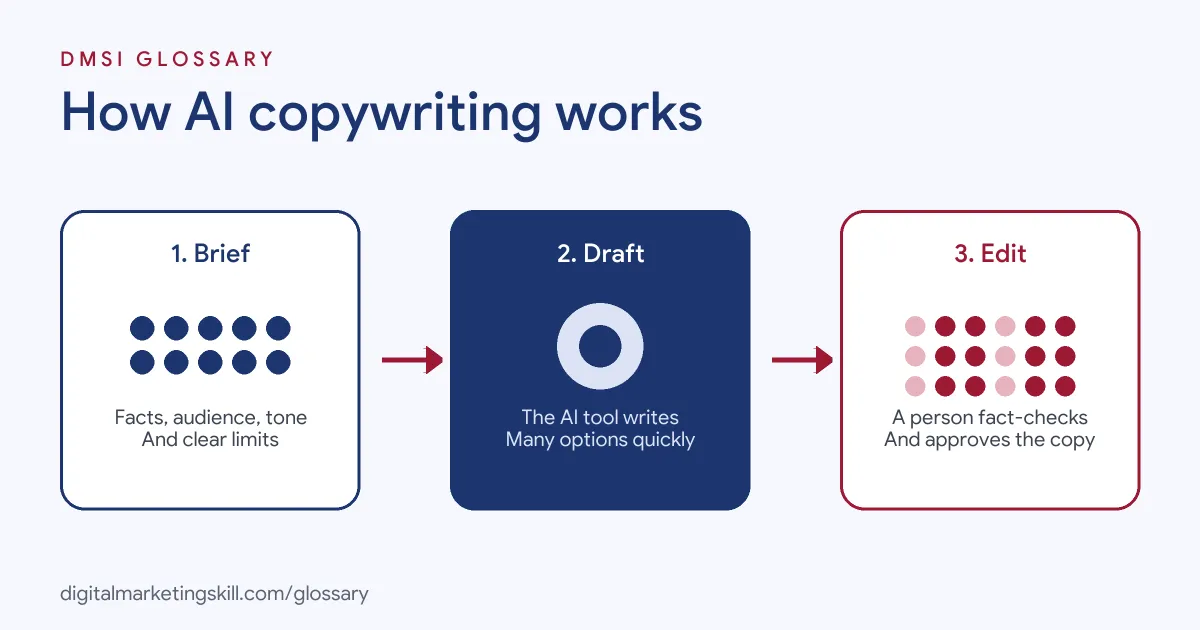
Most workflows have three stages: a brief, a draft and a human edit. Each stage shapes the next one.
The Brief
The brief is your prompt. A strong one includes the product facts, the audience, the channel, the tone and any limits. Anthropic’s prompt engineering guide suggests you first define clear success criteria and a way to test against them. For copy, that might mean “under 30 characters, mentions free delivery, no exclamation marks”.
The Draft
Next, the tool writes options. This is where AI shines, because it can produce many variations quickly. You can ask for different angles, such as price, speed or social proof, and compare them side by side.
The Human Edit
Finally, a person reviews everything. Google calls it “critical to manually factcheck and review all AI-generated content for accuracy and trustworthiness before publishing”. It adds that this also covers page titles, meta descriptions, structured data and image alt text.
AI Copywriting Examples
Here are three made-up examples of how teams use it:
- Search ads: A florist asks an AI tool for 20 headlines under 30 characters for birthday bouquets. It then picks the 15 strongest for one responsive search ad.
- Email: A software company drafts five subject lines for a webinar invite. It tests the two best on a small part of its list before the main send.
- Product pages: An online shop uses AI to draft descriptions from a spreadsheet of product specs. However, a person checks every size, material and care instruction against the real product.
AI Copywriting by Channel
Each channel has its own rules, so your brief should include them. Here is a quick guide:
| Channel | Key limit or rule | What AI helps with |
|---|---|---|
| Google responsive search ads | Up to 15 headlines of 30 characters and 4 descriptions of 90 characters | Generating many unique headlines to test |
| Google responsive display ads | Google AI combines your headlines, descriptions and images automatically | Writing varied headlines and descriptions |
| Website and blog content | Must meet Google’s spam policies, including scaled content abuse | Outlines, structure and first drafts |
| Ecommerce product data | Google Merchant Center asks for AI-generated titles and descriptions to be labelled | Turning specs into readable descriptions |
How to Use AI Copywriting Safely
Follow these steps to get useful drafts without risking your brand:
- Collect the facts. Gather product details, prices, offers and terms from a trusted source.
- Write the brief. Include audience, channel, tone, length and two or three examples of copy you like.
- Set success criteria. Decide how you will judge the output before you see it.
- Ask for variations. Request several options with different angles.
- Edit hard. Cut clichés, fix the voice and remove anything vague.
- Fact-check every claim. Compare numbers, features and promises with your source.
- Test and learn. Run the best versions against each other and keep what performs.
A Worked Example
Here is a made-up brief for a search ad. “Write 20 headlines for a dog-walking service in Bristol. Audience: busy professionals. Each headline must be 30 characters or fewer. Mention at least one of: insured walkers, GPS updates, same-day booking. Plain British English, no exclamation marks.”
The tool returns 20 lines. Next, you count characters, because you can’t assume the tool kept to the limit. Then you remove duplicates, since Google advises giving “as many unique headlines as you can”. After that, you check each claim. If the business has no GPS updates, that headline goes. Finally, you keep the best 15, which is the most Google allows in one responsive search ad.
AI Copywriting Best Practices
- Feed it real detail. Customer reviews, sales call notes and FAQs give the tool better material than a product name alone.
- Keep a style guide. Paste your tone rules into every brief, so drafts sound like you.
- Write ad headlines as a set. Google advises writing the first three RSA headlines as if they will appear together, and making each one unique.
- Add original value. Google asks whether content offers “original information, reporting, research, or analysis”. Your own experience is what AI can’t supply.
- Keep a prompt library. Save the briefs and edited outputs that worked, so each new brief starts from proven examples rather than a blank page.
- Never paste private data. Check your company’s rules before you share customer details with any AI tool.
Common AI Copywriting Mistakes
The most common mistake is publishing the first draft. Another is trusting numbers or features the tool invented. Some teams also generate hundreds of near-identical pages. Yet Google warns that using generative AI “to generate many pages without adding value for users may violate” its scaled content abuse policy. Others ignore channel limits, so headlines run too long and fail at upload. Finally, many people write vague prompts, such as “write an ad”, and then blame the tool for bland results.
Where You’ll Use AI Copywriting at Work
Employers now expect marketers to use AI for writing tasks. For example, remote job listings ask candidates to:
- “Leverage AI tools to support copywriting, ideation, and creative production” (Campaign Marketing Executive).
- Show “Proven, daily proficiency using AI tools to accelerate research, copywriting, and content ideation” (Inbound Marketer).
- “Use AI tools like ChatGPT to ideate, scale, and polish content faster and smarter” (Amazon Agency Listing Copywriter & Catalog Associate).
So whether you aim to be a Social Media Manager, Content Creator or Email Marketing Specialist, you will be expected to brief AI tools well and edit their output with care.
Learn It in the Social Media Track
AI fundamentals, including strategy and planning, are part of every DMSI track. You will use AI copywriting most in the AI-Powered Social Media Management and Advertising track, where you plan, create and run a paid social campaign for a real brand. You also get unlimited 1-on-1 mentoring and a U.S. Project Internship from day one.
Want to know where these tools fall short? Read our review of AI writing tools, or sharpen the human side with our guide to copywriting.
Frequently Asked Questions
What is AI copywriting in simple terms?
It means using an AI tool to help write marketing text. You give it a brief, it drafts options, and you edit and check the final version.
Does Google penalise AI-written content?
Google’s guidance doesn’t ban it. Instead, it asks you to focus on accuracy, quality and relevance. However, mass-producing pages without adding value can break its scaled content abuse policy.
Can AI copywriting replace a copywriter?
It can speed up drafts, but it can’t check facts or know your customers the way a person does. Someone still needs to brief, edit and approve the copy.
How do I write a good AI copywriting prompt?
Include the product facts, audience, channel, tone, length limits and a few examples. Then say how you will judge a good result.
Do I need to label AI-written product descriptions?
For Google Merchant Center, yes. Google says AI-generated titles and descriptions must be specified separately and labelled as AI-generated.
Sources: Google Search Central: Guidance on using generative AI content; Google Ads Help: About responsive search ads; Google Ads Help: About responsive display ads; Anthropic: Prompt engineering overview; remote job listings on Himalayas.