
Copywriting is writing built to move one specific reader toward one action, such as buying, signing up, or replying. It is not the same as general content writing. Content writing informs or entertains. Copywriting always points at a single decision. Businesses pay for copywriting because clear, persuasive text converts more readers into customers than vague text does.
Key Takeaways
- Nielsen Norman Group’s eye-tracking study of 232 users found that most people scan web pages in an F-shaped pattern instead of reading every word (Nielsen Norman Group).
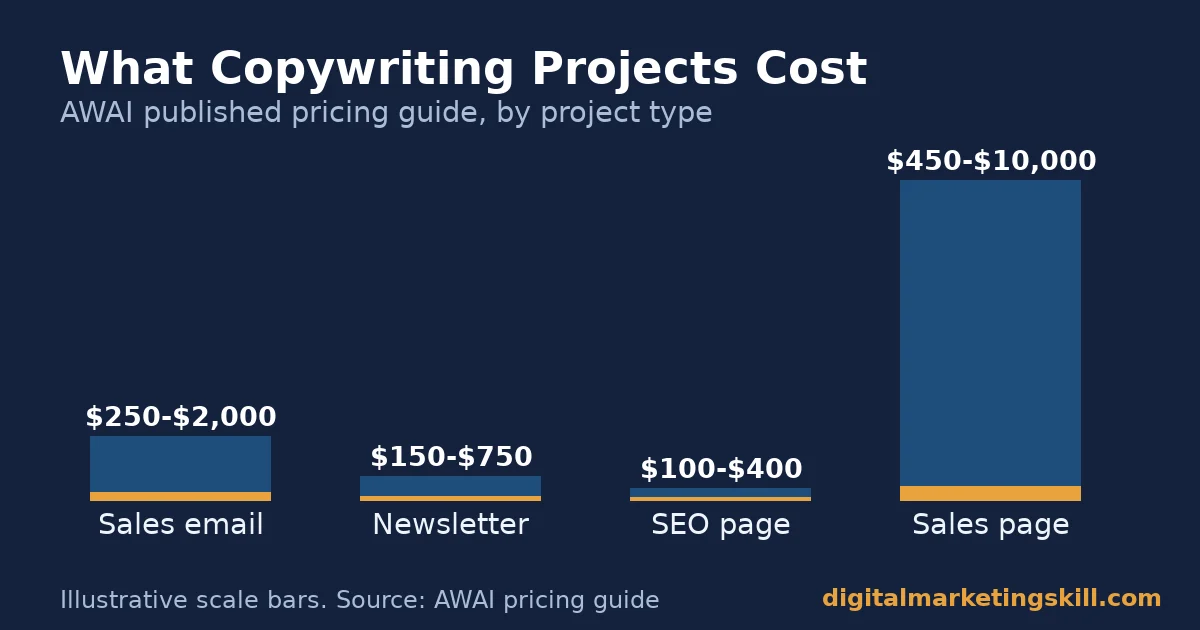
- AWAI’s own published pricing guide lists sales-page copy at $450 to $10,000 per page, and single sales emails at $250 to $2,000 (AWAI).
- The US Bureau of Labor Statistics reports a median annual wage of $76,910 for writers and authors, a US-only category that includes copywriters (BLS).
- Backlinko’s analysis of 11.8 million Google search results found that the average top-10 ranking page runs about 1,447 words (Backlinko).
- FinancesOnline, citing United Nations data, reports that small and medium enterprises make up more than 90% of the world’s business population and up to 70% of global employment (FinancesOnline).
In this guide
- What Most Advice About Copywriting Gets Wrong
- How Copywriting Actually Works
- What Differs By Copy Type
- How To Improve Each Format You Write
- How To Measure Whether Your Copy Is Working
- The One Rule For Pricing And Hiring Copywriting Work
- Common Mistakes That Quietly Lower Conversion
- Freelance Vs In-House Copywriting: Which Fits Your Business
- A Real Case: Rewriting Old Copy Instead Of Writing New Copy
- Frequently Asked Questions About Copywriting
- Where To Go From Here
What Most Advice About Copywriting Gets Wrong
Most articles answer “what is copywriting” with a dictionary definition. Then they stop. That skips the harder question. Why does one piece of writing sell, while another one, about the same product, falls flat?
The honest answer is that copywriting is not one skill. It is several related jobs. A sales page, a cold email, and an SEO page each get judged by a different reader, under different conditions. So one single formula cannot cover all three.
This guide treats copywriting as a set of distinct writing jobs. Each one has its own success metric. Every figure below is checked against its original source. Each one is labelled by scope, such as US-only or self-reported, so you can judge how far it applies to you. Treat this as a current snapshot of the craft, not a permanent ranking of techniques.
One more ground rule: nothing here promises a guaranteed income or a guaranteed conversion lift. Copywriting improves your odds. It does not remove the normal risk of running a business, testing an offer, or pricing freelance work in a market that moves. Anyone promising a fixed income figure from a writing skill alone is skipping that risk, not removing it.
How Copywriting Actually Works
Most copy follows a similar arc. First it grabs attention. Then it builds interest. Next it creates desire. Finally it asks for action. This is the classic AIDA model, still taught because it matches how people process a persuasive message.
What separates copy from a plain article is intent. The writer already knows the one action they want. Nielsen Norman Group’s eye-tracking study of 232 users, across thousands of pages, found a clear pattern. Readers scan horizontally across the top of a page. Then they scan a shorter line further down. Then they scan down the left edge. Researchers call this the F-shaped pattern.
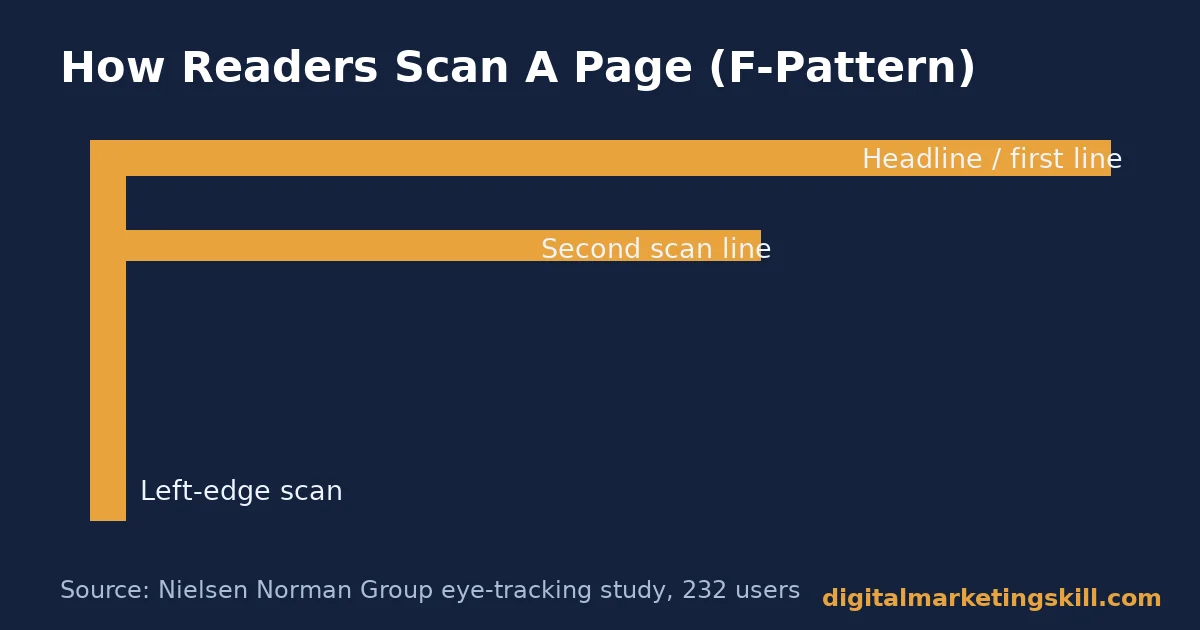
Readers decide whether to keep reading within a few seconds. So the strongest claim, the clearest benefit, or the sharpest number has to sit where that scan actually lands. That means the headline, the first line, and the start of each paragraph carry most of the weight.
A copywriter’s real job is narrower than “write nice sentences.” It is closer to this: put the one thing that matters where the F-pattern scan will find it. Then give the reader a reason, backed by a fact or a guarantee, to act now instead of later. Nothing more complicated than that is really required to get started.
Two Frameworks Worth Knowing: AIDA And PAS
Many copywriters also use a second, narrower framework called PAS: name the Problem, Agitate it briefly so the reader feels its weight, then present the Solution. PAS works well for shorter formats, such as a single email or a social ad, where there is no room for a full AIDA arc. Choosing between AIDA and PAS mostly comes down to length: give AIDA the room of a full page, and save PAS for anything shorter than a few hundred words. Outlining which framework you are using before you draft makes either one easier to apply consistently.
Why The Headline Carries So Much Weight
Because of the F-shaped scanning pattern, the headline and the first line of body copy do more work than any other sentence on the page. A weak headline means most readers never reach the strong proof you built further down. A copywriter who only has time to revise one sentence should almost always revise the headline first, then test a second version against it to see which one holds attention longer.
What Differs By Copy Type
The same principle shows up everywhere: grab attention, then ask for one action. But it plays out differently depending on the format. Here is how three common copywriting jobs differ in what they get judged on.
Sales Pages: Built For One Decision
A reader lands on a sales page because they are already close to buying. So its job is to remove the last objections, not introduce new ideas. AWAI’s own pricing guide prices this by length. A short, one-page sales letter runs $450–$1,000. A long, six-to-twenty-page sales page runs $3,000–$10,000. Bigger purchases need more proof. That is why longer pages cost more to write.
Email Sequences: Built For Repeat Opens
An email is judged first on whether it gets opened at all. The copy inside only matters once that happens. AWAI prices a single sales email at $250–$2,000 and a short regular e-letter at $50–$200. A sequence depends on repeat opens over time. No single email has to close the sale alone.
SEO Pages: Built For Search Intent First
An SEO page answers to two readers at once: a search engine, and an impatient person who typed a question. Backlinko’s study of 11.8 million search results found that top-10 pages average roughly 1,447 words. That suggests ranking content usually needs real depth. A short, purely persuasive pitch rarely has room to answer the full question.
How To Improve Each Format You Write
Sales Pages: Lead With The One Decision
Open with the single outcome your reader wants. State it in plain language. Put your strongest proof, such as a specific number or a direct quote, in the first three sentences. Save secondary benefits for later. Never add a second call to action. One page should ask for one decision, not two.
Email Sequences: Lead With The Subject Line
Treat the subject line as its own piece of copy. It has to earn the open before the body copy gets a chance. Make it specific, not clever. Keep each email focused on a single idea. Vary the angle across the sequence, so repeat opens feel like progress rather than the same pitch again.
SEO Pages: Lead With Search Intent
Answer the reader’s real question in your first paragraph, before you try to persuade them of anything. Build the rest of the page around the follow-up questions a searcher would naturally ask next. Add your sales pitch only once the information need is fully met. A reader who feels informed is far easier to persuade than a reader who feels sold to.
How To Measure Whether Your Copy Is Working
Copywriting is one of the few writing skills with a direct, measurable outcome. Track these four numbers, each defined in one sentence:
- Open rate is the share of recipients who open an email. It tells you whether the subject line and sender name are working, separate from the body copy.
- Click-through rate (CTR) is the share of readers who click your link or button. It tells you whether the offer and call to action are compelling once someone is already reading.
- Conversion rate is the share of visitors who complete the action you asked for, such as a purchase or signup. It is the final test of whether the copy actually sold the decision.
- Cost per word or per project is what you pay, or charge, measured against the rates above. It tells you whether a price is reasonable for the format and length involved.
Reading The Four Numbers Together
Read these four numbers together, not alone. A high open rate paired with a low click-through rate usually means your subject line overpromised what the body copy delivers. A high click-through rate paired with a low conversion rate usually points to a weak, or missing, final call to action.
So before you rewrite an entire page, isolate which number is actually broken. A subject line problem and a call-to-action problem need two completely different fixes. Both problems can show up as “low sales” on the same dashboard, which is exactly why treating them as one problem wastes time.
Track these numbers over a fixed window, such as a full month, rather than a single send. A single bad day can be noise. A full month of consistently low numbers is a real signal worth acting on.
The One Rule For Pricing And Hiring Copywriting Work
Match the writer’s rate to how much a single conversion is worth to you. Do not match it to how long the piece is. A one-page email that drives a $2,000 sale justifies a far higher fee than a ten-page brochure that supports a $20 purchase, even though the brochure takes longer to write.
Illustrative, invented numbers: say a sales email converts at a 2% rate today, and the product nets $150 profit per sale. Sending it to 1,000 people would be expected to produce about 20 sales, or $3,000 in profit. A $400 fee for a sharper rewrite of that single email becomes a reasonable trade if the rewrite lifts the conversion rate even modestly. Replace these numbers with your own real numbers before you make an actual budgeting decision.
Common Mistakes That Quietly Lower Conversion
Three mistakes show up again and again in weak copy, and none of them require a full rewrite to fix.
The first mistake is writing for everyone instead of one reader. Vague copy tries to please every visitor, so it ends up persuading none of them. Naming a single, specific reader in your head while you write almost always sharpens the result.
The second mistake is burying the proof. Google’s own guidance on helpful content names effort, originality, skill, and accuracy as its four main quality signals. Specific, checkable proof is what demonstrates all four at once, so it belongs near the top of the page, not buried in a footnote.
The third mistake is skipping the follow-up email. Litmus’s State of Email survey of nearly 500 marketing professionals found that 35% of marketing leaders report a $10 to $36 return for every $1 spent on email. Email remains one of the highest-return channels available, so a single sales page with no follow-up sequence behind it leaves easy, repeatable revenue on the table.
A fourth mistake, closely related to the first, is writing at the wrong reading level for the audience. Dense, jargon-heavy copy forces a reader to slow down and work for the meaning, which is the opposite of what persuasive writing should do. Short sentences, plain words, and one idea per sentence consistently outperform denser writing, because they let the reader’s attention go toward your argument instead of toward decoding your sentence structure.
Freelance Vs In-House Copywriting: Which Fits Your Business
Most businesses eventually choose between hiring a freelance copywriter per project and bringing the skill in-house. Neither choice is universally right. The better fit depends on how often you need new copy, and how much each piece is worth.
A business that publishes a handful of sales emails and one or two landing pages a year usually does better hiring per project. AWAI’s own pricing guide shows single sales emails running $250–$2,000 and short SEO page optimization running $100–$400 per page, so occasional work can be budgeted project by project without carrying a salary year-round.
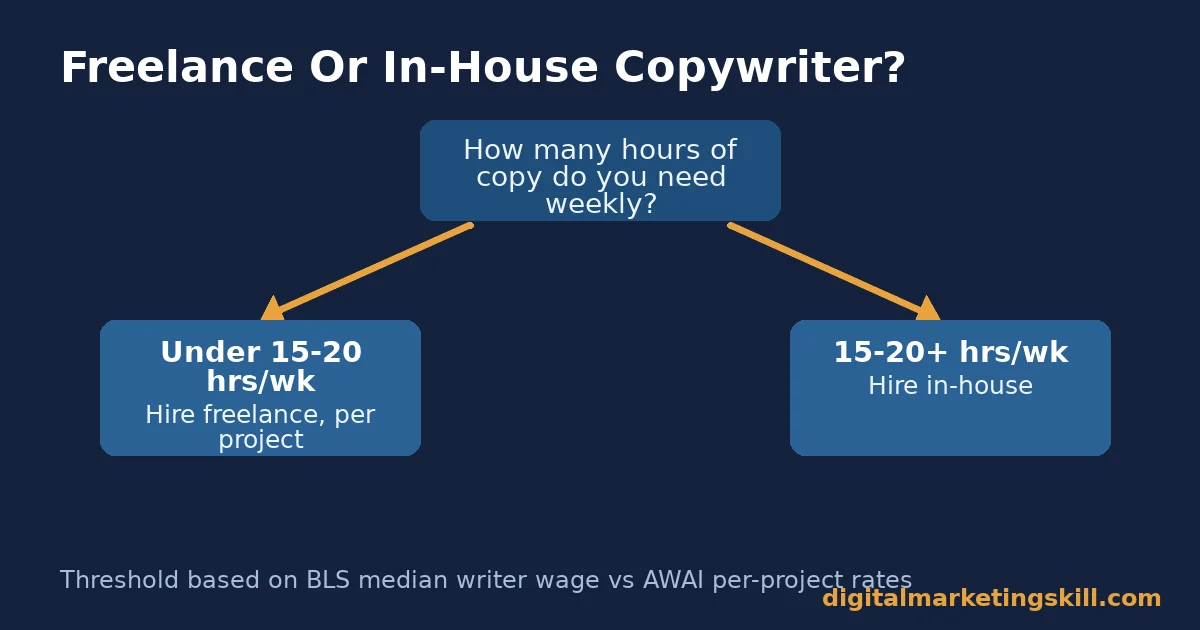
A business that constantly needs new product pages, ad copy, and email sequences usually gets more value from an in-house hire, even at a full-time cost. The US Bureau of Labor Statistics median of $76,910 a year for writers and authors works out to roughly $37 an hour. Once a business needs more than about 15-20 hours of copy a week, that in-house rate usually undercuts stacking multiple freelance projects at AWAI’s published per-project rates.
There is a third option many small teams miss: training an existing marketing hire in copywriting fundamentals, rather than hiring a specialist from scratch. Because small and medium enterprises make up more than 90% of the world’s business population, most businesses reading this guide are exactly the size where one trained generalist, who can write adequate copy alongside other marketing tasks, is more practical than a dedicated specialist on staff.
A Real Case: Rewriting Old Copy Instead Of Writing New Copy
HubSpot’s own blog has published what happened when its team stopped only publishing new posts, and started rewriting old ones instead. The company reports that posts published before a given month drove 76% of that month’s blog views, and 92% of its blog leads. It also reports that updating older posts increased their monthly organic search views by an average of 106%.
The limits matter here. This is one company’s self-reported, internal data, not an independently audited study. HubSpot also has unusual scale and an established content library that a smaller site will not match. Even so, the directional lesson still holds for most writers: the copy you already have is often a bigger lever than the copy you have not written yet.
The underlying reason is simple. An old page already has backlinks, an indexed URL, and some existing search visibility. A brand-new page starts with none of that. Sharper copy on a page search engines already trust tends to convert faster than the same sharp copy on a page nobody has found yet. That is one reason experienced copywriters audit old pages before they draft anything new.
Frequently Asked Questions About Copywriting
What is the difference between copywriting and content writing?
Copywriting is written to drive one specific action, such as a purchase or a signup. Content writing is generally written to inform, educate, or entertain, without a single transactional goal attached to every piece.
Do I need a degree to become a copywriter?
No formal degree is required. Most working copywriters build credibility through a portfolio of real or sample projects, demonstrated results, and practical knowledge of persuasion techniques and the specific industry they write for.
How much can a copywriter charge per project?
Published pricing guides show wide ranges by format and experience. AWAI’s own guide lists sales pages from $450 to $10,000, single sales emails from $250 to $2,000, and short SEO page optimization from $100 to $400 per page.
What skills does a copywriter need besides writing?
A copywriter needs working knowledge of the target audience. They also need basic SEO writing skill. Finally, they need the ability to structure a page so its strongest claim sits where readers actually look first.
Can copywriting be learned, or do you have to be a natural writer?
Copywriting is a learnable, practice-based skill. It relies on applying frameworks like AIDA, studying how readers scan pages, and testing which specific claims and calls to action perform better. It does not rely on innate talent alone.
Is copywriting still relevant now that AI writing tools exist?
AI tools can draft copy quickly. But someone still has to judge whether a draft fits the audience. Someone still has to verify every claim and figure in it. Someone still has to decide which single action the piece should drive. That strategic and verification work has not gone away, even as the first-draft work gets faster.
How do I start a copywriting business or freelance career?
Most people start by writing a small portfolio of sample projects, then pitch that portfolio to a handful of businesses directly. Our guide to starting a copywriting business walks through pricing, finding first clients, and building a simple contract.
What tools do copywriters use to check their writing?
Most copywriters run a draft through a grammar and spelling checker before anyone else reads it. This step catches small errors that would otherwise undercut an otherwise strong pitch. Beyond spelling and grammar, a readability checker that flags long sentences and heavy passive voice helps catch the habits that make copy harder to scan. Reading a draft out loud is a free, low-tech version of the same check, and it catches awkward phrasing that a software tool often misses.
Where To Go From Here
Copywriting works best as one skill inside a complete marketing toolkit, not a skill learned in isolation. If you want to build it alongside email marketing, SEO, and paid advertising, the Master Diploma in Digital & AI Marketing at Digital Marketing Skill Institute runs four AI-powered tracks. They are AI-Powered Social Media Management and Advertising, AI-Powered Lead Generation and Email Automation, AI-Powered Google Specialist, and AI-Powered WordPress and SEO Specialist. All four are built from ten courses in total, with a Full Stack option for completing every track.
Every track includes unlimited 1-on-1 coaching and mentoring, a U.S. Project Internship with a verified U.S. Work Reference Letter, and dual US and UK accreditation recognised in more than 100 countries. The whole program runs 100% online, so you can study from anywhere in your country.
Browse the full program on the Master Diploma page, read real outcomes on the reviews page, or explore more guides on the digital marketing blog. Strong copywriting skill travels with you wherever you live, so whenever you are ready, you can apply here from anywhere via digitalmarketingskill.com.
Every figure in this guide was checked against its original source before publication. Figures marked as illustrative are invented examples, not real results.
![9 Amazing Digital Marketing Skills to Make Money Online [With Proof]](https://digitalmarketingskill.com/wp-content/uploads/2019/07/9-Amazing-Digital-Marketing-Skills-to-Make-Money-Online-With-Proof-17.png)






