
Stories are short, full-screen photo and video posts on apps such as Instagram and Facebook that disappear after 24 hours. Viewers tap through them one frame at a time, at the top of the app rather than in the main feed. They matter because they let brands post quick, informal updates every day without crowding their profile grid.
Key Takeaways
- On Instagram, a story disappears from Feed, your profile and Direct after 24 hours, unless you add it to a highlight.
- Highlights keep chosen stories on your profile after they expire.
- The format is vertical, full screen and quick to tap through.
- Key numbers include reach, replies and navigation, such as taps forward, taps back and exits.
- Story insights through Instagram’s API last only 24 hours, so you need to save them in time.
- Paid partnerships in a story still need a clear disclosure on the screen.
What Are Stories?
Think of a story as a quick message to your followers rather than a permanent post. You add one or more photos or short videos. Then viewers see them in a row of circles at the top of the app and tap through each frame.
Instagram’s Help Centre explains that a story will “disappear from Feed, your profile and Direct after 24 hours, unless you add it as a highlight.” Because they don’t last, people tend to post them more often and with less polish than a feed post.
For example, a café might post its daily special, a behind-the-scenes clip and a poll about new flavours, all in one morning. None of that clutters its main grid. As a result, its feed stays tidy while followers still get fresh updates.
How Stories Work
Each one moves through the same short life cycle. First, you post it. Next, followers view it and react. Finally, it expires, unless you save it to a highlight.
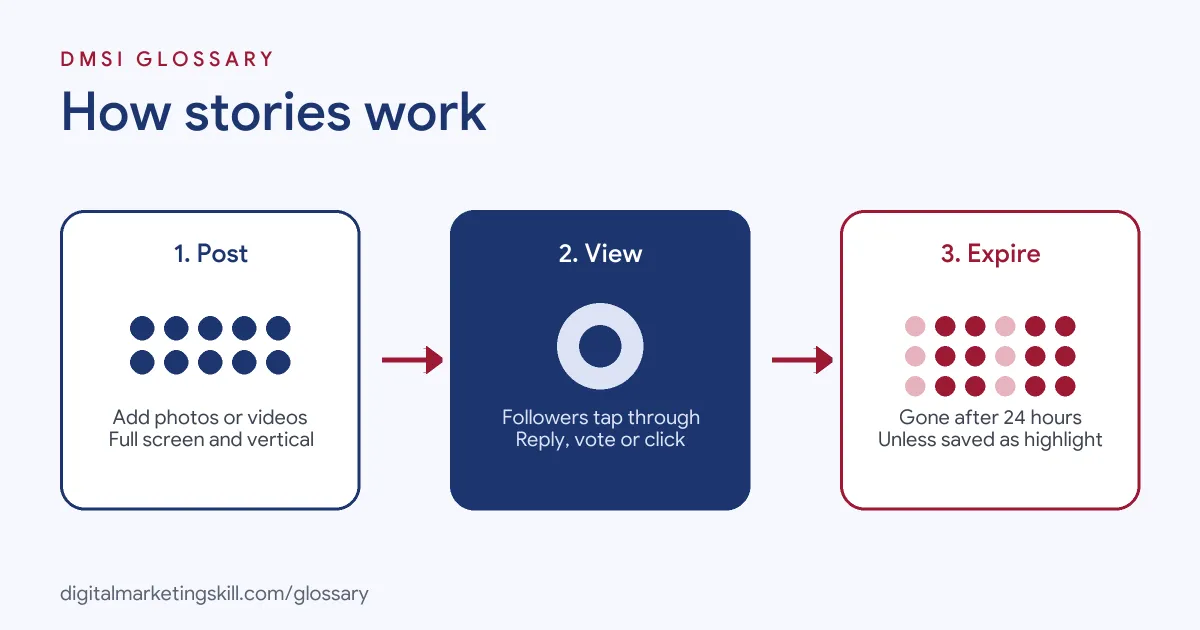
The 24-Hour Window
The time limit shapes how people use the format. Followers know a story won’t stay up, so they check often. Brands use that habit for time-sensitive posts, such as a flash sale, a live event or a quick question.
Highlights
Instagram says you “can add stories to appear on your profile as highlights, even after they disappear.” Highlights sit below your bio. Many brands use them as a mini menu, with sets such as FAQs, reviews, products or how-to guides.
How Viewers Move Through Stories
Viewers tap to move forward, tap to go back, swipe to the next account or leave. Instagram’s developer documentation tracks these as navigation actions. “Forward”, “Back”, “Exit” and “Next Story” are all part of the navigation metric. So you can see where people lost interest.
Stories as an Ad Placement
The format is not only organic. On Meta’s apps, you can also choose the stories placement for paid social campaigns. Your ad then appears between the stories people are already watching. Because the ad fills the screen, it should look native to the format, with vertical video and a clear action. Otherwise, viewers simply tap past it. A good habit is to test what works organically first. Then you can turn your strongest frames into ads with a budget behind them.
Stories Examples
Here are three made-up examples of how a business might use the format:
- Clothing shop (example): It posts three frames of a new jacket, then adds a link to the product page. Later, it saves the set to a “New In” highlight.
- Fitness coach (example): She runs a poll asking followers which workout they want next. Then she films that workout the following day.
- Online course (example): A training school shares a student’s question and answers it in a short video. After that, it adds the clip to an FAQ highlight.
In each case, the content is quick, useful and personal. That is what the format rewards.
Stories vs Feed Posts vs Reels
These three formats often appear side by side, so here is a quick comparison:
| Format | How long it lasts | Best for |
|---|---|---|
| Story | 24 hours, unless saved to a highlight | Daily updates, polls, offers and behind the scenes |
| Feed post | Stays on your profile | Lasting content that sums up your brand |
| Reel | Stays on your profile | Short videos made to reach new people |
In short, a story talks to people who already follow you. Feed posts and Reels do more to build a lasting profile and reach new viewers.
How to Plan Stories for a Brand
A simple routine works better than random posting:
- Set a goal. For instance, drive clicks to a product, collect replies or answer common questions.
- Plan a short sequence. Three to five frames that tell one clear idea usually work better than one long ramble.
- Hook in the first frame. Show the point straight away, because viewers tap fast.
- Add one action. Use a poll, a question box or a link, not all three at once.
- Post at a regular time. Add it to your content calendar, so followers know when to look.
- Save the best. Move strong sets into a highlight before they expire.
- Record the results. Note reach, replies and exits within a day.
How to Measure Stories
Instagram’s API gives several story metrics. Reach shows how many unique accounts saw it. Replies count the messages people sent back, although the documentation notes that for stories made by users in Europe and Japan, the replies metric returns 0. Navigation shows taps forward, taps back, exits and swipes to the next story.
Timing matters here. The documentation states that “story media metrics are only available for 24 hours.” However, you “may receive data after the story expires if the story is added to a highlight.” So if you report through the API, collect the numbers before they vanish.
A high exit count on one frame usually means that frame was weak. By contrast, many taps back suggest people wanted to see it again.
Best Practices
- Design for sound off. Add short captions, so your message still works when the sound is off.
- Keep text away from the edges. App buttons and profile details sit at the top and bottom of the screen.
- Show real people. Faces and voices make the format feel personal.
- Disclose paid posts clearly. The US Federal Trade Commission advises creators to “superimpose the disclosure over the picture and make sure viewers have enough time to notice and read it.”
- Watch your engagement rate. Compare replies and link taps against reach, not just views.
Common Mistakes to Avoid
Many beginners post too many frames at once, so viewers exit halfway. Others reuse feed graphics that don’t fit a vertical screen. Some forget to add an action, so people watch and then leave. Another common error is waiting too long to check results, after the data has already expired. Finally, some brands never use highlights, which wastes their best content.
Where You’ll Use Stories at Work
This format is a daily task in many social media roles. For example, one real remote job listing asks candidates to:
- “Capture and edit short-form video, Reels, Stories, and other social-first content” (Social Media & Partnerships Coordinator).
- Be “Social-savvy: You understand Instagram, TikTok, Reels, Stories, and emerging content trends” (Social Media & Partnerships Coordinator).
So if you want to work as a Social Media Manager or Content Creator, employers will expect you to plan, film, post and report on this format. They will also want examples you have made, ideally with numbers.
Learn It in the Social Media Track
You can learn to plan and create short-form content in the AI-Powered Social Media Management and Advertising track. It covers content creation for graphics and video, social media marketing and analytics, and social media advertising. Your portfolio project is a paid social campaign you plan, create and run for a real brand. You also get unlimited 1-on-1 mentoring and a U.S. Project Internship from day one.
For more ideas, read our guide to Instagram Stories formats and our Instagram marketing strategy guide.
Frequently Asked Questions
How long do stories last on Instagram?
They disappear from Feed, your profile and Direct after 24 hours. However, you can keep them on your profile by adding them to a highlight.
What is a story highlight?
It is a saved set that sits on your profile below your bio. It stays there after the original posts expire, so new visitors can still see them.
Which metrics matter most?
Start with reach, replies, link taps and exits. Exits show where people lost interest, while replies show real engagement.
Do sponsored stories need a disclosure?
Yes. The FTC advises putting the disclosure over the image and giving viewers enough time to read it. Other countries have similar advertising rules.
Are stories good for small businesses?
They can be. The format is quick to make, it suits daily updates, and it lets you talk directly with people who already follow you.
Sources: Instagram Help Centre: How long stories remain visible; Instagram Help Centre: Story highlights; Meta for Developers: Instagram media insights; FTC: Disclosures 101 for Social Media Influencers; remote job listing on Himalayas.