
A retainer is an agreement where a client pays an agency or freelancer a fixed fee at regular intervals, usually monthly, in return for ongoing work or access to their time. Unlike a one-off project, it has no single end deliverable and simply renews each period. For marketers, a retainer turns one-off jobs into steady, predictable income and a longer client relationship.
Key Takeaways
- It is a recurring, prepaid deal, not a one-off project contract.
- The client pays a fixed fee monthly, quarterly or yearly for agreed services or a block of time.
- Common types are hours-based, deliverable-based, access-based and capacity-based.
- A clear scope, with what is included and what isn’t, protects both sides from scope creep.
- Being on retainer is a commercial agreement, not employment.
What Is a Retainer?
Rocketlane, which makes software for service teams, defines a retainer as “a prepaid agreement in which a client pays a fixed fee, monthly, quarterly, or annually, in exchange for ongoing access to a service provider’s time, capacity, or expertise.” In other words, the client books your availability ahead of time.
The word comes from legal practice, where clients would “retain” a lawyer so they were always available. Marketing agencies borrowed the idea. Today, the deal might cover monthly social media management, ongoing SEO work or a set number of design hours.
The key difference is time. A project contract ends when you hand over the work. By contrast, this kind of deal renews, the bill resets and the work carries on.
How a Retainer Works
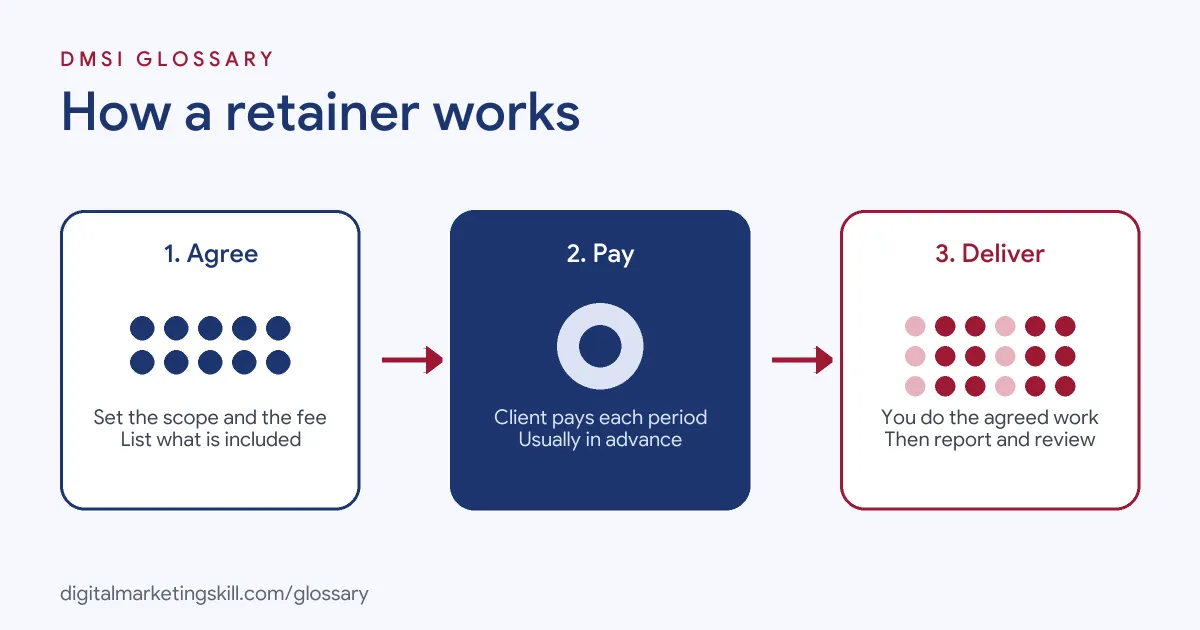
Each one follows the same basic cycle. First, you and the client agree what the fee covers. Next, the client pays at the start of each period. Then you deliver the work, report on it and review the scope before the next period begins.
The Retainer Scope
The scope sets out what the fee buys. Nusii, a proposal software company, advises listing concrete deliverables, a timeline and, just as importantly, exclusions. It says naming what is not included “helps manage expectations and avoids potential misunderstandings down the line.” It also suggests stating how many rounds of revisions the client gets.
Billing and Hours
Most retainers bill in advance, so the client pays before the work starts. With an hours-based retainer, the client buys a fixed number of hours each month. According to Rocketlane, unused hours then either roll over or are lost, depending on the agreement. So you need to agree this rule up front and track hours carefully.
Renewal and Review
Because the deal renews, the scope talk starts again each period. That’s why many agencies hold a short monthly or quarterly review. There, you show results, check whether the scope still fits and agree any changes before the next invoice.
Retainer Examples
Here are three made-up examples for marketers:
- Social media retainer: A café pays a freelancer a fixed monthly fee for 12 posts, community replies and a short report.
- SEO retainer: A law firm pays an agency each month for technical fixes, two blog posts and a ranking report.
- Hours-based retainer: A start-up buys 20 hours of paid ads support per month, used for whatever campaigns need attention.
In each case, the client knows the monthly cost, and the provider knows the monthly income.
Types of Retainer Agreements
Rocketlane groups retainer agreements into four main types:
| Type | How it works | Often used for |
|---|---|---|
| Hours-based | The client buys a fixed number of hours each month | Agencies and consultants with changing work |
| Advisory or access | The client pays for a named expert’s availability | Senior consulting and advisory roles |
| Deliverable-based | A monthly fee tied to set outputs, such as four reports | Content agencies and recurring work |
| Capacity or subscription | A fixed fee for a dedicated block of team time | Managed services and embedded teams |
Bonsai, a business software company, also describes performance-based retainers, where fees link to hitting agreed targets. However, that model needs very clear measures, so both sides agree on what counts as success.
Retainer vs Project Fee
Agencies often choose between the two. A project fee suits a clear, one-time job, such as building a website. A monthly deal suits ongoing work, such as content or ad management. Many agencies start with a project, then offer ongoing support once the client trusts them.
A Worked Example With Numbers
Here is a made-up example. Say you sell a client 20 hours of ad support a month for a fixed fee. In the first month, you use 16 hours. If your agreement says hours roll over, the client starts the next month with 24 hours. If it says they don’t, the client still pays the same fee, but the 4 hours are gone.
Now say the client asks for a new landing page in month two. That job would take 10 hours on its own. So you have a choice. You can use 10 of their 20 hours, which leaves less time for ads. Or you can quote it as extra work. Either way, you both know the rule because you wrote it down first.
How to Set Up a Retainer
- Understand the client’s goals. Ask about their targets, audience, budget and current marketing first.
- Choose the type. Decide whether the retainer covers hours, deliverables or access.
- Write the scope. List deliverables, exclusions, revision rounds and response times.
- Set the fee and terms. Agree the billing period, payment date and what happens to unused hours.
- Agree the reporting. Decide which results you will share and how often.
- Add a notice period. State how either side can end or change the retainer.
- Get it signed. Finally, put everything in a written agreement before work starts.
What to Include in a Retainer Agreement
A short, clear agreement saves you from most problems. At a minimum, include:
- The services and deliverables, with numbers where you can.
- What is not included, so there are no surprises.
- The fee, the billing date and when payment is due.
- The rule for unused hours.
- How many revision rounds the client gets.
- How you will report results, and how often.
- The notice period to end or change the deal.
Best Practices
- Track your time. Even when you bill for outputs, hours show whether the fee still covers the work.
- Report on results, not just tasks. For example, show leads or sales, not only the number of posts.
- Handle extra requests in writing. If a request falls outside scope, quote it as extra work.
- Review the scope often. As a result, the deal keeps matching what the client needs.
- Keep a simple log. For instance, a shared sheet of tasks and hours stops most arguments before they start.
Common Mistakes
The biggest mistake is a vague scope, such as “help with social media.” That invites endless requests for the same fee. Another error is not deciding what happens to unused hours, which causes awkward conversations later. Some freelancers also set the fee too low to win the client, then struggle to raise it. Finally, many forget that this is not a job. Rocketlane notes that a contractor on retainer has no employment relationship with the client, so check the rules where you work.
Where You’ll Use Retainers at Work
Retainers come up in agency, freelance and sales roles. For example, real job listings include lines such as:
- “Familiar with agency economics: retainers, project fees, margin requirements” (Agency Partnerships Lead).
- “experience selling recurring retainers” (E-commerce Sales Closer).
- “Support retainer planning, budget forecasting and funding conversations with business partners” (Account Supervisor).
So whether you become a Freelance Digital Marketer, an Agency Owner or a Digital Marketing Manager, you will need to scope, price and manage these deals. Clients will also expect clear reports that justify each renewal.
Learn It in the Full Stack Programme
The Full Stack (all four tracks) programme covers all ten courses, with one portfolio project from each track. That gives you a range of skills you could sell each month, from paid social to SEO. You also get unlimited 1-on-1 mentoring and a U.S. Project Internship from day one.
Thinking of starting your own business? Read our guide on how to start a digital marketing agency, or compare social media manager rates before you price a retainer.
Frequently Asked Questions
What is a retainer in marketing?
It is a repeat deal where a client pays an agency or freelancer a fixed fee, often each month, for ongoing work or their time.
How is a retainer different from a project fee?
A project fee pays for one set job that ends. The other renews each period and covers ongoing work.
What happens to unused retainer hours?
It depends on your agreement. Unused hours either roll over to the next month or are lost, so agree the rule before you start.
Should a beginner offer a retainer?
Yes, once you can deliver steady results. Many freelancers start with a small project, then suggest a retainer to keep the work going.
Is a retainer the same as being employed?
No. It is a business deal for your time or services. It does not make you the client’s employee.
Sources: Rocketlane: What is a retainer?; Bonsai: Agency retainer pricing, benefits and drawbacks; Nusii: How to write a marketing proposal; remote job listings on Himalayas.