
A brand voice is the consistent personality a brand uses in its words, from social posts to emails and product pages. It covers how the brand sounds, which words it picks and what it never says. With AI tools, a clear brand voice matters even more, because it is how you stop machine-written copy from sounding generic.
Key Takeaways
- Your voice stays the same everywhere. Tone changes with the situation, such as a launch post versus an apology.
- A good voice guide lists traits, words to use and avoid, and real examples of good and bad copy.
- Nielsen Norman Group describes tone on four scales, such as formal vs casual and serious vs funny.
- AI tools follow a brand voice best when you give them a role, clear rules and a few sample texts.
- Anthropic’s prompting guide suggests including three to five examples for the best results.
What Is Brand Voice?
Think of it as the way a brand would talk if it were a person. Some brands sound warm and chatty. Others sound expert and calm. Either way, the reader should recognise the brand even without the logo.
Voice is often confused with tone. Mailchimp’s content style guide explains the difference neatly: “You have the same voice all the time, but your tone changes.” It adds that “our voice doesn’t change much from day to day, but our tone changes all the time.” For example, the same brand might sound playful on Instagram but more serious in a refund email.
Mailchimp then describes its own voice in short traits: “We are plainspoken,” “We are genuine,” “We are translators” and “Our humor is dry.” In other words, you can sum up a voice in a few clear statements. Then any writer, or any AI tool, can follow them.
Your voice also sits inside your wider brand identity, alongside the logo, colours and visual style.
How Brand Voice Works
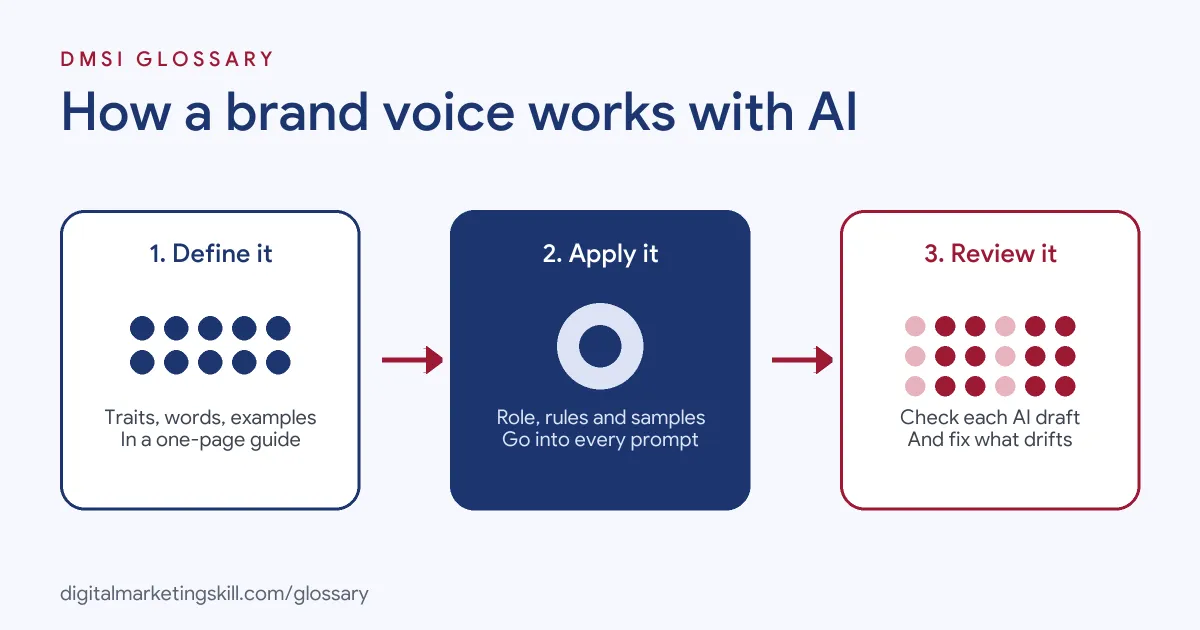
The process works in three stages. First, you define it in a short guide. Next, you apply it to every piece of copy, whether a person or an AI writes it. Finally, you review the output against the guide and fix what drifts.
The Four Tone Dimensions
Nielsen Norman Group, a user experience research firm, breaks tone into four scales:
- Formal vs casual
- Serious vs funny
- Respectful vs irreverent
- Matter-of-fact vs enthusiastic
Each one is a spectrum, so your copy can sit anywhere between the two ends. As a result, you can describe your voice precisely. For instance, “casual, mostly serious, respectful and a little enthusiastic” is far more useful than “friendly”.
Brand Voice in AI Tools
AI writing tools don’t know your brand by default. Instead, they copy the patterns in your prompt. Anthropic’s prompting guide says that setting a role in the system prompt “focuses Claude’s behavior and tone for your use case,” and that “even a single sentence makes a difference.”
Examples matter even more. The same guide calls examples “one of the most reliable ways to steer Claude’s output format, tone, and structure.” It also advises: “Include 3–5 examples for best results.” So a short voice guide plus a few real posts will usually beat a long list of adjectives.
There is one more effect. According to the guide, the style of your prompt can shape the style of the answer. Therefore, if you write your prompt in your brand voice, the output is more likely to match it.
Brand Voice Examples
Here are three made-up examples of the same message in different voices. The message is: “Our summer sale ends tonight.”
- Example 1, playful fashion brand: “Last call, sunshine. The sale packs its bags at midnight.”
- Example 2, calm finance app: “A reminder: sale prices end at midnight tonight. After that, standard prices apply.”
- Example 3, expert training school: “Tonight is the final day to join at the sale price. Here’s what’s included.”
All three say the same thing. However, each one sounds like a different company, and that difference is voice at work.
Brand Voice vs Tone vs Style Guide
People often mix up these three terms. Here is how they differ:
| Term | What it covers | How often it changes |
|---|---|---|
| Brand voice | The brand’s lasting personality in words | Rarely; it stays the same across channels |
| Tone | The mood of one message, set by the situation | Often; it shifts for launches, apologies or support replies |
| Style guide | Rules for grammar, spelling, formatting and word choice | When the team agrees on new rules |
In short, the voice is who you are, the tone is how you feel in the moment, and the style guide is the rulebook.
How to Create a Brand Voice for AI Content
- Collect your best copy. Gather posts, emails and pages that performed well and felt “right”.
- Pick three to four traits. Write each one as a short statement, like Mailchimp’s “We are plainspoken.”
- Place yourself on the four tone scales. Decide where you sit between formal and casual, serious and funny, and so on.
- List words to use and avoid. For example, a brand might say “learn” but never “hack”.
- Write do and don’t examples. Show one good line and one bad line for each trait.
- Turn it into a prompt. Give the AI a role, paste the traits and rules, then add three to five sample texts.
- Review and refine. Check each draft against the guide. Then add new examples whenever the AI drifts.
A Sample Voice Prompt
Here is a made-up example of how a short guide becomes a prompt for an AI tool:
- Role: “You are the social media writer for a plant shop that helps beginners keep houseplants alive.”
- Traits: “Warm, plainspoken and lightly funny. Never preachy.”
- Rules: “Use short sentences. Say ‘plant parent’, never ‘customer’. No more than one exclamation mark per post.”
- Examples: three to five past posts that the team liked, each wrapped in its own example tags.
- Task: “Write three Instagram captions about watering in winter.”
Notice that the prompt itself is short and plain. That way, the model copies the style it sees.
Best Practices for Brand Voice
- Keep the guide short. People actually use a one-page guide. A long document often sits unread.
- Show, don’t just tell. Real examples teach people and AI tools faster than adjectives.
- Vary your examples. Anthropic’s guide says examples should be diverse enough that the model doesn’t copy unintended patterns.
- Plan tone shifts. Note how the voice sounds in good news, bad news and customer support.
- Edit every AI draft. A human should always check facts, claims and fit with the brand before anything goes live.
Common Mistakes to Avoid
The most common mistake is a vague guide, such as “friendly, professional and fun”. Those words mean different things to every writer. Another is changing voice on each channel, so the brand feels like several companies. Some teams also paste their voice guide into an AI tool once, then never check the results. Finally, many guides have no examples at all. Without them, both people and AI tools end up guessing.
Where You’ll Use Brand Voice at Work
This skill comes up in almost every content role. For example, remote job listings ask candidates to:
- Own “Brand Voice and Community Engagement Across Channels: writes copy in each brand’s voice, defines tone and engagement standards” (Social Media Specialist).
- “take ownership of maintaining a clear, honest, reassuring, and knowledgeable brand voice” (Senior Copywriter).
- Stay “aligned with an established creative vision and brand voice” (Scriptwriter, Commercials and Social Video).
So if you want to work as a Social Media Manager or Content Creator, you’ll need to write in a client’s voice and guide AI tools to do the same.
Learn It in the Social Media Track
You can practise brand voice with AI in the AI-Powered Social Media Management and Advertising track. It covers AI fundamentals and content creation, and you plan, create and run a paid social campaign for a real brand. You also get unlimited 1-on-1 mentoring and a U.S. Project Internship from day one.
For more ideas, read our guide to brand storytelling and our round-up of AI writing tools.
Frequently Asked Questions
What is brand voice in simple terms?
It is the personality a brand shows through its words. It should sound the same across every channel, even when the mood of a message changes.
What is the difference between brand voice and tone?
Voice is the lasting personality. Tone is the mood of a single message, which shifts with the situation.
How do I get AI to write in my brand voice?
Give the tool a role, your voice traits and words to avoid. Then add three to five real examples, and edit every draft.
How many traits should a voice guide have?
Most guides use a small set. Mailchimp, for instance, describes its voice in four short statements.
Can a brand voice change?
Yes, but it should change rarely and on purpose, for example after a rebrand. Day-to-day changes belong to tone, not voice.
Sources: Mailchimp Content Style Guide: Voice and tone; Nielsen Norman Group: The four dimensions of tone of voice; Anthropic: Prompting best practices; remote job listings on Himalayas.