
Market research is the process of gathering and analysing information about customers, competitors and demand, so you can make better business and marketing decisions. It combines existing data, such as industry reports, with direct research, such as surveys and interviews. It matters because it replaces guesswork with evidence before you spend money on a product, price or campaign.
Key Takeaways
- The U.S. Small Business Administration says it “blends consumer behavior and economic trends to confirm and improve your business idea.”
- There are two main routes: existing sources, which save time, and direct research, which gives detail about your own audience.
- Direct methods include surveys, questionnaires, focus groups and in-depth interviews.
- Free tools such as Google Trends show relative search interest, but they are not polls.
- The UK’s Market Research Society (MRS) publishes a Code of Conduct that sets out the standards research practitioners must maintain.
What Is Market Research?
In one line, the SBA defines it like this: “Market research blends consumer behavior and economic trends to confirm and improve your business idea.” In other words, it checks whether people want what you plan to sell, and how you should sell it.
The SBA suggests a set of questions to answer. For example, it asks about demand: “Is there a desire for your product or service?” It also asks about market size, income and employment levels, location, how many similar options exist, and what customers pay for those alternatives.
This work is wider than studying rivals. A competitor analysis is one part of it. The rest focuses on customers, their needs and the size of the opportunity.
How Market Research Works
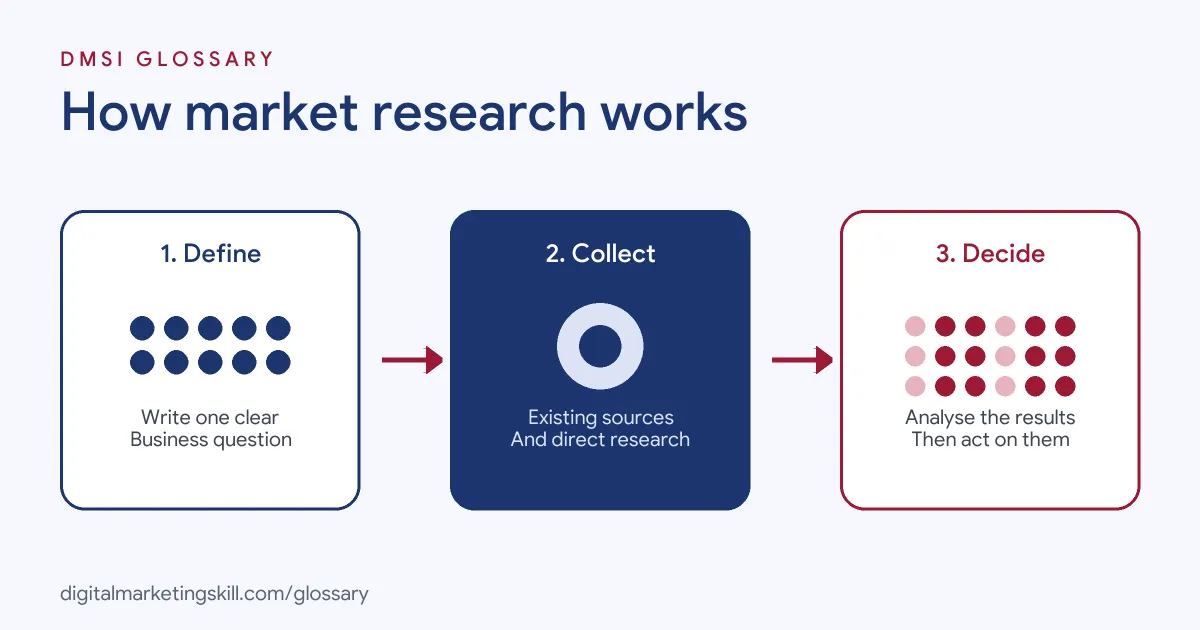
Most projects follow three steps. First, you define the question you need to answer. Next, you collect data from existing sources, direct research or both. Finally, you analyse the results and turn them into a decision.
Existing Sources
Existing sources are data someone else has already collected. The SBA says they “can save you a lot of time and energy,” but the information “might not be as specific to your audience” as you would like. So use them for questions that are “both general and quantifiable, like industry trends, demographics, and household incomes.”
Marketers often call this secondary research. Examples include government statistics, industry reports and search data.
Direct Research
Direct research means asking people yourself. According to the SBA, it “can give you a nuanced understanding of your specific target audience.” However, it “can be time consuming and expensive.” That is why the SBA suggests saving it for questions about your own business, such as reactions to your logo or where customers might go instead.
The SBA lists four direct methods: surveys, questionnaires, focus groups and in-depth interviews. Marketers usually call this primary research.
Search Data
Search data is a quick way to see what people care about. Google Trends, for instance, scales interest “on a range of 0 to 100 based on a topic’s proportion to all searches on all topics.” It uses a sample of searches, which Google says is enough because it handles billions each day. Even so, Google warns that Trends “is not a scientific poll and shouldn’t be confused with polling data.”
Market Research Examples
Here are three made-up examples of research in action:
- New product: A pet food brand checks Google Trends for interest in grain-free food across regions. Then it runs a short survey with existing customers to test flavours.
- Pricing: A software start-up reviews what five alternatives charge. After that, it interviews ten target users to learn which features they would pay more for.
- Campaign planning: A training provider holds a focus group with recent graduates. As a result, it rewrites its ads around the career worries they raised most often.
In each case, the business starts with a question and uses the cheapest method that can answer it.
Primary vs Secondary Market Research
This table compares the two main routes, based on the SBA’s guidance:
| Type | Examples | Strength | Weakness |
|---|---|---|---|
| Secondary (existing sources) | Industry trends, demographics, household incomes, search data | Saves time and energy | May not be specific to your audience |
| Primary (direct research) | Surveys, questionnaires, focus groups, in-depth interviews | Nuanced view of your target audience | Can be time consuming and expensive |
Most good projects use both. Start with existing sources to frame the market, then use direct research to fill the gaps.
How to Do Market Research
Follow these steps for a simple, practical project:
- Write one clear question. For example, “Will local parents pay for weekend coding classes?”
- Define the audience. Describe who you need to hear from, such as age, location and needs.
- Check existing sources first. Look at public statistics, industry reports and Google Trends.
- Choose a direct method. Use a survey for numbers, or interviews for reasons and feelings.
- Collect responses fairly. Ask neutral questions and explain how you will use people’s answers.
- Analyse the results. Look for patterns, and note where the data is thin.
- Decide and act. Finally, turn the findings into one or two clear marketing decisions.
How to Write a Simple Survey
A survey is often the first direct method people try. Keep it short, so more people finish it. Five to ten questions is a good aim for a quick check.
- Ask one thing at a time. “Is our app fast and easy?” mixes two ideas. Split it into two questions.
- Use plain words. Write the way your customers talk, not the way your team talks.
- Offer clear choices. Give answer options that do not overlap, such as age bands.
- Add one open question. For example, “What nearly stopped you from buying?” often gives the most useful answers.
- Test it first. Ask two or three people to try it, then fix any question that confuses them.
Here is a made-up example. A small gym wants to know why members leave. So it sends six short questions to people who cancelled, with one open question at the end. The open answers show that most leavers wanted earlier classes. As a result, the gym adds a 6am class and tracks whether fewer people cancel.
Best Practices for Market Research
- Ask neutral questions. “How do you choose a gym?” gives better answers than “Would you love our gym?”
- Talk to real buyers. Friends and family tend to be too kind.
- Combine numbers and stories. Surveys show how many, while interviews show why.
- Turn findings into personas. Use the results to build a clear buyer persona for your team.
- Follow professional standards. The MRS Code of Conduct sets out the professional standards that research practitioners must maintain.
Common Market Research Mistakes
A few habits make research less useful. First, people start collecting data without a clear question. Second, they ask leading questions that push people towards the answer they want. Third, they treat search interest as proof of demand, even though Google Trends is not a poll. Finally, they finish the research but never change anything. A short study that leads to one decision beats a long report that sits in a folder.
Where You’ll Use Market Research at Work
Research skills appear across marketing and business roles. For example, recent remote job listings ask candidates to:
- “Conduct market research to understand competitors and market trends, making data-driven recommendations” (Sales Representative for a Marketing Company).
- “Conduct and leverage market research to generate insights that create value for clients and support business growth” (Business Development Manager).
- Plan campaigns “based on market research, consumer insights, and local business requirements” (Group Marketing Manager).
So whether you aim to be a Digital Marketing Manager, Growth Marketer or Agency Owner, you will use research to choose audiences, offers and channels.
Learn It in the Full Stack Programme
You can practise these research skills across every channel in the Full Stack programme, which covers all four tracks and all ten courses. Along the way, you complete one portfolio project from each track, so your research shapes real work. You also join a U.S. Project Internship from day one, with unlimited 1-on-1 mentoring.
To turn research into a clear picture of your buyer, read our guide to building a customer avatar.
Frequently Asked Questions
What is market research in simple terms?
It is gathering and studying information about customers, competitors and demand. You use it to make better decisions about products, prices and marketing.
What are the two main types of market research?
Secondary research uses existing sources, such as reports and statistics. Primary research means collecting data yourself, through surveys, focus groups or interviews.
Is Google Trends a good research tool?
It is a useful free starting point for comparing interest in topics. However, Google says it is not a scientific poll, so pair it with other evidence.
How much research does a small business need?
Enough to answer the decision in front of you. Start with free existing sources, then add a small survey or a few interviews where you need detail.
What methods are used in direct research?
The SBA lists surveys, questionnaires, focus groups and in-depth interviews as methods for direct research.
Sources: U.S. Small Business Administration: Market research and competitive analysis; Google Trends Help: FAQ about Google Trends data; Market Research Society: Code of Conduct; remote job listings on Himalayas.