A customer avatar is a detailed picture of one real buyer, not a vague group. Build it from five parts: demographics, information sources, values and goals, pain points, and objections. Use it to write ad copy, emails and content for one person instead of everyone at once. Validate it against real data, and rebuild it when your actual customers drift from it.
Key Takeaways
- Vague targeting has a real cost. CB Insights analysed 431 VC-backed companies that shut down. Poor product-market fit was cited in 43% of failures, more than any other reason.
- Personas are not settled science. Marketing scientist Byron Sharp and the Ehrenberg-Bass Institute argue that real customer bases are far more varied than a single avatar suggests. Occasional buyers, not an “ideal” heavy user, usually drive growth.
- Message match moves conversion. Unbounce’s benchmark of 41,000 landing pages found a 6.6% median conversion rate, and pages built for one specific audience converted far above that median.
- Personas can move real revenue, in at least one documented case. Thomson Reuters reported a 175% increase in marketing-attributed revenue after building personas, per a compilation citing Demand Gen Report.
- One avatar beats five vague ones. A narrow, specific customer avatar is easier to write for, target and measure than a broad description that tries to fit everyone.
In this guide
- What Most Advice on a Customer Avatar Gets Wrong
- What a Customer Avatar Actually Is
- What a Customer Avatar Changes in Four Channels
- Common Mistakes That Undermine a Customer Avatar
- How to Build Your Customer Avatar, Step by Step
- How to Measure Whether Your Customer Avatar Is Working
- The One Decision Rule: Build One Avatar Before You Build Five
- A Real Case: Personas Tied to a Measurable Revenue Jump
- Frequently Asked Questions About a Customer Avatar
- Start With One Avatar, Then Test It
What Most Advice on a Customer Avatar Gets Wrong
Most guides treat a customer avatar as a fun exercise: name them, give them a stock photo, move on. That skips the real test. A customer avatar is only useful if it changes what you actually write and where you actually spend money.
This guide gives you the five-part worksheet. It shows how a customer avatar changes four specific channels. It also gives you a rule for how many avatars to build and when to rebuild one.
A few ground rules first. Not every marketing scientist agrees that personas work. Byron Sharp, of the Ehrenberg-Bass Institute, argues that real customer bases overlap heavily between competing brands and include far more variety than a single avatar captures. His research also points out that light, occasional buyers usually drive more growth than the “ideal” heavy user most avatars describe. Treat a customer avatar as a writing and targeting tool, not a scientific model of your whole market. Use it, but check it against real data often.
One more rule: a customer avatar still has to earn its place through results, not just through feeling thorough. If a detailed avatar does not change a headline, an ad angle or an email subject line, it was an exercise, not a tool.
What a Customer Avatar Actually Is
A customer avatar is one detailed, semi-fictional person built from real research. It is not the same as a full market segment. A segment describes a group. A customer avatar describes one person inside that group, in enough detail that you could write an email to them by name.
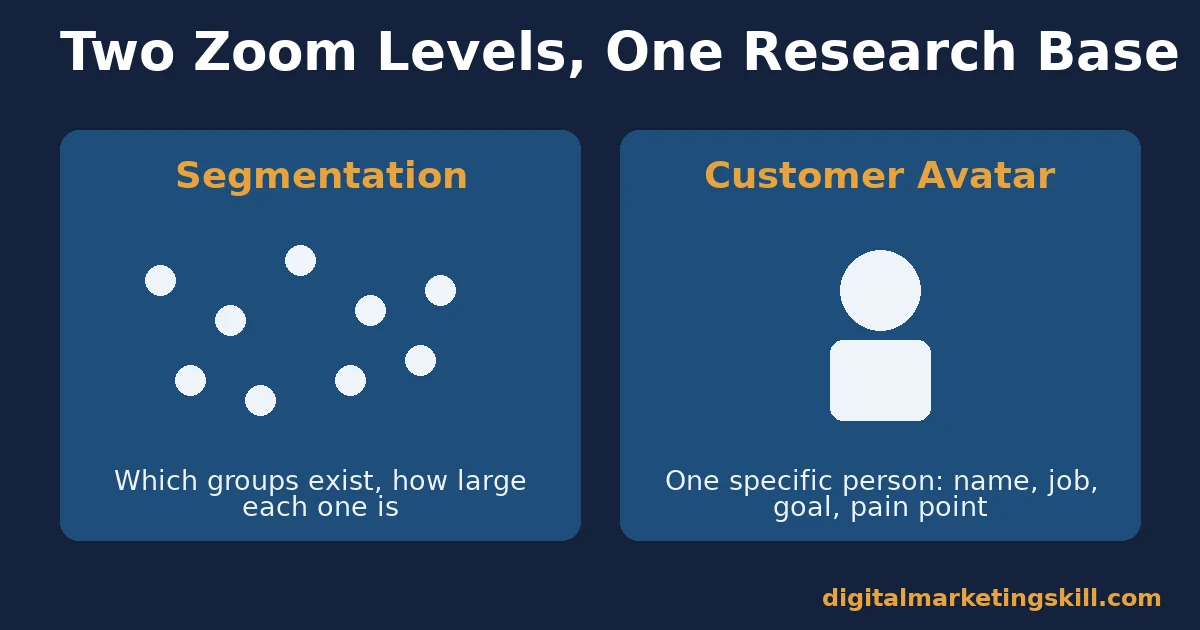
That distinction matters for how you use each tool. Our guide to target audience segmentation covers how to split a market into groups. A customer avatar picks one person from inside your most important group and makes that person vivid enough to write for.
Think of it as two different zoom levels on the same research. Segmentation answers which groups exist and how large each one is. A customer avatar zooms in on one of those groups. It keeps going until that group feels like a specific person, with a name, a job and a real frustration, rather than a slice of a pie chart.
What a Customer Avatar Is Not
A customer avatar is not a list of guesses. It is not every customer you have ever had, averaged together. It is not a demographic alone, such as “women aged 25 to 34.” Those are starting points, not a finished avatar.
A weak avatar has no pain points, no objections and no real quotes behind it. A strong one is built from actual customer conversations, reviews and support tickets, not assumptions made in a meeting room.
Vague targeting has a measurable cost, even outside marketing. CB Insights analysed 431 VC-backed companies that shut down and found poor product-market fit was cited in 43% of failures, more than any other reason. A weak, generic customer avatar is one quiet contributor to that same gap between what a business builds and who actually wants it.
What a Customer Avatar Changes in Four Channels
A clear customer avatar does not just sit in a document. It changes specific decisions in four channels. Each one answers a different question once you have a real person in mind.
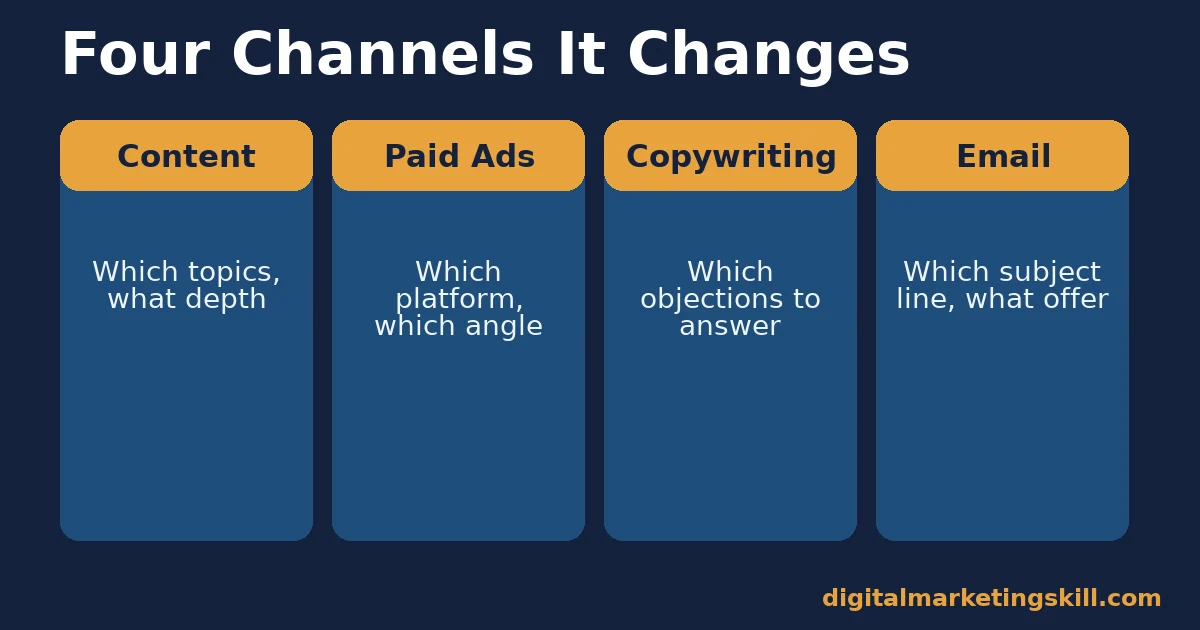
Content: Built to Answer One Person’s Real Question
Without a customer avatar, content tries to serve everyone and ends up serving no one well. With one, you can pick topics that answer your avatar’s actual pain points, in language they would use themselves.
This also shapes format. A busy executive avatar wants a short, scannable answer. A researcher avatar wants depth and sources. The same topic needs two different pieces of content for two different avatars. Our guide to content marketing strategy covers how to plan that content around a real buyer, rather than a topic list alone.
Paid Ads: Built to Target the Right Platform and Angle
A customer avatar tells you which platform your real buyer actually uses, and which angle will stop their scroll. Guessing at both wastes budget fast, especially on platforms charging for every click. Google Ads’ own documentation on audience segments shows how much targeting detail is available once you actually know who you are looking for.
It also sets the creative angle. An avatar driven by status buys on different triggers than one driven by saving time, even if both would eventually buy the same product.
Copywriting: Built to Speak to One Person’s Objections
Generic copy lists features. Copy written for a real customer avatar answers that person’s specific doubts, in their own words. That is why the fifth part of the worksheet, objections, matters as much as the first.
A strong landing page written for one avatar usually outperforms a broad one. Unbounce’s benchmark across 41,000 landing pages found a 6.6% median conversion rate. Pages matched closely to their traffic source converted well above that figure.
Email: Built to Earn the Next Open
A customer avatar changes subject lines, timing and the offer inside an email. Writing to one person, instead of a generic list, usually produces a sharper subject line and a clearer call to action.
It also changes sequencing. An avatar who is price-sensitive needs a different nurture sequence than one who is time-sensitive, even inside the same product line. None of this matters if the emails never arrive, so our guide to email deliverability covers the technical side that keeps avatar-driven emails out of spam folders.
Common Mistakes That Undermine a Customer Avatar
Most weak customer avatars fail for one of five reasons. Check a draft against this list before you trust it with real budget.
- Writing from your own preferences. A customer avatar should describe your buyer, not the person writing the document. It is easy to accidentally describe yourself.
- Making the avatar too perfect. A buyer with no objections and no real friction is not believable, and will not help you write copy that handles real hesitation.
- Stopping at demographics. Age and job title alone do not explain why someone buys. Skipping values, pain points and objections leaves the avatar shallow.
- Never testing it against results. A customer avatar that never gets checked against message match rate or conversion is a guess with better formatting.
- Building five avatars before validating one. Spreading research thin across too many avatars at once usually means none of them are detailed enough to be useful.
How to Build Your Customer Avatar, Step by Step
Building a real customer avatar takes real research, not a guess written in one sitting. Each step below adds one layer of detail.
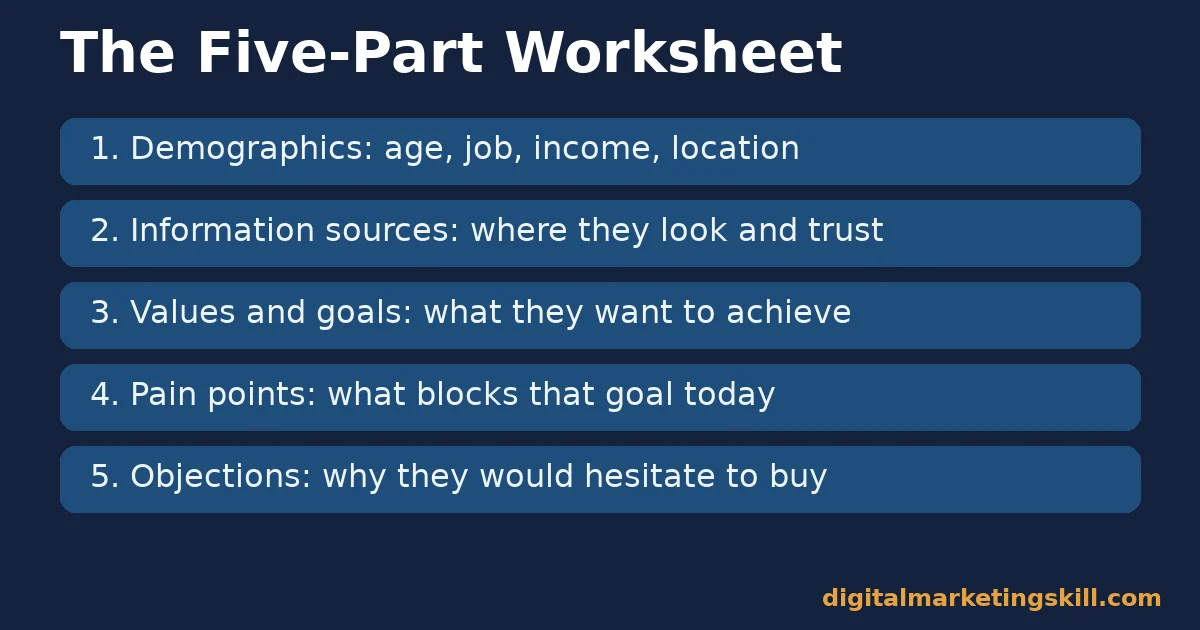
Step One: Demographics
Start with the basics: age range, job title, income level, and where they live. If you already run analytics, Google Analytics’ own demographics and interests reports can fill in some of this before you ask a single customer a question. The rest is the easiest data to gather, often already sitting in your checkout or sign-up form.
Keep this step honest. Demographics alone do not make a customer avatar. They are the frame, not the picture.
Step Two: Information Sources
Find out where your avatar actually gets information: which platforms, which publications, which people they trust. This tells you where to show up, not just who to target.
Ask real customers directly where they first heard about products like yours. Their answer is usually more useful than any guess.
Step Three: Values and Goals
Write down what your avatar actually wants to achieve, in their own words if possible. A goal written as “save time” behaves very differently in copy than one written as “look competent in front of a boss.”
This step is where most weak avatars stay shallow. Push past the first answer and ask what that goal would let your avatar do next.
Step Four: Pain Points and Challenges
List the specific problems stopping your avatar from reaching that goal today. Vague pain points produce vague copy, so be as concrete as the real customer conversations allow.
If you cannot describe the pain point in one clear sentence, you probably have not researched it enough yet.
Step Five: Objections
Write down the real reasons your avatar would hesitate to buy from you. Price, trust, timing and past bad experiences are common ones, but the specific version matters more than the category.
Your copy should answer these objections directly, ideally before the avatar has to ask. That is the whole point of having built them in the first place.
How to Measure Whether Your Customer Avatar Is Working
A customer avatar that never gets checked against real results is just a story. Each metric below is defined in one sentence.
- Message match rate. The share of visitors from a specific ad or email who complete the matching landing page’s offer. A low rate suggests the avatar and the actual audience have drifted apart.
- Cost per acquisition, by avatar-targeted campaign. What it costs to win one customer through a campaign built for this specific avatar, compared with your broader campaigns.
- Email click rate, by avatar segment. The share of a specific avatar-based list that clicks through. A persistently low rate is a sign the avatar’s goals or pain points were guessed, not researched.
- Objection-handling conversion lift. The change in conversion rate after you add copy that directly answers an objection from Step Five. This is the simplest way to test whether an objection was real.
- Lead-to-customer rate, by avatar. The share of leads matching this avatar who become paying customers. Our guide to lead conversion strategies covers how to raise that number once you can see it clearly.
How to Read These Numbers Together
Start with message match rate. If it is low, the avatar itself needs revisiting before you spend more on ads built around it. If message match is healthy but cost per acquisition is high, the targeting is right but the offer or price may not be.
Keep a simple log of changes. When you rewrite a headline, an ad angle or an email subject line based on the avatar, note the date and compare the following month against the one before. That turns a feeling that the avatar “seems to be working” into an actual answer.
Revisit your customer avatar on a fixed schedule, not only when results slip. Real buyers drift as a product or market matures, and an avatar built two years ago quietly stops describing anyone real. A short quarterly check, comparing a handful of real customer conversations against the avatar on paper, usually catches that drift early.
The One Decision Rule: Build One Avatar Before You Build Five
If you remember one rule from this guide, make it this one. Build and validate one customer avatar thoroughly before you build a second. A single avatar built from real research beats five built from guesses.
Here is an illustrative example, with invented numbers. A small software business builds one detailed avatar for its best-converting customer segment: a mid-level manager frustrated by manual reporting. It rewrites its homepage and one ad campaign around that single avatar. Within six weeks, conversion rate on that campaign rises from 1.8% to 2.9%, without any increase in ad spend. The business then builds a second avatar for a different segment, using the same five-step process, instead of guessing at five avatars on day one.
The lesson is depth before breadth. One well-researched customer avatar, actually used in your copy and targeting, outperforms a drawer full of half-finished ones. That one avatar also makes the second one faster to build, because the research process is now familiar and the first avatar often reveals a second, adjacent group worth describing next.
A Real Case: Personas Tied to a Measurable Revenue Jump
According to a compilation citing Demand Gen Report, Thomson Reuters built detailed buyer personas and reported a 175% increase in marketing-attributed revenue. The same report cites a 10% rise in leads sent to sales and a 72% faster lead conversion time.
Treat this as one company’s documented result, not a guaranteed outcome. The figures are secondary-sourced, compiled from a report this guide could not fully verify at its original source, so read them as a strong directional case rather than an audited study. Even skeptics of persona-based marketing science would likely agree that a detailed, well-researched avatar changes what a team actually writes, and that change is where results like this come from.
Frequently Asked Questions About a Customer Avatar
What is a customer avatar?
A customer avatar is a detailed, semi-fictional picture of one real buyer, built from demographics, information sources, values and goals, pain points, and objections. It is used to write content, ads, copy and emails for one specific person.
Is a customer avatar the same as a buyer persona?
The terms are used almost interchangeably in practice. Where people draw a distinction, a customer avatar usually means a more detailed, individual-feeling profile, while a persona can describe a broader group with shared traits.
How many customer avatars should a small business build?
Start with one, built thoroughly from real research, before adding a second. A single well-researched avatar used consistently in copy and targeting beats several shallow ones built in a single meeting.
Do I need survey data to build a customer avatar?
Survey data helps, but existing customer conversations, reviews and support tickets often contain enough real detail to start. The goal is grounding the avatar in real words from real customers, not reaching a specific sample size.
How often should I update my customer avatar?
Revisit it at least twice a year, or sooner if conversion rates on avatar-targeted campaigns start slipping. Markets and buyers shift, and an old avatar quietly stops matching your real customers.
Do all marketers agree that customer avatars work?
No. Marketing scientists at the Ehrenberg-Bass Institute have argued that real customer bases are broader and more varied than a single avatar suggests. Treat a customer avatar as a practical writing and targeting tool, validated against real data, rather than a complete model of your market.
Can a customer avatar be wrong?
Yes, and that is normal for a first draft. A customer avatar built from limited research often needs revising once you test it against real campaign results. Treat the first version as a hypothesis, and update it as message match rate and conversion data come in.
Start With One Avatar, Then Test It
A customer avatar earns its place only when it changes what you actually write and where you actually spend money. Build one thoroughly, using the five-part worksheet above, then measure its message match rate before you build a second.
If you want guided, hands-on practice building and testing real customer avatars, Digital Marketing Skill Institute‘s Master Diploma in Digital & AI Marketing is built from four AI-powered tracks across ten execution-first courses, including AI-Powered Lead Generation and Email Automation, with a Full Stack option for completing all four tracks. It comes with unlimited 1-on-1 coaching and mentoring, plus a U.S. Project Internship with a verified U.S. Work Reference Letter. The diploma is dual US and UK accredited and recognised in more than 100 countries.
The programme is 100% online, so you can build and test customer avatars from anywhere in your country. Browse more guides on the Digital Marketing Skill Institute blog. Read more outcomes on the reviews page. When you are ready, apply for the Master Diploma or start from the Digital Marketing Skill Institute homepage.
Every figure in this guide was checked against its original source before publication. Figures marked as illustrative are invented examples, not real results.