
Responsible AI is the practice of designing, building and using artificial intelligence in a way that is safe, fair, transparent and accountable, with people kept in charge. Where AI ethics sets out the values, responsible AI is how teams put those values into daily practice. It matters because AI tools now shape what customers see and how they are treated, and mistakes can harm people and brands.
Key Takeaways
- It turns principles such as fairness and transparency into checks, roles and habits.
- Microsoft lists six principles: fairness, reliability and safety, privacy and security, inclusiveness, transparency and accountability.
- The US NIST AI Risk Management Framework organises the work into four functions: govern, map, measure and manage.
- Human oversight is central. Someone should always own and review important AI outputs.
- For marketers, it means honest content, fair targeting, careful data use and clear disclosure.
What Is Responsible AI?
Most people agree AI should be fair and safe. The hard part is making that happen when a deadline looms and a tool produces a draft in seconds. That is where this practice comes in. It is the set of steps that close the gap.
Google describes its own approach as developing and deploying AI that meets user needs and broader responsibilities, while safeguarding user safety, security and privacy. It says this work runs throughout the AI lifecycle, “from design to testing to deployment to iteration”.
For example, a marketing team that uses AI to write product descriptions might agree three rules. Every claim must be checked, no customer data goes into public tools, and a named editor approves each page. Those simple rules show the idea at work.
How Responsible AI Works
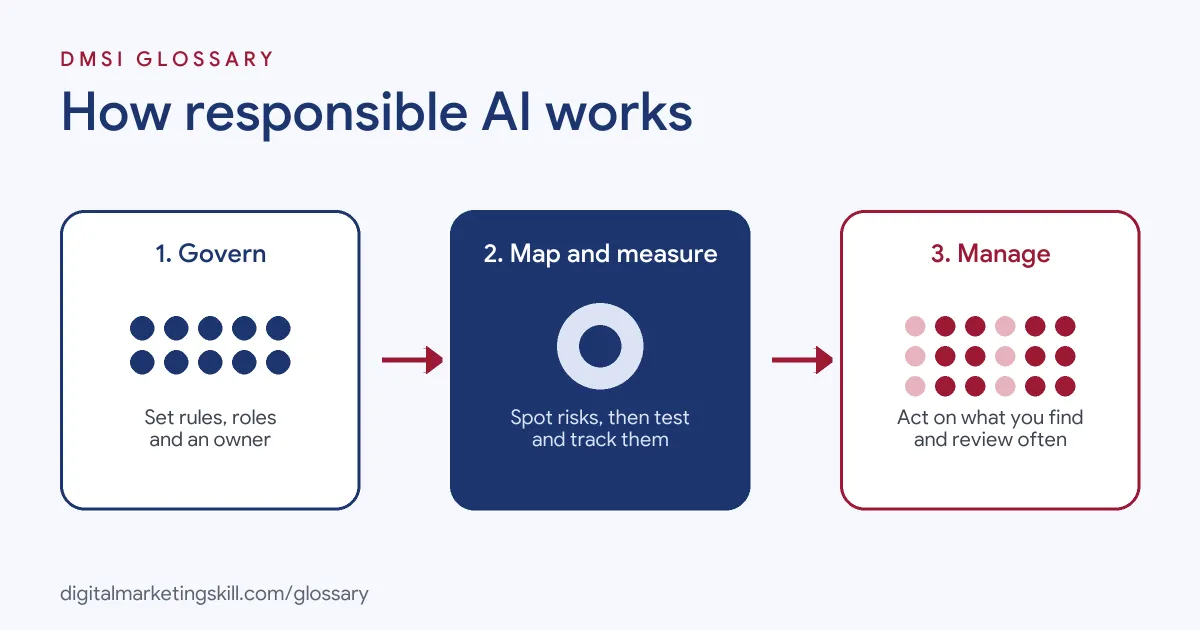
The work usually follows a loop. First, you set rules and roles. Next, you spot risks for each use of AI. Then you test and measure those risks. Finally, you act on what you find, and the loop starts again.
The NIST Framework
The US National Institute of Standards and Technology (NIST) publishes a voluntary AI Risk Management Framework. Its core has four functions:
- Govern: builds a culture of risk management, with clear processes and responsibilities. NIST says it cuts across the other three.
- Map: sets out the context and identifies the risks of a given AI use.
- Measure: uses tools and methods to analyse, assess and monitor those risks.
- Manage: decides how to deal with the risks found, and acts on them.
NIST also stresses that AI systems should be tested before deployment and regularly while in use.
What “Trustworthy” Means
NIST lists the traits of trustworthy AI. They are valid and reliable, safe, secure and resilient, accountable and transparent, explainable and interpretable, privacy-enhanced, and fair with harmful bias managed. In other words, the tool should work, be safe, protect data, be clear about how it works and treat people fairly.
Human Oversight
Almost every framework puts people in charge. Google, for instance, commits to “appropriate human oversight, due diligence, and feedback mechanisms”. Similarly, Microsoft’s accountability principle says people should be accountable for AI systems. So a tool can suggest, but a person decides.
Responsible AI Examples in Marketing
Here are three made-up examples:
- AI copy review (example): An agency uses AI to draft social posts. A human editor checks each one for facts, tone and claims before it goes live, and logs any errors the tool makes.
- Chatbot limits (example): A bank’s website chatbot can answer general questions. However, it hands over to a human for anything about money or complaints, and it says clearly that it is an AI.
- Audience checks (example): A recruiter running job ads reviews who actually sees them each month. When it finds one age group rarely sees the ads, it adjusts settings and tests again.
In each case, the team uses AI, but it keeps control and checks the results.
Responsible AI Frameworks Compared
Here is how three well-known approaches differ:
| Framework | Who it is for | Main idea |
|---|---|---|
| NIST AI Risk Management Framework | Any organisation, used voluntarily | Govern, map, measure and manage AI risks |
| Microsoft responsible AI principles | Guides Microsoft’s own AI work | Six principles, from fairness to accountability |
| Google AI Principles | Guides Google’s own AI work | Bold innovation, responsible development and collaborative progress |
You don’t need to adopt one in full. Even so, they give you a tested starting point for your own rules.
How to Practise Responsible AI in a Marketing Team
You can start small and build up over time. Follow these steps to get started:
- List every AI tool you use. Include writing, image, chat, targeting and analytics tools.
- Name an owner. Give one person responsibility for AI rules and questions.
- Map the risks. For each use, ask what could go wrong and who could be affected.
- Set simple rules. For example, no personal data in public tools, and a human check before publishing.
- Measure results. Track errors, complaints and audience reach across different groups.
- Act and review. Fix problems you find, and review the rules every few months.
- Train the team. Make sure everyone knows the rules and why they matter.
A One-Page AI Policy You Can Copy
You don’t need a long document to start. Here is a short, made-up policy a small team could adapt:
- We list every AI tool we use, and one person owns that list.
- Nobody pastes customer names, emails or orders into public AI tools.
- A person checks every AI draft before it goes out.
- Every fact, price and claim must match a real source.
- We tell people when they chat with a bot, and we offer a human.
- No one uses AI to make fake reviews, quotes or results.
- Each month, we look at who sees our ads and fix any gaps.
- We review these rules every quarter.
Keep it short, so people read it. Then pin it where the team works, and update it as tools change. If a rule doesn’t fit your work, change it. The point is to agree a few habits that everyone follows, not to write the perfect policy on day one.
Best Practices
A few habits make it part of normal work:
- Disclose where it matters. Tell people when they are talking to AI.
- Keep records. Note which tool made what, and who approved it.
- Test before launch. Try new AI features on a small scale first.
- Listen to feedback. Give customers an easy way to flag problems.
Common Mistakes to Avoid
First, many teams write a policy and then never use it. Second, they let tools publish without review because it saves time. Third, they treat it as a job for tech teams only, when marketers make many of the daily choices. Finally, they don’t revisit their rules as tools change. Each gap lets small problems grow.
Where You’ll Use Responsible AI at Work
Employers name this skill in AI, product and change roles. For example, current remote job listings ask for:
- “Demonstrated application of responsible AI practice — fairness, explainability, documentation, and risk assessment — in a regulated or high-consequence setting” (AI/ML Engineer IV).
- “Curiosity and learning agility around AI, evaluation methods, responsible AI, and emerging technologies” (Lead Technology Product Manager, AI Quality and Evaluation).
- “Awareness of responsible AI, security, data privacy, and governance considerations” (Change Management Consultant).
As a marketer, you will apply these ideas every time you use AI to write, design or target. For the values behind the practice, see our page on AI ethics.
Learn It in Any DMSI Track
AI fundamentals, covering strategy and planning, are part of every track in the DMSI Master Diploma. There, you use AI tools on real marketing tasks and learn to check their output. You also join a U.S. Project Internship from day one, with unlimited 1-on-1 mentoring.
To see which tools marketers use, read our guide to AI marketing tools.
Frequently Asked Questions
What is responsible AI in simple terms?
It means using AI in a safe, fair and honest way, with clear rules and a person in charge of important decisions.
What is the difference between AI ethics and responsible AI?
AI ethics sets out the values, such as fairness and privacy. Responsible AI is the practical work of applying those values through rules, checks and roles.
What are the principles of responsible AI?
Microsoft’s six are fairness, reliability and safety, privacy and security, inclusiveness, transparency and accountability. Other frameworks cover similar ground.
What is the NIST AI Risk Management Framework?
It is a voluntary US framework for managing AI risks. Its four core functions are govern, map, measure and manage.
Does a small business need responsible AI?
Yes, at a simple level. A short list of tools, a few clear rules and a human check before publishing go a long way. You can then grow the rules as you use more tools.
Sources: NIST AI RMF: Core functions; NIST AI RMF: Trustworthy AI characteristics; Microsoft: Responsible AI principles; Google: AI Principles; remote job listings on Himalayas.