
A freelance digital marketer is a self-employed professional who runs online marketing work, such as ads, SEO, email or social media, for several clients instead of working as one company’s employee. They agree projects or monthly retainers, set their own hours and are paid per job, per hour or per month. It matters because many businesses need marketing skills without hiring full-time, and freelancing gives skilled marketers a flexible way to work with clients anywhere.
Key Takeaways
- A freelance digital marketer is self-employed and works for several clients, often remotely.
- Common services include paid ads, SEO, content, email marketing, social media and analytics.
- Freelancers find work through referrals, their own websites, LinkedIn and freelance marketplaces.
- Self-employment comes with tax duties. In the UK, gov.uk says you must register for Self Assessment as a sole trader if you earn more than £1,000 in a tax year.
- A strong portfolio of real results is usually the deciding factor when clients choose a freelancer.
What Is a Freelance Digital Marketer?
Think of a freelance digital marketer as a marketing department for hire. A small business might not need a full-time ads manager, but it may need someone for ten hours a week. So it hires a freelancer instead.
The UK government describes the signs of running a business in simple terms. For example, you are likely trading if you are “paid for a service you provide,” and you are probably running a business if you can “decide how, where and when you do your work.” That describes most freelancers well.
Some freelancers are generalists who handle all of a small firm’s digital marketing. Others specialise, for instance in Google Ads, Meta ads, SEO or email automation. In practice, specialists often find it easier to stand out and charge more for proven skills.
How a Freelance Digital Marketer Works
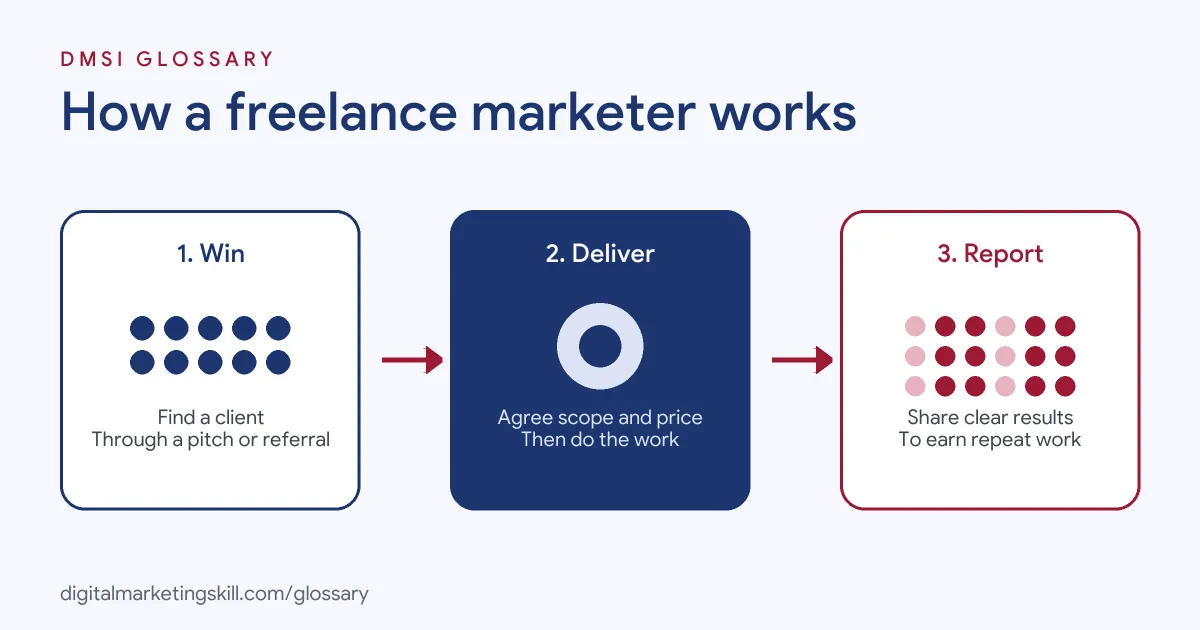
Most freelance work follows three steps. First, the freelancer wins a client through a pitch, referral or marketplace. Next, they agree the scope, price and timeline, then deliver the work. Finally, they report results, and good results lead to repeat work and referrals.
Finding Clients
Freelancers find work in many ways. Some use marketplaces, while others rely on LinkedIn, their own website, local networks and past clients. Job boards also list freelance roles. For example, one real listing says, “We’re looking for a freelance Growth Marketer to help us grow our customer base through continuous experimentation and execution.”
Pricing and Contracts
Freelancers usually charge in one of three ways: by the hour, by the project or with a monthly retainer. A written agreement should set out what is included, how many revisions are allowed, how results will be reported and when payment is due. As a result, both sides know what to expect.
It also helps to agree who owns the ad accounts, logins and creative work. For instance, many clients prefer to own their Google Ads and Meta accounts and give the freelancer access. That way, the client keeps its data if the work ends, and trust stays high on both sides.
Tax and Admin
Being self-employed brings paperwork. In the UK, gov.uk says “you must register for Self Assessment as a sole trader if you earn more than £1,000 in a tax year,” and “When you start trading you must keep records.” In the US, the IRS says you generally must file an income tax return if your net earnings from self-employment were $400 or more, and that self-employed people usually pay estimated tax quarterly. Rules differ by country, so check your local tax authority.
Freelance Digital Marketer Examples
Here are three made-up examples of freelance set-ups:
- Google Ads specialist (example): Manages search campaigns for six local service firms on monthly retainers, with a short report each month.
- Email freelancer (example): Builds welcome sequences and newsletters for online shops, priced per project.
- Social media freelancer (example): Plans and posts content for three cafés, and runs a small paid campaign for each.
In each case, the freelancer offers a clear service that the client understands and can measure. That clarity makes the service easier to sell, deliver and renew.
Freelance vs Agency vs In-House Marketer
Here is how the three main ways of working compare:
| Option | How it works | Good for |
|---|---|---|
| Freelance digital marketer | One self-employed person serving several clients | Small businesses that need flexible, focused help |
| Digital marketing agency | A team offering many services to many clients | Businesses that need a wide range of skills at once |
| In-house marketer | An employee working for one company | Firms that need daily, full-time marketing support |
In short, freelancers offer flexibility and focus, agencies offer breadth, and in-house staff offer full-time attention.
How to Become a Freelance Digital Marketer
- Choose a core skill. Pick one area, such as Google Ads or SEO, that you can do well.
- Build real proof. Complete projects with measurable results, even small ones, and save the numbers.
- Create a portfolio. Show the problem, what you did and the result for each project.
- Define your offer. Write a clear service package with scope, timeline and price.
- Set up the business side. Check your local tax rules, keep records and use simple contracts.
- Find your first clients. Start with your network, LinkedIn and trusted freelance platforms.
- Report clearly. Send short, regular reports that link your work to the client’s goals.
- Ask for referrals. Happy clients are often the best source of new work.
A Simple Pricing Example
Here is a made-up example. A freelancer wants to earn £3,000 a month before tax and expenses. They plan 75 billable hours a month, because some time goes on admin and finding clients. So they need about £40 an hour. With that number in mind, they can price a monthly retainer of 15 hours at £600 and know whether a deal is worth taking.
Best Practices for a Freelance Digital Marketer
- Specialise early. A clear niche makes it easier for clients to remember and refer you.
- Put everything in writing. Scope, price and deadlines avoid disputes later.
- Track your own results. Numbers from past projects are your strongest sales tool.
- Keep learning. Platforms change often, so update your skills regularly and test new features on small budgets.
- Protect your time. Set working hours and response times, so clients know what to expect.
Common Mistakes to Avoid
A common mistake is offering every service at once, which makes it hard to stand out. Another is starting work without a written agreement, so the scope keeps growing. Some freelancers also price too low, then struggle to cover admin time and tax. Others forget to keep records, which makes tax returns harder. Finally, many rely on a single client, which is risky if that client leaves.
Where You’ll Find Freelance Digital Marketing Work
Freelance roles appear on job boards as well as marketplaces. For example, real remote listings say:
- “We’re looking for a freelance Growth Marketer to help us grow our customer base through continuous experimentation and execution.” (Freelance Growth Marketer).
- “We’re looking for a freelance content marketing specialist to support the content engines and strategic initiatives we set up for our clients.” (Content Marketing Specialist, Freelance).
- “We are looking for highly skilled and experienced freelance social media marketers to join our talent marketplace.” (Social Media Marketer).
So clients look for freelancers with clear skills and proof of results, not just a list of tools.
Learn It in the Full Stack Programme
Freelance Digital Marketer is one of the roles the Full Stack (all four tracks) programme prepares you for, alongside Digital Marketing Manager, Growth Marketer and Agency Owner. You take all ten courses and build one portfolio project from each track, so you have real work to show clients. You also get unlimited 1-on-1 mentoring and a U.S. Project Internship from day one.
Next, read our guides on how to get freelance clients and how to move into freelancing.
Frequently Asked Questions
What does a freelance digital marketer do?
They run online marketing for clients, such as ads, SEO, email or social media, as a self-employed professional rather than an employee.
Do I need a degree to be a freelance digital marketer?
Not usually. Clients mainly look at your skills, your portfolio and the results you can show.
How do freelancers find clients?
Through referrals, LinkedIn, their own websites, job boards and freelance marketplaces. Past clients are often the best source.
Do freelancers have to pay tax?
Yes. For example, in the UK you must register for Self Assessment if you earn more than £1,000 in a tax year as a sole trader. Check the rules where you live.
Should I specialise or offer everything?
Many freelancers start with one core skill, because it is easier to sell and to prove. You can add services later.
Sources: GOV.UK: Working for yourself; GOV.UK: Set up as a sole trader; IRS: Self-employed individuals tax center; remote job listings on Himalayas.