
An AI citation is a link or reference to a source that an AI tool, such as ChatGPT search, Perplexity or Google’s AI Overviews, shows alongside its answer to back up what it says. It tells the reader where the information came from and gives them a way to click through to the original page. It matters because being cited puts your brand inside the answer itself, which can bring trust and visits even when people never see a normal list of search results.
Key Takeaways
- An AI citation links an AI-generated answer to the web page it drew on.
- OpenAI says ChatGPT responses that use search “will contain inline citations,” plus a Sources button listing them.
- Perplexity says, “Every answer includes citations linking to the original sources.”
- For Google’s AI features, a page must be indexed and eligible to show with a snippet before it can appear as a supporting link.
- Research on generative engines found that adding quotations, statistics and cited sources made content more visible in AI answers.
What Is an AI Citation?
Think of an AI citation as a footnote in an essay. The AI writes the answer, and the citation shows which source supports each part. As a result, readers can check the facts or read more.
Different tools show citations in different ways. For example, OpenAI explains that in ChatGPT search, hovering over a citation shows more detail and clicking it opens the source. Perplexity uses numbered citations in each answer. Google’s AI Overviews and AI Mode show supporting links, and Google says these features “display a wider and more diverse set of helpful links” than a classic search.
So an AI citation is the new version of a ranking. Instead of asking “Where do I rank?”, marketers now also ask “Am I one of the sources the AI cites?” And because a good answer may satisfy many readers on the spot, a citation can be your main chance to be seen for that question.
How an AI Citation Works
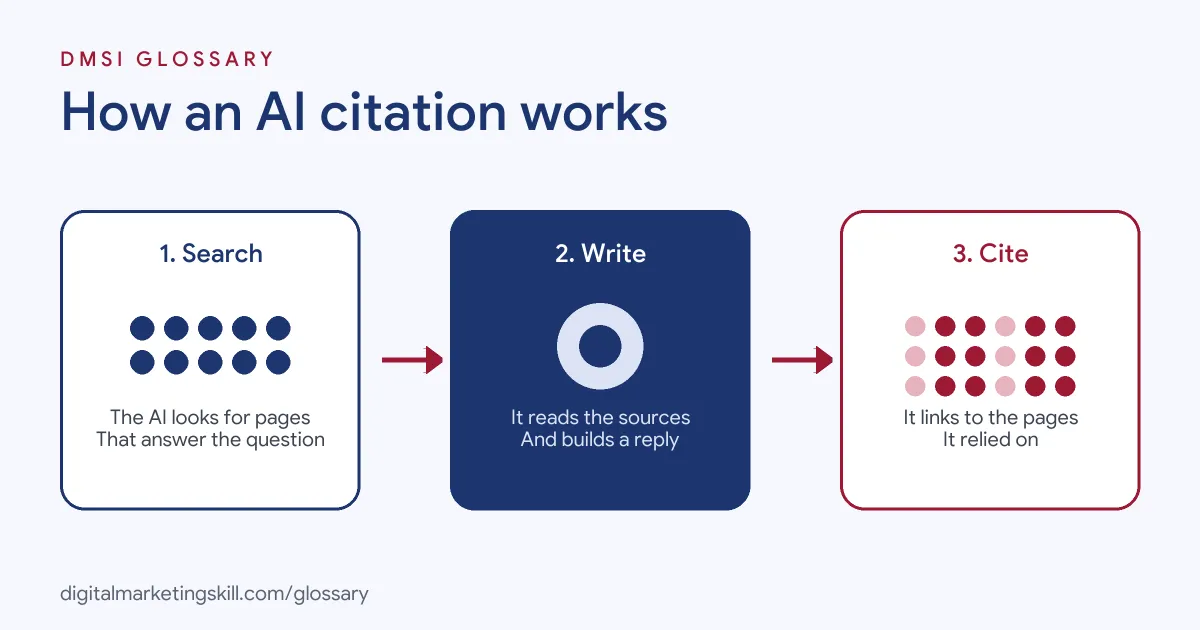
The process has three steps. First, the AI tool searches the web or its index for pages that answer the question. Next, it reads those pages and writes a reply. Finally, it attaches citations to the sources it used, so readers can follow the links.
When AI Tools Search the Web
Not every answer needs a citation. OpenAI says, “ChatGPT will automatically search the web if your question might benefit from information on the web.” Users can also start a search themselves. Perplexity, by contrast, runs a live search for each question. Meanwhile, Google says its AI Overviews appear only when its systems judge them helpful, so they often don’t trigger.
What Makes a Page Eligible
A tool can only cite pages it can reach. OpenAI says sites that block OAI-SearchBot “will not be shown in ChatGPT search answers.” For Google, a page must be “indexed and eligible to be shown in Google Search with a snippet.” Google also says there are no extra technical requirements for its AI features beyond normal SEO basics.
What Makes Content Citable
Research gives some clues. The “GEO: Generative Engine Optimization” paper tested ways to make content more visible in AI answers. Adding quotations worked best, followed by adding statistics, improving fluency and citing sources. However, keyword stuffing scored worse than doing nothing. In other words, specific, well-sourced content is easier for AI tools to use and credit.
AI Citation Examples
Here are three made-up examples of how a business might earn an AI citation:
- Software company (example): It publishes a clear comparison table of its plans. When someone asks an AI tool to compare tools, the answer cites that table.
- Local clinic (example): It writes a plain, expert-reviewed guide to a common treatment. AI answers about that treatment start linking to it.
- Research firm (example): It releases an original survey with clear numbers. Other sites quote it, and AI answers cite the original report.
In each case, the page offers something specific that an AI answer can lean on.
AI Citations by Platform
Here is how three well-known tools show their sources, based on their own help pages:
| Tool | How sources appear | What controls access |
|---|---|---|
| ChatGPT search | Inline citations, plus a Sources button at the end | OAI-SearchBot rules in robots.txt |
| Perplexity | Numbered citations in every answer | Its own crawling of the web |
| Google AI Overviews and AI Mode | Supporting links within and beside the answer | Normal Google indexing and snippet rules |
In short, each tool cites differently, but all of them need to reach and understand your page first.
How to Earn an AI Citation
- Allow the right crawlers. Check robots.txt, so AI search bots such as OAI-SearchBot can reach your pages.
- Confirm indexing. Use Google Search Console to check that key pages are indexed and can show a snippet.
- Answer questions directly. Put a short, clear answer near the top of the page.
- Add evidence. Include specific numbers, short expert quotes and links to your own sources.
- Publish original data. First-hand research gives AI tools a reason to cite you rather than a copy.
- Keep facts current. Update prices, specs and policies, so answers don’t repeat old details.
- Test and track. Ask AI tools your target questions, note who they cite and track AI referral visits in analytics.
Measuring AI Citations
Measurement is still rough, so combine a few signals. Google says traffic from AI Overviews and AI Mode is included in the Search Console Performance report under the Web search type. In your analytics tool, you can also look for visits referred by AI tools. Finally, keep a simple sheet of key questions and check, from time to time, whether each tool cites you. Over time, that sheet shows which pages earn citations and which ones need work.
Best Practices for AI Citations
- Write for people first. Clear, useful pages are easier for both readers and machines.
- Be the original source. Original data gives AI tools a clear reason to cite you rather than a copy.
- Show who wrote it. Named authors and clear sources build trust.
- Cover follow-up questions. A page that answers related questions has more chances to be cited.
- Don’t stuff keywords. The GEO research found it didn’t help.
Common Mistakes to Avoid
A common mistake is blocking AI search crawlers by accident, then wondering why no AI tool cites the site. Another is writing vague, general pages that give an AI nothing specific to quote. Some teams also chase citations with thin pages stuffed with keywords. Others forget the basics, such as indexing and clear headings. Finally, many never check whether AI tools cite them, so they can’t tell if their work is paying off.
Where You’ll Use AI Citations at Work
Tracking and winning AI citations appears in newer SEO and AI search roles. For example, real remote job listings ask for:
- “hands-on experience in GEO / AI search visibility (LLM citation, structured/entity content)” (SEO/GEO Specialist).
- Someone who can “Show familiarity with AI-visibility tracking platforms and citation-influence analysis” (Head of Search and AI Visibility).
So if you want to work as an SEO Specialist or content marketer, employers will expect you to understand how AI tools choose and credit their sources. Our entries on LLM optimisation and the AI crawler cover the related skills.
Learn It in the WordPress and SEO Track
AI fundamentals are part of every DMSI track, and this skill is used most in the AI-Powered WordPress and SEO Specialist track. There, you learn WordPress website and eCommerce development, search engine optimisation and content marketing. Your portfolio project is a WordPress site or store that you build and rank with an SEO content plan. You also get unlimited 1-on-1 mentoring and a U.S. Project Internship from day one.
Next, read our guide to generative engine optimisation for more on AI search visibility.
Frequently Asked Questions
What is an AI citation in simple terms?
It is a link an AI tool shows to prove where part of its answer came from. Readers can click it to see the original page.
How do I get cited by ChatGPT?
Make sure OAI-SearchBot can reach your site, then publish clear, specific and well-sourced pages. There is no guaranteed method.
Do AI citations bring traffic?
They can, because readers can click through. Google includes AI Overview and AI Mode traffic in the Search Console Performance report.
Is an AI citation the same as a backlink?
No. A backlink is a link from another website. An AI citation is a link inside an AI tool’s answer.
Can I pay for an AI citation?
The tools covered here describe citations as links to the sources they used, not as paid placements. So focus on earning them with useful content.
Sources: OpenAI Help: ChatGPT search; Perplexity Help Center: How does Perplexity work?; Google Search Central: AI features and your website; Aggarwal et al.: GEO, Generative Engine Optimization; remote job listings on Himalayas.