
A deepfake is an image, video or audio clip made or changed with AI so that it looks or sounds like a real person, place or event, when it isn’t real. The EU AI Act defines it as AI-generated or manipulated content that would falsely appear to a person to be authentic. It matters to marketers because the same tools that make creative content can also mislead customers, damage trust and break the law if used without care.
Key Takeaways
- A deepfake uses AI to create or change image, audio or video content so it seems real.
- Under the EU AI Act, anyone who uses AI to create a deepfake must disclose that it is artificial.
- YouTube requires creators to disclose realistic AI-made or altered content, such as making a real person appear to say something they didn’t.
- Content Credentials, an open standard from C2PA, record where media came from and how it was edited.
- Brands should never use deepfake content to fake endorsements, reviews or results.
What Is a Deepfake?
A deepfake can be a fake video of a celebrity, a cloned voice on a phone call or a photo of an event that never happened. What makes it a deepfake is that it would fool someone into thinking it is genuine.
The EU AI Act gives a precise definition. It describes a deep fake as AI-generated or manipulated image, audio or video content that resembles existing persons, objects, places, entities or events. Crucially, it would also falsely appear to a person to be authentic or truthful.
Not all AI content is a deepfake, though. For instance, a cartoon mascot made with AI isn’t pretending to be real. However, a realistic video of a real CEO saying words they never said is a deepfake, even if it was made as a joke.
How a Deepfake Works
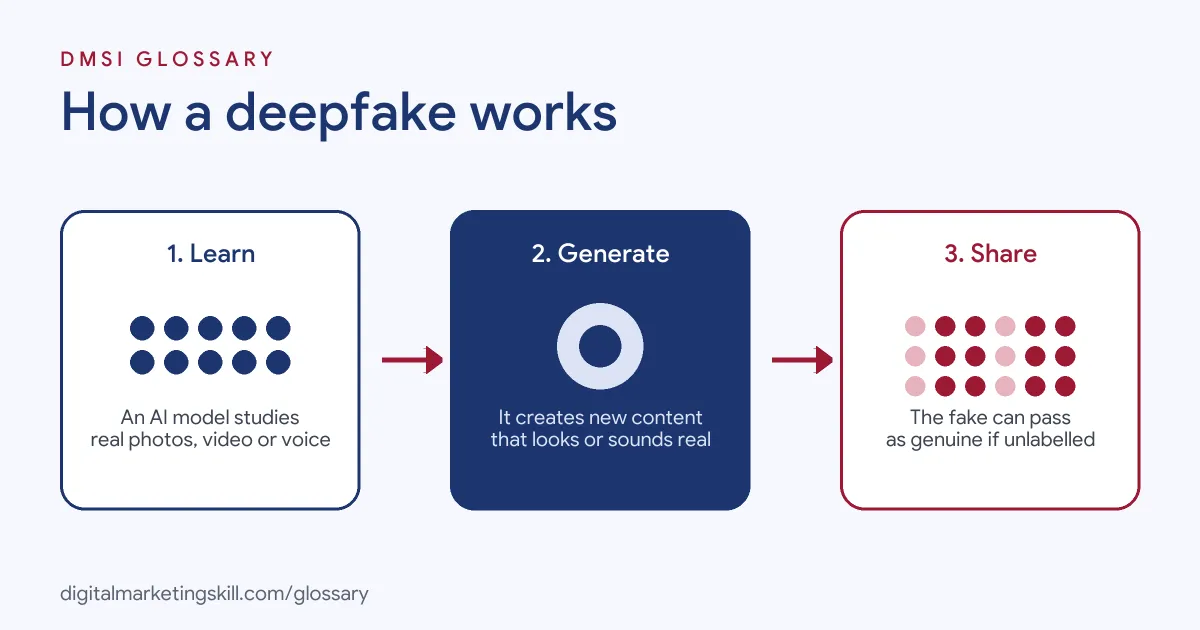
Most deepfakes follow the same basic pattern. First, an AI model learns from real examples, such as photos, video or voice recordings of a person. Next, it generates new content in that style. Finally, the result is edited and shared, often with no label.
Common Types
Deepfakes usually fall into one of these groups:
- Face swaps: one person’s face placed on another person’s body in a video.
- Lip-sync video: a real person’s mouth changed so they appear to say new words.
- Voice clones: AI audio that copies someone’s voice.
- Fake scenes: realistic images or video of events that never took place.
The Rules on Disclosure
Laws and platforms increasingly require labels. Article 50 of the EU AI Act says deployers of an AI system that generates or manipulates deepfake content shall disclose that the content has been artificially generated or manipulated. For clearly artistic, satirical or fictional work, the duty is lighter. In that case, you only need to disclose it in a way that doesn’t spoil the work.
Platforms set their own rules too. YouTube, for example, requires creators to disclose realistic content that is AI-generated or altered. That includes content that makes a real person appear to say or do something they didn’t, alters footage of a real event, or shows a realistic scene that never happened.
Deepfake Examples in Marketing
Here are three made-up examples, from safe to harmful:
- Labelled product demo (example): A brand uses an AI avatar, clearly labelled as AI, to explain a product in ten languages. No real person is imitated, and viewers know it is synthetic.
- Licensed voice (example): A company clones its own presenter’s voice with their written permission and labels the ads. The use is open and agreed.
- Fake endorsement (example): A scam ad uses a deepfake of a famous chef to “recommend” a kitchen gadget. This misleads buyers and harms the chef. It is exactly what brands must never do.
In each case, consent and disclosure decide whether the use is acceptable.
Deepfake vs Other AI Content
Here is how a deepfake compares with other kinds of AI media:
| Type | Looks real? | Imitates a real person or event? | Typical risk |
|---|---|---|---|
| Stylised AI art | No | No | Low |
| Realistic AI stock image | Yes | No | Medium, if it implies a real event |
| Deepfake | Yes | Yes | High: deception, fraud or harm to reputation |
In short, the closer content gets to a real person or event, the more care it needs.
How to Use AI Media Safely
Follow these steps whenever your team creates realistic AI content:
- Ask if it imitates a real person or event. If yes, treat it as a possible deepfake.
- Get written consent. Never copy someone’s face or voice without clear permission.
- Label it. Disclose that the content is AI-generated or altered, as the EU AI Act and platforms such as YouTube require.
- Use platform settings. For example, YouTube offers an “AI use” setting during upload.
- Keep records. Note which tool made the content and who approved it.
- Add provenance where you can. Content Credentials can show the origin and edits of a file.
What to Do If Someone Fakes Your Brand
A deepfake of your founder, staff or spokesperson can spread fast. So it helps to have a plan ready before you need it. Here is a simple one:
- Save the evidence. Take screenshots and copy the links before the content disappears.
- Report it. Use each platform’s reporting tools to flag the fake.
- Tell your audience. Post a short, calm notice on your own channels saying the content is fake.
- Warn your team. Make sure staff know not to share it, and who to send questions to.
- Get advice. If the fake is used for fraud or causes real harm, speak to a legal adviser.
Then review what happened. In particular, check whether more of your official content should carry Content Credentials, so people can tell real from fake.
Best Practices
A few habits protect your brand and your audience:
- Never fake proof. Don’t create fake testimonials, reviews or “real customer” videos.
- Check before you share. Verify surprising clips of public figures before you react or repost.
- Train your team. Show staff common signs of deepfakes and scams that use them.
- Have a response plan. Know what to do if someone makes a deepfake of your brand or staff.
Common Mistakes to Avoid
First, some marketers assume that a joke or parody needs no label. Second, they use a voice or face that “sounds like” a celebrity without permission. Third, they treat AI stock images as harmless even when they suggest a real event. Finally, they ignore platform disclosure settings. Each of these can mislead people and damage trust in your brand.
Where You’ll Use Deepfake Knowledge at Work
Deepfake skills appear most often in security and AI research roles. For example, current remote job listings ask for:
- “Understanding of synthetic speech, replay attacks, deepfakes, or machine learning labeling tasks such as intent recognition or speech analysis” (Audio Annotation Analyst).
- Someone to “Develop firsthand knowledge of voice intelligence, fraud prevention, authentication, and deepfake detection” (Audio Annotation Analyst).
- “Hands-on experience with deepfake tools, voice synthesis, or audio/visual spoofing technologies in an offensive or research context” (Senior Security Researcher, Red Team).
As a marketer, you are less likely to build detection tools. However, you will use AI video and image tools, so you need to know where the line sits. For the bigger picture, see our page on AI ethics.
Learn It in Any DMSI Track
AI fundamentals, covering strategy and planning, are part of every track in the DMSI Master Diploma. There, you use AI tools for real marketing tasks and learn to check and label their output. You also join a U.S. Project Internship from day one, with unlimited 1-on-1 mentoring.
For more on AI in daily marketing work, read our guide to AI in digital marketing.
Frequently Asked Questions
What is a deepfake in simple terms?
It is a fake image, video or audio clip made with AI that looks or sounds real, often showing a real person doing or saying something they didn’t.
Are deepfakes illegal?
Not always, but many uses are. In the EU, the AI Act requires people who create a deepfake with AI to disclose it. Using one to defraud or defame someone can also break other laws.
Can brands use AI avatars and voices?
Yes, with care. Get consent from anyone you imitate, label the content clearly and never use it to fake endorsements.
How can you spot a deepfake?
It isn’t always possible by eye, because the tools keep improving. So check where the clip came from, look for a disclosure label or Content Credentials, and be wary of anything surprising before you share it.
What are Content Credentials?
They are an open standard from the C2PA that records where a piece of media came from and how it was edited, a bit like a nutrition label.
Sources: EU AI Act: Article 50; YouTube Help: Disclosing use of GenAI content; C2PA: Content Credentials; remote job listings on Himalayas.