
Broad targeting is a way of running ads with few or no audience filters, so the ad platform’s algorithm decides who sees them. You usually set only basics such as location and perhaps age, then let the system find the people most likely to act. It matters because modern ad platforms often find buyers more cheaply on their own than with tightly drawn audiences.
Key Takeaways
- This approach removes detailed filters such as interests, lookalikes and custom audiences, and relies on location and the algorithm.
- It works because platforms learn from your conversion data and your ads to find likely buyers.
- Google’s optimised targeting, TikTok’s Smart Targeting and LinkedIn’s Auto-Targeting all lean in this direction.
- Your creative becomes your targeting. The ad itself tells the system who it is for.
- It works best with good conversion tracking and a decent budget, and less well for very niche offers.
What Is Broad Targeting?
For years, advertisers built careful audiences: women aged 25 to 34, interested in yoga, who live in Manchester. This approach flips that. Instead, you tell the platform where you can sell, and it works out who to show your ads to.
Paid social expert Jon Loomer sums it up well. He says the term usually means removing all possible targeting filters: no custom audiences, no lookalike audiences and no detailed targeting. Instead, you rely only on location and let the algorithm do the work.
For example, a shop selling phone cases across the UK might target “UK, aged 18 and over” and nothing else. The platform then learns from who clicks and buys, and it shows the ads to more people like them.
How Broad Targeting Works
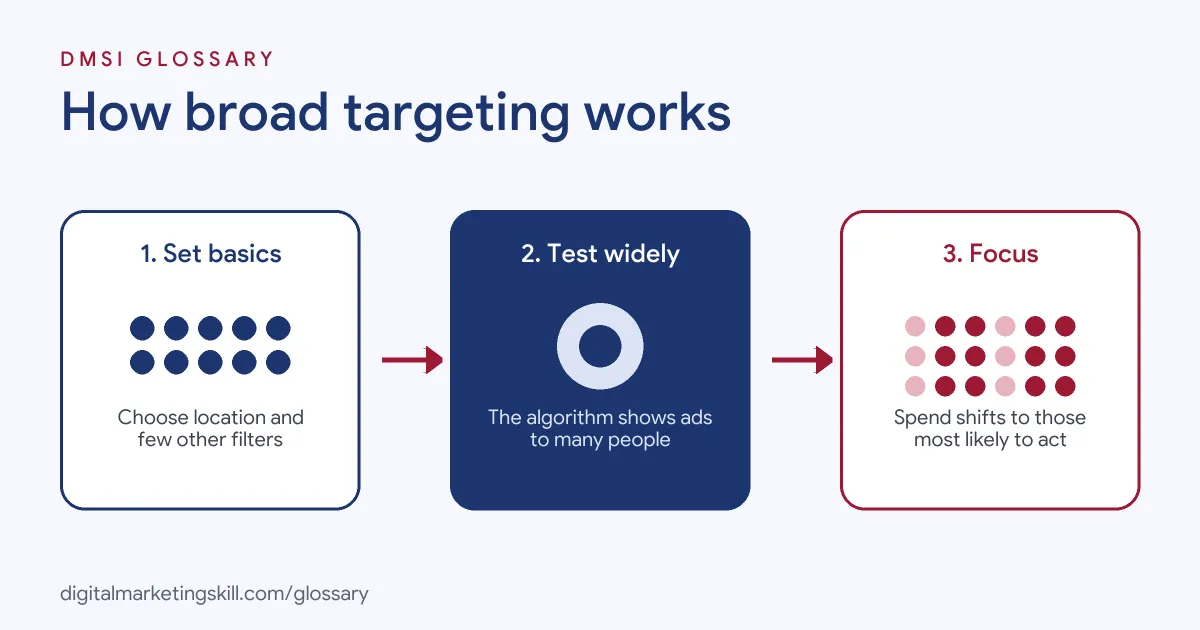
Broad doesn’t mean random. The platform still decides who sees each ad, but it uses its own signals rather than your filters.
The Algorithm Learns From Results
Each time someone sees, clicks or converts on your ad, the platform learns a little more. Google explains this clearly for its optimised targeting. It says the feature looks at things like keywords on your landing page and in your ads, then finds audiences that can meet your campaign goals. It also builds a profile of what a converter looks like based on real-time conversion data.
Your Creative Becomes Your Targeting
With fewer filters, the ad itself does more of the work. A video about running shoes for beginners signals a different audience from one about racing spikes. So with few filters, clear and specific creative matters more than ever.
Signals Still Help
You don’t have to give up every input. Google says you can add audience segments or keywords as “targeting signals”. These act as a starting point. However, if optimised targeting finds better traffic, it may reduce or stop serving on your signals.
Audience expansion is a related but different tool. Google says it looks for more people similar to your existing segments, while optimised targeting looks for the people most likely to convert.
Broad Targeting by Platform
Each platform offers its own version of letting the system decide:
| Platform | Feature | How it works |
|---|---|---|
| Google Ads | Optimised targeting | On by default for many campaigns; finds people likely to convert beyond your chosen segments |
| TikTok | Smart Targeting | Can deliver ads outside your chosen interests and audiences if it is likely to improve results |
| Auto-Targeting | Combines LinkedIn’s audience, platform signals and your inputs to build an audience for you |
TikTok adds a useful detail. Smart Targeting does not change other settings you choose, such as age, gender or location. In addition, TikTok says it reduces cost per acquisition and ad fatigue for most advertisers.
Broad Targeting Examples
Here are three made-up examples:
- National online shop (example): A skincare brand that ships across the UK targets everyone aged 18 and over. Its ads show close-ups of dry skin and its moisturiser, so the people who respond are mostly those with that problem.
- App install (example): A budgeting app targets one country with no interests. The platform finds that young professionals install most, then shifts spend towards them automatically.
- Niche B2B tool (example): A software firm selling to hospital pharmacists tries broad targeting but gets many irrelevant clicks. So it switches back to job-based targeting on LinkedIn.
The last example shows that broad isn’t always best. Very small, specialist audiences often still need precise targeting.
A Simple Test Plan
Here is a made-up test for a UK online shop selling running socks. It has £40 a day to spend for two weeks. So it sets up two ad sets with the same three ads:
- Ad set A: UK, aged 18 and over, no other filters.
- Ad set B: UK, aged 18 to 54, interested in running and marathons.
Each gets £20 a day. After two weeks, A brings 70 sales at about £8 each, while B brings 48 sales at about £11.67 each. So the shop moves most of its budget to the open audience. However, it keeps a small test running, because results can change as the season or the offer changes. Then, next month, it tests new ads in the open audience to see if fresh creative lifts results further.
Broad Targeting vs Detailed Targeting
Here is how the two approaches compare:
| Feature | Broad targeting | Detailed targeting |
|---|---|---|
| Who decides the audience | Mostly the algorithm | Mostly you |
| Audience size | Large | Smaller |
| Best for | Mass-market products with good tracking | Niche products, B2B or new accounts with little data |
| Main risk | Spend on weak traffic if tracking is poor | Higher costs and faster ad fatigue |
In short, going broad trusts the system, while detailed targeting trusts your assumptions. Testing tells you which works better for you.
How to Use Broad Targeting
Follow these steps to test it properly:
- Fix your tracking first. Make sure purchases or leads are tracked accurately, because the algorithm learns from them.
- Choose a conversion goal. Optimise for the action you want, such as purchases, not just clicks.
- Set only the basics. Add location, and age only if your product truly needs it.
- Write clear, specific ads. Show who the product is for and the problem it solves.
- Give it time and budget. Let the campaign gather results before you judge it.
- Compare with a detailed audience. Run both and compare cost per result, not clicks.
Best Practices
A few habits help it succeed:
- Feed the system good data. Accurate conversion tracking is the most important input.
- Use several ads. Different angles help the platform find different groups of buyers.
- Keep exclusions sensible. Exclude recent customers from offers meant for new ones.
- Watch quality, not just volume. Check that leads or sales are real and valuable.
Common Mistakes to Avoid
First, many advertisers go broad with weak tracking, so the system learns from the wrong signals. Second, they judge results after a day or two. Third, they keep vague ads that could appeal to anyone. Finally, they assume broad is always better, even for very niche offers. Each of these leads to wasted spend and a false conclusion.
Where You’ll Use Broad Targeting at Work
We didn’t find current remote listings that name this exact term. Still, deciding how wide to target is a daily choice in paid social roles. As a Paid Social Specialist, you will test broad audiences against detailed ones and report which wins. As a Content Creator, you will make the clear, specific ads that broad targeting depends on. And as a Social Media Manager, you will set budgets that give campaigns enough room to learn. It works alongside interest targeting, which is often the alternative you test against.
Learn It in the Social Media Track
You can learn to test broad and detailed audiences in the AI-Powered Social Media Management and Advertising track. There, you plan, create and run a paid social campaign for a real brand. You also get unlimited 1-on-1 mentoring and a U.S. Project Internship from day one.
For more platform tips, read our guide to Facebook ad targeting.
Frequently Asked Questions
What is broad targeting in simple terms?
It means running ads with very few audience filters, usually just location, and letting the platform decide who sees them.
Does broad targeting work?
Often, yes, especially for mass-market products with good tracking. However, niche or B2B offers may still need detailed targeting, so test both.
Is broad targeting the same as Advantage+ audience?
They are related. Both let the algorithm choose the audience. Advantage+ audience is Meta’s automated option, while going broad is the wider idea of using few filters.
How long should I test broad targeting?
Give it enough time and budget to gather conversions before judging. A few days is rarely enough to learn.
What matters most for broad targeting?
Accurate conversion tracking and clear, specific creative. The algorithm learns from both.
Sources: Jon Loomer: Broad targeting; Google Ads Help: About optimised targeting; TikTok Ads Help: Smart Targeting; LinkedIn Help: Targeting options for LinkedIn Ads.