
Facebook ad targeting decides whether your budget reaches people ready to buy, or people who never convert. Meta has pushed hard toward automated, AI-expanded targeting. So far, that shift has not been free of risk. This guide shows what the data says about each targeting type. It ends with one rule to apply before trusting automation with your budget.
Key Takeaways
- Privacy changes raised the cost of targeting. Meta’s own CFO said so on an earnings call transcript. Apple’s privacy changes cost Meta “on the order of $10 billion” in a single year, he told investors.
- Few users opt in to tracking. Flurry Analytics tracked millions of devices worldwide. It found the opt-in rate for tracking permission settled at roughly 25% globally.
- Automated targeting usually helps, on average. Meta ran 150 of its own A/B tests. In those tests, its AI-expanded Advantage+ audience showed a median cost per result about 9.7% lower than manual targeting.
- But averages hide real losses. An independent study covered $834 million in ad spend. It found average return on ad spend fell 7% during a major automated-targeting rollout. Even so, the advertisers hit hardest were the ones already performing best.
- Sensitive-category targeting is gone. Meta removed detailed targeting options tied to health, religion, political beliefs and similar categories, citing the risk of discriminatory targeting.
In this guide
- What Most Facebook Ad Targeting Advice Gets Wrong
- How Facebook Ad Targeting Actually Works
- What Differs by Targeting Type
- How to Use Each Targeting Type Well
- How to Measure Facebook Ad Targeting
- The One Rule: Test Before You Trust Automation
- A Real Case: What a Large Independent Study Found
- Frequently Asked Questions About Facebook Ad Targeting
- Start With One Test, Then Compare
What Most Facebook Ad Targeting Advice Gets Wrong
Get it right and every single dollar works that much harder. Get it wrong and you simply pay for clicks that go nowhere at all. That gap, between a well-targeted ad and a wasted one, is the whole subject of this guide.
Most advice on Facebook ad targeting treats it as a one-time setup. First pick an audience, launch the ad, then move on. That misses what has actually changed about Facebook ad targeting in recent times. Meta keeps shifting weight away from your manual choices. It leans more and more on its own automated, AI-expanded audience tools.
This guide explains how each targeting type works now. It explains what changed and why. It also shows how to tell if automation helps your account. That is not the same thing as the average account in Meta’s own data, after all.
Even so, treat every figure here as a useful signal. Meta’s own performance claims are medians across its testing, not a guarantee for your account. Independent studies come from analytics vendors with their own products to sell, even when the underlying numbers are real.
None of this means the figures are worthless. It means you should read them as a starting hypothesis to test on your own account, not as a rule to follow blindly. The data points the same direction again and again: test before you trust, and measure instead of guessing. That single habit matters more than any one targeting type covered in this guide.
How Facebook Ad Targeting Actually Works
Facebook ad targeting works through a layered system, with each layer handing more or less control to Meta itself. At first, you can specify an audience directly with detailed targeting, or build one from your own customer data with Custom Audiences.
Meta can also find similar people for you with Lookalike Audiences. Or you can hand the decision almost entirely to Advantage+ audience. It treats your inputs as a starting signal, not a hard rule.
That shift toward automation did not happen by accident. Instead, Apple’s App Tracking Transparency change made it much harder for Meta to see what people do outside its own apps. Meta’s own finance chief said so, too, on an earnings call. Apple’s iOS privacy changes cost the business “on the order of $10 billion” in a single year, he told investors.
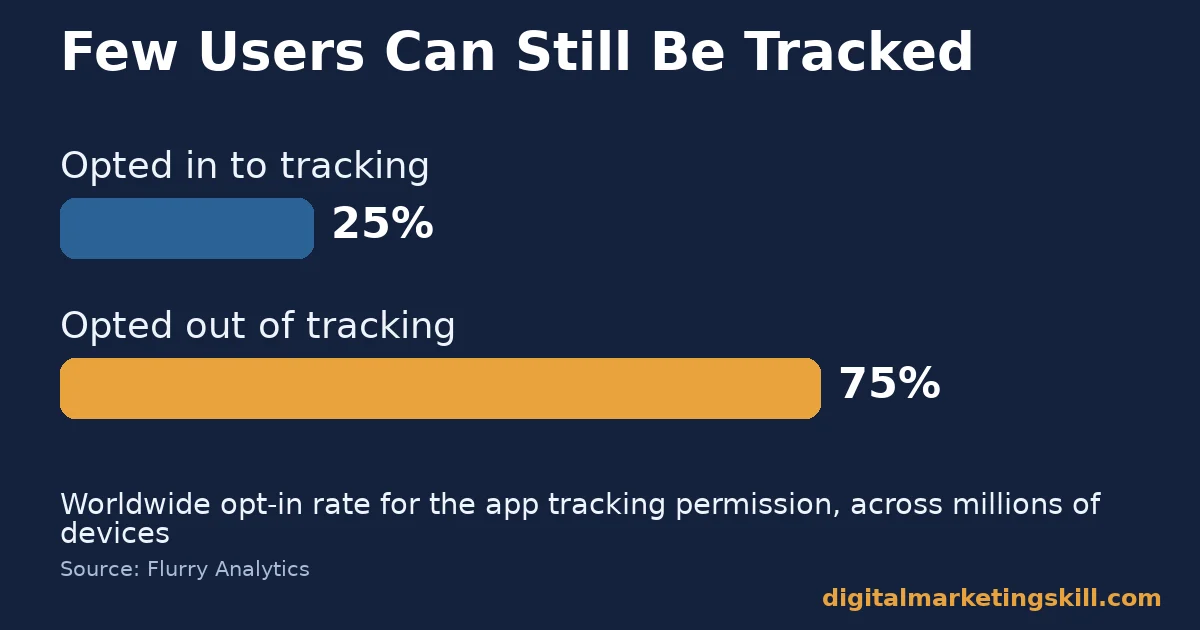
Flurry Analytics tracked the fallout directly. It watched millions of daily active devices worldwide. Eventually, it found the worldwide opt-in rate for tracking permission settled at roughly 25%, well below early readings in some markets.
Three out of four users opted out. So Meta lost most of the signal it once used for precise manual targeting. That loss is the real reason automated, AI-expanded targeting became the default path.
What Differs by Targeting Type
It helps to see all four main tools side by side before picking one, since each solves a different problem in Facebook ad targeting. Detailed targeting, Lookalike Audiences and Advantage+ audience are not three versions of the same idea.
Each one works from a genuinely different kind of input, ranging from your own first-party data to a simple guess at an interest label. So each one also fails in a different, specific way when that input turns out to be wrong.
Custom Audiences: Built From Your Own Data
A Custom Audience is built from people you already know: past customers, email subscribers, or visitors to your site. It is not a new audience Meta finds for you. It is a list you already own, turned into a target.
In practice, this makes Custom Audiences the most reliable starting point for Facebook ad targeting of all, ahead of any targeting option built purely from guesses about who might be interested. The people on the list already took some real action. That is a far stronger signal than any interest or behavior label Meta might apply from the outside.
Detailed Targeting: Built to Specify
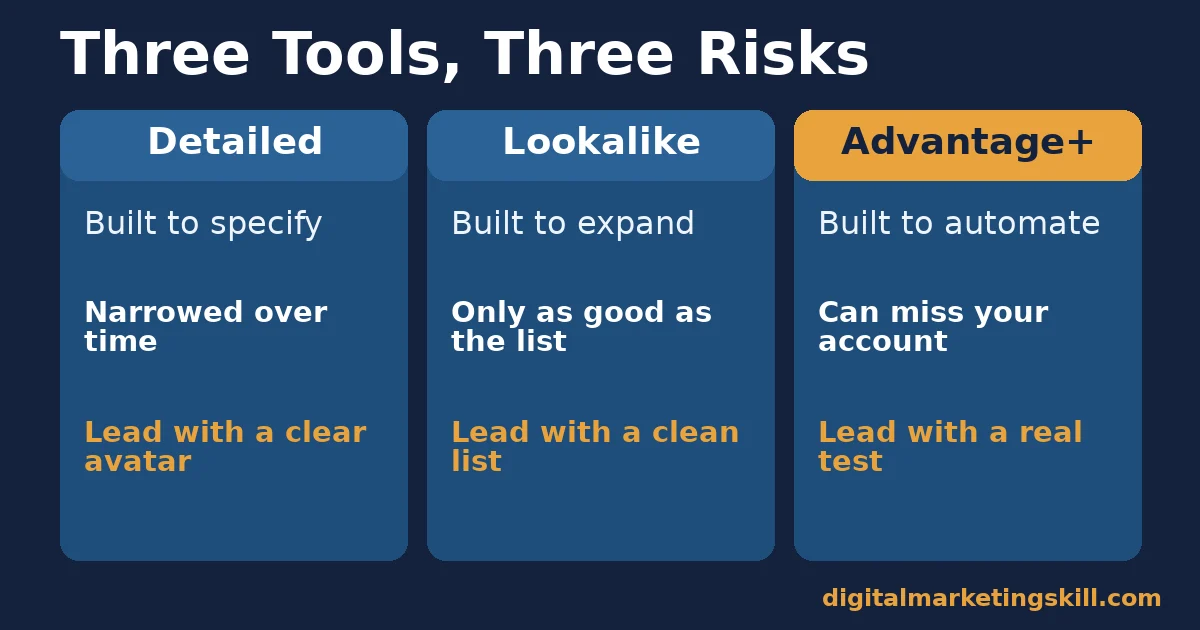
Detailed targeting lets you describe an audience directly, by interest, behavior or demographic. It gives you the most control and the clearest reasoning for who you are reaching.
The cost is that Meta has steadily narrowed what you can specify. It removed sensitive categories. It now treats your choices as suggestions it can expand beyond, not a strict boundary.
Lookalike Audiences: Built to Expand
A Lookalike Audience starts from a source list you provide, usually past customers or site visitors, rather than an interest you pick from a menu. It finds new people who share patterns with that list. It is only as good as the source list. A small or unrepresentative list produces a lookalike that is similarly narrow or skewed.
Advantage+ Audience: Built to Automate
Advantage+ audience treats your targeting inputs as a hint, not a hard filter. It lets Meta’s own models decide who actually sees the ad. Meta’s own testing shows this helps, on average. The independent evidence tells a different story. It does not help every account. It can even hurt a previously strong one the most.
How to Use Each Targeting Type Well
Once you know what each type is built for, that changes how you should actually use it. The goal is not to pick one tool and stick with it forever. The goal is to match the right tool to where your account stands today.
Custom Audiences: Lead With Clean, Recent Data
For strong Facebook ad targeting, keep Custom Audience lists current. A list built from purchases over the last few months usually outperforms one that mixes in people from years back, since buying patterns and prices both shift over time. So refresh the source list on a regular schedule, rather than setting it up once and forgetting it.
Detailed Targeting: Lead With a Clear Customer Avatar
Detailed targeting only works as well as the thinking behind it. Build a clear customer avatar first. Name who actually buys, and why, before you open the targeting panel.
Guessing at interests without that foundation wastes budget. It ends up reaching an audience that matches a label, not a real buyer.
A good customer avatar names the problem a buyer is trying to solve, not just their age or job title. Interests follow naturally once the problem is clear, which makes the targeting panel far easier to use well.
Lookalike Audiences: Lead With a Clean Source List
Before building a Lookalike Audience, check the quality of the source list feeding it. Use a list of real purchasers, not just page visitors or subscribers who never bought. That gives Meta a far stronger pattern to expand from. A clean, specific source list consistently outperforms a larger but noisier one.
For most accounts, this is where Facebook ad targeting quietly goes wrong. A huge, loosely related source list looks impressive on paper. But it teaches Meta the wrong lesson about who to find next, and the resulting lookalike rarely performs as hoped.
Advantage+ Audience: Lead With Guardrails, Not Blind Trust
Treat Advantage+ audience as a test, not a default. Run it alongside a manually targeted ad set with the same creative. Compare cost per result and return on ad spend directly. Do not assume the automated option works just because Meta recommends it.
If performance declines after switching, that decline is itself useful data. It is not a reason to wait it out.
Give the test enough time and enough spend to matter. A day or two of data from a small budget is usually just noise, not a real signal. A week or two, with enough spend to produce a meaningful number of results, gives a far more honest comparison. Write down the result either way, so the next test builds on real history instead of memory.
How to Measure Facebook Ad Targeting
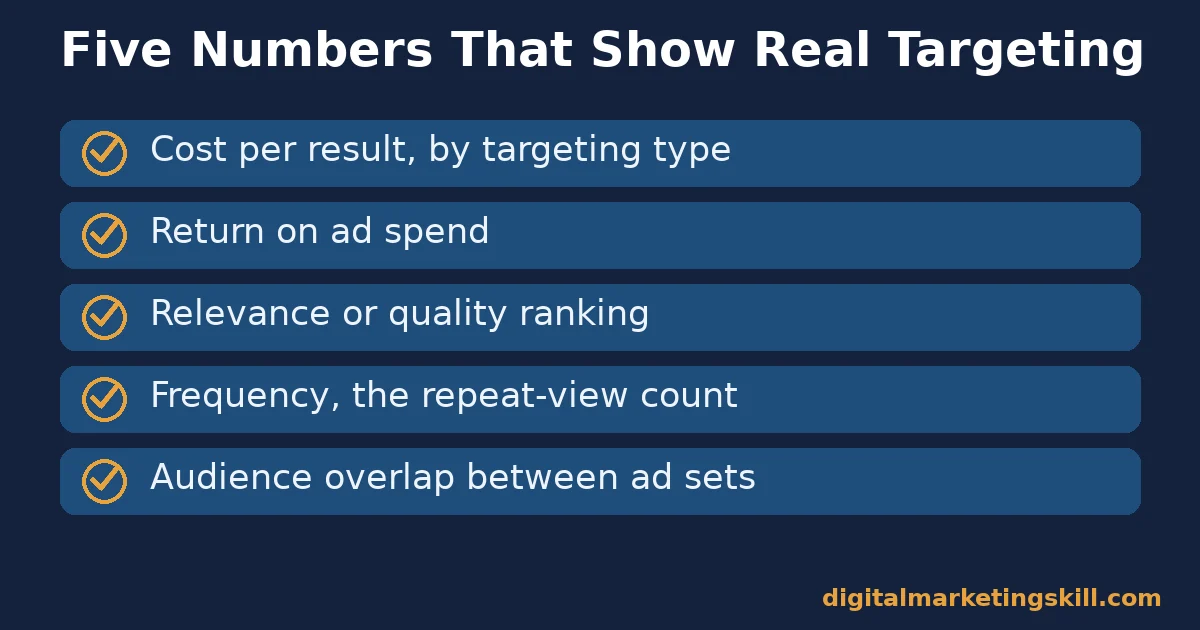
Launching a campaign is not the same as knowing whether the targeting behind it is working. A campaign can run for weeks and still be aimed at the wrong people the whole time. These five numbers show the real picture.
- Cost per result. What you pay for the outcome you want, such as a purchase, a lead or a click. Compare this across targeting types, not just over time.
- Return on ad spend. Revenue generated per dollar spent. Cost per result rising while this falls is the clearest sign that targeting, not just price, got worse.
- Relevance or quality ranking. Meta’s own signal for how well an ad fits the audience it reaches. A falling ranking often shows up before cost per result rises.
- Frequency. How many times the average person sees your ad. Rising frequency with flat results usually means the audience is too narrow. People are seeing the same ad again and again.
- Audience overlap. The share of your audiences that already overlap with each other. High overlap between ad sets means your own campaigns are competing for the same people.
Even so, check these five together, not one at a time. A low cost per result with a high frequency is often a warning sign in disguise: the targeting may be working today by repeatedly hitting a small, tired audience, which tends to stop working soon after.
The One Rule: Test Before You Trust Automation
Never adopt an automated targeting option across your whole account at once. Test it against your current approach first, on a limited budget, and let the comparison decide.
This rule applies to every new targeting feature Meta releases, not just Advantage+ audience. New features tend to come with a recommendation banner inside Ads Manager, nudging you to turn them on everywhere. That banner reflects what helped the median account in Meta’s own testing. It says nothing about your account specifically.
Keep a simple record of each test: what changed, over what period, and what happened to cost per result and return on ad spend. Over a year, that record becomes a far better guide to Facebook ad targeting for your business than any general benchmark could be.
Here is an illustrative, invented example to show why this matters. Imagine an advertiser spending steadily through manual detailed targeting, with a cost per result they are comfortable with. They switch their entire account to Advantage+ audience at once, because Meta’s dashboard recommends it.
For most accounts, Meta’s own data suggests this would lower cost per result somewhat. But this advertiser’s account might resemble the strong performers hit hardest in the independent research. Without a manual comparison running alongside it, costs could rise across the whole account before anyone notices.
A Real Case: What a Large Independent Study Found
An independent analysis covered $834 million in ad spend. That is roughly 1 million ads and more than 115 billion impressions. It followed 3,014 e-commerce advertisers across 73 countries through a major rollout of Meta’s automated targeting system.
The headline number was a 7% average decline in return on ad spend across the full group. A more useful finding sits underneath that average. Advertisers hit hardest were the ones who had been performing best before the rollout. These were not the weaker accounts automation might be expected to help most.
The limit on this case matters. It is one independent study of one rollout, not a permanent verdict on automated targeting. It also cannot fully separate the targeting change from other factors moving at the same time.
Treat it as a reason to test before switching, not as proof that automation never works. The real lesson is not “avoid automation.” It is “verify automation,” on your own account, before you let it run unchecked.
Frequently Asked Questions About Facebook Ad Targeting
Is manual Facebook ad targeting still worth using?
Yes, especially as a comparison point. Advantage+ audience might still win for your account. But running a manual ad set alongside it is the only way to know that for certain. Do not just assume Meta’s own recommendation is correct for your business.
Why did my Facebook ad targeting get more expensive?
A few common reasons explain most cases. Fewer users can be tracked because of privacy changes. Your audience may have grown too narrow, so frequency is rising. Or your ad sets may be overlapping and competing with each other for the same people.
Check frequency and audience overlap before assuming the platform itself is simply more expensive now. It also helps to compare against Google Ads for small business. That shows whether the cost rise is specific to Facebook, or part of a wider trend across paid channels.
How big should a source list be for a Lookalike Audience?
Bigger is not automatically better. A smaller list of real, confirmed purchasers typically beats a much larger list of casual visitors who never converted. The pattern Meta expands from is simply more precise. If your purchaser list is genuinely small, it is usually still worth using before falling back on a bigger, weaker one.
Does detailed targeting still work after the sensitive-category removal?
Yes, for the categories still available. Meta removed options tied to health, religion, political belief and similar sensitive areas. General interest, behavior and demographic targeting still remain. The practical shift is this: remaining choices are now treated as suggestions Meta can expand beyond, not a strict filter.
Should a small advertiser trust Advantage+ audience by default?
Not by default. Meta’s own data shows a median improvement across many accounts. But the independent research tells a different story. It shows the advertisers who already had strong performance were hit hardest by a related automated rollout. Testing on a limited budget first protects a small advertiser’s budget either way.
Can I combine detailed targeting with a Lookalike Audience?
Yes, and many strong accounts do exactly that. A detailed-targeting layer on top of a Lookalike Audience can narrow a broad lookalike down to the people most likely to act. Test this combination against each tool used alone, since narrowing too far can also shrink your reach more than it helps.
Is Custom Audience data safe to use for Facebook ad targeting?
Meta requires that any Custom Audience data come from people who agreed to share it with you, such as customers or subscribers, and the platform runs its own checks on uploaded lists. Still, it is worth reviewing your own data practices and privacy policy regularly, since rules in this area keep changing and the responsibility sits with the advertiser, not just the platform.
What replaced detailed targeting exclusions?
Meta removed the ability to exclude certain detailed-targeting categories from active campaigns. It cited its own internal tests, which showed a lower median cost per conversion without exclusions. Advertisers who relied on exclusions to avoid wasted spend now need Custom Audience exclusions instead, plus close monitoring of frequency and overlap.
Will AI change Facebook ad targeting even more?
Almost certainly. Meta keeps pushing more decisions into its own models, not fewer. The skills in this guide, naming a clear buyer, judging a result with real numbers, and testing before trusting a default, stay useful even as the tools around them change. Whatever the interface looks like next, cost per result and return on ad spend will still be the numbers that matter most.
Start With One Test, Then Compare
You do not need to choose one targeting type forever. Start small instead. Pick the type most relevant to your next campaign. Run it against your current approach, and let the cost per result and return on ad spend decide.
A solid Facebook ad setup, a clear read of your digital marketing channels, and a look at proven Facebook ad strategies for small business all make that comparison easier to run cleanly.
If you want structured help building these skills, the Digital Marketing Skill Institute’s Master Diploma in Digital & AI Marketing is worth a look. It includes an AI-Powered Social Media Management and Advertising track and an AI-Powered Google Specialist track, two of four AI-powered tracks totalling ten courses, with a Full Stack option for completing all four.
The program includes unlimited 1-on-1 coaching and mentoring, a U.S. Project Internship with a verified U.S. Work Reference Letter, and dual US and UK accreditation recognised in more than 100 countries. It is delivered 100% online, so you can learn Facebook ad targeting and apply it anywhere in your country.
Explore the Master Diploma program, browse more guides on the Digital Marketing Skill Institute blog, or read student outcomes on the reviews page. When you are ready, apply here to start building these skills with Digital Marketing Skill Institute, a global institute training marketers at digitalmarketingskill.com.
Every figure in this guide was checked against its original source before publication. Figures marked as illustrative are invented examples, not real results.
![9 Amazing Digital Marketing Skills to Make Money Online [With Proof]](https://digitalmarketingskill.com/wp-content/uploads/2019/07/9-Amazing-Digital-Marketing-Skills-to-Make-Money-Online-With-Proof-17.png)






