
Chain-of-thought prompting is a technique where you ask an AI model to work through a problem in a series of steps before giving its final answer. The steps can be shown through worked examples or prompted with a simple phrase such as “Let’s think step by step.” It matters because breaking a task into steps can make answers to multi-part problems more accurate and easier to check.
Key Takeaways
- Researchers describe a chain of thought as “a series of intermediate reasoning steps.”
- The original research showed big gains on maths, common-sense and logic tasks with large models.
- A zero-shot version simply adds “Let’s think step by step” before the answer.
- Newer reasoning models think internally. OpenAI advises against asking them to “think step by step.”
- It helps most on tasks with several steps, such as calculations, comparisons and plans.
What Is Chain-of-Thought Prompting?
Imagine asking a colleague a tricky maths question. If they blurt out a number, they might be wrong. However, if they talk it through step by step, they are more likely to get it right, and you can see where any mistake happens. This technique asks an AI model to do the same.
The idea comes from a research paper by Wei and colleagues. They showed that generating a chain of thought, which they define as “a series of intermediate reasoning steps,” “significantly improves the ability of large language models to perform complex reasoning.” In their method, “a few chain of thought demonstrations are provided as exemplars in prompting.”
So in its original form, it builds on few-shot prompting. The difference is that each example shows the reasoning steps, not just the final answer.
How Chain-of-Thought Prompting Works
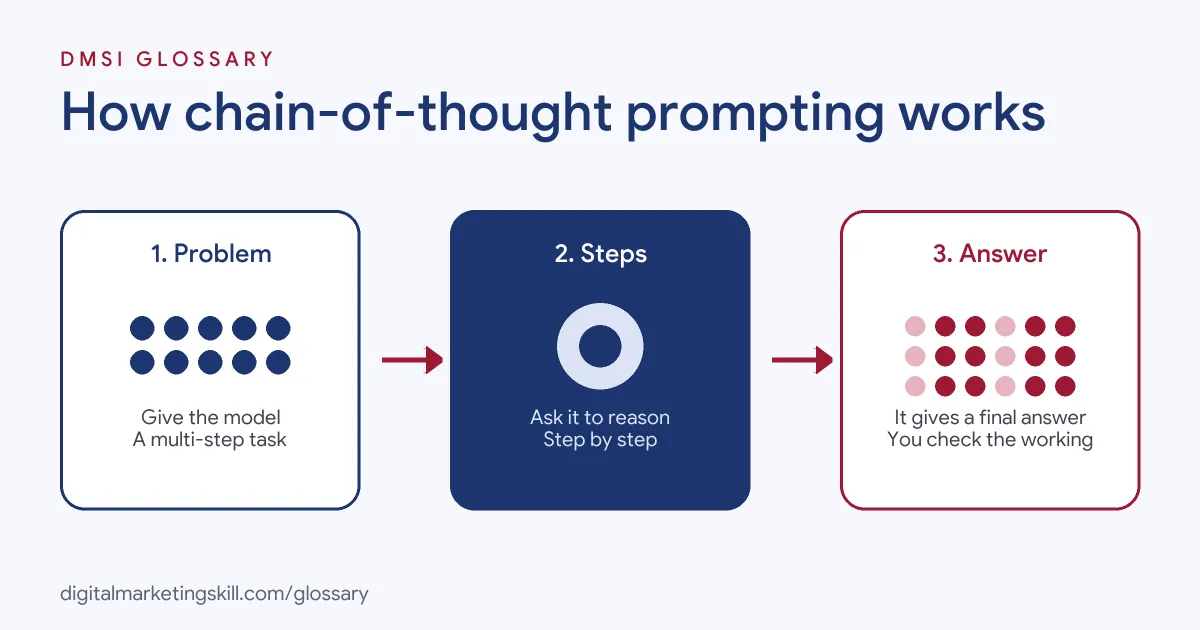
The process has three parts. First, you give the model a problem. Next, you show or ask for step-by-step reasoning. Finally, the model writes out its steps and then gives a final answer that follows from them.
Few-Shot Chain of Thought
In the original approach, your examples include the working. For instance, one example might show a question about ad spend, then each step of the sum, then the answer. The model copies that pattern for the new question. Wei and colleagues reported that prompting a very large model “with just eight chain of thought exemplars” achieved “state of the art accuracy” on a benchmark of maths word problems.
Zero-Shot Chain of Thought
A second paper, by Kojima and colleagues, found a shortcut. They showed that large models “are decent zero-shot reasoners by simply adding ‘Let’s think step by step’ before each answer.” On one maths benchmark, this raised accuracy from 17.7% to 78.7% with a large InstructGPT model. In other words, one short phrase did much of the work that examples did.
Reasoning Models
Newer models change the picture. OpenAI’s guidance on its reasoning models says they “perform reasoning internally,” so asking them to “think step by step” or “explain your reasoning” is “unnecessary.” It adds that this kind of prompt “may not enhance performance (and can sometimes hinder it).” Anthropic similarly notes that some of its latest models rely on built-in thinking, and a prompt asking them to write out reasoning in tags “may be declined.” So check your model’s guidance before you use this technique.
Chain-of-Thought Prompting Examples
Here are three made-up examples for marketing tasks:
- Budget maths: “A campaign spent $1,200 and got 48 sales. Work out the cost per sale step by step, then say whether it beats our $30 target.”
- Audience choice: “List the pros and cons of each of these three audiences, one at a time. Then recommend one and explain why.”
- Content plan: “First list the questions our buyers ask. Next, group them by topic. Finally, suggest one blog post for each group.”
In each case, the prompt sets out a clear order. As a result, the output is easier to check line by line.
A Worked Chain-of-Thought Example
Here is a made-up prompt and the kind of answer you want back. The prompt says: “Our campaign spent $1,200, got 3,000 clicks and 48 sales. Work out the cost per click and cost per sale step by step. Then say whether we beat a $30 cost-per-sale target.”
- First step: Cost per click is $1,200 ÷ 3,000 = $0.40.
- Next step: Cost per sale is $1,200 ÷ 48 = $25.
- Then compare: $25 is lower than the $30 target.
- Answer: Yes, the campaign beat the target by $5 per sale.
Because every step is visible, you can check each sum in seconds. If one number were wrong, you would spot exactly where the mistake happened.
Chain-of-Thought vs Standard vs Few-Shot Prompts
This table compares the main prompting styles:
| Style | What you give the model | Best for |
|---|---|---|
| Standard prompt | A direct question or instruction | Simple tasks and quick answers |
| Few-shot prompt | Examples of inputs and final outputs | Matching a format or style |
| Few-shot chain of thought | Examples that show the reasoning steps | Multi-step problems on standard models |
| Zero-shot chain of thought | An instruction such as “Let’s think step by step” | A quick boost on reasoning tasks without examples |
How to Use Chain-of-Thought Prompting
Follow these steps to try it on a real task:
- Check the model type. If it is a reasoning model, start with a simple, direct prompt instead.
- Pick a multi-step task. Calculations, comparisons and plans benefit most.
- Ask for steps. Add “Work through this step by step” or list the steps you want in order.
- Add a worked example if needed. Show one solved problem with each step written out.
- Ask for a clear final answer. For instance, “End with one line starting ‘Answer:’.”
- Check each step. Read the working and confirm the numbers yourself.
- Ask for a self-check. Anthropic suggests adding something like “Before you finish, verify your answer against” your criteria.
Best Practices for Chain-of-Thought Prompting
- Use it where steps matter. A simple caption does not need step-by-step reasoning.
- Keep the order explicit. Numbered steps make the reasoning easier to follow and to check.
- Separate working from answer. This makes the final result easy to copy into a report.
- Verify the numbers. Clear steps can still contain a wrong figure, so check calculations against your data.
- Read the model’s guidance. Providers such as OpenAI and Anthropic publish prompting advice for each model type.
Common Chain-of-Thought Mistakes
A few errors are common. First, people use it on simple tasks, which only makes the answer longer. Second, they trust the reasoning because it looks neat, without checking the facts. Third, they force step-by-step instructions on reasoning models that already think internally. Finally, they forget to ask for a clear final answer, so the result is buried in the working.
Where You’ll Use Chain-of-Thought Prompting at Work
AI roles name this technique directly. For example, recent remote job listings ask candidates to:
- “Engineer LLM prompts using techniques like instruction tuning, chain-of-thought, and automated prompt engineering” (AI/LLM Engineer).
- Show “Experience exploring behavior of AI tools (fine-tuning, prompt chains, chain-of-thought debugging, or building agents)” (Customer Success Engineer).
- Bring “Demonstrated experience with Large Language Models (LLMs), prompt engineering patterns (e.g., Chain-of-Thought, few-shot), and working with major foundation model APIs or open-weights models” (Context Engineer).
In marketing, you will use the same idea to get clearer budget maths, audience comparisons and campaign plans from AI tools, and to check their reasoning before you act.
Learn It in the Full Stack Programme
AI fundamentals, covering strategy and planning, is part of every DMSI track. To apply prompting across social, email, search and websites, choose the Full Stack programme, which covers all four tracks and all ten courses. You finish with one portfolio project from each track. You also join a U.S. Project Internship from day one, with unlimited 1-on-1 mentoring.
For more prompting ideas, read our guide on how to write ChatGPT prompts.
Frequently Asked Questions
What is chain-of-thought prompting in simple terms?
It means asking an AI model to show its working step by step before giving the final answer, much like showing your working in a maths test.
Does “Let’s think step by step” really work?
Research found it raised accuracy a lot on some reasoning tasks with large models. However, newer reasoning models already think internally, so the phrase may not help them.
When should I not use chain-of-thought prompting?
Skip it for simple tasks, and check your model’s guidance first. OpenAI advises against it for its reasoning models.
Is chain-of-thought the same as few-shot prompting?
Not quite. Few-shot prompting shows examples of answers. The chain-of-thought version shows examples that include the reasoning steps too.
Does it make AI answers always correct?
No. It can improve reasoning, but the steps may still contain errors. Always check important facts and figures.
Sources: Wei et al.: Chain-of-Thought Prompting Elicits Reasoning in Large Language Models; Kojima et al.: Large Language Models are Zero-Shot Reasoners; OpenAI: Reasoning best practices; Anthropic: Prompting best practices; remote job listings on Himalayas.