
A digital nomad visa is a permit that lets you live in a country for a set time while you work remotely for an employer or clients based somewhere else. You usually have to prove a steady income, hold health insurance and show that your work does not come from the local job market. It matters because it gives remote marketers a legal way to work from another country, instead of relying on a tourist visa.
Key Takeaways
- It is for remote workers whose employer or clients are outside the country they want to live in.
- Most schemes ask for proof of a minimum monthly income, often set as a fixed sum or a share of the local minimum wage.
- Stays are time-limited. For example, Estonia offers up to 12 months, and Croatia up to 18 months.
- Rules differ a lot by country, so the official government page is the only source you should trust.
- A visa lets you stay and work remotely. It does not give you a job, so you need remote income first.
What Is a Digital Nomad Visa?
For years, many remote workers simply travelled on tourist visas and worked from their laptops. Estonia’s official e-Residency site describes this as “often skirting the law”. This type of visa solves that problem. It creates a legal category for people who live in one country but earn their money from another.
The idea is simple. The host country gains visitors who spend money locally. In return, you get a clear right to stay for a fixed period. However, you usually cannot take a local job, because the scheme is built around foreign income.
For example, a social media manager who works for an agency in London might want to spend a year in Spain. A remote work visa, called a telework visa in Spain, is one route that may allow this, if they meet the rules.
How a Digital Nomad Visa Works
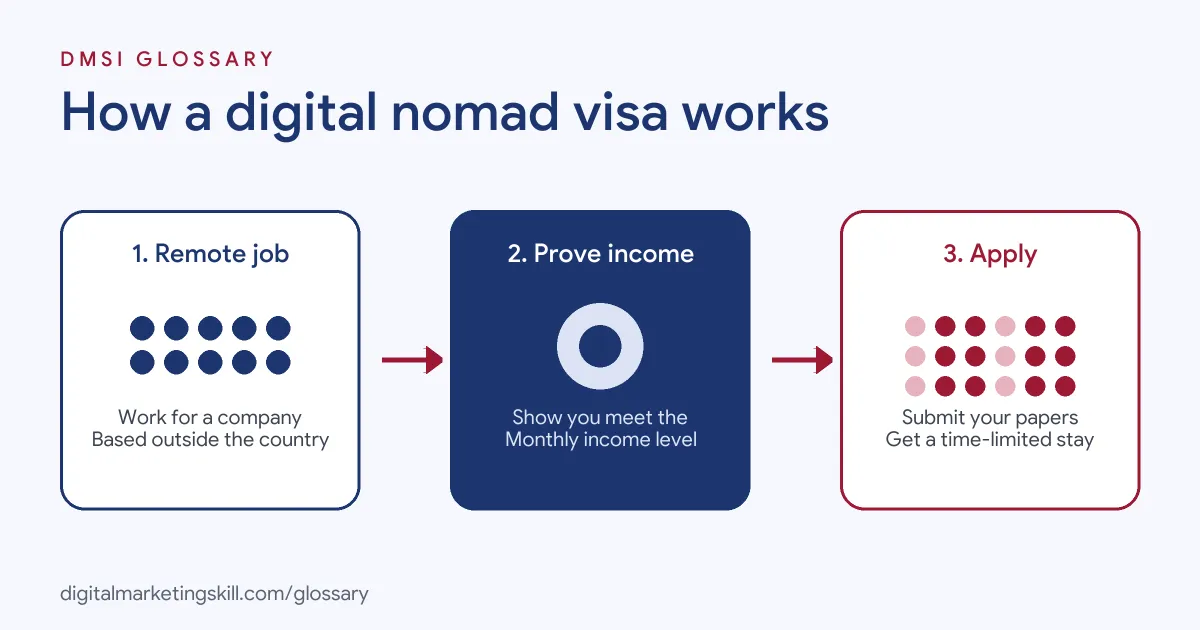
Most schemes follow the same basic pattern. First, you show that your work is remote and based abroad. Next, you prove that you earn enough. Finally, you apply with your documents and, if approved, receive a stay for a fixed time.
Who Can Apply
Each country defines who counts as a digital nomad. Croatia’s Ministry of the Interior, for instance, says a digital nomad is a non-EU, non-EEA and non-Swiss national who works through communication technology for a company “not registered in the Republic of Croatia”. Estonia covers people with a work contract at a foreign company, partners in a foreign company and freelancers.
The Income Rule
Almost every scheme has an income test. Estonia’s e-Residency site states a monthly income threshold of €4,500 before tax. You must also show income for the six months before you apply. Spain sets its level differently. It asks for at least 200% of the Spanish minimum wage per month, plus extra for each family member.
How Long You Can Stay
Stays are always limited. Estonia offers up to 12 months. Croatia grants temporary stay for up to 18 months. Meanwhile, Spain allows people already in the country legally to apply for a residence permit valid for up to three years.
Digital Nomad Visa Examples
Here are three real schemes, based on each government’s own pages:
- Estonia: The scheme covers employees, company partners and freelancers who work for foreign businesses. It has no limits based on your home country or the sector you work in. Depending on how long you plan to stay, you apply for a long-stay D-visa or a short-stay C-visa.
- Spain: The international telework visa is for non-EU nationals working for companies outside Spain. Freelancers can take Spanish clients, but only up to 20% of their total work.
- Croatia: Temporary stay for digital nomads lasts up to 18 months. You must not work for, or provide services to, employers in Croatia.
In each case, the common thread is the same. Your income must come from outside the country.
Digital Nomad Visa Rules by Country
Here is a quick comparison of the three schemes above. Always check the official page before you apply, since rules can change.
| Country | Maximum stay | Income or other key rule |
|---|---|---|
| Estonia | Up to 12 months | €4,500 a month before tax, shown for six months |
| Spain | Residence permit up to three years | At least 200% of the minimum wage; degree or three years’ experience |
| Croatia | Up to 18 months | Work only for companies not registered in Croatia |
As you can see, the income test and the length of stay vary widely. So the best choice depends on your income, your plans and your passport.
How to Apply for a Digital Nomad Visa
The exact process depends on the country, but these steps apply to most schemes:
- Secure remote income first. You need a contract with a foreign employer or steady clients abroad.
- Pick a country. Compare income levels, length of stay and tax rules on official government sites.
- Check you qualify. For example, Spain asks for a degree or at least three years of relevant experience.
- Get any ID numbers first. Spain, for instance, asks you to obtain a foreigner identity number, called an NIE, before you apply for its telework visa.
- Gather proof. This often includes contracts, bank statements, health insurance and a clean background check.
- Apply in the right place. In Estonia, you apply at an Estonian embassy that handles visas, or at a Police and Border Guard office if you are already there legally.
- Plan for renewal. In Croatia, for instance, you can ask for an extension no later than 60 days before your stay ends.
After that, keep copies of everything. You may need the same papers again if you renew.
Best Practices
- Use official sources only. Blogs often repeat old figures, while government pages show the current rules.
- Get tax advice. A visa covers your right to stay, not your tax position, so speak to a qualified adviser.
- Build a track record. Six months of steady income is easier to prove than one large payment.
- Keep your contracts clear. They should show that your employer or clients sit outside the host country.
- Plan for your family. Spain, for example, asks for at least 75% of the minimum wage for the first family member who joins you, and 25% for each extra person.
Common Mistakes to Avoid
The biggest mistake is applying before you have remote income. Without it, you cannot pass the income test. Another is trusting old numbers from travel blogs. For example, Estonia’s own page notes that it raised its income threshold, so older posts may be wrong. A third mistake is taking local work that the visa does not allow. Finally, many people forget about health insurance. Estonia, for example, requires adequate cover as part of its standard visa rules.
Where You’ll Use a Digital Nomad Visa at Work
A visa is not a work skill, but it shapes how and where you can work. Some employers even advertise roles for people who live this way. For instance, one remote listing asks for:
- “Experience with remote work or digital nomad culture: Comfortable working in distributed teams and understanding the nuances of remote collaboration” (Tech Lead and Business Ops).
In digital marketing, the roles that suit this lifestyle best are often freelance or fully remote. These include Freelance Digital Marketer, Growth Marketer and Digital Marketing Manager. In each case, employers care about results you can show, not where you sit.
Learn It in the Full Stack Programme
Remote work starts with skills that employers and clients look for. The Full Stack (all four tracks) programme covers all ten courses, with one portfolio project from each track. It is about 90% hands-on, with unlimited 1-on-1 mentoring and a U.S. Project Internship from day one. You also earn a dual UK and US accredited Master Diploma in 3 months.
If you are still choosing where to go, see our guide to digital nomad visa countries. Then read about remote digital marketing jobs and what remote work means for marketers.
Frequently Asked Questions
What is a digital nomad visa in simple terms?
It is a permit to live in a country for a set time while you work remotely for an employer or clients based elsewhere.
Can I work for local companies on this kind of visa?
Usually not, but check the official rules for your chosen country. Croatia does not allow work for Croatian employers. Spain lets freelancers take Spanish clients for up to 20% of their work.
How much income do I need?
It depends on the country, so always check the official government page before you apply. For example, Estonia’s official page lists €4,500 a month before tax, while Spain’s asks for at least 200% of its minimum wage.
How long can I stay?
It varies, and rules can change. According to each government’s official page, Estonia offers up to 12 months and Croatia up to 18 months, while Spain’s residence permit can last up to three years.
Does the visa help me find a job?
No. You need remote income before you apply. The visa only gives you the right to stay while you work.
Sources: e-Residency of Estonia: Digital Nomad Visa; Spanish Ministry of Foreign Affairs: Telework visa; Croatian Ministry of the Interior: Temporary stay of digital nomads; remote job listings on Himalayas.