
Marketing operations (often called MOps) is the team and set of processes that keep a marketing department running smoothly behind the scenes. It manages the tools, data, workflows and reporting that campaigns depend on. In short, it lets marketers launch faster, measure properly and prove what their work is worth.
Key Takeaways
- Salesforce describes it as the framework that manages “the people, processes, technology, and data” behind marketing.
- It owns the marketing tech stack, such as the CRM, email platform and analytics tools.
- Tool choice is huge. The chiefmartec landscape counts more than 15,000 marketing technology solutions.
- Clean data and clear processes are its main products. Without them, reports cannot be trusted.
- It sits between marketing, sales, finance and IT, so communication is a core skill.
What Is Marketing Operations?
Picture a theatre show. The actors get the applause, but the stage crew runs the lights, sound and set changes. Without the crew, the show falls apart. This role is the stage crew for marketing.
Campaign managers focus on messages, audiences and creative. Meanwhile, the operations side makes sure the email platform is set up, the forms send leads to the right place, the tracking works and the reports are accurate.
In small companies, one marketer may do this alongside everything else. In larger ones, it is a dedicated team with its own manager.
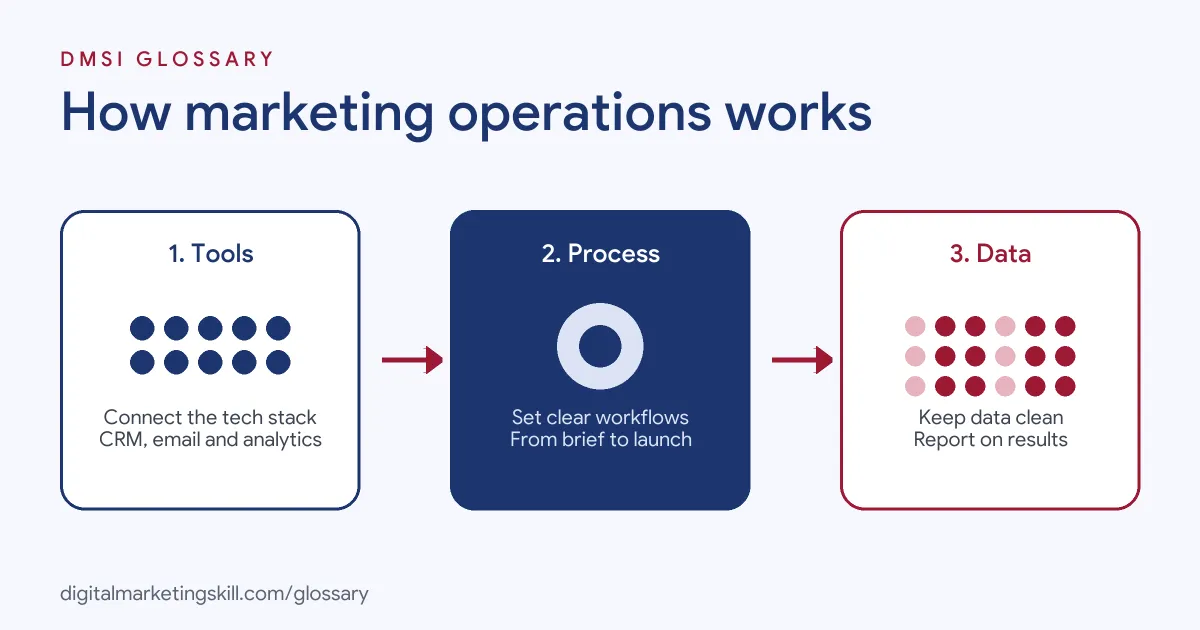
How Marketing Operations Works
Salesforce groups the work into four pillars: people, processes, technology and data. Together, they turn a set of separate tools and habits into one system that runs reliably.
People and Planning
The team tracks who is working on what and whether there is enough capacity. It also helps plan budgets and timelines, so campaigns do not collide or overrun. As a result, leaders can see what the team can really deliver.
Processes
Next, the team documents how work gets done. For example, how a campaign request is briefed, approved, built, tested and launched. Salesforce suggests you cut extra sign-off steps and use one way to run projects. Clear steps mean fewer mistakes and faster launches.
Technology
The tech stack is usually the most visible part. It includes the CRM, email tools, analytics, ad tools and the links between them. The choice is wide. The chiefmartec marketing technology landscape lists 15,384 solutions, up from about 150 in its first edition. So picking, connecting and pruning tools is a real skill.
Data and Reporting
Finally, the team keeps data clean and reports useful. That means consistent naming, UTM parameters on links, agreed lead stages and dashboards that leaders trust. Salesforce says this pillar means setting rules for data and using it to explain how campaigns did.
Marketing Operations Examples
Here are three made-up examples of everyday operations work:
- Lead routing: A software firm finds that demo requests sit unanswered for days. The operations manager fixes the form so each request goes straight to the right sales rep.
- Tool clean-up: A retailer pays for three email tools that overlap. The team moves everything to one platform and cancels the rest.
- Reporting: An agency builds one dashboard that shows spend, leads and sales for every client. Account managers stop building reports by hand each week.
In each case, nobody outside the team sees the work. Yet everyone feels the difference.
Marketing Operations vs Related Roles
| Role | Main focus |
|---|---|
| Marketing operations | Tools, data, processes and reporting for the whole marketing team |
| Campaign or channel marketing | Planning and running specific campaigns, ads or emails |
| Sales operations | Tools, data and processes for the sales team |
| Revenue operations | Joins marketing, sales and customer success operations under one function |
These roles overlap a lot. In many firms, the operations team works daily with sales operations to keep the lead hand-off smooth.
How to Set Up Marketing Operations
- Audit your tools. List every tool, what it does, who uses it and what it costs.
- Map your processes. Write down how a campaign moves from idea to launch to report.
- Define lead stages. Agree with sales what counts as a lead, a qualified lead and an opportunity.
- Set naming rules. Use the same format for campaigns, UTM tags and files.
- Connect the systems. Make sure forms, the CRM and the email platform pass data correctly.
- Build core reports. Start with spend, leads, pipeline and revenue by channel.
- Review and improve. Check the data each month and fix gaps quickly.
Best Practices for Marketing Operations
- Use what you already pay for. Salesforce cites Gartner research saying “martech utilization has dropped to 49%.” In other words, many teams use only about half of what their tools can do.
- Write it down. Documented processes make it easier to train new people and avoid errors.
- Fix data at the source. Required fields and drop-down menus stop messy data entering your CRM.
- Automate repeat tasks. Use marketing automation to route, score and follow up.
- Report on business results. Leaders care about pipeline and revenue more than clicks.
Common Mistakes to Avoid
First, teams buy a new tool to solve a process problem, and the problem stays. Second, every campaign uses different names, so reports never add up. Third, nobody owns the CRM, so duplicates pile up. Finally, the role is seen as admin, not as part of the plan. Fixing these issues often improves results more than any new campaign. So start with the basics: one owner, one naming rule and one source of truth for your data.
A Typical Week in the Role
Here is a made-up example of what the job can look like. On Monday, you check the weekend’s leads. You spot that one form stopped sending data, so you fix it first. Then, on Tuesday, you build an email workflow for a new webinar. Next, on Wednesday, you meet sales to agree what a good lead looks like. After that, on Thursday, you clean up old contacts and merge duplicates in the CRM. Finally, on Friday, you send leaders a short report on spend, leads and pipeline.
As you can see, the work mixes fixing, building and reporting. It is rarely glamorous, but it is never dull, and no two weeks are quite the same. Also, every fix you make helps the whole team move faster.
How to Measure Success
So how do you know the function is working? Look for a few signs. First, campaigns launch on time. Second, leads reach sales quickly and with full details. Third, reports match across tools, so people stop arguing about the numbers. Finally, tool costs fall or stay flat while output grows. If these hold, the system is doing its job.
Skills You Need
This work suits people who like both marketing and systems. Useful skills include setting up a CRM and email tool, building workflows, using spreadsheets and dashboards, and writing clear how-to notes. Just as important, you need to explain technical issues in plain words to marketers, sales teams and leaders. For a head start, see our overview of marketing automation tools.
Where You’ll Use Marketing Operations at Work
Many remote roles focus on this work. For example, job listings describe roles that are:
- “responsible for our marketing tech stack, lead lifecycle processes, campaign infrastructure, and the data that drives decisions.” (Marketing Operations Manager).
- Asking for “7+ years of experience in customer marketing/advocacy, content strategy, product marketing, marketing operations, or related disciplines” (Senior Manager, Content and Operations).
- Seeking “Experience with ZoomInfo or another Account-Based Marketing platform” (Marketing Operations Manager).
So if you enjoy tools and data, a path towards Marketing Automation Specialist or Digital Marketing Manager can lead here. Employers will want proof that you have built and fixed real systems.
Learn It in the Full Stack Programme
Operations touches every channel, so the best fit is the Full Stack programme (all four tracks). You take all ten courses and complete one portfolio project from each track, including an automated email sequence and a Google Ads campaign with conversion tracking. You also get unlimited 1-on-1 mentoring and a U.S. Project Internship from day one.
Frequently Asked Questions
What does marketing operations do?
It manages the tools, data, processes and reports that a marketing team relies on. The goal is to make campaigns run smoothly and results easy to measure.
Is marketing operations a technical role?
Partly. You work with software and data every day, but you rarely write code. Clear thinking and communication matter just as much.
What tools does a MOps team use?
Most teams use a CRM, an email tool, web analytics, dashboards and tools that link them all.
How is it different from revenue operations?
Revenue ops looks after sales, marketing and support as one. MOps looks after the marketing side only.
Do small businesses need marketing operations?
Yes, even if one person does it part-time. Every firm needs forms that work, clean data and reports it can trust.
Sources: Salesforce: What is marketing operations?; chiefmartec: Marketing technology landscape; remote job listings on Himalayas and Himalayas.